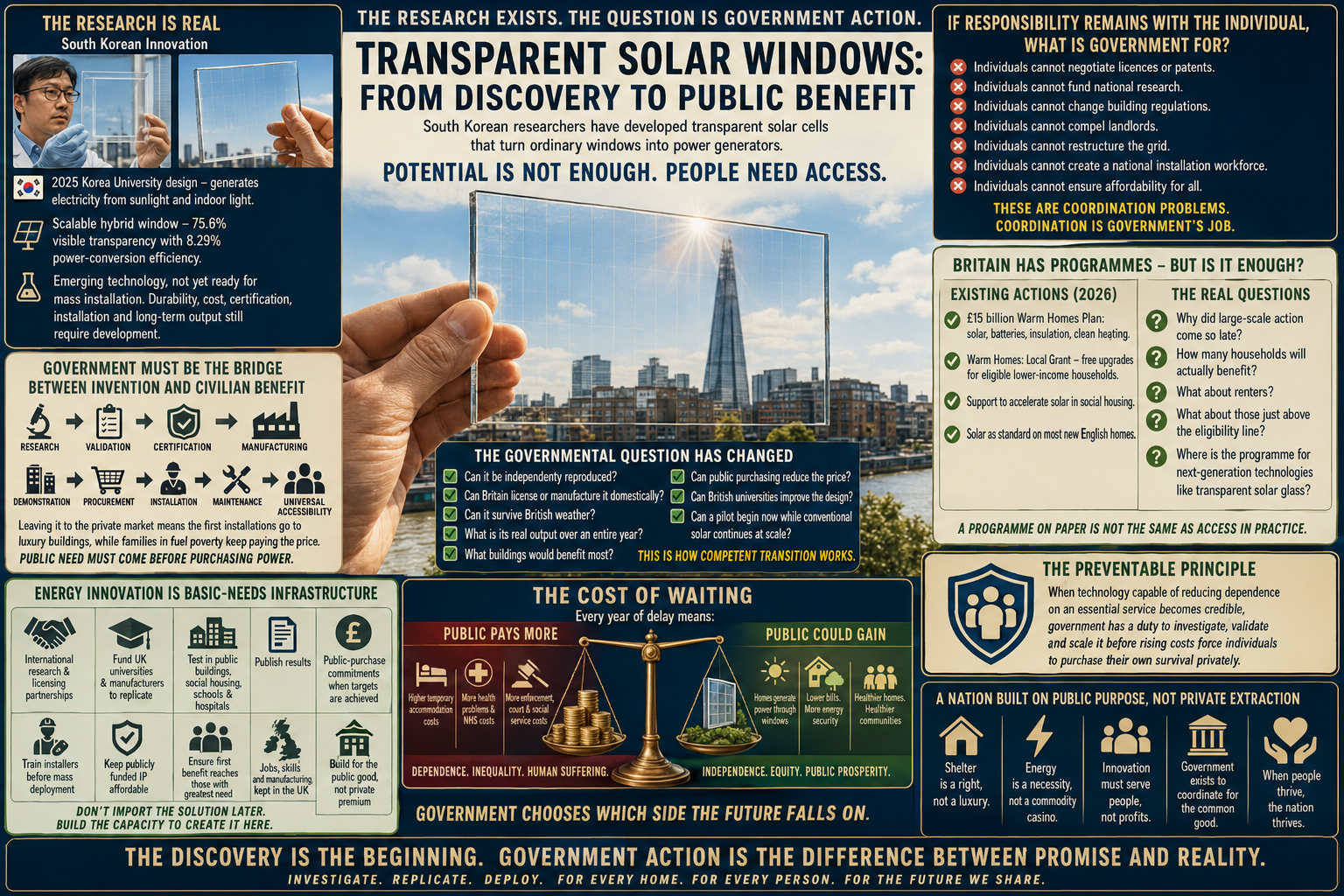
The image appears to refer to South Korean research into transparent photovoltaic windows. This is not imaginary: researchers have demonstrated transparent or highly transparent solar-window systems, including a 2025 Korea University design intended to generate electricity from sunlight and indoor illumination, and another scalable hybrid window reporting 75.6% visible transparency with 8.29% power-conversion efficiency. But these remain emerging technologies rather than ordinary, fully commercial replacement windows ready to be installed across millions of British homes tomorrow. Durability, manufacturing cost, building certification, installation and long-term output still require development and large-scale validation.
That distinction does not excuse government inactivity. It defines the work government should already be doing.
When the Technology Exists but the Transition Does Not
The public should not be expected to discover a foreign innovation on social media, find the manufacturer, determine whether the claims are valid, arrange its importation, finance the installation and personally accept every risk associated with an emerging technology.
That is precisely why government exists.
Government has scientific departments.
Procurement power.
Universities.
Public buildings.
Housing stock.
Regulatory bodies.
Planning authority.
International relationships.
Tax revenue.
Research budgets.
Innovation funds.
Testing facilities.
Energy policy.
If an invention could reduce household energy dependency, the governmental response should not be silence until a private company eventually turns it into a luxury product.
It should be:
Can it be independently reproduced?
Can Britain license or manufacture it domestically?
Can it survive British weather?
What is its real output over an entire year?
What buildings would benefit most?
Can it be incorporated into social housing, schools, hospitals and public offices?
What are the installation and replacement costs?
Could public purchasing reduce the price?
Could British universities improve the design?
Could existing glass manufacturers be supported to produce it?
Can a pilot begin now while conventional solar continues being installed at scale?
That is what competent transition looks like.
The question is not whether every new invention should immediately be imported and placed in every home.
The question is why governments so often behave as though technology becomes relevant only after private markets have completed all the difficult work, secured the intellectual property, established the price and decided which members of the public can afford access.
By then, a public solution has become another premium commodity.
Government Should Be the Bridge Between Invention and Civilian Benefit
A discovery is not yet public infrastructure.
Something has to move it through the stages between laboratory success and social use:
research → independent validation → certification → manufacturing → demonstration → procurement → installation → maintenance → universal accessibility.
Leaving that sequence entirely to private investment means the technology will be developed according to commercial return rather than public need.
The first installations may go to luxury towers.
Corporate headquarters.
New premium developments.
Buildings owned by investors capable of financing long-term experimentation.
Meanwhile, people in fuel poverty may continue choosing between heating and food despite living behind windows that could eventually become part of the energy system.
Government should prevent that order from becoming inevitable.
Its role should be to ensure that technologies responding to foundational needs reach those carrying the greatest burden, not only those offering the strongest purchasing power.
Britain Does Have Programmes—But the Real Question Is Coverage, Speed and Priority
The UK now has a £15 billion Warm Homes Plan covering measures such as conventional solar panels, batteries, insulation and clean heating. Its low-income programmes include free or publicly funded upgrades delivered through local authorities, and the government has also announced support intended to accelerate solar deployment in social housing.
There is also a Warm Homes: Local Grant in England through which eligible lower-income households may receive free improvements, potentially including solar panels. The government has additionally moved towards plug-in solar and solar as standard on most new English homes.
So the accurate criticism is no longer that nothing whatsoever exists.
The sharper criticism is:
Why did large-scale intervention arrive only after years of severe energy-price pressure?
How many households will actually receive the upgrades?
How long will delivery take?
What happens to renters whose landlords do not participate?
What happens to households just above the eligibility threshold but still unable to finance installation?
Why must many homeowners take loans to reduce dependency on an energy system whose volatility they did not create?
Why are proven measures not already standard across all suitable social housing and public buildings?
And where are the publicly visible programmes for testing and replicating next-generation building-integrated technologies such as transparent photovoltaic glass?
The government’s own 2026 analysis acknowledges that solar and battery systems in social housing have historically depended heavily on government schemes and describes the limited use of direct investment models as a missed opportunity.
That is the deeper issue.
A programme existing on paper is not the same as a population having access.
A grant that reaches part of the country is not energy independence.
A future target does not repay past exposure.
A low-interest loan still places transition responsibility on the household.
And installing ordinary solar on some homes does not remove the duty to investigate, replicate and scale the technologies that could turn roofs, windows, walls and public infrastructure into energy-producing surfaces.
If Responsibility Remains With the Individual, What Is Government For?
Government should not exist merely to tell people which solution they might buy.
Its function is not complete when it publishes guidance saying solar panels could reduce household bills.
The individual does not control national manufacturing.
The individual does not negotiate international technology licences.
The individual cannot alter building regulations.
The individual cannot fund national research.
The individual cannot convert public housing stock.
The individual cannot compel landlords.
The individual cannot restructure the grid.
The individual cannot create a national installation workforce.
The individual cannot protect emerging companies from being bought, suppressed or outcompeted by dominant incumbents.
The individual cannot ensure that a useful invention becomes affordable.
Those are coordination problems.
Coordination is one of the principal reasons government exists.
Where the government leaves every household to finance its own escape from rising energy costs, wealth determines who gains independence first. The affluent install generation and storage. Renters remain dependent. Lower-income households wait for restricted grants. People in unsuitable buildings continue paying the full market price. The same system then praises the transition while reproducing inequality through the method of delivery.
That is not universal energy reform.
It is privately purchased resilience.
Energy Innovation Should Be Treated as Basic-Needs Infrastructure
Transparent solar windows may not yet be ready to replace ordinary glazing everywhere. But they are exactly the kind of technology that should trigger a national replication and testing programme.
Government could:
- establish UK–South Korea research and licensing partnerships;
- fund British universities and glass manufacturers to reproduce and improve the technology;
- test it on government offices, social housing towers, stations, schools and hospitals;
- publish performance results openly;
- create advance public-purchase commitments if defined targets are achieved;
- train installers before mass deployment;
- require that publicly funded patents or improvements remain affordable;
- and ensure the first social benefit does not belong exclusively to commercial property owners.
The UK has funded broad clean-energy innovation programmes, but I have not found evidence of a dedicated national programme specifically intended to import or replicate this particular Korean transparent-window technology for subsidised household deployment. The existing domestic emphasis is presently on more mature measures such as conventional rooftop solar, batteries, insulation and heat pumps.
That absence is precisely where the question belongs:
Not, “Why has an experimental window not already been installed everywhere?”
But:
Where is the permanent governmental machinery that identifies technologies capable of reducing basic-needs costs and carries them rapidly from scientific proof into public use?
Because waiting for the private market is itself a policy decision.
Waiting means the patent develops elsewhere.
Manufacturing develops elsewhere.
The expertise develops elsewhere.
The jobs develop elsewhere.
The price is decided elsewhere.
Britain later imports the finished solution at commercial cost, and households are told to apply for finance to purchase the technology that their government could have helped reproduce.
The Preventable Principle
This belongs in the housing and energy case as another clear principle:
When technology capable of reducing dependence on an essential service becomes credible, government has a duty to investigate, validate and scale it before rising costs force individuals to purchase their own survival privately.
The purpose of government is not to remove all individual responsibility.
It is to carry the responsibilities that individuals cannot perform separately.
A person can choose to conserve electricity.
They cannot redesign the energy system.
A household can apply for a grant.
It cannot create universal access.
A tenant can ask for solar panels.
They cannot compel the owner to install them.
A scientist can invent a transparent solar window.
They cannot single-handedly transform the national building stock.
That is where government enters.
Or should.
Because if every meaningful solution remains the responsibility of the individual—housing, energy, healthcare, safety, education, retirement and protection from foreseeable harm—then taxation begins to look less like collective provision and more like payment to an institution that continually returns its own duties to the person who funded it.





Leave a Reply