When Shelter Is a Basic Need but Its Price Is Allowed to Outrun Human Income, Who Is Responsible for the People Pushed Out?
Housing is often discussed as though it were one isolated market among many.
It is not.
Housing is the physical container through which almost every other basic need becomes usable. A person sleeps there, stores food there, protects documents there, receives correspondence there, charges the devices now required for banking and employment, prepares for work there, raises children there, recovers from illness there and establishes the address through which most institutions recognise that they exist.
Without stable housing, the person does not merely lose a room.
They lose an operating base.
That is why homelessness cannot be understood only as the moment someone begins sleeping on a pavement. It begins earlier: when rent consumes nearly all available income, when a family moves repeatedly through temporary accommodation, when someone remains in an unsafe relationship because leaving would mean having nowhere to go, when a worker sleeps on someone else’s sofa, when a household cannot heat the home it technically occupies, or when a person has an address today but no credible way to keep it next month.
The deepest failure is not simply that homelessness exists.
It is that a society can possess empty dwellings, repairable buildings, unused land, public purchasing power, tax revenue, construction capacity and years of warning—and still organise access to shelter primarily around the ability to satisfy a rising market price.
The central question is therefore:
If shelter is foundational to civilisation, why is access to it governed more reliably by competition than by human need?
A Home Is Not an Asset Before It Is a Habitat
A house can be an investment.
It can hold financial value.
It can be inherited, improved, rented, sold or used to build wealth.
But before any of those functions, it is a habitat.
That order matters.
The property market frequently reverses it.
The first question becomes how much the house can earn, how quickly it may appreciate, what rent the market will tolerate, how efficiently it can be leveraged and how much demand can be converted into return.
The human question comes later:
Can somebody actually live there?
Can they remain there?
Can a child grow there without repeated displacement?
Can the person earning an ordinary wage afford it?
Can the home be heated?
Is it free from mould?
Does the tenant have enough money left after rent to eat?
When a society protects the asset function more strongly than the habitat function, the house may continue performing financially while failing socially.
Its value may rise while its occupants become less secure.
Its rent may increase while its condition remains unchanged.
Its owner may accumulate equity while the tenant accumulates anxiety.
The market may describe this as growth.
The household experiences it as contraction.
London Makes the Contradiction Impossible to Hide
London concentrates the contradiction because housing scarcity, concentrated wealth, speculative value, high rents, temporary accommodation and visible rough sleeping exist within the same city.
The city possesses extraordinary financial capability.
It contains expensive developments, second homes, underused commercial buildings, vacant properties, hotels, offices and land held for future value.
At the same time, people sleep outside buildings whose individual value could finance secure accommodation for entire groups of people.
This is not because London has physically run out of matter from which shelter can be created.
It is because access to existing shelter is controlled by ownership, price, planning, allocation, condition and institutional priority.
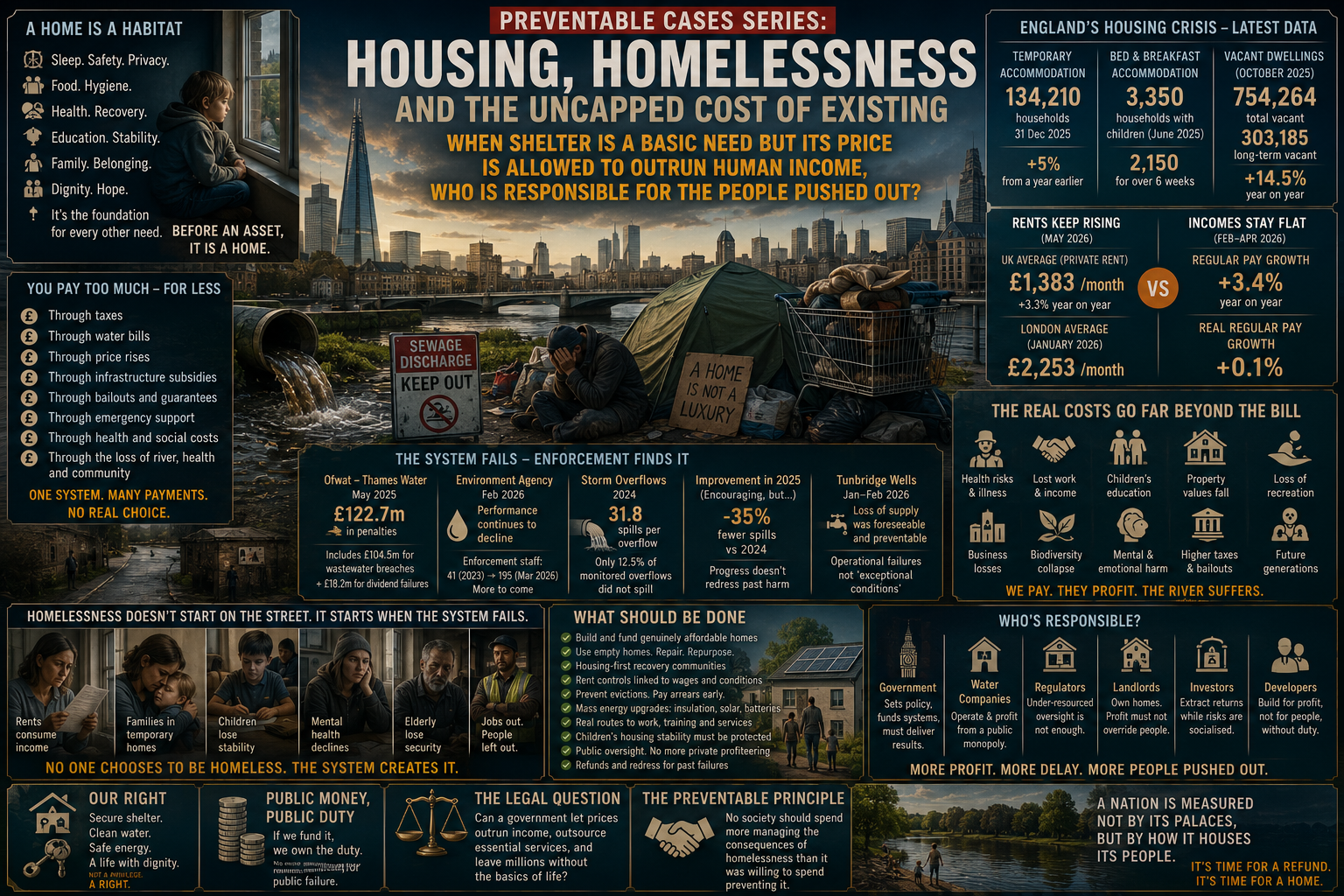
Across England, there were 754,264 vacant dwellings recorded in October 2025, including 303,185 classified as long-term vacant. The number of long-term vacant homes had risen by 14.5% in a year. Those figures do not mean every empty property could immediately house a homeless household—some are between occupiers, uninhabitable, subject to probate or undergoing work—but they make one fact unavoidable: the crisis is not merely the physical absence of buildings. It is also a failure of mobilisation, repair, allocation and access.
The country can therefore have homelessness and empty housing at the same time because the housing system is not primarily designed to match available shelter to human need.
It is designed to preserve separate legal and financial interests first.
The empty property belongs to one category.
The homeless person belongs to another.
The repair budget belongs somewhere else.
The council has a different duty.
The owner has separate rights.
The planning department has another process.
The benefits system has another threshold.
The person remains outside while the institutions correctly administer their compartments.
That is what systemic failure looks like when every department can claim that it followed procedure.
Homelessness Is Already a Population-Level Housing Failure
On 31 December 2025, 134,210 households in England were living in temporary accommodation—5% more than a year earlier. More than 50,000 were in nightly paid self-contained accommodation, a category whose use had risen 17% year on year.
These are households, not individual people.
Behind one household may be a parent, several children, a couple, an older person, a disabled person or an entire family trying to construct ordinary life inside an arrangement never intended to become home.
Temporary accommodation is often spoken of as though it resolves homelessness.
It does not necessarily resolve it.
It relocates it indoors.
A roof may prevent exposure to rain while leaving the household without permanence, control, sufficient space, stable schooling, cooking facilities, privacy or any confidence about where they will be living next.
When temporary accommodation continues for months or years, “temporary” becomes an administrative description rather than a lived reality.
The public institution can say the person has been housed.
The family still cannot establish a home.
The State Pays More Because It Refused to Secure Less
Councils have legal duties towards qualifying homeless households, so when permanent and genuinely affordable homes are unavailable, they procure temporary accommodation from the private market.
This produces one of the most absurd financial cycles in the housing system.
Government does not invest sufficiently in permanent public or genuinely affordable housing.
Housing scarcity strengthens the private market.
Private rents rise.
People become homeless.
Councils are legally required to house them.
Councils then pay private providers inflated temporary-accommodation costs.
The public therefore finances the consequences of not having created the public capacity in the first place.
London Councils warned in 2025 that the gap between borough spending on temporary accommodation and central-government funding was producing a projected £740 million shortfall. Boroughs were increasingly reliant on the same expensive private rental market whose conditions were contributing to homelessness.
This is not thrift.
It is delayed spending at a higher price.
The state avoids the capital commitment of providing secure housing, then pays repeated emergency costs without acquiring a lasting public asset.
A permanent home requires investment once and maintenance over time.
A hotel room, nightly placement or privately procured temporary unit may require continuous payment while leaving the public with nothing durable at the end.
The taxpayer finances occupancy.
The private provider retains ownership.
The household remains insecure.
The public balance sheet gains no home.
This is what happens when government treats prevention as expensive but never calculates the lifetime cost of reaction.
Build a Real Route Back Into Civilisation
A person sleeping rough does not only need removal from the pavement.
They need restoration of an operating base.
That means a secure room or home, an address, safe document storage, bathing facilities, food preparation, communication access, healthcare, administrative support and a credible route into employment or benefits.
It is possible to obtain some work or services without a conventional fixed address; charities, councils and employers sometimes provide workarounds. But in practice, lacking a stable address, identification, bank access, clean clothing, sleep, transport and secure communication creates mutually reinforcing barriers.
The person is told to get a job to afford housing.
The employer expects stability, contact details, documentation and reliable presentation.
The landlord demands proof of income, references, deposits and sometimes a guarantor.
The benefits system may require appointments, evidence and digital access.
The bank requires identity checks.
The person is expected to solve the final problem before being given the foundation required to solve it.
That is not a pathway.
It is a loop.
A serious housing-first programme would break the loop at its most foundational point.
Provide secure shelter first.
Then rebuild documentation.
Then healthcare.
Then financial access.
Then training and employment.
Then longer-term independence where possible.
This does not remove personal responsibility.
It restores the conditions through which personal responsibility can become actionable.
You cannot demand that someone stabilise their life while the ground beneath every attempted step remains unstable.
Why Not Create Purpose-Built Recovery Communities?
If conventional housing supply cannot immediately meet the need, government should be capable of establishing well-designed transitional housing communities—not punitive encampments hidden outside cities, but properly governed places that restore legal and social participation.
They could include:
- private, secure accommodation;
- official postal addresses;
- document-recovery support;
- mental and physical healthcare;
- substance-dependency treatment;
- kitchens and food access;
- digital facilities;
- employment and skills services;
- childcare;
- transport connections;
- legal assistance;
- and direct routes into permanent housing.
The object should not be to warehouse homeless people together.
It should be to rebuild the foundations through which people can re-enter ordinary systems.
Different residents would require different support. Some people primarily need affordable housing. Others may need trauma care, addiction support, protection from abuse, immigration advice, disability assistance or long-term supported living.
The architecture must recognise distinctions rather than forcing every person through one explanation of homelessness.
But the foundation is shared:
A person cannot consistently reconstruct a life while having nowhere from which to construct it.
The Market Is Not Self-Correcting When the Product Is Unavoidable
Supporters of unrestricted rents may argue that prices reflect supply and demand.
That may describe the mechanism.
It does not justify the outcome.
Water also experiences demand.
Food experiences demand.
Healthcare experiences demand.
Energy experiences demand.
But where the product is indispensable, allowing price to rise until enough people are excluded does not produce a morally or socially acceptable equilibrium.
In an optional market, unaffordability may reduce demand.
In housing, unaffordability does not remove the need for shelter.
It produces overcrowding, debt, displacement, temporary accommodation, rough sleeping, migration away from support networks and increased public-service demand.
The market clears itself by pushing human beings out.
That is why housing cannot be governed as though it were a luxury product.
A landlord may say the price reflects what somebody is willing to pay.
But when multiple people compete for one home because the alternative is instability, “willingness” includes coercion by necessity.
Someone will pay.
That does not mean the price is just.
It means the need is strong enough to be exploited.
The Uncapped Cost of Existing
The larger case is not only that rents are high.
It is that the state permits essential costs to move without ensuring that the income from which people must pay them moves proportionately.
Average UK private rent reached £1,383 a month in May 2026, 3.3% higher than a year earlier. England’s average reached £1,442. London remained far more expensive than the national average; in January 2026, average rent there was £2,253 per month.
At the same time, regular earnings grew by 3.4% in February to April 2026, but after accounting for CPIH inflation, real regular-pay growth was only 0.1%. The number of payrolled employees was provisionally lower than a year earlier, and job vacancies had continued to fall.
This is the widening pressure point.
Rent rises.
Food rises.
Energy rises.
Transport rises.
Insurance rises.
Council tax rises.
Water rises.
But the household does not receive a coordinated increase in the income required to carry all of them.
Each company or sector may justify its own increase independently.
The energy company points to wholesale conditions.
The landlord points to mortgage or market pressures.
The insurer points to risk.
The supermarket points to supply chains.
The council points to funding gaps.
The water company points to investment.
Every increase may come with its own explanation.
The household receives them simultaneously.
Government continues regulating sectors separately while the human being pays from one bank account.
That is the missing whole.
When Prices Rise Faster Than the Population’s Capacity to Pay, Government Is Not a Spectator
Not every price increase can or should be directly prohibited.
Poorly designed price controls can reduce supply, encourage withdrawal or transfer cost elsewhere.
But that does not mean government is powerless or that every uncapped market outcome must be accepted.
Government controls planning.
Taxation.
Public construction.
Housing benefit.
Tenancy regulation.
Landlord standards.
Empty-home powers.
Social-housing investment.
Public land.
Infrastructure funding.
Competition rules.
Wage policy in the public sector.
Minimum wage.
Energy regulation.
Building standards.
Renewable-energy programmes.
Transport policy.
Council finance.
It cannot influence nearly every condition shaping the market and then describe the resulting unaffordability as a natural event.
Where essential prices are rising faster than income, government has a duty to assess the combined affordability burden.
Not merely whether each company complied with its sector’s rules.
The relevant question is:
After paying for shelter, energy, water, food, transport and mandatory public charges, does an ordinary person still possess enough income to live?
If the answer is increasingly no, the system is not functioning merely because every invoice was lawfully issued.
This Is Not Technically a Recession—But People Can Still Be Living Through Contraction
The United Kingdom was not technically in recession in early 2026. Real GDP grew by 0.6% in the first quarter after very weak growth at the end of 2025. But national GDP growth does not mean every household experiences recovery. Inflation remained at 2.8% in May 2026, real regular-pay growth was almost flat, employment indicators were subdued and the accumulated price increases of previous years remained embedded in household budgets.
That distinction matters.
Inflation slowing does not mean prices return to where they were.
It means they are increasing more slowly.
A household whose rent, food and energy bills have risen substantially does not recover because the next increase is smaller than the previous one.
The higher base remains.
People can therefore experience personal economic contraction while economists report modest national growth.
Their wages may technically increase while their available life decreases.
They can earn more pounds and afford less existence.
A government that relies only on headline GDP can miss the recession taking place inside the household.
Homelessness Is Produced Before the Person Reaches the Street
Every major increase in unavoidable cost creates further housing risk.
A person may fall behind because of rent.
Or because energy costs consume money reserved for rent.
Or because an illness reduces work.
Or because childcare makes employment financially unviable.
Or because a relationship ends.
Or because benefits are delayed.
Or because a landlord raises the rent.
Or because insurance, transport and food collectively remove the remaining margin.
Homelessness may therefore appear to be caused by one final event, but the household may have been living without financial resilience for years.
The eviction notice is the visible collapse.
The architecture that produced it includes wages, prices, housing supply, benefits, energy, health, childcare and debt.
This is why government cannot solve homelessness exclusively through homelessness departments.
By the time the household reaches that department, multiple other systems have already failed.
Children Do Not Experience Temporary Accommodation as a Budget Category
For a child, housing instability enters development.
It can mean changing schools.
Long journeys.
No private space.
No reliable place to study.
Inability to invite friends home.
Embarrassment.
Interrupted sleep.
Parental stress.
Crowding.
Unsafe surroundings.
Meals prepared without adequate facilities.
Possessions repeatedly packed and moved.
Uncertainty about whether the family will be relocated again.
In June 2025, 3,350 households with children were living in privately owned bed-and-breakfast-style temporary accommodation in England, and 2,150 had remained there for more than six weeks.
The child may later present with anxiety, behavioural difficulty, tiredness or poor academic performance.
Education receives the symptom.
Healthcare receives the symptom.
The family receives judgement.
But housing produced the condition.
The public then pays multiple institutions to manage the developmental consequences of one foundational failure.
A secure home would not solve every problem.
But instability guarantees that every other problem becomes harder to solve.
Housing Failure Creates Health Expenditure
A cold, damp, mouldy or overcrowded home does not remain a property matter.
It becomes respiratory illness.
Sleep disruption.
Stress.
Infection risk.
Mental strain.
Developmental harm.
Missed school.
Missed work.
Healthcare demand.
A family that cannot afford heat may remain legally housed while living without thermal safety.
That is a form of infrastructural homelessness: the shell exists, but the conditions through which it becomes a habitable home are absent.
Housing law may say the person has accommodation.
Energy policy may say they are a customer.
Healthcare may treat the illness.
No institution necessarily carries the whole relationship between the three.
The home damages the body.
The health service repairs the body.
The taxpayer pays for both systems.
The owner of the deficient asset may continue collecting rent.
Energy Is Now Part of the Habitability of Housing
Modern housing is not functional without energy.
Banking is digital.
Employment applications are digital.
Schoolwork is digital.
Public services are increasingly digital.
Communication is digital.
Heating, refrigeration, cooking, lighting, device charging and often hot water depend on energy.
Access to electricity is therefore no longer merely a convenience attached to housing.
It is part of whether the home permits participation in society.
A person can possess four walls and still be excluded from ordinary life because they cannot afford to operate what happens within them.
That makes energy affordability a housing issue.
Why Was Domestic Energy Independence Not Treated as Foundational Earlier?
Solar panels, batteries, insulation and heat pumps cannot remove every energy cost or suit every property. Solar generation is intermittent, installations require capital and grid connection, renters often lack authority to modify buildings, and older homes may require substantial work.
But the existence of practical limitations is not an argument against mass deployment.
It is the reason coordinated public deployment is needed.
The UK government’s 2026 Warm Homes Plan committed £15 billion, including targeted packages involving solar panels, batteries, insulation and clean heating for lower-income households. The Warm Homes: Local Grant can provide free energy-saving upgrades to eligible lower-income households in poorly performing privately owned homes. New rules are also intended to make solar standard on most new English homes.
Those measures demonstrate that broad public intervention is possible.
They also raise the retrospective question:
Why was decentralised household resilience not treated with this urgency earlier?
Why did millions of homes remain exposed to volatile energy prices while proven technologies were available?
Why was insulation left incomplete?
Why were renters excluded from decisions over the energy performance of homes they paid to occupy?
Why did solar remain predominantly an individual purchasing decision rather than part of national basic-needs infrastructure?
A future programme may be good policy.
It does not erase the years during which preventable energy poverty was allowed to continue.
Government Should Not Merely Help People Pay Bills. It Should Reduce the Need for the Bill
Subsidising energy bills can provide immediate relief.
But relief and redesign are not the same.
If government repeatedly transfers public money to households so they can pay private energy providers, the system preserves dependency.
A more durable strategy reduces household demand and increases local generation through:
- insulation;
- solar;
- batteries;
- district energy;
- heat networks;
- efficient appliances;
- building repair;
- community generation;
- and public or cooperative energy models.
The object should not only be to make an unaffordable bill temporarily payable.
It should be to reduce the structural conditions creating the bill.
That is the difference between maintenance and transformation.
The “Free Energy” Question Must Be Governed by Proof, Not Suppressed Curiosity or Easy Belief
There is electrical potential throughout nature, and living systems participate in electrochemical processes. Researchers continue exploring ambient energy harvesting, including heat, vibration, radio-frequency energy and other low-power sources.
But there is currently no established, safe and scalable method by which ordinary homes can be powered simply by plugging devices into trees or drawing unlimited usable electricity from an undefined surrounding “field.”
That does not mean unconventional energy research should be mocked or automatically suppressed.
It means foundational infrastructure must be built on independently demonstrated performance.
The correct governmental response to a promising technology is neither blind dismissal nor premature adoption.
It is rigorous testing.
Can it generate useful power?
At what scale?
Under what conditions?
What are the environmental effects?
Can independent researchers reproduce it?
Who owns it?
Can it be safely deployed?
Does it reduce dependency without creating another hidden cost?
Government should actively investigate credible innovations rather than allowing incumbent industries to determine which alternatives become visible. But public housing and energy security cannot be postponed while waiting for a technology that has not yet met the standard required for foundational use.
Solar, insulation, batteries, heat pumps and established community-energy systems can be deployed now.
Future breakthroughs can expand the architecture when they are proved.
Lobbying and the Preservation of Dependency
Energy and property interests possess enormous influence because they sit around needs people cannot simply abandon.
A household can reduce leisure spending.
It cannot permanently stop needing shelter or power.
That makes basic needs highly profitable forms of dependency.
Government must therefore be especially resistant to lobbying where the commercial interest conflicts with reducing public dependence.
The central question should not be whether an industry wants to remain profitable.
It should be whether the industry’s continued structure serves the public better than the available alternatives.
Where decentralised energy, public housing, rent stabilisation, empty-home mobilisation or community ownership would reduce dependence, government must be able to act even where incumbent industries lose revenue.
A system cannot claim to serve the public while allowing the profitability of dependency to determine how quickly independence is developed.
There Is No Single Housing Shortage
The phrase “housing shortage” can hide several different failures.
There may be a shortage of homes in places where people need to live.
A shortage of social housing.
A shortage of genuinely affordable private rentals.
A shortage of accessible homes.
A shortage of family-sized homes.
A shortage of emergency accommodation.
A shortage of homes linked to transport and employment.
A shortage of properly maintained dwellings.
At the same time, there may be empty properties, second homes, under-occupied properties and buildings that could be converted.
These realities can coexist.
The solution is therefore not simply “build more.”
Build what?
Where?
For whom?
At what rent?
Under whose ownership?
With what energy system?
Connected to which schools, hospitals and jobs?
Will it remain affordable?
Will public investment create public assets, or merely increase private land value?
A government can meet a construction target while failing to produce accessible homes.
The number of units is not the same as the social function of housing.
The Empty-Home Duty
Where a home remains long-term empty while homelessness is increasing, government should possess stronger, faster and properly funded mechanisms to bring it back into use.
That could include:
- escalating empty-home taxation;
- compulsory leasing;
- renovation grants tied to affordability;
- local-authority purchase;
- community housing trusts;
- compulsory purchase in cases of prolonged neglect;
- public repair programmes;
- and temporary public use with protections for legitimate owners.
Not every vacant home should be seized or immediately reassigned. Ownership rights, probate, safety and individual circumstances matter.
But ownership should not include an unlimited right to withhold habitable shelter from social use while the surrounding public finances emergency homelessness.
Rights carry context.
A person may own the building.
The jurisdiction carries the consequence of its prolonged absence from use.
The Rent-to-Income Control Question
A simple numerical rent cap imposed everywhere could produce unintended consequences.
But government can still regulate housing affordability through more intelligent structures.
It could link permissible increases to:
- wage growth;
- inflation excluding housing;
- property condition;
- local income;
- actual landlord costs;
- length of tenancy;
- and whether public subsidy or tax advantages have supported the property.
It could prevent extreme in-tenancy increases designed primarily to force tenants out.
It could create stronger rent-stabilised sectors.
It could expand social and cost-rental housing.
It could penalise poor condition.
It could require transparency around how rents are set.
Most importantly, it could establish a national affordability test measuring the combined cost of housing, energy, water, transport and food against ordinary incomes.
No basic-needs policy should be considered successful while households are forced to choose which basic need to abandon.
The Class Is Larger Than People Sleeping Rough
A housing class action or broader public-law challenge should not define the affected population only through visible street homelessness.
Potential classes include:
People Sleeping Rough
Those denied safe shelter despite the existence of public duties, available buildings and foreseeable need.
Households in Temporary Accommodation
Families and individuals whose lives remain suspended while government pays repeated emergency costs rather than providing stable homes.
Renters Subjected to Unaffordable Increases
People whose rents rose beyond income growth within a market they could not meaningfully leave.
Families Experiencing Hidden Homelessness
People sofa-surfing, overcrowded or moving between relatives because formal homelessness systems did not provide accessible alternatives.
Tenants in Uninhabitable Homes
People paying for housing that lacked safe heat, ventilation, repair, sanitation or freedom from damp and mould.
Households in Fuel Poverty
People technically housed but unable to operate the home safely.
People Displaced From Communities
Households moved far from schools, work, care and support networks because local affordable housing was unavailable.
Young Adults Locked Out of Independent Housing
People whose wages cannot reach the price of entry into either ownership or secure renting.
Taxpayers
Members of the public financing temporary accommodation, healthcare consequences, emergency support and private-provider profits after insufficient investment in permanent public capacity.
The injury differs by group.
The architecture is shared.
Shelter was treated as a market outcome before it was secured as a public foundation.
The Responsibility Map
Central Government
It controls national housing policy, public investment, benefits, taxation, planning architecture, social-housing programmes, energy strategy and the legal powers available to councils.
Its responsibility is structural.
Local Authorities
They hold homelessness and planning duties, manage public housing and understand local conditions.
Their responsibility must be assessed against the resources and legal powers actually available to them.
Private Landlords
They provide housing within a market of necessity.
Their responsibility concerns habitability, fair dealing, reasonable increases, non-discrimination and the avoidance of exploitative use of scarcity.
Institutional Investors and Developers
They shape supply, tenure, land use, pricing and the balance between homes built as habitats and units built as assets.
Mortgage Lenders and Insurers
Their decisions affect landlord costs, ownership accessibility and whether homes remain financially viable.
Energy Companies
Their pricing and infrastructure shape whether a dwelling can be lived in safely.
Public Regulators
They are responsible for recognising that compliance within one sector can still produce failure across the whole household economy.
Employers
Wages determine whether work provides access to shelter, although no individual employer can repair a national housing architecture alone.
Property Owners Holding Long-Term Vacancies
Their rights must be balanced against the social costs created by prolonged withdrawal of usable homes.
The Public
People carry responsibilities towards property, community and lawful use.
But they cannot solve structural scarcity through personal discipline.
The Governmental Failure Is the Absence of a Ceiling and a Floor
The state has failed to create a reliable floor beneath existence.
A floor means nobody falls below secure shelter, warmth, food, water, healthcare and basic participation.
It has also failed to create an effective ceiling on how aggressively necessity can be monetised.
Not necessarily one crude national price for every home.
A ceiling on extraction.
A ceiling on rent increases disconnected from wages and condition.
A ceiling on public money being transferred into emergency private accommodation without producing permanent assets.
A ceiling on homes remaining empty while councils finance homelessness.
A ceiling on energy dependency where public alternatives can be installed.
A ceiling on the number of times the same person must pay for one systemic failure.
Without a floor, people fall.
Without a ceiling, necessity becomes an extraction field.
Government must establish both.
The Legal Triage Failure
Housing should sit at the highest level of government triage because failures in housing multiply across every other system.
A government should ask:
How many people lack stable shelter?
How many homes are empty?
How many are repairable?
How many households are spending unsustainable proportions of income on rent?
How many children are in temporary accommodation?
How much public money is being paid to private temporary providers?
How many people are unable to work because housing is unstable?
How much healthcare demand is generated by cold, damp and overcrowding?
How much homelessness could be prevented by paying arrears before eviction?
How much public land could provide permanent homes?
How much energy expenditure could be removed through household upgrades?
Which intervention produces the most stability per pound?
Instead, the system frequently waits until a person is legally homeless before releasing the most expensive form of support.
It treats the emergency as the eligibility threshold.
That is the opposite of prevention.
The Remedies
1. A Legal Right to Foundational Shelter
The state should carry an enforceable duty to ensure access to safe minimum accommodation, with responsibility clearly allocated rather than dispersed across unfunded bodies.
2. National Empty-Homes Mobilisation
A complete national register of long-term vacant housing should support repair, leasing, purchase and compulsory-use measures where justified.
3. Housing-First Recovery Infrastructure
People sleeping rough should receive secure housing before being expected to resolve employment, health, addiction or documentation barriers.
4. Permanent Public Assets Before Repeated Emergency Payments
Where public money is repeatedly paying private temporary-accommodation charges, government should be required to assess whether purchasing or constructing permanent housing would provide better long-term value.
5. Rent Stabilisation Tied to Human Affordability
Rent policy should account for wages, local income, property condition and cumulative essential costs, not merely market demand.
6. Automatic Homelessness Prevention Funding
Councils should be empowered to clear manageable arrears, negotiate tenancies and intervene before eviction where doing so costs less than temporary accommodation.
7. Proof-of-Address Restoration
Every person in emergency or transitional housing should receive a recognised address, document support, digital access and a route to banking and employment.
8. Mass Domestic Energy Upgrades
Low-income and social households should receive publicly financed insulation, solar, suitable clean heating and batteries where technically appropriate.
9. Landlord Energy Duties
A landlord who profits from a dwelling should carry responsibility for making it reasonably affordable to heat and operate.
10. Child Housing Stability Priority
Families with children should not be repeatedly displaced or left in unsuitable temporary accommodation where avoidable.
11. Public Accounting for the Full Cost of Homelessness
Budgets should calculate health, education, policing, court, welfare and temporary-accommodation costs created by housing failure.
12. Housing Supply Defined by Function
Government targets should distinguish social rent, cost rent, accessible housing, family housing and speculative market units rather than reporting all construction as equal.
13. Anti-Extraction Rules for Publicly Supported Housing
Where development receives public land, subsidy, guarantees or infrastructure, affordability obligations should remain attached to the property.
14. Combined Basic-Needs Affordability Regulation
Government should measure whether wages cover housing, food, energy, water, transport and mandatory charges together.
15. A Prevention Duty Before Eviction
Public bodies, lenders and large landlords should demonstrate that reasonable preventative routes were attempted before a household enters homelessness.
The Preventable Principle
The central preventable principle is:
No society should spend more managing the consequences of homelessness than it was willing to spend securing the home that would have prevented them.
The public should not pay a landlord an emergency premium because it would not build public housing.
It should not finance a hotel room for years without acquiring a home.
It should not treat an empty dwelling as untouchable while a family lives in temporary accommodation.
It should not allow rents to outrun wages and describe the eviction as an individual budgeting failure.
It should not call a home habitable where the occupant cannot afford heat.
It should not make digital participation mandatory while leaving people without affordable power.
It should not wait until the pavement before recognising the fall.
Closing: The Price of Being Allowed to Exist
The housing crisis is not simply a shortage of buildings.
It is a shortage of correctly ordered responsibility.
There are homes.
There is land.
There is construction capacity.
There are repairable buildings.
There are energy technologies.
There is public money.
There are councils with knowledge.
There are charities with experience.
There are people willing to work.
There are people willing to rebuild their lives.
What is missing is the triage that places human habitation above the extraction value of the asset.
The landlord may say the market set the rent.
The market may say supply is limited.
The developer may say land is expensive.
The council may say its budget is exhausted.
Government may say construction takes time.
The energy company may say prices reflect costs.
The employer may say wages reflect the labour market.
Every institution may explain its individual number.
The person receives the total.
And when that total is greater than the income available for existing, homelessness is not an inexplicable personal failure.
It is the arithmetic of the system.
A person cannot budget their way out of a national mismatch between wages and necessity.
A family cannot individually build the social housing that was not constructed.
A child cannot stabilise the temporary accommodation into which they were placed.
A rough sleeper cannot demonstrate the consistency required by employment while sleeping without safety.
The public cannot install national energy resilience one household at a time.
These are governmental-scale problems because they were created and maintained through governmental-scale architecture.
The state does not have to own every house.
But it must govern the conditions under which every person can access habitat.
It does not have to abolish private property.
But it must distinguish property rights from the unlimited right to exploit basic need.
It does not have to freeze every price.
But it must intervene when the combined price of necessities rises beyond the population’s capacity to remain housed, fed, warm and functional.
Because housing is not simply where a person keeps their belongings.
It is where the legal identity becomes administratively reachable.
Where employment becomes practically possible.
Where a child begins development.
Where health is protected.
Where energy becomes usable.
Where food becomes storable.
Where safety becomes physical.
Where the human being can close a door and briefly stop defending their right to occupy space.
A government that cannot provide that foundation cannot conceal the failure behind growth figures, construction totals, market language or future plans.
The country may possess enormous property wealth while its people possess less security.
It may build luxury units while families live in hotels.
It may subsidise energy bills while leaving roofs empty of solar panels.
It may criminalise conduct associated with homelessness while failing to provide the conditions required to escape it.
It may call the person vulnerable while preserving the architecture that makes them vulnerable.
That is the true housing failure.
The home became an asset before it was protected as a habitat.
The price became more authoritative than the need.
The market received freedom.
The household received pressure.
The council received the emergency.
The taxpayer received the bill.
And the person who could no longer keep up received the pavement.
That is not an unavoidable consequence of modern life.
It is a preventable result of what the government chose not to cap, what it chose not to build, what it chose not to mobilise and what it refused to place first.
It is not merely a housing crisis.
It is the uncapped cost of being allowed to exist.
And it is an open case.


Leave a Reply