
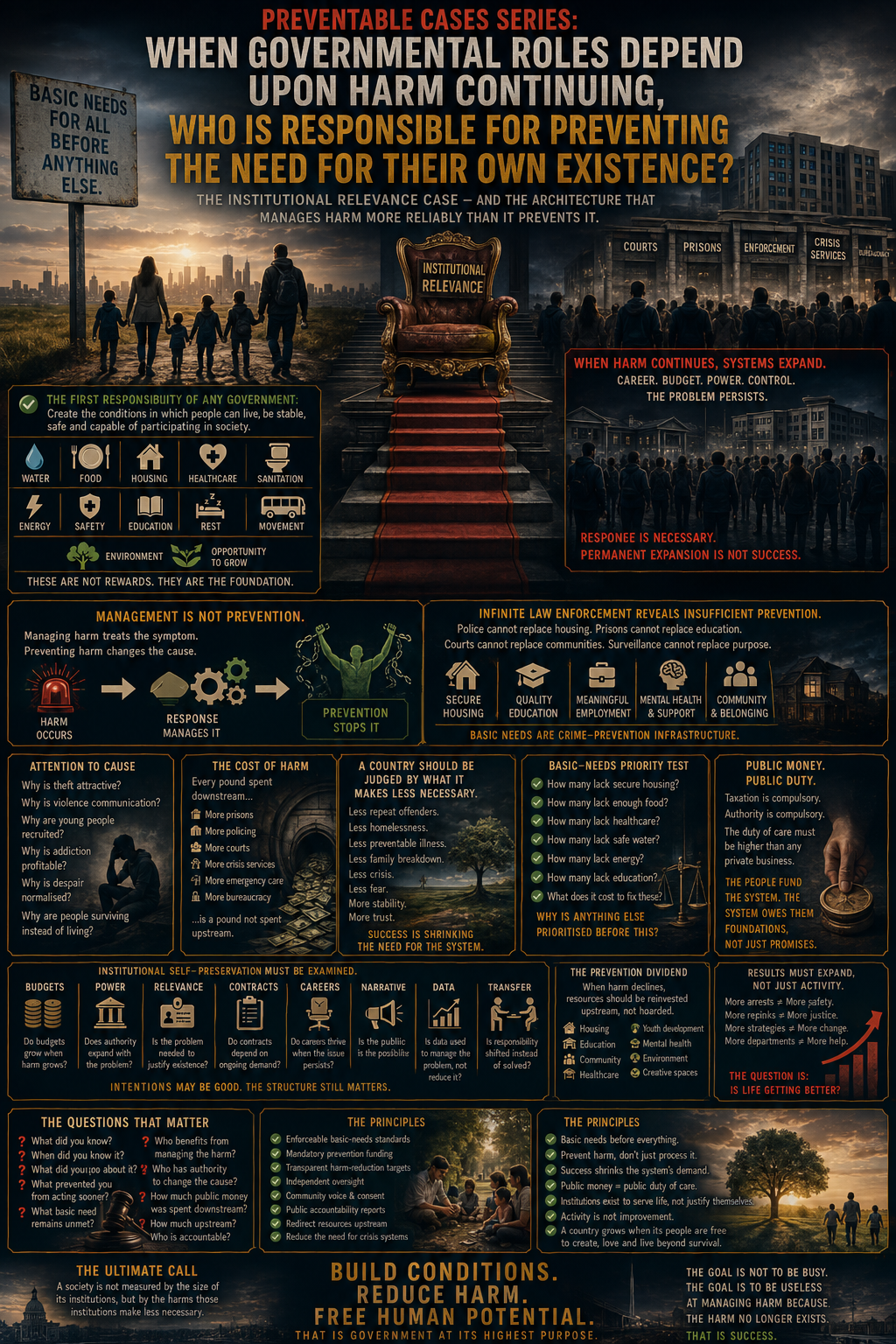
The Institutional Relevance Case — and the Architecture That Manages Harm More Reliably Than It Prevents It
Governmental standards, responsibilities, promises and care should begin with one order of priority:
Basic needs for all before anything else.
Before expansion.
Before prestige.
Before technological ambition.
Before military projection.
Before political theatre.
Before industries are protected.
Before institutions defend their relevance.
Before governments celebrate economic growth that has not reached the people whose lives financed it.
The first responsibility of any government should be to create the conditions in which people can remain alive, stable, safe and capable of participating in society without having to spend every day fighting for the foundations of existence.
Water.
Food.
Housing.
Healthcare.
Sanitation.
Energy.
Safety.
Education.
Rest.
Access to movement.
A viable environment.
The opportunity to develop beyond survival.
Those things should not be treated as rewards for navigating the system successfully.
They are the conditions required for the system to claim it is functioning at all.
And yet so many governmental positions, departments, professions and entire industries only exist at their current scale because harm continues to exist.
That creates a question rarely asked directly enough:
When a role exists because harm exists, what incentive does the institution have to eliminate the harm completely?
If the results of those roles are not expanding, can we trust that they are trying to reduce harm?
Or are they doing enough to persist its existence so that they can still remain relevant?
This is not an accusation that every judge wants crime, every police officer wants violence, every social worker wants neglect or every lawyer wants injustice.
It is an examination of institutional design.
A person may sincerely want to help while working inside a system whose funding, staffing, authority and professional importance all increase when the problem remains severe.
That tension cannot be ignored simply because individual intentions may be good.
The structure still matters.
Some Roles Are Evidence of the Harm They Were Created to Address
You do not need ten criminal judges where there is little to no crime.
You do not need endlessly expanding prisons where social conditions are producing less harm.
You do not need enormous enforcement structures where prevention is working.
You do not need entire industries dedicated to managing crises if the causes of those crises have been substantially reduced.
Certain roles only show the continued existence of a country’s failures.
A growing criminal justice system may indicate increased population, complexity or better access to justice.
But it may also indicate that the country has failed to reduce the conditions feeding crime.
A growing homelessness sector may mean more services are finally being provided.
But it may also mean housing remains structurally inaccessible.
A growing food-bank network may reflect extraordinary compassion.
But its expansion also proves that ordinary economic systems are failing to feed people.
A growing mental-health crisis industry may increase access to care.
But it also reveals that the surrounding society continues producing conditions people struggle to withstand.
A growing domestic-abuse response system may save lives.
But the need for constant expansion also demonstrates that prevention, education and early intervention remain inadequate.
The existence of a response can be necessary.
Its permanent enlargement should never be mistaken for success.
Management Is Not Prevention
Modern governments are often highly developed in managing harm.
They can process cases.
Open files.
Create departments.
Build reporting systems.
Appoint commissioners.
Fund inquiries.
Publish recommendations.
Create referral pathways.
Increase enforcement.
Expand prosecution.
Construct more prisons.
Hire more officers.
Introduce another complaint mechanism.
Develop another strategy.
But the existence of an increasingly sophisticated response system does not mean the source of harm is being reduced.
It may only mean the state has become more organised at receiving failure after it occurs.
That distinction is essential.
A government that manages poverty is not necessarily preventing poverty.
A government that prosecutes violence is not necessarily preventing violence.
A government that houses people temporarily after eviction is not necessarily preventing housing instability.
A government that treats preventable illness is not necessarily creating the conditions for health.
A government that responds to youth crime is not necessarily providing young people with belonging, direction, security and meaningful opportunities before criminal environments become attractive.
The system may become excellent at catching people after the fall while refusing to redesign the structure from which they keep falling.
Infinite Law Enforcement Reveals Insufficient Prevention
Infinite amounts of law enforcement show that there is not enough prevention.
A society requiring permanent expansion of policing, prosecution, imprisonment and surveillance should not automatically interpret that expansion as strength.
It may be evidence that the deeper architecture is weak.
Law enforcement intervenes after a line has been crossed or when authorities believe it may be crossed.
Prevention asks why so many people are approaching the line in the first place.
Why is theft attractive?
Why is violence becoming communication?
Why are young people being recruited into harmful networks?
Why do people feel that legitimate pathways are unavailable?
Why do some communities experience the state mainly through punishment rather than care?
Why are addiction, exploitation, desperation and untreated trauma allowed to accumulate until police become the institution sent to manage the outcome?
Police cannot compensate for every failure of housing, healthcare, education, employment, family support, environmental safety and community infrastructure.
Judges cannot sentence society into coherence.
Prisons cannot manufacture belonging.
Surveillance cannot create purpose.
Enforcement can interrupt immediate harm.
It cannot, by itself, produce the conditions that make harm less likely to begin.
Basic Needs Are Crime-Prevention Infrastructure
Prevention begins far earlier than policing.
It begins with whether people can eat.
Whether they can sleep securely.
Whether they can access healthcare.
Whether children grow in stable environments.
Whether schools develop thought rather than merely process attendance.
Whether families receive help before pressure becomes collapse.
Whether people can work without remaining trapped beneath the cost of living.
Whether communities have safe public spaces.
Whether young people can participate in creative, athletic, educational and social pursuits.
Whether people can imagine a future they do not need to escape through risk, violence, addiction or exploitation.
When people have their needs covered, they are less eager to create havoc.
Not because poverty automatically creates criminality.
Not because every wealthy person behaves responsibly.
Not because human conflict disappears once people are comfortable.
But because deprivation, instability and persistent insecurity create conditions in which desperation, exploitation and harmful economies become easier to produce.
A person with secure housing is less vulnerable to coercion tied to shelter.
A person with food is less likely to steal for survival.
A young person with belonging is less easily recruited by groups offering identity.
A person with healthcare is less likely to deteriorate until crisis services become the only remaining contact.
A family with support is more capable of interrupting harm before it becomes generational.
Basic needs are not only welfare.
They are public-safety infrastructure.
What Happens After Survival Is Secured?
When people are not consumed by covering their needs, they can focus on what exists beyond survival.
Creative pursuits.
Love.
Family.
Learning.
Community.
Friendship.
Discovery.
Craft.
Nature.
Rest.
Play.
Care.
Spiritual growth.
Building.
Experimenting.
Enjoying what life has to give.
Human beings possess enormous capacities that remain unused when all their energy is devoted to remaining housed, fed, warm, medically stable and financially afloat.
A society that secures basic needs does not make people lazy.
It releases attention.
It allows intelligence to move beyond emergency.
It gives creativity somewhere to grow.
It allows relationships to become more than survival arrangements.
It gives people space to discover what they could contribute when fear is no longer directing every decision.
The country gains more than the individual.
It gains inventors.
Artists.
Parents with more emotional availability.
Citizens capable of thought.
Workers who are less exhausted.
Communities with greater trust.
Young people who can imagine futures beyond escape.
Prevention is not merely stopping harm.
It is creating enough life that harm loses part of its attraction.
A Country Should Be Judged by the Problems It Makes Less Necessary
Governments often measure success through activity.
How many arrests?
How many prosecutions?
How many inspections?
How many beds?
How many referrals?
How many cases processed?
How much money spent?
How many departments created?
But activity is not the same as improvement.
A stronger measure would ask:
Which problems became less necessary?
Which emergency services experienced reduced demand because conditions improved?
Which communities required less enforcement?
Which children required fewer crisis interventions?
Which hospitals treated fewer preventable conditions?
Which families no longer needed food banks?
Which people moved out of temporary housing permanently?
Which courts saw fewer repeat cases?
Which prisons reduced their populations because fewer people entered them?
Which public roles could shrink because the harm itself genuinely declined?
That should be the ambition.
The goal of a harmful-systems profession should be to reduce the need for its own expansion.
A successful fire service does not need more fires to prove its importance.
A successful public-health system should not require more illness to justify its budget.
A successful criminal justice system should not depend on a stable supply of crime.
The role proves its value not by remaining permanently busy, but by helping create conditions in which its intervention becomes less necessary.
Institutional Self-Preservation Must Be Examined
Institutions, like people, can develop survival instincts.
Budgets must be defended.
Departments must justify their existence.
Leadership roles require continued relevance.
Funding applications require evidence of need.
Political authority often grows around crisis.
An organisation created to solve a problem may gradually become dependent upon the problem remaining visible enough to preserve its resources.
This does not always require conscious corruption.
It can happen through ordinary incentives.
A department receives more funding when case numbers rise.
A contractor earns more when more people require intervention.
A prison operator benefits from occupancy.
A legal industry expands through greater complexity and dispute.
A security company benefits from fear.
A technology vendor sells more surveillance when institutions perceive greater threat.
A consultancy returns each year because the original issue remains unresolved.
The individual participants may believe they are responding responsibly.
The system can still become organised around continuation rather than elimination.
That is why institutional motives should not be judged only by statements of purpose.
They should be judged by measurable direction.
Is the harm declining?
Is the institution reducing future dependency upon itself?
Is funding being directed toward prevention?
Is knowledge being transferred to communities?
Are early interventions expanding?
Are the causes changing?
Or is the system simply becoming more efficient at processing an endless supply of damage?
Certain Industries Become Saturated Because Failure Has Been Normalised
There should not need to be an unlimited number of professions dedicated to the consequences of social failure.
The saturation of some industries is itself information.
Too many criminal courts may reveal too much criminalisation, too much harm or too little prevention.
Too many debt advisers may reveal an economy designed around financial instability.
Too many food charities may reveal that wages and public support do not meet the cost of survival.
Too many emergency shelters may reveal that permanent housing policy has failed.
Too many private security systems may reveal declining collective trust.
Too many crisis hotlines may reveal that ordinary social relationships and healthcare systems are not catching distress early enough.
Too many lawyers may reveal not only a strong legal culture, but a society whose rules are so fragmented, inaccessible or conflict-producing that ordinary people cannot navigate their lives without professional mediation.
The profession may be valuable.
The saturation is still a symptom.
A country should not celebrate the number of people employed in cleaning up harm without asking why the harm has become such a reliable employer.
The State Must Not Create Careers From Conditions It Refuses to End
There is a moral contradiction when people build secure careers from managing conditions that others are forced to survive.
Again, this does not make the worker immoral.
Many enter these roles because they genuinely care.
The contradiction belongs to the structure.
One person receives a stable salary to process homelessness.
Another remains homeless.
One person receives a professional title for assessing poverty.
Another is assessed repeatedly without receiving enough to escape poverty.
One person gains authority through criminal justice.
Another becomes permanently defined by contact with that system.
One institution is funded to study inequality.
The people being studied continue carrying it.
At some point, the public has the right to ask:
How long can a problem remain a career field before continued failure becomes part of the accountability?
How many reports are enough?
How many consultations?
How many pilot schemes?
How many strategies?
How many governments may repeat the same promise before the promise itself becomes evidence?
Promises Must Be Treated as Public Commitments, Not Political Language
Governments make promises about safety, health, opportunity, housing, growth, fairness and care.
Those promises are often treated as political aspiration rather than enforceable standards.
But repeated public commitments shape civilian reliance.
People organise lives around what government says will be available.
They pay taxes.
Follow laws.
Wait for housing.
Enter education.
Contribute labour.
Trust public institutions.
Delay alternatives because they are told reform is coming.
A government should not be able to benefit from public trust while treating its promises as disposable language.
The more foundational the promise, the greater the duty.
A promise concerning water, food, housing, healthcare, safety or education should not be placed in the same category as a speculative policy ambition.
These are not optional enhancements.
They are the operational basis upon which civilians are expected to accept governmental authority.
Taxation Creates a Higher Duty of Care
Government is not an ordinary service provider.
People cannot generally opt out of taxation while continuing to live entirely outside the state’s systems.
The contribution is compulsory.
The laws are compulsory.
The institutions are publicly authorised.
That creates a higher responsibility than the duty carried by a voluntary business.
The taxpayer does not simply purchase one service.
They fund the entire architecture through which the state claims legitimacy.
In return, the state should secure the conditions that make civic participation possible.
Where basic needs remain persistently unmet while governments fund expansion elsewhere, the issue is not merely policy disagreement.
It is a question of priority and institutional fidelity.
Did government use compulsory contributions first to preserve the people compelled to contribute?
Or did it treat them as a revenue source while asking them to privately solve the conditions the state claimed authority to manage?
The Basic-Needs Priority Test
Every major governmental spending decision should be subjected to a Basic-Needs Priority Test.
Before allocating substantial public resources elsewhere, the state should disclose:
How many people lack secure housing?
How many cannot reliably access food?
How many are waiting for essential healthcare?
How many communities lack safe water or sanitation?
How many households cannot afford energy?
How many schools are structurally inadequate?
How many people are living beneath a viable standard?
What would it cost to address those conditions?
Why is the proposed expenditure being prioritised before them?
What emergency or long-term benefit justifies the order?
What measurable improvement will the public receive?
This does not mean governments can spend only on immediate survival.
A functioning society also needs transport, research, culture, defence, technology and long-term planning.
But basic needs should be the floor beneath every other ambition.
A government should not construct prestige upon civilian instability.
Preventive Capacity Must Be Counted as Infrastructure
Governments understand roads as infrastructure.
Hospitals as infrastructure.
Power grids as infrastructure.
Police stations as infrastructure.
They should also understand prevention as infrastructure.
Early-years support.
Family assistance.
Youth programmes.
Accessible mental-health care.
Community centres.
Addiction treatment.
Housing stability.
Debt prevention.
Nutrition.
Creative education.
Public spaces.
Restorative conflict systems.
Employment pathways.
These are not soft extras.
They reduce pressure upon courts, hospitals, prisons, emergency services and social systems.
A government that cuts prevention may later spend more managing the harm created by the cut.
The later expenditure appears necessary.
The earlier reduction disappears from public memory.
That accounting is dishonest.
The full cost of removing prevention must include the future systems required to manage the consequences.
Judges and Police Should Not Be Measured by Volume Alone
A judge processing more criminal cases may be working diligently.
A police service making more arrests may be responding to genuine harm.
But increased volume should not automatically be celebrated as institutional success.
More arrests may mean more enforcement.
It may also mean more crime, broader criminalisation or failed prevention.
More convictions may mean effective prosecution.
It may also mean the country keeps producing the same harms and offenders without changing the underlying conditions.
The legal system should measure:
Repeat offending.
Community stability.
Victim recovery.
Successful reintegration.
Reduced youth entry.
Reduced emergency demand.
Long-term safety.
The purpose is not to maximise the flow of people through courts.
It is to reduce the conditions requiring court intervention while protecting people when intervention remains necessary.
The Question Is Not Whether Roles Should Disappear Overnight
Certain harm-related roles will always remain necessary.
Human beings will still experience conflict.
Some people will deliberately exploit others.
Some harm cannot be prevented completely.
Judges, lawyers, police officers, social workers, doctors, regulators and emergency services will continue to have legitimate functions.
The argument is not for reckless abolition.
It is for institutional honesty.
The aim should be lower preventable demand.
Smaller pipelines into harm.
Fewer repeated cases.
Earlier intervention.
More restoration.
Greater civilian stability.
A society should be proud when certain harmful-system professions become less saturated because the underlying conditions improved.
That should be treated as success, not as a threat to employment.
Workers can be retrained and redirected toward prevention, education, restoration and community development.
Human capacity need not be discarded simply because social harm declines.
It can move closer to life.
A Prevention Dividend
When public demand for courts, prisons, emergency healthcare, temporary accommodation or crisis response declines, part of the savings should form a Prevention Dividend.
That dividend could be reinvested into:
Housing.
Education.
Youth development.
Community spaces.
Family support.
Healthcare.
Creative opportunities.
Environmental restoration.
Local enterprise.
The system would then reward reduced harm by strengthening the conditions that helped produce it.
Without such a mechanism, prevention can become politically unattractive because successful departments appear to need less money while crisis departments can continually justify expansion.
The funding model should not punish success.
Officials Should Be Required to Publish Harm-Reduction Trajectories
Every major governmental department addressing harm should publish not only activity figures but a long-term harm-reduction trajectory.
It should state:
What harm is being reduced?
By how much?
Over what period?
Which root causes are being addressed?
Which communities remain most affected?
What preventive measures are funded?
What happens if the figures do not improve?
How will the department reduce future dependency upon crisis intervention?
This would make it harder for institutions to present endless management as progress.
When Results Do Not Expand, Responsibility Must
When years pass and the same harms remain, responsibility should not remain static.
The first year may involve diagnosis.
The next may involve intervention.
But after repeated reports, policies, funding rounds and promises, continued failure becomes different.
At some point, the issue is no longer lack of knowledge.
It is inadequate execution.
Misplaced priority.
Institutional resistance.
Fragmented authority.
Or acceptance of the problem as permanent.
The longer an institution holds power over a recognised harm without materially improving it, the stronger the accountability should become.
Authority without expanding results cannot remain protected indefinitely by intention.
The Preventable Case
The future case would not accuse governments of causing every crime, illness, family breakdown or act of violence.
That would be too broad.
It would ask whether governments and publicly funded institutions failed to discharge a reasonable preventive duty where:
The harm was persistent.
The contributing conditions were known.
Basic-needs interventions were available.
Public bodies possessed authority.
Warnings accumulated.
Budgets favoured downstream management over upstream prevention.
And civilians continued carrying foreseeable consequences.
The potential claim would examine whether institutional systems benefited from managing social harm while failing to create the conditions required to reduce it.
The Proposed Legal Formulation
The central allegation could be expressed as follows:
Public authorities that exercise compulsory power, receive compulsory funding and assume responsibility for public welfare owe a continuing duty to prioritise the basic conditions necessary for life, health, safety and meaningful civic participation. Where those authorities possess knowledge that deprivation, instability and unmet basic needs materially contribute to foreseeable social harm, they must not rely primarily upon enforcement and crisis management while failing to implement reasonable preventive measures.
And:
Where institutions derive budgets, authority, professional relevance or commercial benefit from managing persistent harm, their performance should be assessed not merely by the volume of interventions delivered, but by whether their conduct reduces future dependency upon those interventions.
And:
Continued expansion of courts, prisons, enforcement systems and crisis services may constitute evidence of governmental activity, but it cannot by itself establish governmental success where the underlying harm remains stable or worsens.
The Questions That Must Be Asked
Why does this role still need to exist at this scale?
What harm justifies its continued expansion?
What prevention has been attempted?
What basic need remains unmet?
Who benefits from managing the consequence?
Who has authority to change the cause?
What warnings were received?
How much public money was spent downstream?
How much was spent upstream?
Which outcomes improved?
Which remained unchanged?
Who is accountable when activity increases but life does not?
And how long can a country call a response successful merely because the response itself remains busy?
The Central Principles
Governmental care begins with basic needs for all before anything else.
A role created to address harm should be measured by whether it reduces the future need for that role.
The permanent expansion of enforcement is not proof of safety. It may be evidence that prevention remains inadequate.
Basic needs are not separate from public safety. They are part of its infrastructure.
A society should not celebrate the number of people employed in managing harm without asking why harm remains such a reliable employer.
Public activity is not the same as public improvement.
The state cannot process the consequences forever while treating the causes as somebody else’s responsibility.
When people are released from survival, they gain capacity for creativity, family, love, contribution and the fuller experience of life.
The goal is not to eliminate every necessary public role. It is to eliminate the preventable conditions making those roles endlessly expand.
A country should be judged not only by the institutions it builds, but by the harms those institutions make less necessary.
The deepest question is not whether governments are doing something.
They are always doing something.
The question is whether what they are doing is reducing the need for themselves to keep doing it.
Because an institution that becomes larger every year while the harm remains may not be solving the problem.
It may only be learning how to live beside it.
And when the people financing the system continue lacking water, food, housing, healthcare, security and the freedom to develop beyond survival, the state must answer for the order of its priorities.
Human beings should not be kept in conditions that generate harm and then governed mainly through the industries created to manage that harm.
The first governmental responsibility is not to become excellent at processing damaged lives.
It is to build a country in which fewer lives are damaged in the first place.






Leave a Reply