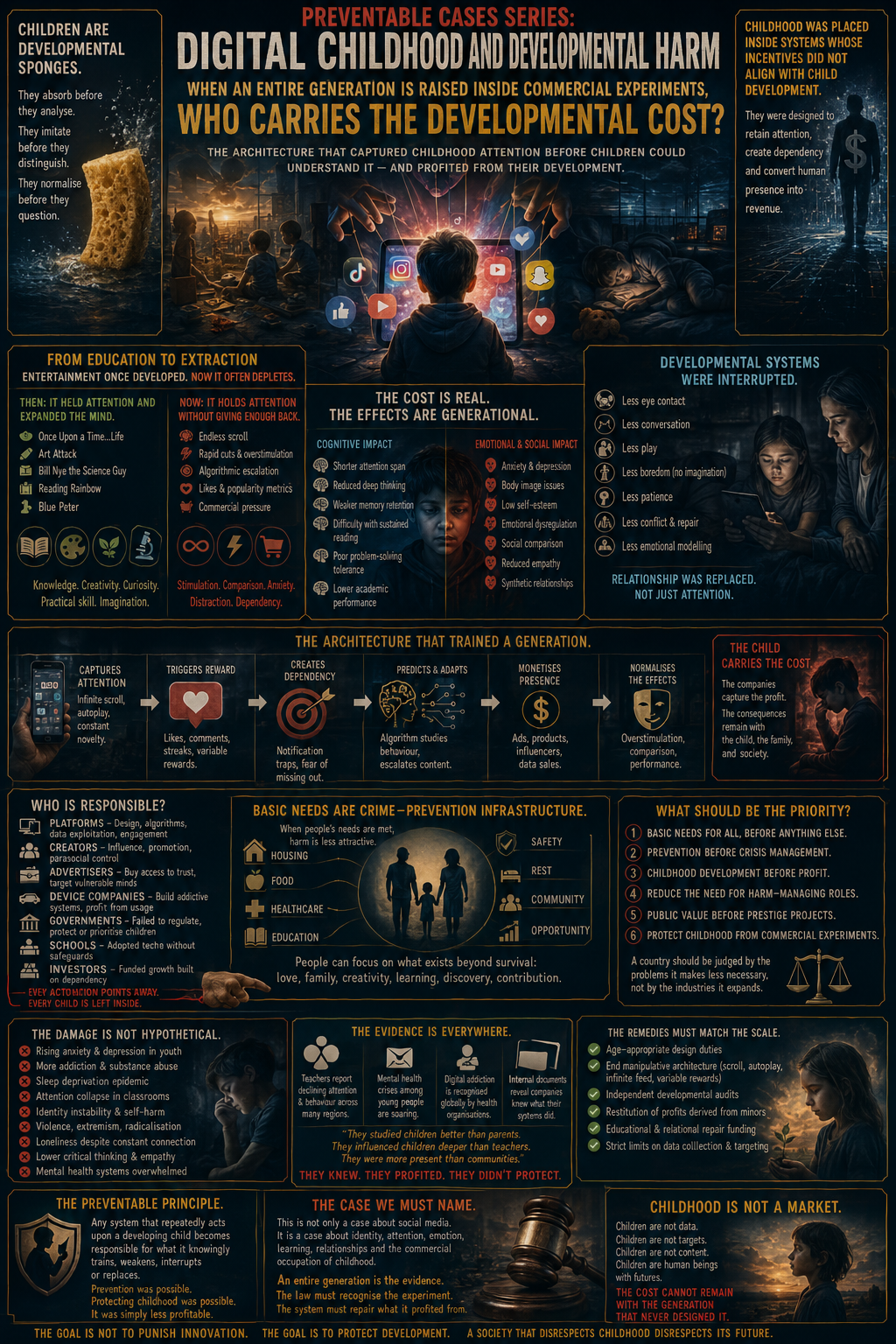
When an Entire Generation Is Raised Inside Commercial Experiments, Who Carries the Developmental Cost?
The existing social-media cases may eventually appear narrow compared with the fuller developmental case that has been building around childhood for more than two decades.
The issue is not only that children were commercially exploited.
It is not only that social-media platforms became addictive.
It is not only that children were exposed to violent material, sexual material, harassment, body-image pressure, gambling-like reward systems, algorithmic extremism, sleep disruption or synthetic relationships.
The deeper case is that entire generations were raised inside digital environments that participated in shaping their brains, identities, emotions, attention, relationships, learning habits and expectations of reality before those children had the developmental capacity to understand what was happening to them.
This was not merely a change in entertainment.
It was a change in childhood architecture.
Children began spending increasing portions of their developmental lives inside commercial systems built primarily to retain attention, increase engagement, gather behavioural information, create dependency and convert human presence into revenue. These systems did not simply show children content. They studied them, adapted to them, predicted them, stimulated them and learned which forms of reward, fear, curiosity, comparison, outrage and excitement would keep them returning.
The child was therefore not only the audience.
The child was the developing subject of the experiment.
And unlike an adult entering a commercial relationship with at least some established sense of identity, judgement and restraint, the child entered these systems while the very capacities required to evaluate them were still forming.
That distinction changes the entire legal question.
A child is not a smaller adult.
A child has no fully developed filtering mechanism built into the mind. Children absorb before they analyse. They imitate before they distinguish. They normalise before they question. They do not begin life with a stable understanding of advertising, manipulation, performance, fiction, social pressure, reward engineering, emotional coercion or the difference between what is popular and what is valuable.
Children are developmental sponges.
Whatever repeatedly surrounds them does not remain external.
It enters their formation.
If the surrounding environment is patient, educational, relational, challenging and grounded, those qualities contribute to development.
If the surrounding environment is fragmented, overstimulating, compulsive, commercial, performative and emotionally extractive, those qualities also contribute to development.
The question is therefore not merely what children watched.
The question is what repeatedly watched the children back, learned from them and shaped itself around their weaknesses.
When Entertainment Stops Developing the Child
There was a period when a significant amount of children’s entertainment was designed to hold attention while also expanding knowledge, creativity, practical skill and curiosity.
Programmes such as Once Upon a Time… Life introduced children to the body through imaginative storytelling. Art Attack encouraged children to make, construct, experiment and understand that creativity was something they could physically practise. Other programmes introduced science, nature, history, problem-solving, language, music and social understanding through entertainment that did not abandon education in order to remain enjoyable.
The entertainment still entertained.
But it also gave something back.
Much of the modern digital environment is built differently. It may be colourful, fast, highly responsive and endlessly available, but stimulation is not the same as development. A programme, platform or game can occupy a child for hours without meaningfully strengthening the child’s ability to think, make, question, regulate, relate or understand.
A system can keep a child intensely engaged while leaving the child developmentally underfed.
This distinction is rarely measured because the commercial metric is not whether the child grew.
The commercial metric is whether the child stayed.
That shift matters.
When children’s media becomes shorter, faster, louder, more repetitive and increasingly designed around rapid reward, the developing mind is taught to expect constant effect. The child becomes accustomed to exaggerated sound, visual intensity, endless novelty, instant transition and immediate gratification. Ordinary life then has to compete with an engineered sensory environment that can change every second.
Reality cannot compete on those terms.
A conversation develops slowly.
A book requires patience.
A relationship requires reciprocity.
Learning requires repetition.
Skill requires frustration.
Nature does not provide a new scene every few seconds.
The human nervous system was not built to experience every quiet moment as a failure of entertainment.
Yet many children are growing inside environments that train them to perceive stillness as emptiness, difficulty as rejection, waiting as suffering and ordinary life as insufficiently stimulating.
That is not a harmless preference.
It changes the child’s internal baseline.
Special Effects, Hyperreality and Dependency on Stimulation
It is often argued that modern forms of entertainment, including animation, gaming and anime, contain valuable philosophies, moral questions and complex ideas. Some undoubtedly do.
But the presence of meaning inside entertainment is not the same as the structured teaching of meaning.
A child does not automatically inherit the philosophy contained in a story.
The child still requires guidance, interpretation, discussion, context and developmental support. Without those things, profound themes may remain aesthetic impressions rather than integrated understanding.
A child may recognise heroism without learning responsibility.
A child may admire courage without learning emotional regulation.
A child may watch sacrifice without understanding duty.
A child may identify with power without understanding consequence.
The special effect can be absorbed more easily than the lesson.
That is especially important when children spend more time consuming heightened fictional realities than developing skills within ordinary physical reality. Digital worlds can make action look immediate, power look effortless, transformation look spectacular and success appear disconnected from repetition, discipline, failure and time.
Children do not possess special effects.
They must develop through process.
If they grow up expecting life to feel like the systems that entertained them, they may become dependent on whatever reproduces intensity. When ordinary existence feels too slow, too quiet or too emotionally plain, the person may search for substitutes: substances, risk, compulsive consumption, constant media, gambling, extreme experiences, unstable relationships or any other source capable of producing the missing effect.
This is where childhood overstimulation may later intersect with adult dependency.
The dependency may not begin with the drug.
It may begin with the baseline.
The Artificial Mining of Dopamine and Adrenaline
Many members of the generations born between the early 2000s and the mid-2000s entered childhood during a period when digital systems became increasingly portable, personalised and permanent.
They did not merely encounter technology.
Technology followed them.
It entered bedrooms, classrooms, family meals, journeys, friendships and periods of solitude. It replaced boredom before boredom could produce imagination. It replaced waiting before waiting could produce patience. It replaced uncertainty before uncertainty could produce exploration. It replaced difficult emotion before difficult emotion could be understood.
Their nervous systems were repeatedly exposed to artificial novelty, reward anticipation, social evaluation, urgency, interruption and heightened emotional content.
The result is a population whose brains may have been conditioned into forms of persistent vigilance and repeated stimulation long before adulthood.
Notifications produce anticipation.
Short-form media produces rapid novelty.
Likes produce social reward.
Online conflict produces adrenaline.
Infinite scrolling removes natural stopping points.
Algorithmic recommendations remove the need to choose.
Autoplay removes the need to pause.
The system continuously supplies the next stimulus before the child can recognise that enough has occurred.
This is not the natural experience of dopamine and adrenaline within a balanced environment.
It is the industrial mining of attention through neurochemical response.
The system learns which emotional trigger works, delivers it repeatedly and calls the outcome engagement.
Then, when the child becomes an adolescent or adult who struggles with stillness, substance use, emotional instability, compulsive behaviour or the need for increasingly intense experiences, the same society treats the outcome as an individual weakness.
But what if the individual was trained into intensity?
What if later alcohol and drug dependency is, in part, an extension of developmental overstimulation?
What if substances are sometimes not the beginning of dysregulation, but the continuation of a nervous system already taught that ordinary consciousness is not enough?
This does not mean every child exposed to technology will develop addiction, nor that every addiction has the same cause. It means the relationship between early digital overstimulation and later dependence should no longer be dismissed simply because institutions have not yet fully measured what they allowed to happen.
The effects are already visible.
The absence of complete measurement does not mean the absence of consequence.
The Depletion of Emotional Relation
The developmental harm is not limited to what children consume.
It also includes what digital systems replace.
Emotional relation is depleting faster than many institutions are willing to acknowledge.
A child develops relational intelligence through repeated human contact. Through faces, tone, pauses, misunderstandings, repair, touch, eye contact, frustration, shared activity and the slow discovery that another person has a separate inner world.
These capacities do not appear automatically.
They are practised.
A child learns when to speak by experiencing conversation.
A child learns empathy by witnessing emotion.
A child learns patience by waiting for another person.
A child learns emotional regulation partly by being regulated within relationship.
A child learns conflict through rupture and repair.
A child learns identity partly through stable human reflection.
When a device repeatedly interrupts or replaces those processes, the developmental loss is not measured merely in hours of screen time.
It is measured in missed relational formation.
In many homes, both the parent and the child are physically present while psychologically elsewhere. The child may be using one device while the parent uses another. The family exists in the same room but not within the same experience.
Technology becomes a developmental competitor.
It is not only taking the child’s attention.
It is also taking the attention of the adults responsible for reflecting the child back to themselves.
The child then receives less eye contact, less conversational depth, less emotional interpretation and less patient correction. Meanwhile, commercial systems remain constantly available, endlessly responsive and capable of offering immediate stimulation without requiring reciprocity.
Human relationship begins to feel demanding.
Technology feels easier.
But the child does not develop emotional depth through what is easiest.
The child develops emotional depth through participation.
When that participation is reduced, children may become less able to read social nuance, less able to tolerate frustration, less able to sustain difficult conversation, less able to remain emotionally present and less able to understand the consequences of their behaviour on another person.
A platform can connect millions of people while weakening their capacity for relationship.
Connection is not the same as relation.
Visibility is not the same as intimacy.
Communication is not the same as emotional development.
Identity Formation Inside Commercial Platforms
One of the most serious developmental consequences concerns identity.
Childhood and adolescence are periods in which the person gradually discovers who they are, what they value, how they relate to others and where their internal sense of worth comes from.
Historically, identity was shaped through family, community, school, environment, culture, physical experience, challenge, reflection and direct social participation.
Digital platforms inserted themselves into that process.
The developing child began constructing identity inside systems that rewarded visibility, imitation, desirability, performance, controversy, consumption and immediate response.
The child learned that being seen could be measured.
Approval became numerical.
Belonging became visible.
Popularity became countable.
Beauty became editable.
Personality became performative.
Identity became content.
The self was no longer only something to become.
It became something to display, compare and optimise.
This fundamentally changes development.
A child who repeatedly evaluates themselves through views, reactions, likes, comments and trends may struggle to distinguish internal value from external response. The person may become increasingly dependent on audience confirmation, not because they are naturally vain, but because the architecture taught them that recognition is evidence of existence.
The digital self may also become more important than the embodied self.
Children may learn how to present a life before learning how to live one.
They may learn how to appear confident before learning how to become secure.
They may learn how to reproduce the language of emotional awareness before learning how to practise emotional responsibility.
They may learn how to signal identity before understanding its foundations.
The result can be a self that is highly visible but internally unstable.
A self constructed from reaction rather than relationship.
A self accustomed to performance but unfamiliar with silence.
A self capable of producing an image but uncertain how to inhabit reality without one.
The Collapse of Attention Is Not an Individual Moral Failure
Teachers have increasingly reported that students struggle to focus, retain information, follow instructions, complete longer tasks, tolerate difficulty and regulate behaviour within classrooms.
These observations should not be dismissed as older generations complaining about younger ones.
Teachers are frontline witnesses to developmental change.
They see large groups of children across repeated years.
They observe patterns that individual parents may not be able to see inside one household.
When teachers across different regions begin reporting similar declines in attention, reading endurance, memory, behavioural regulation and cognitive application, that should be treated as potential population-level evidence.
The legal system frequently waits for a clinical diagnosis.
But educational decline may emerge before diagnosis.
The classroom may reveal the injury before the clinic names it.
Children accustomed to rapid stimulation may find sustained attention unusually difficult. Children accustomed to immediate answers may struggle with uncertainty. Children accustomed to constant entertainment may experience learning as emotionally intolerable when the process does not continuously reward them.
This does not mean children have become less intelligent.
It may mean their intelligence is developing inside environments that repeatedly interrupt its application.
A capable mind can still become poorly trained.
A creative mind can still become unable to concentrate.
A curious child can still become dependent on being entertained.
The injury may not be the loss of intelligence itself.
It may be the weakening of the conditions through which intelligence becomes usable.
That distinction matters because institutions may wrongly label children as lazy, disruptive, unmotivated or deficient when the wider developmental environment has been training them in the opposite direction from the classroom.
The child is then punished for displaying the outcome of the architecture surrounding them.
A Generation Raised by Whatever the Internet Offered
Children from recent generations did not grow up merely using the internet.
They grew up within whatever the internet happened to provide.
The quality of that environment was not determined by developmental experts working under a universal duty of care.
It was largely determined by commercial competition.
The content that travelled furthest was not necessarily the content that helped children grow.
It was the content most effective at capturing attention.
The platform did not ask whether a video strengthened reasoning.
It asked whether the video retained the viewer.
The algorithm did not ask whether a recommendation supported emotional development.
It asked whether the recommendation produced another click.
The system did not distinguish between healthy fascination and harmful compulsion when both created engagement.
Commercial success therefore became capable of overriding developmental value.
That is the foundational defect.
Childhood was placed inside systems whose incentives did not align with childhood development.
Companies benefited when children stayed longer.
Advertisers benefited when children became more predictable.
Influencers benefited when attention intensified.
Platforms benefited when emotional reaction increased.
Device manufacturers benefited when dependency deepened.
Yet the developmental cost was carried by children, families, schools, healthcare systems and society.
The profits were concentrated.
The consequences were distributed.
The Full Preventable Case
The potential action should not be limited to social-media addiction alone.
The fuller case should examine a combined developmental architecture including:
- compulsive and dependency-forming design;
- exposure to violent and sexual material;
- sleep disruption;
- body-image pressure;
- attention degradation;
- online harassment;
- gambling-like reward systems;
- algorithmic radicalisation;
- synthetic companions;
- the commercialisation of identity;
- the replacement of developmental human contact;
- reduced educational depth;
- emotional dysregulation;
- hyperstimulation;
- behavioural surveillance;
- and the long-term relationship between childhood digital exposure and later dependency.
Each of these may already support separate legal claims.
But separating them may hide the cumulative injury.
Children do not experience each system in isolation.
The child may move from entertainment to social media, from social media to gaming, from gaming to streaming, from streaming to synthetic companionship, from synthetic companionship to online shopping, gambling, pornography, extremist content or substance-related communities.
The developmental environment is continuous.
The architecture follows the child across platforms.
The injury field is cumulative.
The law should therefore examine not only individual products, but the combined effect of digital systems acting upon a developing population.
The Class Should Be Defined by Exposure, Not Only Diagnosis
The key class should not be limited to children or adults who can prove a named psychiatric diagnosis.
That would reproduce the same legal weakness seen in other preventable cases: waiting until the harm becomes clinically visible before recognising that the exposure itself was wrongful.
A diagnosis may prove that harm reached a recognised threshold.
It does not define the entire harmed population.
The class could instead be organised around common exposure to identifiable design systems during developmental periods.
This could include children exposed to:
- infinite-scroll systems;
- autoplay;
- manipulative notification structures;
- algorithmic content escalation;
- variable reward systems;
- targeted advertising;
- behavioural tracking;
- publicly visible popularity metrics;
- age-inappropriate recommendation systems;
- deliberately weak stopping mechanisms;
- and products designed to maximise time spent rather than developmental value.
The legal question should be whether children were exposed to common systems capable of shaping development during periods when they could not meaningfully understand or resist those systems.
The child should not have to prove that every later difficulty came from one specific platform.
The companies created a shared environment.
The law should be capable of recognising shared developmental exposure.
The Responsibility Chain
The companies may say parents controlled access.
Parents may say the products were presented as ordinary communication tools, harmless entertainment or necessary educational technology.
Schools may say devices became essential to modern education and participation.
Governments may say innovation moved faster than regulation.
Advertisers may say they merely purchased access to available audiences.
Content creators may say platforms rewarded whatever gained visibility.
Each actor may point towards another.
But the child carries the combined outcome.
The child carries the interrupted sleep.
The child carries the damaged attention.
The child carries the emotional dependency.
The child carries the social comparison.
The child carries the weak frustration tolerance.
The child carries the compulsive behaviour.
The child carries the developmental delay.
The child carries the confusion between identity and performance.
That is why responsibility must be allocated according to control, knowledge and benefit.
Who understood the system?
Who designed the system?
Who measured the child’s behaviour?
Who tested the reward structure?
Who had access to internal evidence?
Who profited from continued exposure?
Who had the power to alter the design?
Who chose not to?
The central question is:
Who Had the Greatest Ability to Understand and Alter the Architecture Before the Developing Child Was Expected to Resist It?
Children had the least control.
Parents had limited visibility.
Schools had limited alternatives.
Governments had legislative power but delayed.
Companies had the behavioural data, technical knowledge, design control and financial incentive.
Responsibility should follow that hierarchy.
A child cannot be blamed for failing to resist a system intentionally built around the weaknesses of a developing mind.
A parent cannot be expected to independently discover every mechanism concealed within proprietary design.
A school cannot be expected to reject technology entirely when governments and institutions increasingly treat digital access as necessary.
The actors with the greatest ability to prevent the harm were those who built, studied, regulated and profited from the architecture.
Foreseeability
The defence that nobody could have predicted the developmental effects becomes less credible with every passing year.
Companies observed user behaviour in extraordinary detail.
They knew how long children stayed.
They knew which notifications brought them back.
They knew what content increased engagement.
They knew which emotional states produced repeated use.
They knew how usage differed by age.
They knew that sleep was being interrupted.
They knew that popularity metrics affected behaviour.
They knew that children were exposed to content beyond their developmental capacity.
They knew that recommendation systems escalated intensity.
They knew that compulsive design worked.
The same knowledge used to increase retention could have been used to reduce harm.
The capacity to optimise is also the capacity to foresee.
If companies understood children well enough to hold their attention, then they understood enough to recognise that childhood attention was being altered.
Prevention was available.
It was simply less profitable.
The Failure of Governmental Prevention
Governments cannot place the entire burden on technology companies while ignoring the regulatory vacuum that allowed those companies to become developmental authorities.
States require adults to meet standards before teaching, treating, supervising or professionally caring for children.
Yet commercial systems were permitted to influence children for thousands of hours without equivalent developmental duties.
No teacher could secretly test dozens of behavioural methods on a classroom to determine which one kept children emotionally dependent.
No clinician could repeatedly expose a child to escalating material without oversight.
No childcare provider could design an environment around sleep disruption, constant interruption and compulsive reward.
Yet digital platforms were allowed to do versions of these things at scale because the interaction was classified as technology, entertainment or communication rather than as developmental influence.
The classification protected the industry.
It did not protect the child.
Governments also encouraged digital participation without building the necessary safeguards. Devices entered schools. Homework moved online. Public services became digital. Social belonging increasingly required technological access.
The child was pushed into the environment while the law continued treating entry as voluntary.
That contradiction must be confronted.
A society cannot make digital participation functionally necessary and then claim that children and parents freely accepted every developmental risk attached to it.
Preventability
This case belongs in the Preventable Cases Series because the harm did not arise from one unforeseeable event.
It developed through repeated choices.
Platforms could have removed visible popularity metrics for minors.
They could have introduced genuine stopping points.
They could have disabled autoplay.
They could have restricted behavioural tracking.
They could have separated childhood products from adult commercial architecture.
They could have slowed recommendation systems.
They could have prohibited escalation towards violent, sexual or extreme content.
They could have funded independent developmental research before scaling.
They could have designed for learning, rest, relation and cognitive growth.
Governments could have imposed age-specific design duties earlier.
Schools could have protected device-free learning spaces.
Public-health bodies could have studied developmental exposure before crisis levels emerged.
Advertisers could have refused to fund systems that profited from childhood compulsion.
The harm was not inevitable.
It was repeatedly permitted.
The Remedies
The remedy should not wait until every claimant proves an individual clinical injury.
By then, the legal system is already responding too late.
A population-scale developmental case requires remedies proportionate to the architecture.
These could include:
1. Age-Specific Design Duties
Every product accessible to children should be required to demonstrate that its design serves childhood development rather than merely avoiding the most obvious forms of harm.
A product should not qualify as child-safe simply because it does not immediately injure the child.
The standard should ask whether the product supports attention, sleep, emotional regulation, learning, autonomy and healthy relation.
2. Restitution of Profits Derived From Minors
Where revenue was generated through the behavioural monitoring, manipulation or compulsive engagement of children, a proportion of those profits should be returned to public developmental repair.
Companies should not retain the full benefit of an architecture whose costs were transferred to families, schools and health systems.
3. Independent Developmental Audits
Digital products used by minors should undergo independent audits examining attention effects, sleep effects, emotional dependency, algorithmic escalation, identity pressure, social comparison and long-term cognitive consequences.
Companies should not be allowed to audit themselves.
4. Compulsory Safety Research
Platforms and device manufacturers should be required to fund long-term research without controlling its conclusions.
The research should follow children across developmental periods rather than measuring only immediate user satisfaction.
5. Educational Repair
Funding should be directed towards restoring concentration, reading endurance, practical creativity, emotional literacy, memory, critical thinking and device-independent learning.
Schools should not be expected to repair commercially produced developmental harm without support from the industries that contributed to it.
6. Relational Repair
Public programmes should support parents, children and communities in rebuilding forms of human contact displaced by digital dependency.
The remedy must recognise that the loss is not only cognitive.
It is relational.
7. Restrictions on Manipulative Architecture
Infinite scroll, autoplay, variable rewards, public popularity metrics, predatory notifications and behavioural targeting should face strict limitations where minors are concerned.
8. Long-Term Psychological Support
Children and young adults affected by digital dependency, identity instability, body-image harm, harassment, compulsive use and exposure to extreme content should have access to long-term support funded partly by the industries involved.
9. A Developmental Duty of Care
Any company capable of materially shaping childhood behaviour should carry a legal duty proportionate to that influence.
The more time a system occupies in a child’s development, the greater its responsibility should become.
10. Protection of Childhood as a Public Interest
Childhood should be treated as a protected developmental condition, not as an open commercial territory.
The law should recognise that commercial freedom ends where population-level developmental interference begins.
The Wider Social Cost
The developmental cost does not remain with the child.
It enters adulthood.
It enters employment.
It enters relationships.
It enters healthcare.
It enters education.
It enters crime.
It enters addiction services.
It enters politics.
It enters public discourse.
It enters the ability of a population to think carefully, tolerate complexity, manage emotion and participate responsibly in society.
A generation with weakened attention is easier to manipulate.
A generation dependent on stimulation is easier to sell to.
A generation uncertain of its identity is easier to influence.
A generation unable to tolerate discomfort is less able to build, repair or sustain.
A generation trained to perform rather than relate may become highly connected while remaining profoundly alone.
The harm is therefore not only personal.
It is jurisdictional.
It affects the future competence of the whole society.
Governments that fail to protect childhood development eventually inherit the adult consequences through public spending, healthcare demand, educational decline, productivity loss, social instability and weakened civic judgement.
Prevention would have cost less.
But the costs were delayed, distributed and transferred to the public.
The Case the Law Has Not Yet Fully Named
The law still tends to separate these harms into isolated categories.
Addiction.
Privacy.
Content exposure.
Harassment.
Mental health.
Advertising.
Consumer protection.
Education.
Data protection.
Child safety.
Each category captures part of the problem.
None captures the whole.
The whole is developmental occupation.
Commercial systems were permitted to occupy increasing portions of childhood while avoiding the responsibilities traditionally attached to those who shape children.
They were allowed to influence without being recognised as educators.
To condition without being recognised as behavioural authorities.
To observe without being recognised as researchers.
To profit without carrying the full developmental cost.
That is the case the law has not yet fully named.
The Central Legal Questions
The action should ask:
- Can a child meaningfully consent to behavioural systems designed to exploit developmental vulnerability?
- Can parental consent be valid where the relevant design mechanisms were concealed?
- Should childhood exposure itself constitute legally recognisable harm before diagnosis?
- Should responsibility follow the actor with the greatest design control?
- Can governments avoid liability where digital participation became socially and educationally necessary?
- Should profits derived from minors be subject to developmental restitution?
- Should companies be required to prove developmental safety before exposing children at scale?
- Can the cumulative effect of multiple digital systems be recognised as one developmental injury field?
- Should teachers’ reports of cognitive and behavioural decline be treated as public-health evidence?
- Should childhood be legally protected from commercial architecture in the same way that it is protected from other unsafe environments?
The Preventable Principle
A society cannot place children inside systems designed to hold their attention and then blame them for becoming unable to control it.
It cannot replace human development with commercial engagement and then blame families for the developmental loss.
It cannot profit from children’s emotional vulnerability and later classify the consequences as private mental-health problems.
It cannot allow technology to raise children while refusing to assign technology the duties of anyone else entrusted with childhood.
The central preventable principle is this:
Any system that repeatedly acts upon a developing child becomes responsible for what it knowingly trains, weakens, interrupts or replaces.
The child did not create the architecture.
The child did not approve the experiment.
The child did not understand the consequences.
The child simply adapted to the world adults placed around them.
Closing
This is not only a case about social-media addiction.
It is not only a case about content.
It is not only a case about screen time.
It is a case about identity, attention, emotional development, learning, relation, stimulation, dependency and the commercial occupation of childhood.
It is a case about generations raised inside environments that were permitted to become more psychologically informed than the parents, more constantly present than the teachers and more behaviourally influential than many public institutions.
The platforms may say the parents were responsible.
The parents may say the tools had become unavoidable.
The schools may say they had to modernise.
The governments may say innovation moved too quickly.
The companies may say the child chose to remain.
But a developing child cannot carry the responsibility of every adult institution that failed to protect the conditions of development.
The deepest question is not whether children used the systems.
The deepest question is why systems designed around commercial extraction were allowed to become part of raising them.
Because when an entire generation is raised inside a commercial experiment, the developmental cost cannot remain with the generation that never designed it.
And when the resulting harm was foreseeable, measurable and preventable, it is no longer simply a cultural concern.
It is an open case.
…
Ok great, expand this cause therw’s so much kore than hust commercial exploitation on childreen, what does it do to their sense of identity, emotuonal relation is depleating faster than job redundancies, children and recent generations grew up online by whatever online offered, kids are like sponge, they have no filtering mechanism buikt in their minds, in a case where the cartoons they watch arent as educstional, arent as challenging, are mostly entertaining, i mean we had once upon a time…life, we had art attack, we had educstional entrrtsinment that these days isnt found. Sure many mightbsay anime provides with good fhilosophies of life, but it is still left to the mind to develop the understanding, it does not inheritly teach children how to grow, esoecially cause children dont have special effects, if they grow up rhinking special effects are real theyll forever be dependent on what gives the special effect like effects.. and I can already see generations between 2000 and 2006 who are rhe most addicted to drugs and alcohol consumptions cause their brains have been accustomed to being hyper vigilant, fakely dopa/adrenaline-mined, they have been soo overly stimulated simply hy introducing technology or parents who use technology more than interacting with their kids. The effects are alresdy seen, whether people aant to accept it or not, there’s a reason why so many teachers complain about their students, and have witnessed a huge decline in learning abikities and cognitive behavioural applications.
Digital Childhood and Developmental Harm
When an Entire Generation Is Raised Inside Commercial Experiments, Who Carries the Developmental Cost?
The existing social-media cases may eventually appear narrow compared with a fuller childhood action combining:
compulsive design;
exposure to violent and sexual material;
sleep disruption;
body-image pressure;
attention degradation;
online harassment;
gambling-like reward systems;
algorithmic radicalisation;
synthetic companions;
and the replacement of developmental human contact with commercial platforms.
The key class would not be defined only by diagnosis. It could be organised around exposure to common design systems during identifiable developmental periods.
The companies may say parents controlled access.
Parents may say the products were represented as ordinary communication tools.
Schools may say devices became educational necessities.
Governments may say technology developed faster than regulation.
The child carries the combined outcome.
The central question is:
Who had the greatest ability to understand and alter the architecture before the developing child was expected to resist it?
The remedy should not wait until every claimant proves an individual clinical injury. It could include age-specific design duties, restitution of profits derived from minors, independent developmental audits, compulsory safety research and long-term funding for psychological and educational repair.



Leave a Reply