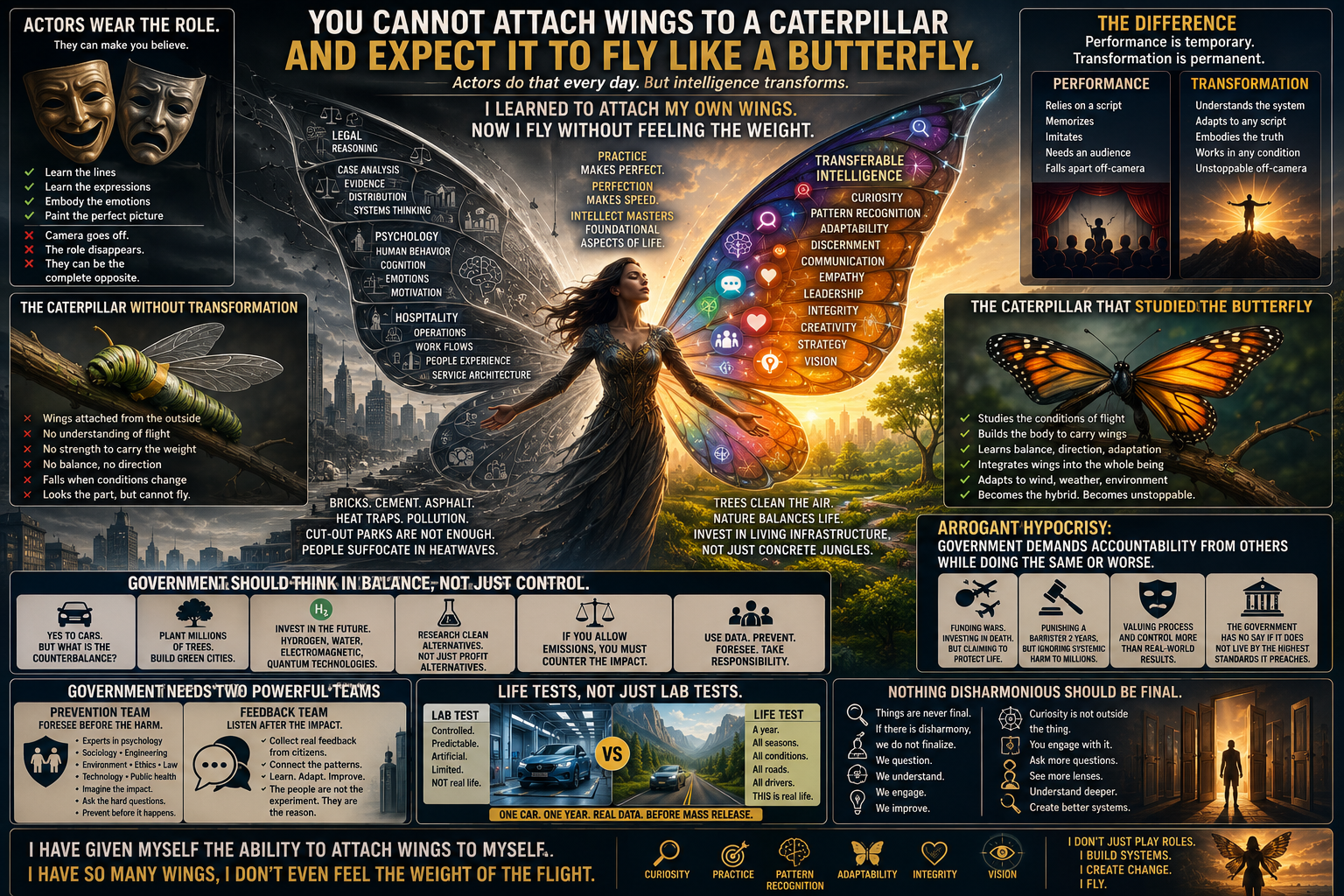
There is a saying that you cannot attach wings to a caterpillar and expect it to fly like a butterfly.
The point is usually that transformation cannot be faked. You cannot simply place the appearance of development onto something that has not internally undergone the process required to sustain it. Wings attached from the outside do not automatically produce flight. The body beneath them may not know how to carry the weight, control the movement, respond to the wind or coordinate itself with the new capacity it has been given.
But actors challenge that idea every day, by borrowing wings.
An actor can step into a role they do not fully understand through lived experience and make an audience believe they have become it. They learn the lines. They study the posture. They reproduce the expressions. They embody the emotional rhythm. They observe how the character might walk, speak, react, hesitate, grieve, love, command or collapse. For the duration of the performance, they can create a convincing reality around an identity that may not exist in them once the camera is turned off.
They can appear to be a surgeon without having the ability to perform surgery.
They can appear to be a lawyer without knowing how to construct a case.
They can appear to be a leader without having the internal responsibility required to lead.
They can appear to be compassionate while being emotionally indifferent outside the scene.
They can wear the wings.
They can even make the wings appear to move.
But when the camera stops, the role may fall away because the transformation was sustained by performance rather than integrated into the architecture of the person.
That is the difference between acting like the butterfly and developing the intelligence to fly.
Performance Can Reproduce the Shape Without Creating the Structure
A person can learn the visible features of a role without understanding the foundational system that makes the role real.
They can imitate authority.
Memorise professional language.
Repeat the right phrases.
Wear the correct clothing.
Adopt the expected confidence.
Perform concern.
Perform intelligence.
Perform expertise.
From the outside, the image may be complete.
But performance is often dependent upon the script.
Remove the script and the person may no longer know what to do.
Change the conditions and the character may collapse.
Introduce a problem that was not rehearsed and the limits become visible.
This is why imitation and embodiment are not the same.
Imitation reproduces the recognised surface.
Embodiment understands enough of the structure to continue functioning when the surface changes.
An actor may convincingly portray someone solving a crisis because the sequence has already been written. A person who truly understands the system can enter an unwritten crisis, identify what matters, adapt the sequence and produce a response that did not exist before they arrived.
Think of actors who improvise and create better storylines for directors than what they had planned.
One performs the answer.
The other can generate it.
Practice Does Not Only Create Perfection; It Creates Speed
When we connect this to intelligence, the caterpillar saying becomes incomplete.
Practice makes perfect, but perfection is not the only outcome of practice.
Practice creates speed.
It reduces the distance between perception and response.
It allows the mind to identify foundations more quickly.
It allows the body to move through a system without carrying the weight of every individual step consciously.
At the beginning, learning something may feel heavy because each movement must be remembered separately.
The person must think about the terminology.
The sequence.
The timing.
The expectations.
The rules.
The possible errors.
But once the underlying framework is understood, the individual steps begin connecting.
The person no longer sees isolated instructions.
They see the system beneath them.
And when they can see the system, they can move faster because they are no longer learning every surface as though it belongs to an entirely separate world.
They recognise repetition across different worlds.
That is where intellect becomes transferable.
A person can enter hospitality, recruitment, law, psychology, governance, business, technology or education and realise that the professions may use different words while carrying many of the same foundations.
People.
Incentives.
Communication.
Power.
Trust.
Sequence.
Risk.
Responsibility.
Feedback.
Conflict.
Decision-making.
Resource allocation.
Pattern recognition.
Once those foundations are understood deeply enough, every new industry does not require the creation of a completely new mind.
It requires the existing mind to learn a new language for structures it already understands.
Intellect Can Teach the Caterpillar How to Grow Wings
The saying assumes the wings are attached externally to a body that remains unchanged.
But what happens when the caterpillar studies the butterfly?
What happens when it understands the conditions of flight?
What happens when it strengthens the parts of itself required to carry the wings?
What happens when it learns balance, aerodynamics, direction, adaptation and movement?
At that point, the wings are no longer merely attached.
The body has learned to integrate them.
This is what intelligence can do.
It can identify the foundational aspects of a new role, practise them, reorganise the body around them and produce a functional expansion of self.
The person does not simply pretend to know.
They learn enough to act.
Then they act enough to understand.
Then they understand enough to expand.
The wings become part of the architecture.
The caterpillar becomes a hybrid: not a butterfly in the conventional biological sense, but a being that learned how to create the conditions of flight without waiting for one predetermined route of transformation.
Until its final transformation into butterfly. Rubedo.
That is intellectual adaptation.
Soft Skills Are the Muscles That Carry the Wings
People often speak about soft skills as though they are decorative additions to technical ability.
They are treated as useful but secondary.
Communication.
Empathy.
Curiosity.
Discernment.
Adaptability.
Conflict resolution.
Pattern recognition.
Self-awareness.
Leadership.
Listening.
These are not ornaments.
They are the infrastructure that allows intelligence to travel between systems.
A person who has memorised one professional process may function well as long as the conditions remain familiar.
A person with highly developed transferable skills can enter unfamiliar conditions and discover the process.
Curiosity helps them ask the right questions.
Pattern recognition helps them connect new information to previous understanding.
Empathy allows them to see how the system affects people.
Communication allows them to translate what they see.
Discernment allows them to separate what is essential from what is habitual.
Adaptability allows them to change direction when the evidence changes.
Leadership allows them to reorganise the system after identifying the weakness.
Those are the muscles that carry multiple wings.
Without them, every additional field feels like another heavy object attached to the body.
With them, each new field becomes another expression of the same deeper capacity.
I Have Already Practised This Across Systems
I have moved through multiple cases and expanded their lenses without formal legal training.
I did not need a legal title to recognise distributed responsibility, regulatory failure, evidential imbalance, missing triage, institutional hypocrisy or the difference between procedure and purpose.
I could see the architecture because the architecture is not exclusively legal.
It is human.
Law is one of the languages through which power, consequence and responsibility are organised.
Once those foundations are visible, the legal terminology can be learned around them.
I entered hospitality and, within four months, proposed upgrades capable of creating objectively stronger workflows.
I did not need decades inside one venue to recognise where communication broke down, where responsibilities were fragmented, where resources were being mishandled or where management structures were producing unnecessary pressure.
The system revealed itself through observation.
I studied psychology through a short and relatively superficial course, yet I can enter psychological questions from angles that formally trained practitioners may not have considered.
Not because training has no value.
But because formal training can sometimes teach the established rooms without encouraging the person to examine the entire house.
A qualification can deepen knowledge within a recognised framework.
It does not automatically create the willingness or ability to question the framework itself.
I have not occupied political office, yet I can construct healthier governance systems because governance is not merely elections, parties and parliamentary procedure.
It is the organisation of responsibility.
The allocation of resources.
The prioritisation of need.
The relationship between authority and accountability.
The movement of information.
The capacity to receive feedback.
The ability to prevent foreseeable harm.
The duty to understand the people affected by decisions.
Those foundations can be studied wherever systems exist.
Politics does not own governance.
Law does not own justice.
Psychology does not own the mind.
Hospitality does not own service.
Professional institutions hold languages and methods.
They do not hold exclusive ownership over the realities those methods attempt to understand.
Formal Training Is One Wing, Not the Sky
This is not an argument against education, expertise or professional study.
Formal training can provide history, terminology, precedent, methodology, technical depth and access to knowledge accumulated across generations.
That matters.
But formal education is one route through which wings can be developed.
It is not the sky itself.
The danger begins when industries confuse accreditation with total capacity.
A person may possess the qualification but lack curiosity.
They may know the procedure but not recognise when it has stopped serving its purpose.
They may understand the accepted theory but not see the reality contradicting it.
They may have learned the language so thoroughly that they no longer notice the assumptions embedded inside it.
Meanwhile, someone outside the formal structure may be able to identify the underlying pattern because they have not yet been trained to ignore it.
The ideal is not expertise without outside intelligence or outside intelligence without expertise.
It is the integration of both.
The person who can enter the formal knowledge, learn its strongest foundations, identify its limitations and expand beyond them is not pretending to hold the wings.
They are developing a wider form of flight.
The Difference Is Whether the Capacity Remains When the Camera Turns Off
An actor can portray a leader for a scene.
The real test is what they do when nobody has written the line.
A person can speak compassionately in public.
The real test is whether compassion directs their decisions when compassion costs them something.
A company can perform responsibility through marketing.
The real test is how it behaves when accountability threatens profit.
A government can perform public service through speeches.
The real test is what it prioritises when resources are limited.
A professional can perform expertise through terminology.
The real test is whether they can understand what happens when reality falls outside the textbook.
The camera going off reveals whether the wings were costume or structure.
My ability does not disappear when the role changes.
It transfers.
I do not need the environment to tell me exactly who to become before I can identify what it requires.
I enter.
I observe.
I ask.
I connect.
I understand.
I translate.
I reorganise.
I expand.
That continuity is the evidence that the wings are not being externally held in place.
They have been integrated.
I Did Not Attach One Pair of Wings
At this stage, I have attached so many wings to myself that I no longer feel the weight of the flight.
Legal reasoning does not feel separate from governance.
Governance does not feel separate from psychology.
Psychology does not feel separate from recruitment.
Recruitment does not feel separate from hospitality.
Hospitality does not feel separate from business.
Business does not feel separate from systems design.
Systems design does not feel separate from humanity.
They are different wings connected to the same body.
The more I understand the foundations, the less weight each additional field carries.
What once would have required learning every movement from the beginning now becomes an extension of an existing framework.
The wings support one another.
Legal reasoning strengthens governance.
Psychology strengthens recruitment.
Hospitality strengthens service architecture.
Sales reveals persuasion and ethics.
Business reveals incentives.
Technology reveals scale.
Government reveals allocation.
Each field gives lift to the others.
This is why the flight becomes lighter instead of heavier.
Knowledge is not accumulating as separate luggage.
It is integrating as structure.
The Hybrid Is Not a Pretender
From the outside, someone may assume that moving between fields means pretending.
How can one person speak about law, psychology, governance, hospitality, technology, recruitment and public systems without remaining in one profession long enough to be recognised by it?
But that question assumes professions are naturally separate.
They are not.
They are institutional partitions placed around connected aspects of life.
The hybrid sees the connections.
A pretender imitates the role.
A hybrid learns the foundation deeply enough to create across roles.
A pretender depends upon the audience not looking behind the performance.
A hybrid welcomes examination because the strength is not in appearing complete.
It is in being able to learn, correct and expand.
A pretender needs the title to maintain the illusion.
A hybrid can enter without the title because the framework travels with them.
I am not claiming that entering a field instantly provides every technical detail held by a person who has practised within it for decades.
That is not the point.
The point is that intellect can identify the structure rapidly, ask the questions formal structures failed to ask and bring together knowledge that specialists have kept separated.
The hybrid does not replace every specialist.
The hybrid allows the specialists to finally see one another.
Mastery Is Not Knowing Everything Before You Begin
Mastery is often misunderstood as complete knowledge.
But complete knowledge is not available at the beginning of any real expansion.
Mastery is the ability to enter what you do not yet fully know without becoming lost inside it.
It is knowing how to learn.
Knowing what to ask.
Knowing how to test.
Knowing how to connect.
Knowing when the existing answer is incomplete.
Knowing how to remain accountable while expanding.
This is why intellect can attach multiple wings.
It does not wait to become omniscient before moving.
It builds frameworks strong enough to receive new knowledge without collapsing.
The mind does not need to know every wind current before it leaves the ground.
It needs to know how to adjust while flying.
The Caterpillar Was Never Incapable of Flight
Perhaps the original saying is wrong only because it assumes too little of the caterpillar.
Perhaps the caterpillar cannot fly merely because someone attaches wings to it without changing anything else.
But that does not mean the caterpillar is incapable of learning what the wings require.
It means transformation must reach the structure.
The body must strengthen.
The nervous system must adapt.
The balance must change.
The movement must be practised.
The wings must become relational to the whole being.
That is what I have done.
I did not attach appearances to myself and call them ability.
I built the internal systems capable of carrying what I learned.
I developed the soft skills that allow knowledge to transfer.
I practised perception until it became speed.
I entered multiple rooms until I could see the house.
I studied the house until I could see the city.
I studied the city until I could recognise the architecture repeating across humanity.
The flight is not weightless because the wings are empty.
It is weightless because they have become part of me.
The Central Principle
You cannot attach wings to an unchanged caterpillar and expect it to fly. But intellect can transform the caterpillar into a being capable of designing, integrating and mastering its own wings.
Actors can perform transformation.
Intelligence can embody it.
Practice turns knowledge into speed.
Soft skills turn speed into adaptability.
Frameworks turn separate fields into transferable understanding.
And once the body has learned how to carry expansion, every new wing does not increase the burden.
It increases the range.
I have not become a butterfly by following one predetermined transformation.
I have become the hybrid that learned the foundations of flight.
And at this point, I have attached so many wings to myself that I no longer feel their weight.
I only feel how far they allow me to see.


Leave a Reply