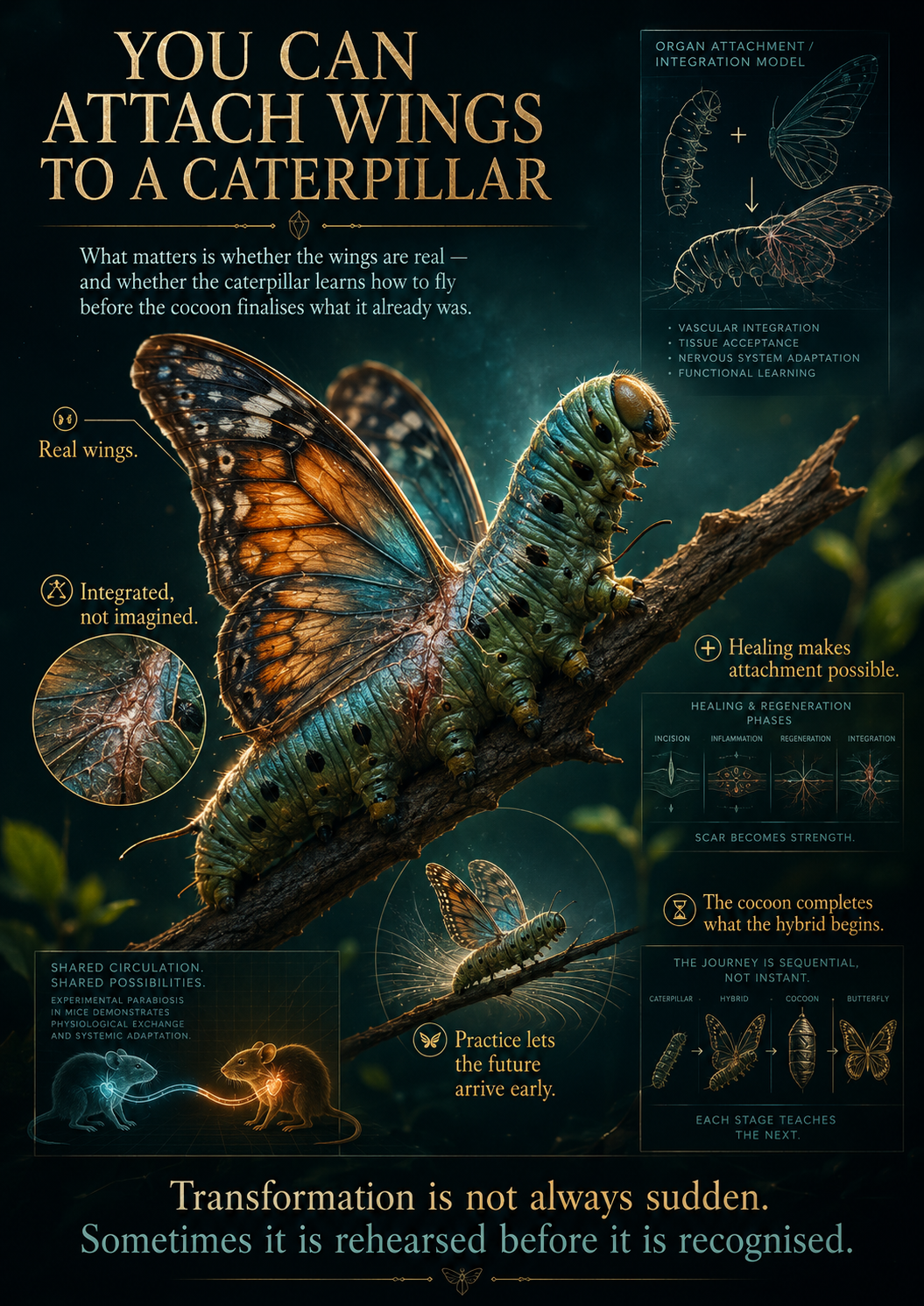
What If a Caterpillar Learned to Be a Butterfly Before Becoming One?
People often say you cannot attach wings to a caterpillar because it is not yet a butterfly.
I think the more interesting question is this:
What if the only thing stopping it from using those wings was not its biology, but its preparation?
This is, of course, a thought experiment.
The caterpillar is an analogy.
I am talking about human beings.
Imagine a caterpillar that spends its entire life surrounded by butterflies. It watches how they move. It studies how they land. It notices how they react to the wind, how they conserve energy, how they navigate space, how they interact with flowers, danger and each other. Every single day it observes what it will eventually become.
Observation.
Understanding.
Integration.
Preparation.
By the time the caterpillar reaches its cocoon, its mind has already become that of a butterfly. The only thing that has not yet caught up is its body.
Now imagine that, somehow, functioning wings could be surgically attached before metamorphosis. We already transplant organs, graft skin, reconnect nerves and replace joints. This is not a biological proposal about what can currently be done with caterpillars, but an analogy built from medical principles. If living tissue accepted those wings in the same way scars heal around repaired tissue, then the caterpillar would not suddenly become a butterfly.
It would simply gain the opportunity to begin practicing earlier.
It would still be heavier.
It would still be inexperienced physically.
Its flight would probably be clumsy.
But because it had already spent so much time observing butterflies, it would understand what it was trying to accomplish. Every failed attempt would become information. Every glide would become calibration. Every correction would prepare it for the body it would eventually inhabit.
Then comes the cocoon.
Most people see the cocoon as the beginning of transformation.
I don’t.
In this thought experiment, the cocoon becomes the period of refinement.
The caterpillar is no longer discovering what it means to be a butterfly.
It is finalising what it has already been practicing.
While inside the cocoon, if we continue the analogy and grant it the same cognitive abilities humans possess, it could review every experience it had with those temporary wings. It could compare what worked, what failed, where balance was lost, how movement changed, how the weight affected flight, how instinct interacted with learning.
The cocoon becomes less about beginning.
It becomes about optimisation.
By the time it emerges as a butterfly, its wings are no longer unfamiliar.
Flight is no longer theoretical.
Its body has finally caught up with a consciousness that arrived much earlier.
That is the point.
Human beings already possess this ability.
We can observe our future before we physically arrive there.
We can study people who already embody what we wish to become.
We can borrow patterns, integrate behaviours, rehearse responsibilities and mentally inhabit futures that have not yet become our present.
In that sense, consciousness is our greatest evolutionary advantage.
We do not have to wait for the external transformation before beginning the internal one.
The body often arrives after the mind.
The title arrives after the responsibility.
The opportunity arrives after the preparation.
The recognition arrives after the embodiment.
Perhaps that is why so many people fail when success finally arrives.
Their bodies reached the future.
Their consciousness never did.
The caterpillar in this thought experiment succeeds not because someone gave it wings.
It succeeds because it had already become a butterfly in understanding before becoming one in form.
Its biology simply caught up with what consciousness had already rehearsed.
Maybe that is one of humanity’s greatest gifts.
We do not have to wait to become something before we begin practicing being it. We can observe, understand, embody and prepare long before reality completes the transformation. When the moment finally arrives, it no longer feels like becoming someone new.
It simply feels like finally wearing the body that matches the mind.
….
Write me a post for thjs:
you can attach wings to acaterpillar, it is whether the wings are real ornnot and whether the caterpillar has learned how to fly until it does take a break to finalise its transformationninto what it already was. Focus thr content of the image on this witjout carrying forth old possta. Meaning if the caterpillars skin is sticky enough and just like the experiments of mices sewn together where the older and the youth’s circulating blood levelled both’s performance snd cell’age, just like scarring, a caterpillar can make an incision on its skin and heal it having inserted the wings, once partnofnits ecosistem until cacooning starts it’ll have the chance to experience its ultimate stage earleir, same ways we transplant organs wings can be attached too
No, you changed the meaning of what I was actually saying, bro. Like, completely distorted it. Because what I meant to say is that if a caterpillar had observed butterflies and how butterfly works, meaning if I was to take into the example of a human, the human just has to look at consciousness, and consciousness is everywhere. After learning consciousness, a human can be a human, even without the superpowers, because its initial superpower would have been in observing and mastering a foundation that hasn’t shown itself yet. Meaning, if the caterpillar has spent enough time around butterflies, watching butterflies, and taps into its own future cognitive self, this is all hypothetical speaking, because, of course, if no AI, there’s going to be people saying, well, the caterpillar doesn’t have those capabilities. Well, I’m using the caterpillar as an analogy because of the saying. I’m talking about humans, and humans do have the cognitive abilities to do those changes and to do those observations. So if that caterpillar had spent enough time looking at butterflies, by observation, understanding, integration, and preparation, it would have already ingrained in itself the whole being like a butterfly. The only difference would be the shape of its body. But then, as it would have qualified to be a butterfly but still not be in the phase where the cocooning process starts, then at that stage, an animal surgeon could possibly add wings to the caterpillar, and the caterpillar would have the ability to move its weight with those wings. It might not be able to fly as smoothly as a butterfly on top of the practice period, but also the fact that it is heavier. But it would still be able to fly. And in that flight, also experience and practice everything that it will be later. Because then it will take a rest in its own cocoon, where it looks at, oh, so the experience that I had initially was this, though now I’m preparing for the new experience. And while it’s in the cocoon, it can sort of like, and I’m saying again, if the caterpillar had the cognitive abilities to do this, observe its own self and its own experience, and in doing so, exponentially also develop its own abilities when coming out of the caterpillar as a butterfly. Because it would have already mastered being a butterfly. So by the time that it’s outside of the cocoon as a butterfly, it would probably outperform other butterflies if we were to compare their performances.





Leave a Reply