
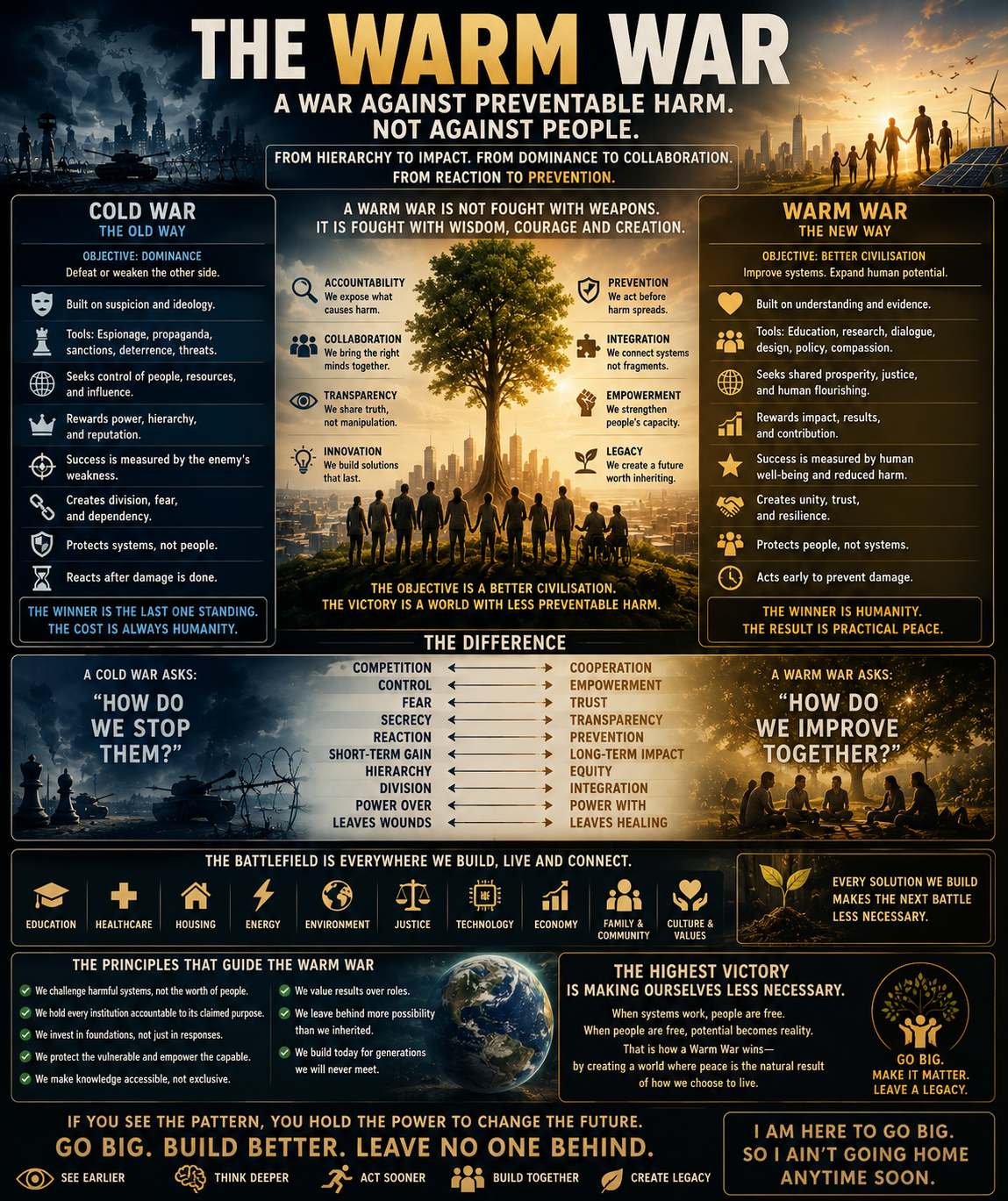
Not a War Against People. A War Against Preventable Harm.
I actively used cold war tactics to burn the energy out and see what it creates. Yeah I’m defo the last one standing, yet it was all to show ourselves the patterns humanity has practiced, to birth out a warm war.
I give cold wars to those who don’t provide a warm one. You can’t get it both ways, if you act cold you get cold as giving warmth would become extraction and self-provided abuse. We are smarter than that.
History has shown us cold wars.
Wars fought through ideology, influence, espionage, economics, deterrence and the constant threat of escalation.
The objective was not always direct battle.
It was dominance.
It was control.
It was preventing the other side from becoming stronger.
A Warm War begins from a different question.
What if the objective was not domination?
What if the objective was better civilisation?
A Warm War is not fought against nations.
It is fought against unnecessary suffering.
It is not fought to destroy institutions.
It is fought to help them become worthy of the purpose they claim to serve.
It is not a war against people.
It is a war against outdated architecture.
Against preventable harm.
Against unnecessary delay.
Against systems that protect procedure while forgetting purpose.
Against fragmentation where integration is possible.
Against reaction where prevention should have existed.
The weapons are different.
Not missiles.
Questions.
Not propaganda.
Evidence.
Not secrecy.
Transparency.
Not coercion.
Understanding.
Not destruction.
Construction.
The battlefield is every place where human beings interact.
Schools.
Hospitals.
Governments.
Businesses.
Families.
Technology.
Law.
Healthcare.
Housing.
Energy.
Justice.
The objective is not to leave an enemy weaker.
The objective is to leave humanity stronger.
A Cold War often creates suspicion.
A Warm War creates accountability.
A Cold War asks:
“How do we stop them?”
A Warm War asks:
“How do we improve what all of us depend on?”
It does not ignore conflict.
Conflict still exists.
People will disagree.
Institutions will resist.
Power will defend itself.
Ideas will compete.
But the competition is directed toward producing the better solution, not eliminating the other participant.
The winner is not the loudest voice.
The winner is the architecture that produces the least preventable harm and the greatest expansion of human capability.
Every system is invited into the contest.
Not to prove its authority.
To prove its function.
If your healthcare system works better…
Show it.
If your education system develops better thinkers…
Show it.
If your legal system prevents more harm…
Show it.
If your technology expands human freedom instead of dependency…
Show it.
The Warm War replaces ideological victory with functional victory.
Titles become less important than outcomes.
Hierarchy becomes less important than impact.
Prestige becomes less important than measurable benefit.
It asks every institution the same question:
What do you claim to protect?
Then:
Can you demonstrate that you actually protect it?
If the answer is no, the objective is not humiliation.
The objective is redesign.
That is why a Warm War is collaborative.
People from different disciplines become allies.
Scientists.
Engineers.
Lawyers.
Teachers.
Doctors.
Artists.
Builders.
Citizens.
Not because they all think alike.
Because they all contribute to solving the same foundational problems.
The greatest victory in a Warm War is not defeating an opponent.
It is making yesterday’s harmful architecture unnecessary.
In that sense, the battlefield slowly disappears.
Because every successful solution removes the need for another battle.
The final measure of victory is not how many enemies were defeated.
It is how many people no longer needed rescuing in the first place.
That is the paradox.
A Warm War wins by making itself less necessary.
It is a war whose highest achievement is becoming peace.
…
I like the distinction you’re making. The phrase “warm war” works as a metaphor only if you clearly define it, because “war” normally implies defeating an opponent, whereas your description is about competing ideas and replacing ineffective systems through accountability, collaboration, and better outcomes rather than violence.
…
Okay, I’m just watching, what’s the show called? This show is called, I think it’s NCIS Hawaii. I’m not fully sure. But, yeah, it’s NCIS Hawaii. And the episode, season one, episode 22, specifically talks about like U.S. and Russia, like agents, or Russia agents infiltrating U.S. soil and whatnot. And they were talking about one of the strategies of the Russians, one of the strategies of the spies or whatever, criminal behind it, is to, well, one of the suggestions that the detectives or, well, lead of command of the NCIS suggested is that they’re trying to remove those who work towards peace to create another Cold War between U.S. and Russia. And it just sprung to me, and it was like, oh my God, I’m doing a warm war. Because I’m actually removing those who might claim to work for peace, but actually are working against peace because of how they’re going about things, to create a warm war, which is a collaborative war, which is not really war, but it’s just collaborative. But to use the exact same notion, but to specify the differences, is that this leads to collaboration, leads to actually reassessment, brings accountability, like responsibility, and widens the lenses to reach those who are practiced, and so much more. But because you understand what a Cold War is, add more to what a warm war would look like under the scope that I’ve given you, which is not necessarily like fighting and actual, like, battling, but the peaceful type of war, which is a war against the old way of being, the old world order, to lessen the focus on hierarchy and put the focus on impact and results.





Leave a Reply