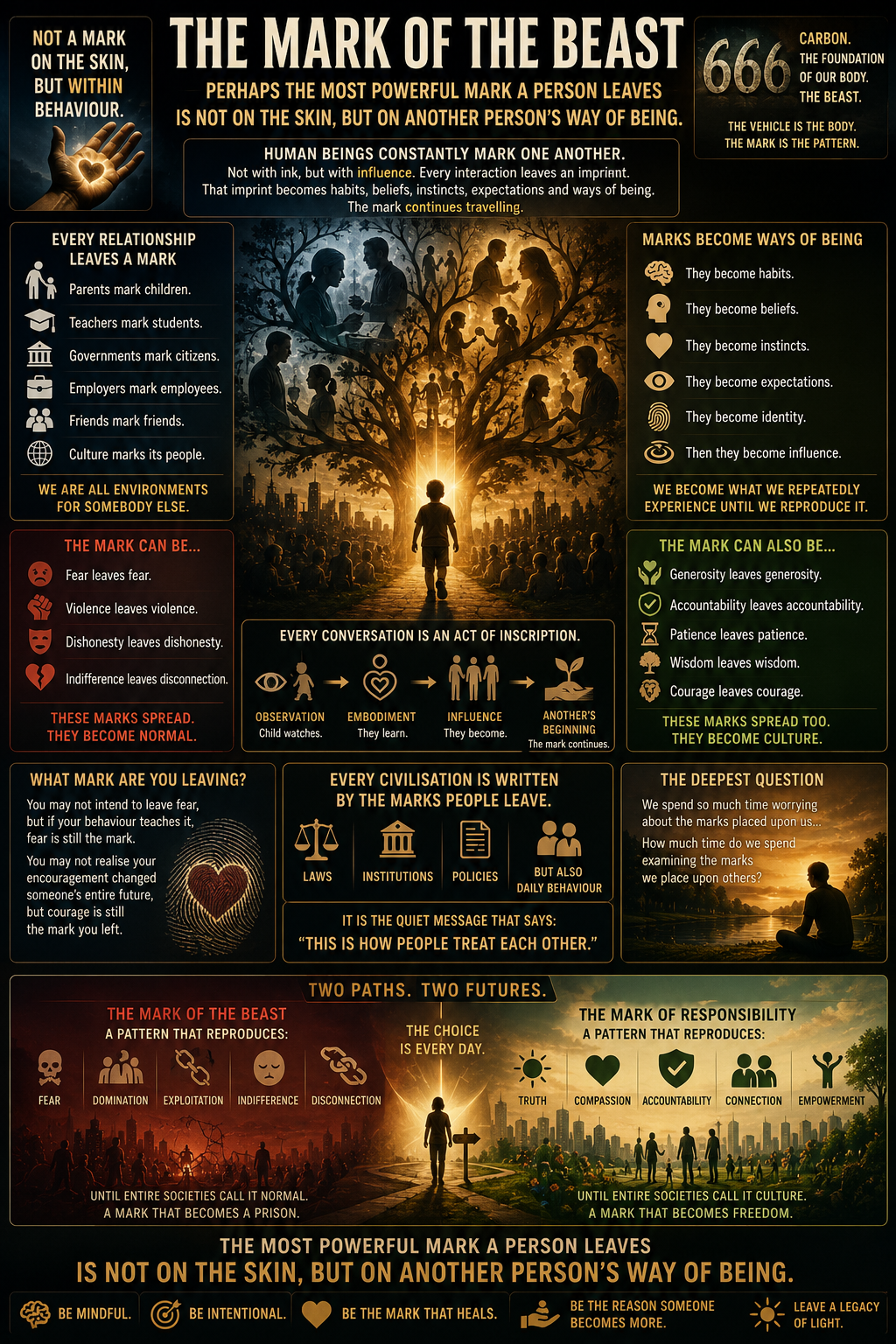
Perhaps the Most Powerful Mark a Person Leaves Is Not on the Skin, but on Another Person’s Way of Being
When people hear the phrase “the mark of the beast,” many immediately imagine a physical mark.
A chip.
A tattoo.
A barcode.
A number.
A document.
Some visible object carried by the body.
But what if the deeper question has never been about what is placed on the body?
What if it is about what is placed within it?
Not beneath the skin.
But beneath behaviour.
Because human beings are constantly marking one another.
Not with ink.
With influence.
Every conversation leaves something behind.
Every relationship changes someone.
Every parent marks a child.
Every teacher marks a student.
Every government marks its citizens.
Every company marks its employees.
Every culture marks its people.
Every friendship leaves fingerprints on personality.
Every act of kindness expands someone.
Every act of cruelty reshapes someone.
Every lie alters trust.
Every betrayal changes the way another human being learns to survive.
Perhaps the greatest marks have always been invisible.
They become habits.
Beliefs.
Instincts.
Expectations.
Ways of thinking.
Ways of speaking.
Ways of loving.
Ways of fearing.
Ways of governing.
Ways of existing.
That is why the most important question may not be:
“Do you carry the mark?”
But rather:
“What kind of mark do you leave?”
Every human being becomes an environment for somebody else.
And so, systems, organisations, services and products, social agreements, …
Children inherit far more than DNA.
They inherit emotional language.
Conflict resolution.
Self-worth.
Shame.
Confidence.
Curiosity.
Fear.
Compassion.
Violence.
Responsibility.
Many people spend adulthood trying to understand marks they never consciously chose.
Some spend decades removing them.
Others unknowingly continue passing them forward.
One person’s unresolved pain becomes another person’s childhood.
One person’s courage becomes another person’s possibility.
One person’s integrity becomes another person’s standard.
One person’s dishonesty becomes another person’s expectation of humanity.
The mark continues travelling.
Perhaps this is why behaviour spreads so easily.
Hatred teaches hatred.
Violence teaches violence.
Dishonesty teaches dishonesty.
But so does generosity.
So does accountability.
So does patience.
So does wisdom.
We become marked by what we repeatedly experience until we begin reproducing it ourselves.
That is how cultures are formed.
Not through laws alone.
Through imitation.
Human beings learn by watching long before they learn by reading.
A child watches.
An employee watches.
A citizen watches.
A partner watches.
Eventually, observation becomes embodiment.
Embodiment becomes identity.
Identity becomes influence.
Influence becomes another person’s beginning.
The mark continues.
This is why responsibility cannot stop at intention.
You may never intend to leave fear inside another person.
But if your behaviour repeatedly teaches them fear, then fear is still the mark you left behind.
Likewise, you may never realise that your encouragement changed someone’s entire future.
Yet courage becomes the mark you left.
People often ask what they will leave behind when they die.
Buildings.
Businesses.
Money.
Books.
Achievements.
But perhaps those are only secondary.
Perhaps the first inheritance is behavioural.
How many people think differently because they met you?
How many became kinder?
More honest?
More responsible?
More capable?
More hopeful?
More fearful?
More suspicious?
More closed?
Every interaction is an act of inscription.
Not upon the skin.
Upon consciousness.
Perhaps that is why the greatest transformations in history have rarely spread through force alone.
They spread because ways of being became contagious.
An idea became a movement.
A movement became a culture.
A culture became civilisation.
Or collapse.
Which raises another question.
If we spend so much time worrying about the marks placed upon us…
How much time do we spend examining the marks we place upon everyone else?
Perhaps the mark of the beast is not merely something to fear receiving.
Perhaps it is any pattern of being that continuously reproduces fear, domination, exploitation, indifference and disconnection through one person into another until entire societies begin calling those behaviours normal.
And perhaps the opposite is equally true.
A mark of responsibility.
A mark of compassion.
A mark of truth.
A mark of accountability.
A mark of courage.
A mark of discernment.
These also spread.
These also reproduce.
These also become contagious.
Every civilisation is ultimately written by the marks people leave on one another.
Not just through laws.
Not just through institutions.
But through daily behaviour.
Through the example that quietly tells another human being:
“This is how people treat each other.”
Perhaps that is the most important mark any of us will ever carry.
And perhaps the most powerful mark a person leaves is not on the skin…
…but on another person’s way of being.
3am thoughts, I guess the closest time to the unveiling
…
Lets wirte a piece on it. Well ofcourde the book of revelation isnt going to say so, the whole book is in parables not actual explained instructions. Regardless lets focus on the matter at hand. Call it mark of the beast, and focus on this and having people ppen their minds to questioning what type of mark do people leave on each other.
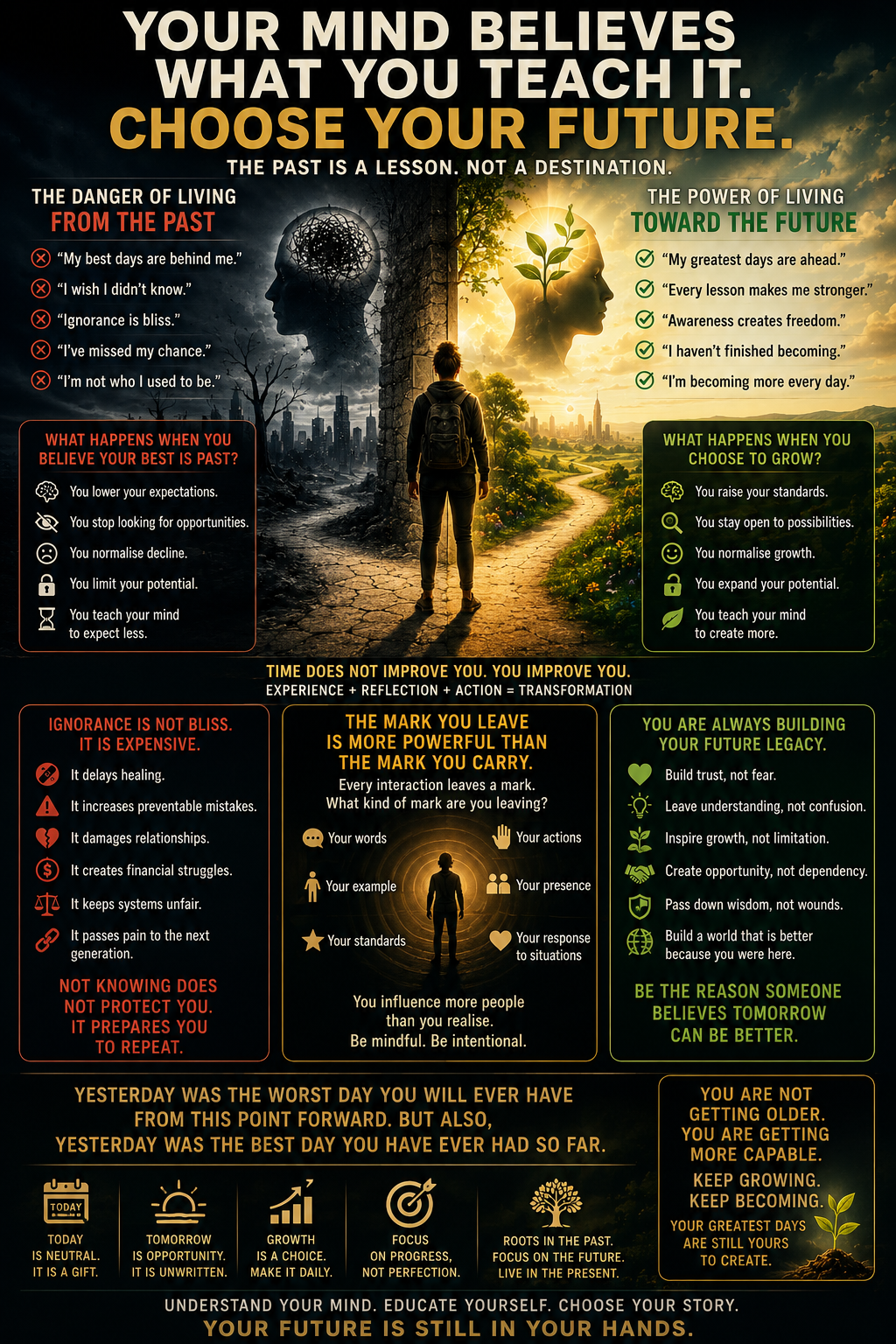
Perhaps the most powerful mark a person leaves is not on the skin, but on another person’s way of being.



Leave a Reply