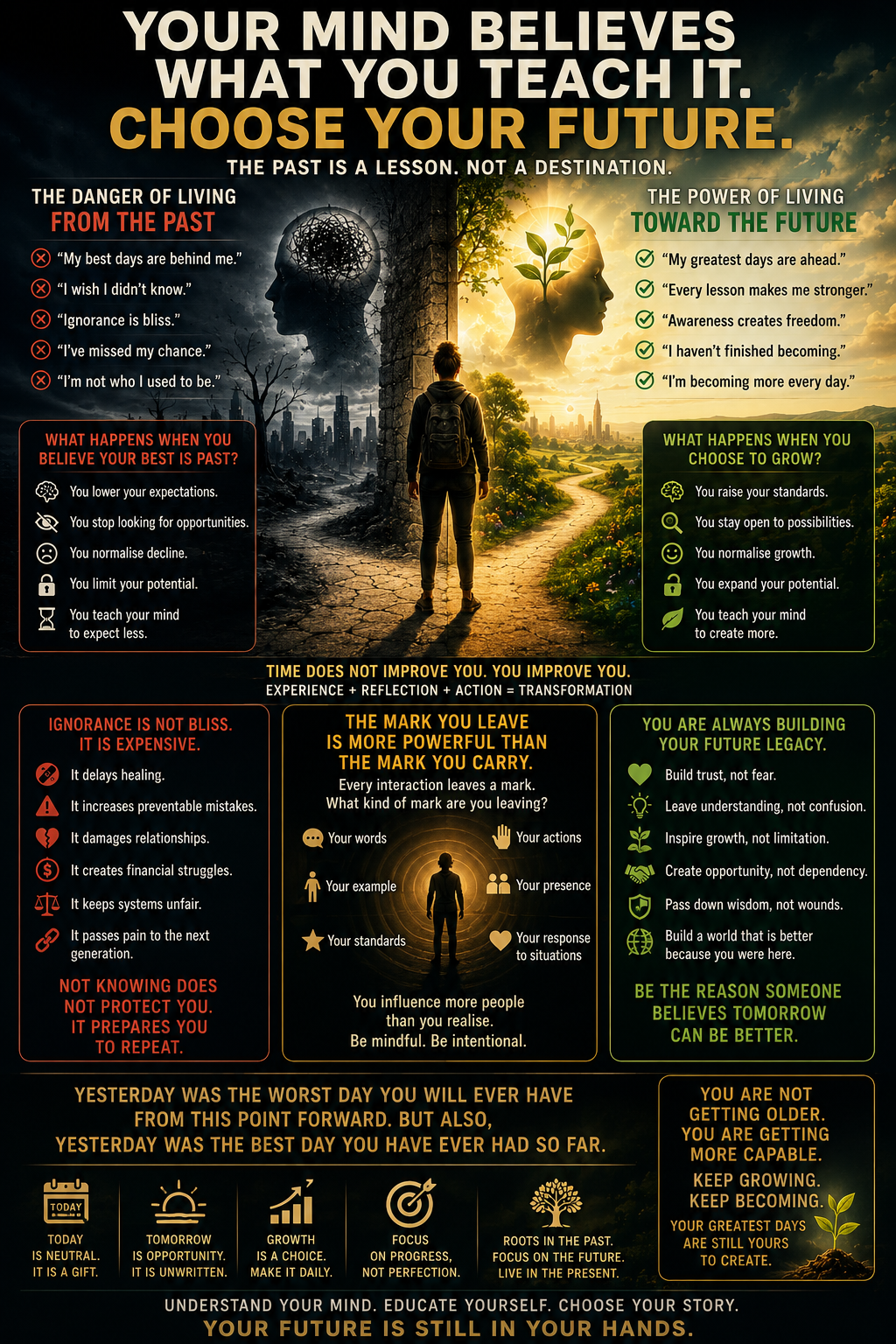
The Quiet Danger of Believing That the Past Was Better Than the Future
One of the most common things people say is:
“I wish I didn’t know.”
Or:
“Ignorance is bliss.”
The sentence sounds comforting.
But is it actually true?
Or does it simply make temporary discomfort feel more acceptable?
Because when we look carefully, ignorance rarely protects people.
More often, it delays understanding.
It delays responsibility.
It delays growth.
It delays the very lessons that eventually reduce unnecessary suffering.
The pain is not usually caused by knowing.
It is caused by adjusting to what the knowledge asks of us.
Knowledge changes us.
Growth changes us.
Awareness changes us.
And change can be uncomfortable.
But discomfort and harm are not the same thing.
A child may be more comfortable believing fire cannot burn them.
Reality does not become kinder because they remain unaware.
The same principle appears throughout life.
The person who understands money usually makes different financial decisions.
The person who understands relationships notices unhealthy patterns earlier.
The person who understands manipulation becomes harder to manipulate.
The person who understands their emotions becomes less controlled by them.
Knowledge may increase responsibility.
But responsibility often increases freedom.
Perhaps the real opposite of bliss is not knowledge.
Perhaps it is repeatedly suffering preventable consequences because we refused to learn.
The Mind Is Always Listening to the Story You Tell It
Something far more important happens when people repeatedly say:
“My best years are behind me.”
It sounds harmless.
It may even sound nostalgic.
But the mind does not only hear memories.
It also hears direction.
When you repeatedly tell yourself that your greatest experiences already happened, what instruction are you giving your future?
You are quietly teaching your mind that tomorrow has less value than yesterday.
That your greatest discoveries have already been made.
That your greatest relationships have already happened.
That your greatest opportunities have already passed.
Whether or not that is objectively true, your mind begins organising itself around that expectation.
Expectations influence attention.
Attention influences behaviour.
Behaviour influences outcome.
The story becomes a pattern.
The pattern becomes a reality.
Not because the future was incapable of becoming beautiful.
But because you gradually stopped looking for reasons that it could.
Growth Changes the Meaning of Time
Imagine two different ways of organising life.
The first says:
“My best days were behind me.”
The second says:
“My greatest understanding is still developing.”
The first treats life as decline.
The second treats life as expansion.
Neither denies difficulty.
Neither promises perfection.
But they organise the future very differently.
If every year teaches you something meaningful…
If every challenge leaves you wiser…
If every mistake improves your judgement…
If every relationship deepens your understanding…
Then why should yesterday permanently outperform tomorrow?
The future has something the past no longer possesses.
Possibility.
Yesterday can only be remembered.
Tomorrow can still be created.
Experience Should Compound
We understand compound interest in finance.
Small gains accumulate.
Why do we struggle to imagine that wisdom works the same way?
Experience compounds.
Understanding compounds.
Pattern recognition compounds.
Discernment compounds.
Emotional regulation compounds.
The longer someone genuinely keeps learning, the larger their internal library becomes.
That does not guarantee an easier life.
But it increases the tools available to navigate life.
The objective is not simply to become older.
It is to become more integrated.
More coherent.
More capable.
More peaceful.
More useful.
Age alone cannot promise that.
Growth can.
The Past Can Be Beautiful Without Becoming Your Destination
There is nothing wrong with appreciating yesterday.
Memories matter.
People matter.
Childhood matters.
Moments deserve gratitude.
The danger begins when memory becomes residence.
When nostalgia becomes identity.
When the past becomes the place where all hope lives.
The healthiest relationship with the past may be one of appreciation rather than occupation.
Carry its lessons.
Carry its love.
Carry its wisdom.
Do not ask it to become your future.
Your Brain Follows the Curriculum You Repeatedly Teach It
Every repeated sentence becomes a lesson.
“I always fail.”
“I’ve missed my chance.”
“I’m too old.”
“I’m not who I used to be.”
“My best years are over.”
Each statement quietly becomes part of the curriculum through which the mind interprets future events.
But the opposite is equally true.
“I can still grow.”
“I haven’t finished becoming.”
“My future deserves my investment.”
“There is still more to understand.”
“There is still more to create.”
These are not magical affirmations.
They are orientations.
They influence what your attention searches for.
The brain cannot easily pursue possibilities it has already been instructed to reject.
Perhaps We Should Measure Life Differently
Maybe the question is not:
“When was I happiest?”
Perhaps it is:
“Am I becoming more capable of creating meaningful days?”
Not every day will feel extraordinary.
Some days will be painful.
Some will be ordinary.
Some will be full of uncertainty.
Growth does not remove those realities.
But it changes how we meet them.
The person you become matters as much as the circumstances you experience.
A Different Perspective
What if yesterday was not your greatest day…
But simply your greatest day so far?
What if tomorrow is not automatically better…
But contains the possibility of becoming better because you are no longer the same person who lived yesterday?
That perspective does not deny hardship.
It honours development.
It allows grief without surrendering hope.
It allows mistakes without turning them into identity.
It allows ageing without assuming decline.
It allows experience to become an expanding resource instead of a countdown.
Closing
Perhaps the greatest danger is not getting older.
It is unconsciously teaching yourself that life has already reached its highest point.
Because once the mind accepts that story, it may stop building towards tomorrow with the same enthusiasm it once reserved for yesterday.
The challenge, then, is not to pretend every day will be easier.
It is to ask a different question:
Am I becoming someone who can experience life more deeply, more wisely and more fully than I could yesterday?
If the answer continues to be yes, then your greatest days are not guaranteed.
But neither have they already been spent.
They remain something you can still help create.



Leave a Reply