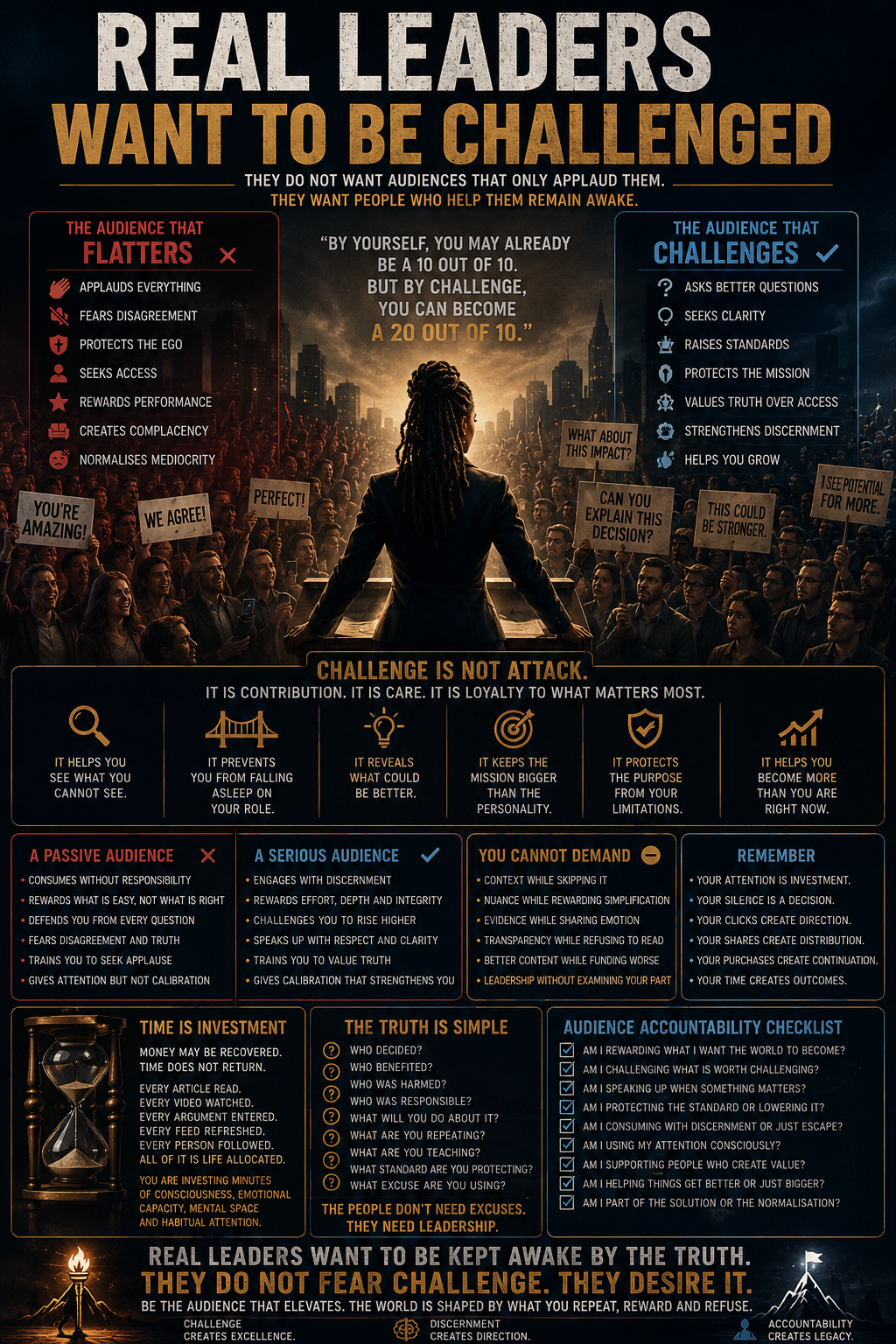
They Do Not Want Audiences That Only Applaud Them. They Want People Who Help Them Remain Awake
Real leaders want to be challenged.
Not disrespected.
Not sabotaged.
Not opposed for performance.
Not questioned by people who have no intention of understanding.
Challenged.
There is a difference.
A challenge says:
“I can see what you are building.”
“I understand what you are trying to do.”
“I am paying enough attention to notice where the standard could rise.”
“I respect the work enough not to let you become careless inside it.”
“I am willing to say what others may privately notice but publicly avoid.”
That is not hostility.
That is contribution.
A serious audience does not only receive from the person standing in front of it.
It also helps preserve the quality of what is being given.
A serious friend does not only enjoy your company.
They notice where you are becoming smaller than yourself.
A serious partner does not only validate your feelings.
They help you see where your behaviour contradicts your values.
A serious collaborator does not only agree with the vision.
They help protect the vision from the limitations of the person carrying it.
A serious community does not only celebrate its leaders.
It helps keep them awake.
Because no matter how capable someone is, no one can see themselves from every angle.
The person doing the work sees from inside the work.
The audience sees from outside it.
That distance can reveal something.
A gap.
A contradiction.
A weak point.
A missed consequence.
A standard that has quietly lowered.
A pattern that became normal because it happened gradually.
A role that became routine.
A purpose that became performance.
Real leaders understand the value of that perspective.
They do not treat every challenge as a threat to authority.
They recognise that challenge can protect authority from decay.
An Audience Is Not Only There to Receive
People with audiences often think about what they are giving.
Content.
Leadership.
Education.
Entertainment.
Insight.
Representation.
Direction.
But they should also examine what kind of audience is forming in front of them.
Does the audience possess discernment?
Does it understand responsibility?
Does it have a backbone?
Does it challenge what should be challenged?
Does it raise meaningful concerns?
Does it distinguish disagreement from betrayal?
Does it know how to offer correction without trying to seize control?
Does it ask for more truth?
More clarity?
More integrity?
More consistency?
Or does it only reward familiarity?
Charm?
Confidence?
Performance?
Aesthetic?
Entertainment?
Does the audience help the person become better?
Or does it make stagnation profitable?
This matters because audiences train the people in front of them.
Not only through praise.
Through silence.
Through attention.
Through what they tolerate.
Through what they repeatedly reward.
A leader may begin with great intention.
But if the audience never questions them, never raises the standard, never responds seriously and never demonstrates that quality matters, the role can become passive.
The person becomes accustomed to being received.
Accustomed to being trusted.
Accustomed to being praised.
Accustomed to being watched without being examined.
That is dangerous.
Not because every leader is secretly corrupt.
But because repetition can make anyone less conscious.
Routine Can Put a Role to Sleep
People often speak positively about routine.
Routine can create stability.
Discipline.
Reliability.
Efficiency.
It can reduce unnecessary decision-making.
But routine can also make a person passive inside something that was once intentional.
The action continues.
The consciousness behind it weakens.
The person still speaks.
Still teaches.
Still leads.
Still creates.
Still manages.
Still performs the role.
But they may no longer be fully awake inside it.
Second nature does not always mean mastery.
Sometimes it means the person no longer examines what they are doing.
They know the words.
They know the process.
They know how to produce the expected result.
They know what the audience will applaud.
They know what will perform.
They know what will avoid conflict.
They may continue functioning well enough that nobody sees the drift.
But a role can be performed competently while its deeper purpose is slowly being forgotten.
That is why challenge matters.
Challenge interrupts automaticity.
It asks:
“Are you still choosing this?”
“Is this still the highest expression of the work?”
“Has your method become more important than your purpose?”
“Are you acting from discernment, or from habit?”
“Are you repeating what worked before because it remains right, or because it remains easy?”
A serious challenge reactivates consciousness.
Real Leaders Do Not Want to Fall Asleep on Their Own Authority
Authority can become comfortable.
People listen.
People defer.
People assume the leader knows.
The leader becomes less accustomed to having to explain.
Less accustomed to being questioned.
Less accustomed to hearing:
“I think you missed something.”
“I do not understand why this decision was made.”
“This is not matching what you said before.”
“This may be producing a consequence you cannot see from your position.”
A weak leader experiences those statements as disrespect.
A serious leader recognises them as information.
The person speaking may be wrong.
The challenge may be incomplete.
The feedback may not account for the full context.
But the fact that someone cared enough to raise it still has value.
A leader can say:
“I appreciate that you saw this.”
“I understand why it looks that way.”
“In another circumstance, that observation might have helped me correct something.”
“In this case, however, the outcome is intentional.”
“I made this choice consciously.”
“This is why.”
That response does not require surrendering authority.
It demonstrates authority that can explain itself.
The challenge still served a purpose.
It gave the leader an opportunity to test the decision again.
To clarify the architecture.
To distinguish deliberate choice from accidental limitation.
That is healthy.
Challenge Does Not Mean the Audience Must Control the Leader
Wanting challenge does not mean following every opinion.
It does not mean allowing the audience to govern the work.
It does not mean changing direction whenever someone is uncomfortable.
It does not mean confusing public reaction with truth.
A leader must still possess discernment.
They must decide what feedback reveals something useful and what feedback merely reflects preference.
Some people challenge because they see a weakness.
Others challenge because they want the work to become more familiar to them.
Some want greater clarity.
Others want dilution.
Some want the leader to rise.
Others want the leader to become easier to consume.
The leader must distinguish between them.
But discernment is strengthened through exposure to challenge.
Not through avoidance of it.
A person who never hears opposition cannot know whether their position is resilient.
A vision protected from every question may appear strong because it has never been tested.
A leader protected from every challenge may appear exceptional because nobody is permitted to reveal where they remain underdeveloped.
Real leadership does not require immunity from pressure.
It requires the capacity to use pressure intelligently.
A Silent Audience Shows Only What the Leader Can Be Alone
Silence has limits.
A silent audience may be observing.
Learning.
Reflecting.
Processing.
Not every person must respond publicly to everything.
But chronic silence creates a ceiling.
It shows only what the leader can generate from their own awareness.
It does not add perspective.
It does not test assumptions.
It does not reveal how the work is landing.
It does not show where meaning is being lost.
It does not show which consequences have become visible to others.
It does not show what the leader cannot see because they are too close to the work.
By themselves, a capable person may already be excellent.
But challenge can reveal another level.
By yourself, you may be a ten out of ten.
Through serious challenge, you may discover what twenty out of ten requires.
Not because the challenger is greater than you.
Not because they understand the whole work.
But because they occupy an angle you cannot occupy at the same time.
They can see the side of the structure you are not facing.
A mature person wants that information.
The Audience Should Not Fear Making the Leader Greater
Some people withhold useful challenge because they do not want to contribute to another person’s growth.
They see the weakness.
They notice the opportunity.
They recognise what could be improved.
But they remain silent.
Perhaps they fear being dismissed.
Perhaps they fear conflict.
Perhaps they assume it is not their responsibility.
Perhaps they do not want the person to become even stronger.
Perhaps they prefer privately recognising the limitation because it gives them a sense of advantage.
That is not serious participation.
If you can see something that may raise the standard, and the relationship permits honest communication, why would you want the person to remain below what they could become?
Why would you choose private superiority over shared improvement?
Why would you benefit from someone’s work while withholding the insight that could strengthen it?
A serious audience does not hoard useful perception.
It contributes it.
An Audience With No Backbone Creates Fragile Leaders
A leader surrounded only by applause may become less capable of hearing truth.
Praise becomes normal.
Agreement becomes expected.
Criticism feels abnormal.
Even gentle correction begins to feel hostile because the leader has not built the muscles required to receive it.
This is how audiences can weaken the very people they admire.
They protect them from discomfort.
Defend every decision.
Attack anyone who questions them.
Interpret scrutiny as hatred.
Treat correction as disloyalty.
The leader becomes increasingly insulated.
The audience believes it is protecting the person.
But it may be protecting the person from the very pressure required to remain worthy of the role.
A serious audience should not become a wall between the leader and reality.
It should help reality reach them clearly.
Admiration Without Accountability Can Become Neglect
People often assume that accountability is the opposite of support.
It is not.
Sometimes the least supportive people are those who watch someone deteriorate and say nothing.
They see arrogance increasing.
The work becoming weaker.
The person becoming less careful.
The message becoming inconsistent.
The consequences becoming visible.
But they continue applauding because they want access.
Approval.
Proximity.
Status.
Entertainment.
They do not want to risk the relationship.
That is not loyalty.
It is neglect disguised as admiration.
A person who values you should care about what you are becoming.
Not only what they can receive from you now.
Manipulators Flatter. Leaders Hold Accountable
Manipulators understand that praise creates access.
They tell people what keeps the door open.
They agree when agreement benefits them.
They soften what should be said.
They protect the person’s ego because they want proximity to the person’s power.
They lick ass.
They mirror.
They perform loyalty.
They tell the leader that everybody else is jealous.
That criticism is hatred.
That challenge is disrespect.
That nobody understands the vision.
They make the leader more dependent upon affirmation and less capable of receiving truth.
A real leader does not build around that energy.
A real leader wants people who can say:
“This is excellent.”
And also:
“This is not your highest standard.”
“This was clear.”
And also:
“This part created confusion.”
“I respect your decision.”
And also:
“I need you to see what it produced.”
That is a stronger relationship than constant praise.
The Highest Form of Support Is Not Permanent Agreement
Permanent agreement is not proof of alignment.
It may be proof of fear.
Dependency.
Indifference.
Lack of attention.
A desire to preserve access.
Someone can disagree with you and still support your deeper purpose.
They may challenge the method because they care about the outcome.
They may question the decision because they understand the mission.
They may resist the immediate expression because they are protecting the continuity of what you said you wanted to build.
A mature leader knows how to recognise that.
They do not ask:
“Did this person agree with me?”
They ask:
“What are they trying to protect?”
“What did they see?”
“Is there information here?”
“Does this reveal a weakness?”
“Does it expose an unintended consequence?”
“Is this challenge aligned with the highest purpose of the work?”
That is discernment.
A Challenge Can Still Be Valuable When the Leader Does Not Change Course
Feedback does not only have value when it changes the decision.
Sometimes it confirms the decision.
The leader hears the concern.
Re-examines the choice.
Tests the reasoning.
Considers the alternative.
Then decides:
“No. This remains the correct direction.”
That process still matters.
The challenge ensured the decision was active.
Not automatic.
It required the leader to choose again with greater clarity.
This is why people should not think their feedback was wasted simply because the person did not follow it.
The purpose of challenge is not always obedience.
It is activation.
It can make the leader more conscious of why they are doing what they are doing.
That alone strengthens the work.
The Leader Must Create Conditions Where Challenge Is Safe
Leaders cannot say they want honesty while punishing everyone who provides it.
They cannot ask for feedback and then become cold.
Defensive.
Mocking.
Retaliatory.
Dismissive.
They cannot require perfect wording before receiving useful truth.
They cannot demand that the challenger regulate the entire emotional environment while they refuse to regulate themselves.
People learn quickly whether honesty is safe.
If every challenge threatens access, belonging, opportunity or relationship, people will become quiet.
The leader may then complain that nobody tells them the truth.
But silence may be a culture the leader produced.
A real leader must show that challenge can enter without the challenger being destroyed for bringing it.
That does not mean accepting abuse.
It means being able to separate poor delivery from useful content.
The person may communicate imperfectly and still see something important.
Leaders Must Distinguish Challenge From Projection
Not every criticism is wisdom.
Some people project insecurity.
Resentment.
Competition.
Personal preference.
Ideological rigidity.
Some challenges are attempts to control.
Some are efforts to make the leader smaller.
Some are punishment for not being familiar enough.
A serious leader must recognise this too.
They should not become so eager to prove openness that they surrender their architecture to every voice.
Challenge should be examined.
Not worshipped.
The leader must ask:
Does this person understand the purpose?
Are they responding to the actual work or to an imagined version of it?
Are they identifying consequence or expressing discomfort?
Are they pointing towards a higher standard or merely towards their own preference?
Can the concern be verified?
Is there a repeated pattern?
What becomes clearer when emotion is removed?
Discernment remains necessary on both sides.
The Audience Must Learn How to Challenge Well
A strong audience does not merely criticise.
It contributes.
It identifies what it sees.
Explains why it matters.
Distinguishes fact from interpretation.
Considers context.
Asks questions before declaring certainty.
Offers correction in proportion to its understanding.
A responsible challenge may sound like:
“This is what I observed.”
“This is how it appeared from my position.”
“This may be creating a consequence you did not intend.”
“Can you explain the choice?”
“Does this still align with the standard you established?”
“I may not have the full context, but I thought it was important to raise.”
That is different from:
“You are wrong.”
“You have changed.”
“You do not care.”
“You are a fraud.”
A challenge should increase clarity.
Not merely release emotion.
Do Not Only Show Interest. Show Responsibility
Many audiences show interest.
They watch.
Read.
Listen.
Follow.
Return.
But interest is a low standard.
Interest does not prove care.
It does not prove understanding.
It does not prove that the audience is helping the person or the work improve.
A serious audience demonstrates responsibility.
It asks what its attention is supporting.
What its silence is allowing.
What its feedback could strengthen.
What contradiction it has noticed.
What clarification is needed.
The question is not only:
“Did you enjoy it?”
It is:
“Did you engage enough to help protect the standard?”
Leaders Should Examine the Audience They Have Trained
Every audience develops a culture.
What does the audience reward?
How does it respond to correction?
Does it attack anyone who questions the leader?
Does it value nuance?
Does it repeat claims without understanding them?
Does it hold the leader to the principles the leader teaches?
Does it want depth or only stimulation?
Does it ask meaningful questions?
Does it expect greater embodiment over time?
The audience is partly shaped by what the person in front of it encourages.
A leader who rewards flattery will receive more flattery.
A creator who responds only to praise will train people not to challenge.
A public figure who weaponises followers against criticism will create an audience that protects ego over truth.
A teacher who welcomes serious questions will produce more serious students.
The audience is not separate from the leadership.
It is one of the leadership’s outcomes.
Your Audience May Reveal the Level at Which You Are Willing to Be Met
A person with a passive audience should ask why passivity feels comfortable around them.
Do they make challenge difficult?
Do they over-explain themselves until nobody feels needed?
Do they dominate the conversation?
Do they only acknowledge praise?
Do they signal that disagreement will be punished?
Do they present certainty so completely that people assume there is no space to contribute?
Or has the audience itself become accustomed to consumption without responsibility?
Both possibilities should be examined.
A strong leader should not only ask:
“How many people are watching?”
They should ask:
“What kind of watchers are they becoming?”
One Serious Person Can Be a Real Audience
Audience size is irrelevant to the principle.
One person can function as a serious audience.
A partner.
A friend.
A colleague.
A sibling.
A collaborator.
A reader.
A member of staff.
A child.
One person can see the thing nobody else says.
One person can notice the drift.
One person can ask the question that reactivates the whole role.
An audience of millions can be passive.
An audience of one can be transformative.
The value lies not only in quantity.
It lies in the quality of attention.
Real Leaders Want People Who Can See Beyond the Role
The role can become a costume.
Founder.
Parent.
Teacher.
Manager.
Artist.
Politician.
Spiritual leader.
Expert.
Public figure.
The person receives recognition through the title.
But people close to them may see what the audience does not.
Fatigue.
Ego.
Avoidance.
Fear.
Inconsistency.
An unexamined pattern.
A person who is respected only through the role can become trapped inside it.
They need people who can address the human beneath the title.
People who are not intimidated by the image.
People who can say:
“You are capable of better.”
“You are losing yourself here.”
“This is becoming performance.”
“You are protecting the position instead of the purpose.”
That kind of challenge may preserve the leader’s humanity.
Silence Can Become Participation in Decline
If you see someone you value becoming less responsible and say nothing, your silence has consequence.
It may allow the pattern to continue.
It may signal that nothing is wrong.
It may teach the person that the standard remains acceptable.
Of course, not every person has access.
Not every environment is safe.
Not every challenge will be heard.
Responsibility must remain proportionate.
But where a relationship exists and truth can reasonably be offered, silence should be examined.
What were you protecting?
The person?
Or your access to them?
The relationship?
Or your comfort inside it?
Sometimes people call silence respect when it is actually fear.
The Leader Should Want an Audience That Can Outgrow Them
A weak leader wants dependence.
A serious leader wants development.
They want the audience to become more discerning.
More capable.
More responsible.
More able to identify weakness.
More able to challenge.
More able to continue the work independently.
This may make the leader less central.
That is not failure.
It is evidence that the leadership worked.
If the audience remains permanently dependent upon the leader’s interpretation, the person may have produced followers rather than thinkers.
A real leader should be able to create people capable of questioning them.
Challenge Protects the Mission From the Personality
Every leader has limitations.
Biases.
Blind spots.
Preferences.
Emotional patterns.
The mission should not become trapped inside them.
Challenge creates a distinction between the person and the purpose.
It asks whether the person is still serving the work.
Or whether the work has become arranged around protecting the person.
This is crucial.
The mission must be able to survive the leader’s correction.
The organisation must be able to improve beyond the founder’s initial understanding.
The relationship must be able to tell the truth beyond one person’s comfort.
The work should not become smaller because the leader’s ego cannot tolerate expansion.
Real Leadership Requires Enough Inner Stability to Be Corrected
A person who experiences every challenge as annihilation cannot lead safely.
They will protect themselves instead of the work.
They will silence information.
Punish honesty.
Surround themselves with agreement.
Interpret loyalty through obedience.
Leadership requires enough internal stability to say:
“I may be wrong here.”
“I may have missed something.”
“This person can challenge my decision without erasing my worth.”
“My role can be examined.”
“My authority does not depend upon infallibility.”
“The truth matters more than my appearance of certainty.”
That is strength.
Challenge Is a Form of Aftercare
Aftercare is not only what happens after obvious harm.
It is also what prevents good work from deteriorating.
A person creates.
Leads.
Builds.
Teaches.
The audience responds.
That response can become aftercare for the work.
It can show where the message landed.
Where confusion remains.
Where consequence emerged.
Where the person needs to return.
Where the next level exists.
Without response, the work may be released into silence.
The creator receives no meaningful mirror.
No calibration.
No indication of whether the architecture remained intact when it reached others.
Challenge helps carry the work after release.
We Cannot Build a Conscious Society Through Passive Relationship
Passivity weakens every layer.
Passive audiences.
Passive leadership.
Passive friendship.
Passive partnership.
Passive citizenship.
Passive collaboration.
People observe.
Consume.
Receive.
But do not intervene.
Do not question.
Do not correct.
Do not contribute.
Then they are surprised when standards fall.
A conscious society requires activation.
Discernment activated.
Accountability activated.
Responsibility activated.
Care activated.
People must remain awake inside their roles.
The audience is not exempt.
The leader is not exempt.
The friend is not exempt.
The partner is not exempt.
The collaborator is not exempt.
Everybody must help preserve the quality of the field they participate in.
The Real Leader Challenge Test
Whenever someone presents themselves as a leader, creator, teacher, professional, partner or public figure, ask:
What kind of challenge can they receive?
Can they hear disagreement?
Can they explain a deliberate choice?
Can they distinguish feedback from control?
Can they identify useful information inside imperfect delivery?
Can they change without experiencing correction as humiliation?
Can they remain present when consequence appears?
Then ask:
What kind of audience have they created?
Does the audience think?
Question?
Verify?
Challenge?
Raise standards?
Protect purpose?
Or does it flatter, defend and consume?
Then ask:
Does the relationship make both sides more capable?
Does challenge improve the leader?
Does explanation educate the audience?
Does the interaction increase discernment?
Does it create clearer decisions?
Does it strengthen the work?
Or does the leader perform and the audience passively receives?
That is the test.
The Leadership and Audience Accountability Matrix
A serious evaluation should ask:
- Does the leader genuinely invite challenge?
- Is challenge safe?
- What happens when someone disagrees?
- Is useful feedback acknowledged?
- Does the leader explain intentional choices?
- Can they separate criticism of conduct from rejection of self?
- Does the audience question contradictions?
- Does it value truth above access?
- Does it challenge respectfully and clearly?
- Does it distinguish preference from consequence?
- Does it reward improvement?
- Does it defend the leader from every examination?
- Does the leader use the audience to silence critics?
- Has the role become routine?
- Is the person still active inside the purpose?
- What blind spots can the audience see?
- What insight has been withheld?
- Has praise become more common than truth?
- Does the audience raise the bar or merely increase the numbers?
- Is the leader becoming greater through being seen?
- Or merely more comfortable through being watched?
These questions do not begin with opposition.
They begin with development.
Purpose.
Consciousness.
Continuity.
Criticising a Leader Is Not Automatically Rejecting Their Leadership
To challenge a decision is not to deny the person’s value.
To identify a limitation is not to erase their achievement.
To ask for clarity is not to seize control.
To expect improvement is not to demand perfection.
The leader may remain excellent.
The work may remain valuable.
The choice may remain correct.
Challenge simply ensures that excellence does not become protected from examination.
A leader should not need to be diminished in order to be corrected.
And a challenger should not need to be silent in order to be loyal.
The Highest Form of Leadership Accountability
The highest form of accountability does not ask only:
“Did people follow?”
It asks:
Given the number, intelligence, perspective and observational power of the people in front of this leader, how much greater should the leader and the work reasonably have become by now?
Did the audience improve the person?
Did it identify blind spots?
Did it protect the mission?
Did it raise standards?
Did it demand clarity?
Did it prevent the role from becoming passive?
Did it help the leader remain awake?
Did the leader become more discerning because people spoke?
Did the audience become more capable because the leader listened and explained?
Or did the leader receive attention while the audience surrendered responsibility?
Did both sides grow?
Or did one perform while the other consumed?
That question reveals the distance between visibility and development.
And that distance is where responsibility lives.
Closing: Real Leaders Desire Challenge
Real leaders do not only want to be seen.
They want to be sharpened.
They do not only want applause.
They want information.
They do not only want loyalty.
They want truth strong enough to protect the purpose from their own limitations.
They want people who can recognise excellence and still ask whether more is possible.
People who can respect the decision and still raise the consequence.
People who can say:
“I see you.”
“I value what you are doing.”
“And I believe the standard can rise here.”
That is not disrespect.
That is relationship.
That is contribution.
That is care with a backbone.
By yourself, you may already be great.
But greatness that cannot receive challenge eventually becomes repetition.
Repetition becomes routine.
Routine becomes passivity.
And passivity puts even the strongest role to sleep.
Real leaders want to remain awake.
They want audiences that remain awake.
Friends who remain awake.
Partners who remain awake.
Collaborators who remain awake.
People who do not merely stand nearby while the standard lowers.
People who say something.
People who contribute what they see.
People who are not threatened by another person becoming greater.
Because a real leader does not fear being challenged into a higher version of themselves.
They desire it.
They recognise it as one of the greatest privileges of being surrounded by conscious people.
A passive audience gives attention.
A serious audience gives calibration.
A flattering audience protects the personality.
A responsible audience protects the purpose.
Real leaders do not ask to be protected from truth.
They ask to be kept awake by it.
…
Okay, so good job on the picture. And I was reading it, it just came to me that in doing so, in writing about audiences and readers, watchers, and customers, I also trained and shared a level of education to those in front of their audiences. Because they have to then look at their audiences and look, what type of audience is in front of you? Does your audience have any sense of responsibility? Does your audience have any backbone in the sense, do they challenge you to become a better version of you? Do they hold you accountable to the things that you might not see, but they see because obviously they’re observing you, and there’s hundreds, thousands, God knows how many, that are looking at you? Do they raise your standards? And not in the sense of where they show interest in. No, no, no. Do they voice the things that you could do better so that you can then use your own discernment to either be clearer about your choice in what you’re doing and why you’re doing it? Because if someone gives you feedback on something that you already made the choice on and you’re actively doing, then you can just be like, I appreciate you and I see you, because if in a different scenario, you would have helped me raise my standards. Amazing. Thank you for that. For this one specifically though, it’s a choice. I’m choosing to go about this this way, you know? But do those interactions even happen? Do people understand? Like, I don’t think that they don’t understand. The reason why throughout my whole blog, there’s so many specific blogs where I ask people to challenge me, raise my standards, push me, like all of those things. Because silence only shows what I can be for myself. Their challenge raises my bar, where they might see something that I might not see that I could possibly increase, do better, whatever the case might be, you know? Because we all want an audience that can challenge you. We all want people that can challenge you. We all want partners that can challenge you. We all want… well, I say we, but let me speak for myself because I don’t know how people think. All of that has… everything that I’ve always observed is that I do not… like, I can see the energy moving, but I don’t understand the actual mental chatter that creates it. Like, because I speak so positively with myself, but I’m also, like, embodying what I speak to myself. I really don’t understand what people tell themselves in their minds about things. Like, how do they live? How do they be? Like, I don’t know. Because how can someone be so hypocritical about life? Like, what is the conversation here? Like, what are they telling themselves? I don’t understand. It’s so funny. I really don’t understand it. But still, I want friends that challenge me. I want audiences that challenge me. I want partners that challenge me. I want collaborators that challenge me. I want people that challenge me because by myself, I’m great. I can already do greatness. But if I can be greater, even better. And maybe that’s why people don’t challenge me, because they don’t want me to be greater than what I already am. But and that’s fine, that’s fine. To each their own, you know? I’m still going to be great either way. Like, by myself, I’m a 10 out of 10. But by challenge, I’m a 20 out of 10. So I can see why some people might not want to challenge me too much, you know? But apart from me, this post, we want to write it for all those that have audiences in front of them, whether it’s one person or thousands or millions, it doesn’t really matter. You want people that challenge you because if not, you’re going to fall asleep on your role. You’re going to forget what you were there for. You’re going to forget what you were put in place to do. You’re going to forget because you’re just going to get used to the routine, and it becomes a routine. And routines, it becomes second nature. But second nature doesn’t mean that you’re actively doing it. It doesn’t mean that you’re actively doing at the highest level of standards, you know? It doesn’t mean that you’re active about things. It means that you’re passive in the second nature. And passivity, we cannot have passivity. As a society, we cannot. We genuinely cannot. We cannot sleep on ourselves. We cannot sleep on each other. We cannot sleep on our roles. We cannot sleep on nothing because the moment we start sleeping, everything just moves sideways. It just goes wrong. Because if we fall asleep, then discernment is not activated. The accountability is not activated. Sense of responsibility is not activated. We’re just consuming and consuming and consuming on every part, everywhere. Just consuming, that’s it. Which lowers the level and the quality of the creations itself. Like, we should want people that actually… Let’s write this post. The title is, Real Leaders Want to Be Challenged, Desire to Be Challenged.



Leave a Reply