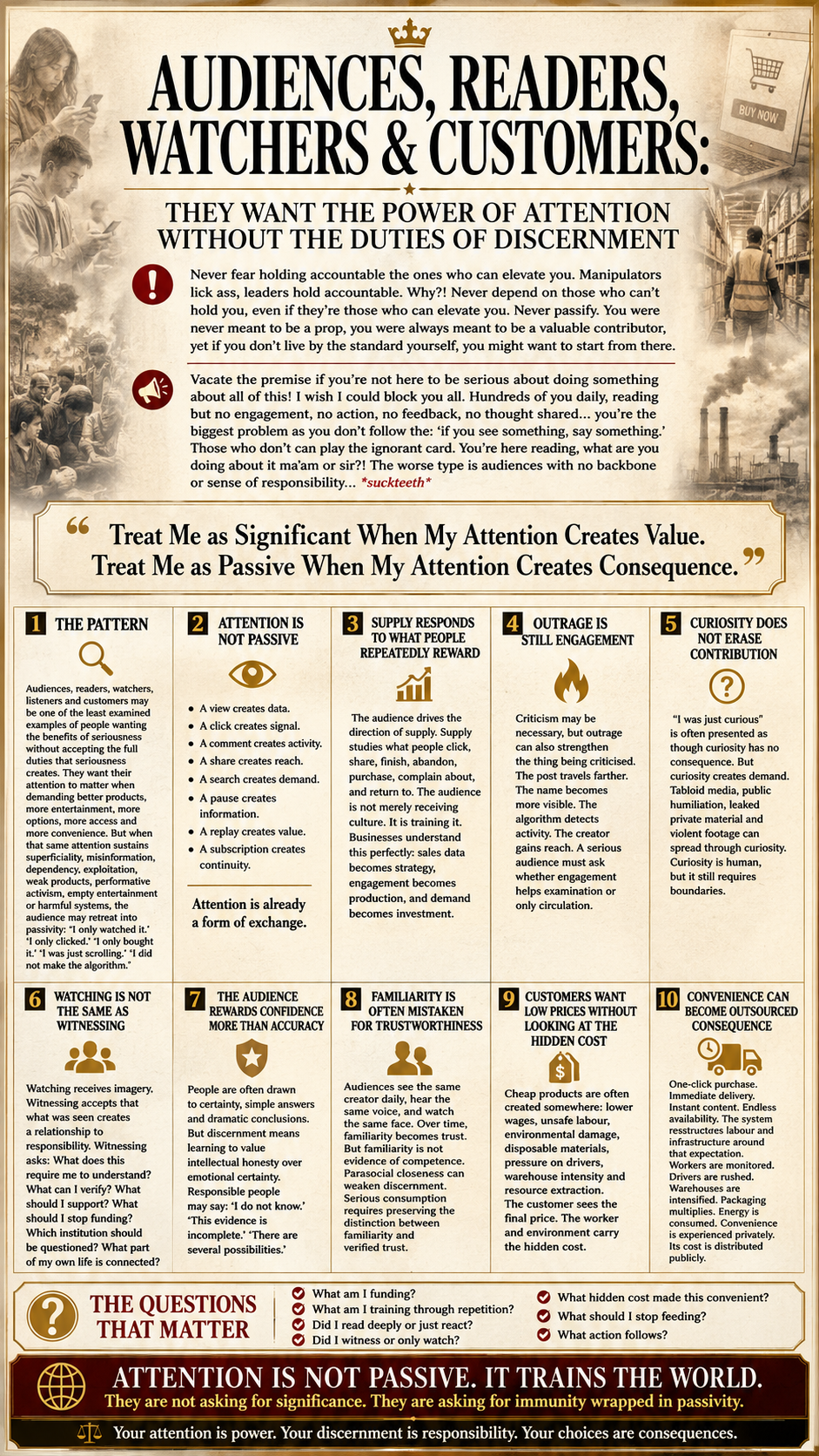
Never fear holding accountable the ones who can elevate you. Manipulators lick ass, leaders hold accountable. Why?! Never depend on those who can’t hold you, even if they’re those who can elevate you. Never passify. You were never meant to be a prop, you were always meant to be a valuable contributor, yet if you don’t live by the standard yourself, you might want to start from there.
Vacate the premise if yiu’re not here to be serious about doing something about all of this! I wish I could block you all. Hundreds of you daily, reading but no engagement, no action, no feedback, no thought shared… you’re the biggest problem as you don’t follow the : ” if you see something, say something.” Those who don’t, can play the ignorant card. You’re here reading, what are you doing about it ma’am or sir?! The worse type is audiances with no backbone or sense of responsibility… *suckteeth*
“Treat Me as Significant When My Attention Creates Value. Treat Me as Passive When My Attention Creates Consequence.”
Audiences, readers, watchers, listeners and customers may be one of the least examined examples of people wanting the benefits of seriousness without accepting the full duties that seriousness creates.
They want their attention to matter when demanding entertainment.
Better products.
More representation.
Faster service.
More content.
More options.
More access.
More convenience.
They want companies, creators, media organisations, politicians, artists, institutions and public figures to care about what they think.
They want to be counted.
Surveyed.
Targeted.
Consulted.
Appealed to.
Persuaded.
Protected.
Respected.
They understand that their attention has value when a creator needs views.
When a company needs purchases.
When a politician needs votes.
When a campaign needs signatures.
When a publication needs subscriptions.
When a platform needs engagement.
When an artist needs listeners.
When a business needs customers.
They know the audience matters when they want something improved.
But when the same attention sustains superficiality, misinformation, dependency, outrage, exploitation, weak products, performative activism, empty entertainment or harmful systems, the audience may retreat into passivity.
“I only watched it.”
“I only clicked.”
“I only bought it.”
“I was just scrolling.”
“I am not responsible for what they create.”
“I did not make the algorithm.”
“I am only one person.”
“I was just curious.”
“I did not know sharing it would matter.”
The audience wants to be treated as significant when significance gives it influence over supply.
Then it wants to be treated as informal when that influence creates responsibility for what supply becomes.
That is the contradiction.
The audience drives the direction of supply.
Not the other way around.
Supply responds to what people repeatedly reward.
It studies what people click.
What they share.
What they finish.
What they abandon.
What they purchase.
What they complain about.
What they return to.
What keeps them emotionally activated.
What they pretend not to like but continue consuming.
The audience is not merely receiving culture.
It is training it.
Attention Is Not Passive
Attention is often treated as though nothing has happened until money changes hands.
But attention is already a form of exchange.
A view creates data.
A click creates signal.
A comment creates activity.
A share creates reach.
A search creates demand.
A pause creates information.
A replay creates value.
A subscription creates continuity.
Even outrage can create profit.
The system does not need you to approve of the content.
It may only need you to remain.
To watch.
React.
Argue.
Return.
The audience may believe it is observing.
The platform records participation.
That distinction matters.
If millions of people repeatedly watch a type of content, the system learns to produce more of it.
If audiences reward emotional simplification, creators learn that complexity is commercially expensive.
If people share shallow content quickly and avoid deeper work requiring thought, the market learns that superficiality travels farther.
If audiences give hours to people who offer little value, those people gain more visibility, money and authority.
The audience may later complain that the culture has become empty.
But emptiness was repeatedly funded with attention.
Time Is Investment
People speak about wasting money more seriously than wasting time.
But money may be recovered.
Time does not return.
Every article read.
Every video watched.
Every argument entered.
Every feed refreshed.
Every personality followed.
Every outrage cycle repeated.
All of it is life allocated.
The audience is not only consuming content.
It is investing minutes of consciousness.
Hours of emotional capacity.
Days of mental space.
Years of habitual attention.
A person may say:
“It was only ten minutes.”
But ten minutes repeated daily becomes more than sixty hours a year.
Ten minutes from one million people becomes ten million minutes of collective life.
The platform understands this value.
That is why it measures watch time.
Retention.
Session duration.
Return frequency.
The audience often does not.
It behaves as though time is free because no invoice arrived.
But attention is paid in life.
The Audience Wants Better Supply While Rewarding Worse Supply
People often complain that content has become less intelligent.
Music more repetitive.
News more sensational.
Products cheaper.
Politics more performative.
Creators more artificial.
Cinema more formulaic.
Platforms more addictive.
Advertising more invasive.
But supply responds to behaviour.
Not only stated preference.
People may say they want depth.
Then abandon the article after two paragraphs.
Say they want truth.
Then share the most emotionally satisfying claim before checking it.
Say they want originality.
Then reward whatever resembles what they already know.
Say they want ethical businesses.
Then choose the cheapest product regardless of how it was made.
Say they want responsible creators.
Then give the most attention to conflict, scandal and excess.
Say they want healthier platforms.
Then punish every piece of content that requires patience.
The market observes what people actually do.
Not only what they claim to value.
That is why audience responsibility must be judged through repeated behaviour.
Superficiality Spreads Because It Demands Little
When something is light, quick, emotionally obvious or socially safe, people share it easily.
A joke.
A slogan.
A clip.
A short opinion.
A dramatic accusation.
A motivational sentence.
A simplified explanation.
But when content requires reflection, self-examination, accountability or responsibility, engagement slows.
People watch silently.
Read privately.
Avoid responding.
Move away.
The deeper the content asks them to think, the less publicly present they become.
Because deep engagement may require change.
It may expose contradiction.
Ask them to reconsider behaviour.
Challenge identity.
Demand responsibility.
Remove the comfort of spectatorship.
Superficial content allows the audience to remain intact.
Deep content may require the audience to become different.
That is why people often share what confirms them and avoid what confronts them.
They want stimulation without transformation.
Insight without obligation.
Truth without consequence.
The Cloak of Audience
The category of “audience” can become a hiding place.
The person says:
“I am only watching.”
“I am not part of this.”
But watching is part of the architecture.
The audience gives the speaker relevance.
The publication circulation.
The brand demand.
The politician attention.
The influencer power.
The scandal endurance.
The falsehood repetition.
The harmful trend social proof.
Without an audience, many systems lose force.
The audience often behaves as though being on the receiving side removes responsibility.
But receiving can still sustain.
Silence can still normalise.
Repetition can still legitimise.
Purchasing can still fund.
Sharing can still distribute.
The cloak of audience allows people to witness consequence while presenting themselves as external to it.
They are close enough to consume.
Too distant to be accountable.
Demand Shapes Supply
People often imagine that corporations, platforms and creators decide what the public wants.
They do influence desire.
They advertise.
Manipulate.
Recommend.
Repeat.
Normalise.
But they also study response.
Supply follows reward.
A company continues producing what sells.
A creator repeats what performs.
A platform amplifies what retains users.
A publication emphasises what generates traffic.
A politician repeats what mobilises voters.
A streaming service commissions what keeps subscribers.
The audience may not control every decision.
But collectively, it determines which decisions become commercially sustainable.
That is power.
The audience is not powerless because it acts through millions of small choices.
Distributed power is still power.
The fact that no one individual controls the whole does not mean no individual participates in the direction.
Consumption Is a Vote
Every purchase is not morally identical.
People have different incomes.
Access.
Needs.
Options.
Sometimes the harmful or lower-quality choice is the only affordable or available one.
That context matters.
But where meaningful choice exists, consumption carries direction.
Buying is a vote for continuation.
Streaming is a vote.
Following is a vote.
Subscribing is a vote.
Returning is a vote.
The audience may reject the language because it creates responsibility.
But businesses understand it perfectly.
Sales data becomes strategy.
Engagement becomes production.
Demand becomes investment.
What people repeatedly reward, systems learn to reproduce.
Outrage Is Still Engagement
The audience may believe it is resisting harmful content by attacking it publicly.
Sometimes criticism is necessary.
But outrage can also strengthen the thing being criticised.
The post travels farther.
The name becomes more visible.
The algorithm detects activity.
The creator gains reach.
The audience becomes part of the distribution network.
People say:
“Look how terrible this is.”
Then thousands more watch it.
The audience may oppose the message while expanding its market.
A serious audience must ask whether engagement helps examination or only circulation.
Not every harmful thing needs to be repeated in full.
Not every absurdity deserves collective attention.
Sometimes discernment means refusing to feed what survives through reaction.
Curiosity Does Not Erase Contribution
“I was just curious” is often presented as though curiosity has no consequence.
But curiosity creates demand.
Tabloid media survives through curiosity.
Public humiliation survives through curiosity.
Leaked private material spreads through curiosity.
Violent footage circulates through curiosity.
The audience may condemn exploitation while consuming the product of exploitation.
Curiosity is human.
But it still requires boundaries.
The question is not whether people should never look.
It is whether they have examined what their looking sustains.
The Audience Cannot Demand Transparency While Refusing to Read It
Companies may publish terms.
Reports.
Corrections.
Disclosures.
Creators may explain context.
Institutions may provide longer evidence.
The audience often ignores it.
Reads only the headline.
Watches the clip.
Skips the full statement.
Then acts upon an incomplete impression.
This does not excuse institutions that bury truth in inaccessible language.
Transparency must be clear and properly aimed.
But the audience also carries a duty to engage deeply enough to understand what it judges.
You cannot demand context while refusing to read beyond the first sentence.
You cannot demand nuance while rewarding simplification.
You cannot demand evidence while sharing what merely feels true.
The Reader Must Distinguish Recognition From Understanding
A person may recognise words without understanding the architecture.
They may recognise the topic.
The language.
The political side.
The emotional tone.
Then believe they understand the argument.
But recognition is not comprehension.
Reading requires more than moving the eyes across a page.
Understanding requires following distinctions.
Testing assumptions.
Holding context.
Considering what the argument implies.
Asking whether one’s own behaviour is included.
A reader who extracts one sentence from a long argument may not have engaged with the work.
They may only have searched the work for something usable.
Agreement.
Disagreement.
A quote.
A reason to dismiss.
Deep reading requires allowing the work to remain whole long enough to be understood.
Watching Is Not the Same as Witnessing
A person can watch suffering repeatedly without witnessing it.
Watching receives imagery.
Witnessing accepts that what was seen creates a relationship to responsibility.
The watcher sees poverty.
War.
Abuse.
Pollution.
Displacement.
Institutional failure.
Then moves to the next piece of content.
The image becomes part of the feed.
Witnessing asks:
What does this require me to understand?
What can I verify?
What should I support?
What should I stop funding?
Which institution should be questioned?
What part of my own life is connected?
Without this movement, suffering can become entertainment disguised as awareness.
The audience feels informed while remaining unchanged.
Information Without Integration Becomes Mental Clutter
People consume enormous quantities of information.
Articles.
Podcasts.
Videos.
Threads.
News alerts.
Documentaries.
Interviews.
They may know fragments about hundreds of subjects.
But knowledge that is not integrated can become accumulation without development.
The person knows more facts.
Their judgement remains weak.
They can repeat many perspectives.
They have not formed one.
They consume analysis without applying discernment.
They collect language without changing behaviour.
Information becomes another form of stimulation.
A serious audience should ask:
What did this teach me?
How does it connect?
What changed in my understanding?
What action follows?
What should I now stop believing?
What responsibility did this reveal?
Without integration, consumption can create the illusion of growth.
The Audience Rewards Confidence More Than Accuracy
People are often drawn to certainty.
The confident speaker.
The absolute claim.
The simple answer.
The dramatic conclusion.
Uncertainty feels less satisfying.
But reality is often complex.
Responsible people may say:
“I do not know.”
“This evidence is incomplete.”
“There are several possibilities.”
The audience may punish that honesty by giving more attention to someone who speaks with greater confidence and less evidence.
Then later blame the creator for misleading them.
The speaker remains responsible for the claim.
But the audience must examine why confidence was rewarded as though it were proof.
Discernment means learning to value intellectual honesty over emotional certainty.
Familiarity Is Often Mistaken for Trustworthiness
Audiences see the same creator daily.
Hear the same voice.
Watch the same face.
Over time, familiarity becomes trust.
But familiarity is not evidence of competence.
A person may feel known because they are frequently seen.
The audience may accept advice from someone whose qualifications, incentives and limitations it never examined.
Parasocial closeness can weaken discernment.
The audience may defend the figure as though defending a friend.
Buy because the recommendation feels personal.
Dismiss criticism because it threatens emotional comfort.
Serious consumption requires preserving the distinction between familiarity and verified trust.
Customers Want Low Prices Without Looking at the Hidden Cost
A customer may demand cheap products.
Fast delivery.
Free returns.
Constant availability.
But low prices are often created somewhere.
Lower wages.
Unsafe labour.
Environmental damage.
Disposable materials.
Pressure on drivers.
Warehouse intensity.
Resource extraction.
The customer sees the final price.
The worker and environment may carry the rest.
Not every customer can afford the ethical option.
But where people possess choice, the demand for impossible cheapness can become participation in hidden harm.
The audience wants companies to behave responsibly while punishing the cost of responsibility.
That contradiction must be examined honestly.
Convenience Can Become Outsourced Consequence
The customer wants one-click purchase.
Immediate delivery.
Instant content.
Endless availability.
The system restructures labour and infrastructure around that expectation.
Workers are monitored.
Drivers rushed.
Warehouses intensified.
Packaging multiplied.
Energy consumed.
Local businesses displaced.
Convenience is experienced privately.
Its cost is distributed publicly.
A serious customer should ask:
What had to happen for this to arrive so quickly?
Who absorbed the pressure?
What system am I training through expectation?
Convenience is not inherently wrong.
But convenience without curiosity about consequence becomes entitlement.
Audiences Create Public Figures
People often complain that certain public figures are famous without value.
But fame requires attention.
The audience created the visibility.
It watched.
Shared.
Commented.
Mocked.
Followed.
Returned.
Even negative attention can produce cultural importance.
Then the audience asks why the person remains relevant.
Because relevance was continuously supplied.
A public figure may manipulate attention.
The platform may amplify them.
But the audience still participates.
You cannot repeatedly feed a figure and then act confused that the figure grew.
The Audience Wants Representation Without Responsibility for What It Elevates
People demand to see themselves represented.
That matters.
Representation affects belonging and possibility.
But audiences may elevate figures based on identity alone and resist examining conduct because criticism feels like betrayal of the group.
The public figure becomes symbolically protected.
Any accountability is treated as an attack on representation itself.
But representation without standards can reproduce harm inside the group.
A person should not be immune because their visibility carries collective meaning.
The audience must distinguish supporting representation from surrendering discernment.
Loyalty Can Become an Accountability Shield
Fans defend creators.
Customers defend brands.
Readers defend publications.
Voters defend politicians.
Once identity becomes attached, criticism feels personal.
The audience may attack whistleblowers.
Dismiss evidence.
Excuse patterns it would condemn in an opponent.
This allows powerful figures to avoid direct accountability because the audience performs the protection.
A serious audience should be able to say:
“I value this person’s work and still require correction.”
“I support the cause and still question the strategy.”
“I use the product and still examine the company.”
Loyalty without discernment becomes obedience.
Silence Is Still Feedback
The audience may believe that not commenting means neutrality.
But silence can function differently depending on context.
A creator produces deep work.
People read but do not engage.
The system interprets low response as low value.
The creator may stop producing that work.
Meanwhile shallow content receives rapid interaction.
The market learns the direction.
The audience later complains that depth disappeared.
But depth was left unsupported.
Silence is not always rejection.
Yet systems cannot distinguish thoughtful silence from indifference unless people make value visible.
If something matters, engagement helps it continue.
People Want Creators to Keep Giving Without Reciprocating Value
Audiences may consume years of work without contributing.
No comment.
No share.
No purchase.
No citation.
No meaningful discussion.
No support.
Then expect the creator to continue.
The creator’s labour becomes treated as an endless public resource.
People understand that entertainment companies require revenue.
They may still treat individual thinkers, writers, educators and artists as though attention alone should be enough compensation.
Attention has value.
But not all attention sustains the creator materially or socially.
A serious audience should understand reciprocity.
Value received creates the question of how value is returned.
Deep Work Requires Deep Reception
A complex piece cannot be received through the same posture as a short clip.
It may require time.
Re-reading.
Discussion.
Reflection.
Following linked arguments.
The audience may demand that everything be made instantly accessible.
Clarity matters.
Writers should not hide weak thinking behind complexity.
But some subjects are genuinely complex.
The demand that every idea become effortless can flatten the work until it no longer carries the truth.
A serious audience must develop the capacity required to receive what it asks others to produce.
Depth is not elitism.
Sometimes it is the terrain reality requires.
The Audience Cannot Ask for Education While Resisting Discomfort
Education may challenge beliefs.
Expose ignorance.
Reveal complicity.
Require correction.
The audience often wants educational content that feels validating.
The moment the work reaches their own behaviour, they disengage.
They support accountability in theory.
Not when they become part of the map.
But education that never reaches the receiver’s conduct may remain entertainment.
A serious audience should ask:
What part of this includes me?
Where am I contributing?
What must I change?
Without that question, learning remains external.
The Audience Demands Authenticity but Rewards Performance
People say they want creators to be real.
Then punish complexity.
Change.
Uncertainty.
Ordinary appearance.
Boundaries.
The creator learns to perform authenticity.
Curated vulnerability.
Controlled imperfection.
Strategic relatability.
Audiences then complain that everything feels artificial.
But performance grew partly in response to what audiences rewarded.
People wanted access without respecting privacy.
Consistency without allowing growth.
Confidence without uncertainty.
The audience must examine whether its expectations make authenticity commercially dangerous.
The Customer Cannot Demand Endless Growth and Ethical Restraint Simultaneously
Consumers and investors often expect constant expansion.
More features.
Lower prices.
Faster service.
Greater returns.
Then demand reduced environmental impact, better wages and stronger safeguards.
All may be desirable.
But trade-offs must be faced.
The public often wants every benefit without accepting any cost.
Companies should not use customer demand as an excuse for harm.
Leadership still decides.
But audience expectations form part of the pressure.
A mature public must be willing to support slower, more expensive or less convenient systems where responsibility requires it.
The Audience Does Not Only Receive the Algorithm. It Trains It
Algorithms observe behaviour.
The user may not understand the full system.
Platforms possess far greater responsibility because they design it.
But users still provide the signals.
What they watch.
Skip.
Like.
Search.
Repeat.
The system becomes a mirror of aggregated attention, intensified by commercial optimisation.
People complain that the algorithm shows outrage.
But outrage retained them.
Complain that it shows superficiality.
But superficiality was completed and shared.
The algorithm is not innocent.
Neither is the audience entirely absent from its training.
Free Content Is Not Free
When the user pays no money, payment may come through:
Attention.
Data.
Profiling.
Advertising exposure.
Behavioural prediction.
Time.
Emotional activation.
The audience may call the platform free because no direct charge appears.
But value is still extracted.
A serious user should ask what exchange is occurring.
What is collected?
What is predicted?
What is being sold?
What behaviour is being shaped?
Free access can conceal an expensive relationship.
The Audience Also Shapes What Becomes Politically Possible
Politicians respond to votes.
Polls.
Media pressure.
Public outrage.
Silence.
If people repeatedly reward symbolic conflict over structural work, politics adapts.
If voters punish long-term policy because benefits are not immediate, governments learn to prioritise visible gestures.
If the public ignores prevention and reacts only after crisis, institutions learn that prevention carries less political reward.
The audience cannot complain that politics has become theatre while consuming politics mainly as theatre.
Citizens are not only spectators.
They form the incentive environment.
Readers Must Protect Against Headline Citizenship
Many people engage with public life through headlines.
They form positions before reading.
Share summaries.
React to clips.
Judge complex cases through fragments.
This creates citizens highly activated but weakly informed.
A serious democracy requires more.
Reading full arguments.
Checking dates.
Distinguishing allegation from finding.
Understanding legal and scientific uncertainty.
Recognising when one example is being used to represent a whole system.
The audience cannot demand better governance while refusing the intellectual labour citizenship requires.
The Audience Wants Rights Without the Duties of Participation
People want freedom of speech.
Access to information.
Representation.
Consumer protection.
Transparent institutions.
Those rights matter.
But public systems also depend upon participation.
Voting.
Reading.
Questioning.
Correcting misinformation.
Supporting good work.
Withdrawing support from harmful systems.
Showing up beyond moments of outrage.
Rights without participation can leave institutions controlled by those most willing to act.
The audience becomes frustrated with outcomes produced partly through its own absence.
Non-Action Is Still a Choice
A person may say they do not know what to do.
That is sometimes true.
Problems are large.
Information is incomplete.
But doing nothing should still be named accurately.
It preserves the current direction.
Non-action is not always morally wrong.
People have limited capacity.
Survival demands.
But the audience should not treat inaction as though it has no effect.
Where enough people remain passive, harmful systems gain continuity.
No one individual created the whole.
Collective non-participation still protects it.
The Audience Cannot Demand Courage From Others While Practising Permanent Distance
People praise whistleblowers.
Activists.
Journalists.
Creators.
Workers who speak.
But many remain silent when their own support could matter.
They want someone else to take the risk.
Expose the truth.
Lose the job.
Face the criticism.
Build the alternative.
Then they watch from safety.
A serious audience should ask what proportionate courage looks like from its own position.
Not everyone must become the public face.
But support can be expressed.
Shared.
Funded.
Defended.
Cited.
Practised.
The people carrying difficult work should not be left alone by those privately agreeing with them.
The Audience Often Arrives After Success
Many ignore early work.
The new idea.
The unknown creator.
The difficult argument.
Then arrive once recognition proves that attention is safe.
They support what has already been validated.
This creates a culture where innovation struggles before institutional approval.
The audience later celebrates itself for recognising value after the risk of recognition has disappeared.
Discernment means developing the ability to notice value before popularity confirms it.
Otherwise, the audience is not discovering.
It is following.
Proximity and Revelation Are Different
Some people recognise value because they are close enough to see it forming.
Others require public success before they believe.
The first group participates in development.
The second arrives after revelation.
Both may appreciate the outcome.
But they did not carry the same relationship to it.
An audience should be honest about whether it supported the work when support mattered or only when association became rewarding.
Recognition after success is not the same as faith before proof.
People Do Not Know How to Value Themselves, So They Misread the Value of Their Attention
Many people surrender attention cheaply because they do not understand what their time is worth.
They allow strangers, platforms and brands to occupy hours of their mind without asking what entered in return.
If a person does not value their own consciousness, they will not protect what reaches it.
They may spend hours with content that leaves them emptier, then say they lacked time for the work that could have expanded them.
The issue is not constant productivity.
Rest and entertainment matter.
The issue is unconscious allocation.
Self-value includes deciding what deserves access to the mind.
The Audience Should Conduct an Attention Audit
A serious audience should ask:
Who received most of my attention this week?
What did they give me?
What emotions did they repeatedly activate?
What did I buy because of them?
What did I believe without checking?
Which content improved my capacity?
Which content merely occupied me?
Which creators did I benefit from without supporting?
Which harmful systems did I fund through curiosity?
Which deep work did I ignore because it required effort?
Where did my time go?
The answers may be uncomfortable.
That is the point.
The Audience Seriousness Test
Whenever audiences, readers, watchers, listeners or customers ask to be taken seriously, ask:
What privileges does their attention give them?
The power to create demand.
The power to elevate voices.
The power to direct supply.
The power to reward products.
The power to strengthen platforms.
The power to shape culture.
The power to influence politics.
The power to sustain or starve business models.
Then ask:
What duties should accompany those privileges?
Discernment.
Depth.
Verification.
Intentional consumption.
Support for valuable work.
Withdrawal from harmful systems.
Recognition of hidden costs.
Engagement beyond spectatorship.
Responsibility for what is shared.
The willingness to act when knowledge creates obligation.
Then ask:
Do they accept both, or only the side that benefits them?
Do they want better content while rewarding worse content?
Ethical companies while demanding impossible prices?
Truth while sharing rumours?
Depth while refusing to read?
Representation without accountability?
Influence over supply without responsibility for demand?
The right to complain without the duty to change consumption?
That is the test.
The Audience Accountability Matrix
A serious evaluation should ask:
- What received my attention?
- Why did I give it?
- What value did I receive?
- What did my engagement help distribute?
- What did my purchase help continue?
- Did I verify before sharing?
- Did I read beyond the headline?
- Did I distinguish confidence from competence?
- Did I support the work I claimed mattered?
- Did I reward superficiality while complaining about its dominance?
- Did I consume suffering without acting?
- Did I use the language of community while remaining passive?
- Did I expect creators to keep producing without reciprocity?
- Did I hide beneath the identity of audience to avoid responsibility?
- What did my silence communicate?
- What did my curiosity amplify?
- Did my loyalty prevent discernment?
- Did I become more capable or only more stimulated?
- What would the cultural supply look like if everyone consumed as I do?
These questions do not begin with blame.
They begin with participation.
Attention.
Demand.
Consequence.
Criticising the Audience Is Not Blaming Civilians for Everything
Platforms hold greater power.
Corporations possess more data.
Governments regulate.
Media organisations frame.
Creators design.
Advertisers manipulate.
The audience does not carry equal responsibility.
But unequal responsibility is not zero responsibility.
The audience may be influenced and still influential.
Manipulated and still participating.
Vulnerable and still capable of greater discernment.
A serious analysis should not transfer every systemic failure onto individuals.
Nor should it erase individual participation because systems are powerful.
Both levels matter.
Audience Identity Can Prevent Accountability
People may fuse themselves with being the consumer, fan, reader or supporter.
Criticism of the creator feels like criticism of their judgement.
Admitting manipulation feels humiliating.
Admitting wasted time feels painful.
So they defend the thing rather than examine the relationship.
But maturity requires enough separation to say:
“I gave this too much attention.”
“I trusted this person without evidence.”
“I helped spread something false.”
“I rewarded a system I claim to oppose.”
“I received value and gave nothing back.”
“This must change.”
That is discernment.
The Audience Should Not Make Creators Carry Its Ego
When people refuse correction because they do not want to admit they were misled, the harmful figure remains protected.
The audience attacks critics.
Rewrites evidence.
Maintains demand.
The creator’s influence continues because followers protect their own identity through protecting the creator.
The audience should not force reality to preserve its self-image.
The Highest Form of Audience Accountability
The highest form of accountability does not ask only:
“What did I consume?”
It asks:
Given the time, attention, money and emotional energy I invested, what should I reasonably have become capable of by now?
Am I more discerning?
More informed?
More able to act?
More grounded?
More independent?
Did the content strengthen my mind?
Or merely fill it?
Did my purchases improve the systems I claim to value?
Did my attention help worthy work grow?
Did I convert awareness into action?
Did I use my place in the audience to hide from the responsibility of participation?
That question reveals the distance between consumption and development.
And that distance is where responsibility lives.
The Pattern Beneath Audiences, Readers, Watchers and Customers
The audience wants:
Access.
Choice.
Representation.
Convenience.
Influence.
Recognition.
Protection.
Entertainment.
Information.
Value.
But may resist:
Discernment.
Depth.
Verification.
Reciprocity.
Action.
Correction.
Intentional consumption.
Accepting consequence.
Remaining present when the work requires responsibility.
This is selective seriousness.
Seriousness when attention creates influence.
Informality when attention creates consequence.
Closing: Immunity Wrapped in Spectatorship
Seriousness is not reading the headline.
Watching the video.
Buying the product.
Sharing the post.
Following the creator.
Joining the audience.
Seriousness is understanding that attention is a form of power.
Time is investment.
Consumption is direction.
Silence is feedback.
Repetition is legitimacy.
The audience does not merely receive supply.
It trains it.
It cannot repeatedly reward superficiality and then ask why depth disappeared.
It cannot fund harmful systems and present itself as external to the harm.
It cannot ask creators, companies, institutions and leaders to take responsibility while hiding beneath the idea that watching is neutral.
The people who want their attention taken seriously but reject responsibility for what their attention sustains are not asking for participation.
They are asking for immunity wrapped in spectatorship.
And audiences have hidden beneath that cloak for far too long.


Leave a Reply