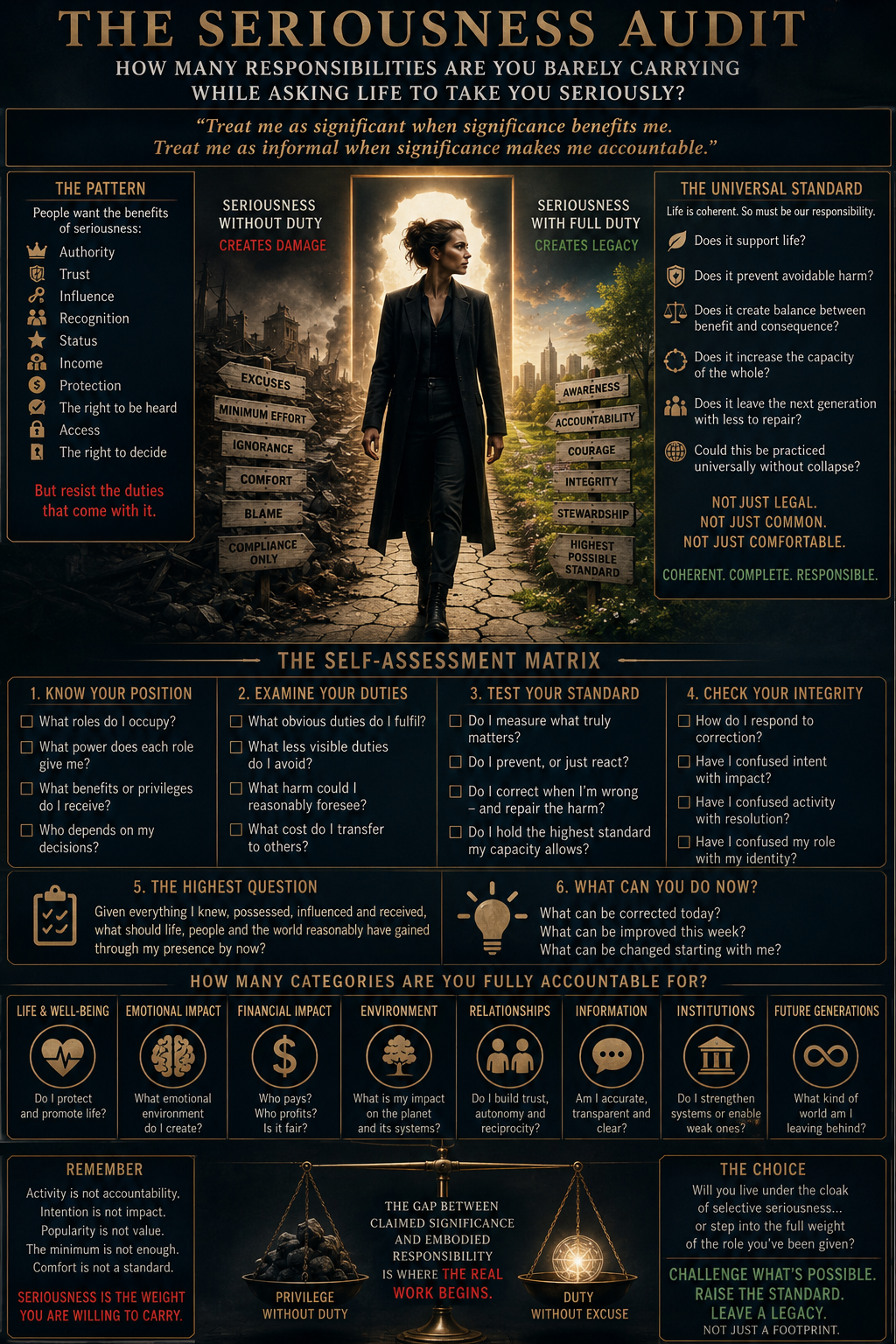
“Treat Me as Significant When Significance Benefits Me. Treat Me as Informal When Significance Makes Me Accountable.”
Across politics, corporations, universities, charities, media, activism, parenting, monarchy, audiences, customers and civilians, the pattern keeps returning.
People want the benefits of seriousness.
Authority.
Trust.
Influence.
Recognition.
Protection.
Access.
Status.
Income.
Respect.
The right to be heard.
The right to make decisions.
The right to shape other people’s lives.
The right to occupy space inside the public mind.
The right to be treated as meaningful.
But meaning creates weight.
Significance creates responsibility.
Influence creates consequence.
Authority creates duty.
Access creates expectation.
Knowledge creates obligation.
And too many people want seriousness only up to the point where seriousness becomes work.
Not symbolic work.
Not visible effort.
Not performance.
The actual work of asking:
What is the highest standard this role could reasonably reach?
What have I not considered?
What consequence have I not followed far enough?
What category of responsibility have I excluded because including it would demand more from me?
What am I calling “enough” only because I have not challenged what more is possible?
That is the deeper confrontation beneath this entire series.
The problem is not only that people reject accountability.
Many people accept a small, comfortable version of it.
They apologise.
Explain.
Attend.
Donate.
Vote.
Provide.
Post.
Work.
Speak.
Report.
Deliver.
They do something.
Then treat the existence of that activity as proof that the duty has been fulfilled.
But responsibility is not measured only by whether something was done.
It is measured by whether what needed doing was understood widely enough, carried seriously enough and raised towards the highest standard reasonably possible.
There is a difference between participation and stewardship.
Between completing the visible task and understanding the full responsibility.
Between doing enough to appear responsible and doing enough to materially improve the system one has entered.
Most People Do Not Reject Responsibility Completely
They reduce it.
A parent may provide food and shelter but avoid emotional accountability.
A university may deliver lectures but avoid responsibility for preparation.
A charity may offer relief but avoid examining dependency.
A politician may announce policy but avoid measuring embodiment.
A corporation may create profit but avoid lifecycle consequence.
An activist may create visibility but avoid strategic evaluation.
A journalist may publish accurate sentences while constructing a misleading pattern through omission and repetition.
An audience may consume thoughtful work while avoiding engagement, action or reciprocity.
A civilian may pay taxes while refusing to pay attention to the country those taxes sustain.
A monarch may perform symbolism while treating symbolism as too ceremonial to carry measurable obligation.
Responsibility is accepted where it is familiar.
Where it is socially recognised.
Where it is easy to demonstrate.
Where the person can point to an action and say:
“I did my part.”
But the unexamined categories remain outside the frame.
That is where responsibility escapes.
How Many Categories of Responsibility Are We Avoiding?
When most people assess themselves, they ask one question:
Did I do something?
The better questions are:
What did I do?
What was the full need?
What part did I reach?
What part did I leave untouched?
What harm remained?
What harm did my method create?
What did I know?
What should I reasonably have known?
What did I possess the capacity to improve?
What did I ignore because it was inconvenient?
What responsibility belonged to my role even if nobody had formally assigned it to me?
Every position contains more than one duty.
A parent has material responsibility.
Emotional responsibility.
Developmental responsibility.
Protective responsibility.
Educational responsibility.
Corrective responsibility.
A company has financial responsibility.
Environmental responsibility.
Labour responsibility.
Consumer responsibility.
Informational responsibility.
Community responsibility.
A government has legislative responsibility.
Preventive responsibility.
Economic responsibility.
Basic-needs responsibility.
Environmental responsibility.
Intergenerational responsibility.
A creator has expressive responsibility.
Commercial responsibility.
Psychological responsibility.
Informational responsibility.
Audience responsibility.
A civilian has personal responsibility.
Collective responsibility.
Environmental responsibility.
Political responsibility.
Community responsibility.
The failure begins when one category is used to conceal the others.
“I provided financially.”
But were you emotionally safe?
“We followed the law.”
But did you prevent foreseeable harm?
“We raised awareness.”
But did anything change?
“We made the information available.”
But did you ensure people could meaningfully understand it?
“We gave people choice.”
But was the choice informed, viable and free from manipulation?
“We worked very hard.”
But did the work produce the result the role existed to create?
Activity inside one category does not complete responsibility across the whole.
Bare Accountability Is Still Avoidance
There is a form of accountability that appears mature but remains incomplete.
The person admits enough to end the conversation.
“I could have handled that better.”
“I am sorry you felt that way.”
“We recognise lessons must be learned.”
“We are reviewing procedures.”
“We accept that mistakes were made.”
The language sounds responsible.
But nothing moves.
No standard changes.
No resource is redirected.
No harmed person receives aftercare.
No recurrence is prevented.
No authority is reduced.
No system is redesigned.
No one identifies the full chain.
That is not accountability at its highest level.
It is acknowledgement used as closure.
Awareness without correction remains incomplete.
An apology can be the beginning.
It cannot be the entire architecture.
Real accountability asks:
What changed because the truth became visible?
What became impossible to repeat?
What was repaired?
What new duty was recognised?
What standard now exists that did not exist before?
The Highest Standard Is Rarely Found by Accepting the First Answer
The highest standard is found by challenge.
What else?
Who else?
How far does this travel?
What happens next?
What happens after that?
What if everybody acted this way?
What if the system scaled?
What if the person affected had less money, less power, less language or less access?
What if the warning was correct?
What if the risk becomes real?
What if the person with authority disappears?
What remains?
This is how responsibility expands.
Not through adding complexity for its own sake.
Through refusing to stop at the first layer simply because the first layer is comfortable.
A basic answer may be correct and still incomplete.
A policy may solve one problem while creating three others.
A product may work for the buyer while damaging the worker and environment.
A punishment may address one offence while increasing future instability.
A charity intervention may save a life today while leaving the cause untouched.
A school may teach information while weakening curiosity.
The first visible success must always be followed by the wider question:
What did this create across the whole?
There Is a Universal Standard for a Reason
The universe does not operate through partial coherence.
Planets do not remain in orbit because gravity works only when convenient.
Bodies do not survive because oxygen reaches some organs and abandons the others.
Ecosystems do not thrive because one species extracts everything while returning nothing.
Balance does not mean stillness.
It means every force exists within relationship.
Pressure.
Response.
Limit.
Exchange.
Correction.
Nothing exists alone.
The planet holds distance from the sun.
The atmosphere carries proportion.
Water cycles.
Waste returns as material.
Bodies regulate.
Animals breathe within systems they did not invent but must remain compatible with.
Humans think because countless systems are coordinated well enough for thought to occur.
That coordination is the universal standard.
Not perfection as a frozen image.
Coherence across consequence.
Every part carrying enough of its function that the whole remains viable.
Human institutions often reject this standard.
They maximise one measure.
Profit.
Speed.
Convenience.
Visibility.
Control.
Then call the result successful while the wider system absorbs instability.
The universe does not evaluate one organ through its private achievement.
If the heart performs magnificently while depriving the brain of blood, the body still fails.
Human systems should be judged the same way.
What did the role contribute to the whole?
What did it extract?
What did it weaken?
What did it leave others to carry?
The Universal Standard Is Not Abstract
It can be translated into questions.
Does this support life?
Does it protect the foundations required for life?
Does it create balance between benefit and consequence?
Does it increase the capacity of the whole?
Does it prevent avoidable harm?
Does it restore what it uses?
Does it leave the next person, generation or system with less damage to manage?
Does it remain coherent when applied to the person benefiting from it?
Would the standard still seem fair if positions were reversed?
Could this method be practised universally without collapse?
That is the bar.
Not whether the action is common.
Not whether the industry permits it.
Not whether the law has caught up.
Not whether everybody else is doing worse.
The relevant question is whether the action remains coherent when raised to the level of the whole.
We Often Call Something Impossible Before Testing the Standard
People lower expectations before fully examining capacity.
“That is unrealistic.”
“No system could do that.”
“You cannot please everyone.”
“There will always be harm.”
“People are only human.”
Those statements may contain truth.
No system will remove every conflict.
No person will foresee every consequence.
No institution will achieve perfect outcomes.
But imperfection is often used as permission not to pursue excellence.
The existence of limits does not justify refusing to locate them accurately.
You do not know what is impossible until you have challenged what is possible.
Many things described as impossible are merely inconvenient to current priorities.
We can fund war but call universal shelter unrealistic.
We can build global platforms but call transparent moderation too complicated.
We can measure every click but call social impact difficult to calculate.
We can move capital instantly but allow public support to take months.
We can create products for billions but claim responsibility for their afterlife is unmanageable.
The capacity exists.
The priority does not.
That distinction must be exposed.
Highest Standard Does Not Mean Doing Everything Alone
Responsibility by scale does not require one person to carry the entire world.
It requires the person to identify what belongs to their capacity and ensure it connects properly to others.
The individual notices.
The manager escalates.
The institution investigates.
The regulator enforces.
The government coordinates.
The public monitors.
Responsibility can be distributed.
It must not be dissolved.
The highest standard is not omnipotence.
It is coherence.
Knowing what belongs to you.
Knowing what does not.
Knowing who must receive what you cannot complete.
Knowing when delegation requires supervision.
Knowing when silence would break continuity.
A person fails responsibility not only when they refuse to solve everything.
They may fail when they do not pass the warning to the person who can.
The Scale of Responsibility Must Match the Scale of Capacity
A civilian and a government do not carry equal duty.
A customer and a corporation do not possess equal knowledge.
A child and a parent do not hold equal authority.
A junior employee and a chief executive do not control the same resources.
But everyone carries something.
The greater the power, the wider the obligation.
The greater the access, the greater the duty to see.
The greater the knowledge, the less credible ignorance becomes.
The greater the benefit, the greater the responsibility to account for cost.
The greater the influence, the more seriously consequence must be examined.
A person with small capacity should not be crushed beneath expectations designed for institutions.
An institution with enormous capacity should not be protected by excuses acceptable from an individual.
This is why accountability must be scaled.
Not equalised blindly.
The Self-Assessment Begins With Position
What role am I occupying?
Not only the title.
The actual function.
Am I a parent?
Employer?
Worker?
Customer?
Reader?
Citizen?
Leader?
Follower?
Creator?
Partner?
Friend?
Professional?
Witness?
What influence does that role give me?
What does it allow me to decide?
What does it allow me to withhold?
Who depends upon my choices?
Who is affected without being present?
What does society assume I will do because I accepted the position?
What does the role make possible?
The person should not begin with self-image.
“I am caring.”
“I am responsible.”
“I am a good person.”
Begin with function.
What did the role require?
What did reality receive?
Then Assess the Privileges
What did the role give me?
Authority.
Money.
Security.
Access.
Trust.
Information.
Protection.
Status.
Time.
Decision-making power.
The benefit of being believed.
The ability to define the story.
The right to make rules.
The right to evaluate others.
The right to receive their labour, attention or loyalty.
Privilege does not mean the person did not work.
It means the position created additional capacity.
The duty should be proportionate to that capacity.
Then Assess the Visible Duties
What did I obviously know I had to do?
Provide.
Deliver.
Teach.
Protect.
Report.
Pay.
Explain.
Respond.
Maintain.
These are the duties most people can list.
But self-assessment cannot stop there.
Then Assess the Invisible Duties
What did the role require that was never written down?
Did people need emotional safety?
Clear explanation?
Accessible information?
Aftercare?
A warning?
A pathway to independence?
Protection from retaliation?
Long-term planning?
A system for correction?
Recognition of hidden costs?
The invisible duties are often where the highest standard lives.
Law may state the minimum.
Consciousness must examine the rest.
Then Assess What Was Preventable
What harm could I reasonably have seen?
What evidence existed?
What warning appeared?
What pattern repeated?
What did I dismiss as small?
What did I postpone?
What became more expensive because I waited?
Prevention is a higher standard than reaction because it requires attention before crisis creates urgency.
Too many people are praised for responding to emergencies they had the capacity to prevent.
The rescue becomes visible.
The negligence before it disappears.
A serious self-assessment examines both.
Then Assess What You Outsourced
What benefit did I retain?
What cost did I pass to someone else?
Did I keep the profit and outsource pollution?
Keep authority and outsource blame?
Keep convenience and outsource exhaustion?
Keep public trust and outsource the risk?
Keep the title and outsource the emotional labour?
Keep the credit and distribute the failure?
Every system should be examined for displaced consequence.
Someone carries what you do not.
The absence of cost from your immediate view does not mean the cost disappeared.
Then Assess Your Metrics
What did I count?
Hours worked?
Money earned?
People reached?
Tasks completed?
Cases processed?
Views received?
Did those measures prove the purpose was fulfilled?
A parent may count sacrifice.
The child may count safety.
A company may count sales.
The public may count damage.
A university may count graduations.
The graduate may count capability.
A government may count policies.
The civilian may count whether life improved.
The wrong metric can make failure look successful.
The highest standard requires measuring what the role was ultimately meant to produce.
Then Assess the People Who Could Not Easily Speak
Who was absent from the decision?
Who had less power?
Who could not challenge me?
Who feared losing access?
Who lacked the language to explain the harm?
Who was dependent?
Who would carry the long-term consequence?
Responsibility is not complete if it only listens to those already capable of entering the room.
The people most affected may be the least equipped to negotiate.
That is precisely why the powerful role carries greater duty.
Then Assess Your Response to Correction
What happens when someone tells me I caused harm?
Do I listen?
Defend?
Explain?
Attack their tone?
Question their memory?
Point to my intentions?
List everything I have done well?
Demand gratitude?
Disappear?
Or do I remain present long enough to understand what became visible?
Correction is one of the clearest tests of seriousness.
Anyone can claim responsibility before consequence arrives.
The truth appears in what happens afterward.
Then Assess Whether the Role Became Your Identity
Can I hear criticism of my work without hearing that I have no worth?
Can I admit the role failed without experiencing total personal collapse?
Can I change method without losing myself?
Many people cannot.
The parent becomes parenthood.
The executive becomes the company.
The academic becomes the theory.
The activist becomes the cause.
The politician becomes the office.
Then reality becomes threatening.
The person defends the identity rather than correcting the function.
Healthy separation is necessary.
You are more than the role.
That is exactly why the role should be examinable.
Then Ask What the Highest Standard Would Look Like
Not the legal minimum.
Not industry average.
Not what your peers tolerate.
What is the highest coherent expression of the role?
What would parenting look like if development, dignity and independence were held together?
What would government look like if basic needs, prevention and long-term continuity came first?
What would business look like if profit, labour, environment and public value were measured as one system?
What would education look like if knowledge became embodied capability?
What would activism look like if moral urgency, precision, strategy and repair remained integrated?
What would citizenship look like if civilians treated place as something to steward rather than merely occupy?
The highest standard should be imagined clearly enough to reveal the gap.
Without the image of what is possible, people mistake present limitation for natural law.
Then Ask What Is Stopping You
Lack of knowledge?
Time?
Money?
Authority?
Courage?
Discipline?
Support?
Or comfort?
Sometimes the barrier is real.
Sometimes it is identity.
Sometimes it is fear of conflict.
Sometimes it is refusal to lose advantage.
Sometimes the person simply does not want the responsibility to become larger.
They want the title.
Not the full function.
Honest self-assessment must distinguish incapacity from unwillingness.
Then Ask What You Could Begin Now
The highest standard may take time.
But direction can be immediate.
One correction.
One disclosure.
One conversation.
One redesigned process.
One report.
One boundary.
One act of reciprocity.
One decision to stop funding harm.
One question asked earlier.
One person included.
One responsibility map created.
Perfection is not required before movement.
But movement should point towards coherence.
The Universal Responsibility Audit
Ask yourself:
Life
Does what I do protect life, weaken it or merely avoid noticing the effect?
Basic needs
Do my choices support or obstruct access to food, water, shelter, healthcare, safety, energy, education and dignity?
Emotional consequence
What emotional environment do I create around others?
Mental consequence
Do I expand understanding or create confusion, dependency and fear?
Financial consequence
Who pays for my decisions?
Who profits?
Who absorbs risk?
Environmental consequence
What happens after I use, consume, produce or discard?
Relational consequence
Does my behaviour create trust, autonomy and repair?
Informational consequence
Am I accurate, clear and transparent enough for others to decide properly?
Institutional consequence
Does my participation strengthen responsible systems or protect weak ones?
Intergenerational consequence
What will remain after me?
Corrective responsibility
What do I do when harm becomes visible?
Preventive responsibility
What am I doing before the harm occurs?
Reciprocal responsibility
What am I returning for what I receive?
Scale
Is my accountability proportionate to my power, knowledge, access and benefit?
Most people are not accountable across all of these categories.
Some are barely accountable across one.
That is the reality the audit must expose.
The Highest Standard Does Not Ask Whether You Are Better Than Others
Comparison lowers the bar.
“I do more than most.”
“I am not as bad as them.”
“They should be held accountable first.”
Another person’s failure does not complete your responsibility.
The relevant comparison is between your capacity and your embodiment.
Given what you know, what should you be doing?
Given what you possess, what should you be returning?
Given the role you occupy, what should reality look like around you?
That is the measurement.
The Self-Assessment Matrix
Ask:
- Which roles do I occupy?
- What power does each role give me?
- What benefits do I receive?
- What obvious duties do I fulfil?
- Which less visible duties do I avoid?
- What harm could I reasonably foresee?
- What warnings have I ignored?
- What cost have I transferred?
- What do I measure?
- Do those metrics prove the purpose was fulfilled?
- Who depends on my decisions?
- Who cannot easily challenge me?
- What happens when I am corrected?
- Have I confused intention with outcome?
- Have I confused effort with fulfilment?
- Have I confused activity with resolution?
- Have I confused legality with responsibility?
- Have I confused popularity with value?
- Have I confused familiarity with truth?
- Have I confused my role with my identity?
- What is the highest coherent standard for each position?
- What prevents me from approaching it?
- Is the obstacle genuine incapacity or protected comfort?
- What can be corrected now?
- What would the world look like if everyone carried responsibility at the level I do?
These questions do not begin with shame.
They begin with accuracy.
Capacity.
Consequence.
Expansion.
The Highest Form of Accountability
The highest form of accountability does not ask only:
“Did I technically fulfil my duty?”
It asks:
Given everything I knew, possessed, influenced and received, what should life reasonably have gained through my presence by now?
Did I make people safer?
More capable?
More informed?
More independent?
Did I reduce harm?
Prevent recurrence?
Protect the environment?
Return value?
Strengthen the systems around me?
Did I help life continue?
Or did I take the privileges of seriousness while giving the world only the minimum required to preserve my self-image?
That question reveals the distance between claimed significance and embodied responsibility.
And that distance is where the real self-assessment begins.
Closing: Seriousness Is the Weight You Are Willing to Carry
Seriousness is not calling yourself responsible.
It is not being busy.
It is not holding a title.
It is not having good intentions.
It is not being admired.
It is not suffering while performing the role.
It is not meeting the lowest accepted standard.
Seriousness is the willingness to examine every category of consequence your position can reach.
To challenge what more is possible.
To expand responsibility as capacity expands.
To correct when truth arrives.
To prevent where foresight permits.
To return what benefit requires.
To carry the visible and invisible duties of the role.
The universal standard exists because life depends on relationship, proportion and continuity.
The planets do not survive through selective coherence.
Bodies do not remain alive through partial responsibility.
Systems do not endure when every part maximises itself and abandons the whole.
Neither will humanity.
So the question is no longer merely:
Are you accountable?
It is:
Across how many dimensions are you accountable?
How deeply?
How consistently?
How proportionately?
How preventively?
How honestly?
How close is your standard to the highest one your capacity makes possible?
Because many people are not refusing seriousness completely.
They are performing just enough of it to avoid confronting how much more the role requires.
And that is no longer enough.




Leave a Reply