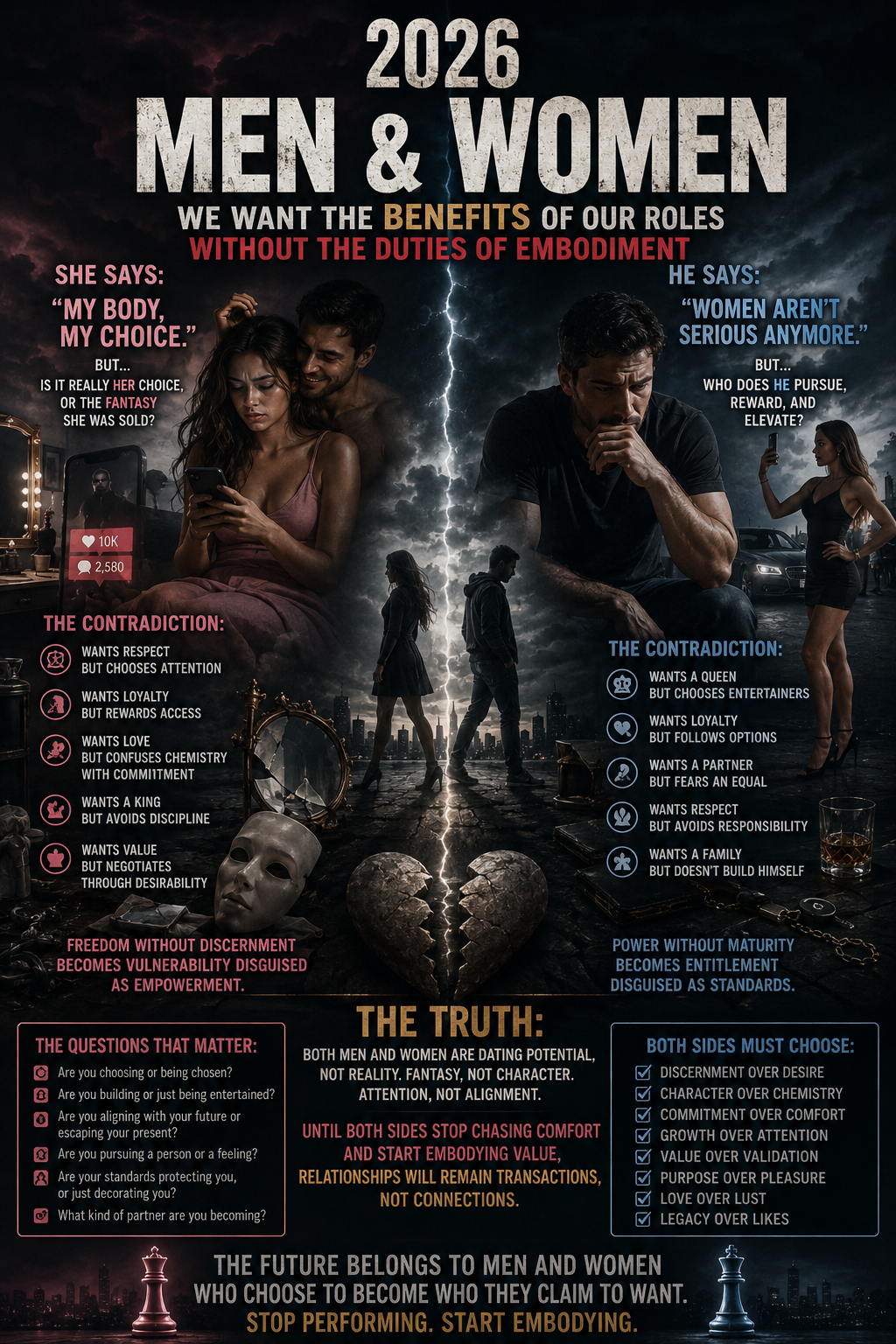
“Treat My Claims as Significant When They Protect My Identity. Treat My Behaviour as Informal When It Contradicts What I Say I Want.”
Where have we arrived?
In 2026, men and women speak constantly about standards.
What a woman should be.
What a man should be.
What femininity means.
What masculinity means.
What commitment should look like.
What family should mean.
What respect should require.
What freedom should protect.
What strength should embody.
But many people are not living the standards they publicly defend.
They are claiming identities they have not developed the discernment to carry.
They want the seriousness of the title without the duties of the role.
Women speak of autonomy.
“My body, my choice.”
“My life, my decision.”
“My standards.”
“My boundaries.”
“My freedom.”
Those statements matter.
A woman’s body belongs to her.
Her consent matters.
Her choices matter.
Her right to refuse matters.
Her right not to be controlled matters.
But autonomy is not only the right to choose.
It is also the responsibility to examine what is choosing through you.
Was the decision made through discernment?
Or through loneliness?
Seduction?
Validation?
Fantasy?
Fear of losing attention?
The desire to be desired?
The need to feel chosen?
The pressure to appear liberated?
The hope that access would become affection?
The belief that chemistry meant value?
A person may technically make a choice while acting inside an emotional architecture someone else designed.
If a woman was seduced by a fantasy constructed to gain access to her, was the decision fully hers?
Legally, perhaps yes.
Physically, perhaps yes.
But psychologically, emotionally and relationally, the question is more complicated.
Did she choose the person?
Or the future they implied?
Did she choose the encounter?
Or the version of herself she felt while being pursued?
Did she choose freely?
Or did she respond to a carefully produced experience of attention, urgency, desirability and imagined significance?
Only that who knows their direction can say the opposite, if you know what you desire for your future you have certainty to respond instanly, when you don’t the question arises. The two aren’t the same.
Autonomy without discernment can become vulnerability defended as freedom.
And men do the same thing through different language.
Men say women are no longer serious about dating.
Women do not want families.
Women are too independent.
Women want attention but not commitment.
Women have lost femininity.
Women do not respect men.
But many of those same men repeatedly pursue women whose lives already reveal that they are not building towards the future those men claim to want.
They choose attention over alignment.
Appearance over character.
Availability over direction.
Admiration over accountability.
They follow women who make them feel powerful rather than women whose embodiment would require them to become more powerful within themselves.
They say they want a queen.
But do they recognise queenship when it is not performing for them?
Do they value the woman with discipline?
Vision?
Boundaries?
A developed life?
A mind of her own?
A standard that does not lower itself to make him comfortable?
Or do they call her intimidating?
Difficult?
Too independent?
Too serious?
Too much?
Some men say they want strong women, but what they actually want is a woman strong enough to support them and soft enough never to challenge them.
They want her competence to benefit the relationship.
But not her discernment when it evaluates them.
They want her intelligence in private.
But not her authority in the shared structure.
They want her ambition until it makes their lack of direction visible.
They want her beauty, loyalty, labour and emotional intelligence.
But they do not always want the internal development required to stand beside her without trying to reduce her.
That is not a preference for femininity.
It is a preference for comfort.
We Are Not Living the Stereotypes We Keep Defending
People speak as though men and women still occupy clear, stable roles.
The man leads.
The woman nurtures.
The man protects.
The woman inspires.
The man provides.
The woman creates home.
But where is the embodiment?
Leadership is not dominance.
Protection is not possessiveness.
Provision is not payment used to purchase obedience.
Nurture is not self-erasure.
Femininity is not permanent pleasantness.
Masculinity is not emotional absence.
A man does not become a leader because he expects to be followed.
A woman does not become a queen because she expects to be adored.
The role is proved through function.
Does he possess direction?
Judgement?
Emotional regulation?
Consistency?
The ability to protect without controlling?
The ability to hear truth without collapsing into ego?
The ability to build something beyond appearance?
Does she possess discernment?
Self-respect?
Boundaries?
Nurture that does not become enablement?
The ability to receive without surrendering agency?
The ability to distinguish attention from devotion?
The ability to choose beyond immediate feeling?
Many people are not failing traditional stereotypes because they rejected them.
They are failing because they claim the symbolism while avoiding the development.
“My Body, My Choice” Does Not Mean Every Choice Serves the Self
Bodily autonomy is foundational.
But not every freely made choice is a wise choice.
Freedom does not guarantee discernment.
Consent does not guarantee value.
Desire does not guarantee alignment.
Pleasure does not guarantee safety.
Attention does not guarantee care.
A woman may have every right to give someone access to her body.
The deeper question is whether that access is consistent with what she says she values.
Did the person earn trust?
Did they demonstrate care?
Did they respect the whole woman?
Did they understand the meaning she attaches to intimacy?
Were they interested in her life, or only in the access her body provided?
Was she choosing from fullness?
Or negotiating from hunger?
The body may belong to the woman.
But the consequences also arrive in her body.
Her nervous system.
Her memory.
Her sense of trust.
Her attachment.
Her self-perception.
Her future boundaries.
Autonomy should not be reduced to permission.
Its highest form is governance of the self.
The ability to choose not merely because something is available, but because it belongs within the direction of one’s life.
Seduction Can Produce Agreement Without Producing Clarity
Seduction is not automatically manipulation.
Attraction, romance and pursuit can be beautiful.
But seduction becomes dangerous when it creates an emotional reality that the seducer has no intention of sustaining.
The person performs interest.
Future.
Depth.
Exclusivity.
Vulnerability.
Spiritual recognition.
They mirror the other person’s desires.
They create urgency.
Then, once access is gained, the world they created disappears.
The person who agreed did not agree only to the physical act.
They may have agreed to the meaning attached to it.
If that meaning was intentionally fabricated, the decision was influenced through deception.
This does not erase personal responsibility.
But it does require greater honesty about how choices are shaped.
A woman must ask not only:
“Did I say yes?”
But:
“What exactly was I saying yes to?”
And:
“Was that reality actually present?”
Men must ask the same.
Was he choosing a woman?
Or choosing how she made him feel?
Was he interested in her character?
Or in what being seen with her communicated about him?
Was he building relationship?
Or purchasing temporary validation through attention?
Men Often Complain About the Women They Keep Rewarding
A man may say women are superficial.
Then give the most attention to appearance.
He may say women only care about status.
Then lead every interaction with money, visibility or performance.
He may say women do not value character.
Then overlook the women whose character does not immediately flatter his ego.
He may say women are not serious.
Then repeatedly pursue those who are clearly enjoying life without claiming to be building towards family, partnership or continuity.
A woman is allowed to live casually.
She is allowed not to want marriage.
Not to want children.
Not to want a serious partnership.
The contradiction appears when a man knowingly chooses that woman and then presents her as evidence that women as a whole have failed.
He selected the pattern.
Rewarded it.
Pursued it.
Centred it.
Then complained that it existed.
You cannot repeatedly invest attention in what contradicts your stated values and then claim the world no longer contains those values.
Sometimes the women men say they cannot find are simply women they have not trained themselves to recognise.
Some Men Do Not Want a Queen. They Want an Audience
A queen in embodiment is not merely beautiful.
She has internal government.
Standards.
Vision.
Discernment.
Self-possession.
Responsibility.
She is not waiting to be given an identity by male attention.
She is already moving.
That can intimidate a man who has confused masculinity with being the most powerful person in the room.
Her strength does not automatically make him weaker.
But if his identity depends upon her dependence, her wholeness will feel like rejection.
He may call her difficult because she asks questions.
Controlling because she has boundaries.
Unfeminine because she will not shrink.
Arrogant because she knows what she offers.
Too independent because she can leave.
The issue is not always that strong women are unavailable.
Sometimes strong women are avoided because they require a man to meet himself.
Some Women Do Not Want a King. They Want Relief
Women may say they want leadership.
A provider.
A protector.
A masculine man.
But sometimes what they want is relief from self-responsibility.
They want someone else to decide.
Carry.
Finance.
Stabilise.
Protect.
Absorb consequence.
Leadership becomes attractive because it promises escape from uncertainty.
But a king in embodiment is not merely a man who pays.
He has direction.
Discipline.
Restraint.
Moral architecture.
Responsibility.
The ability to choose what is best, when, where and in what sequence.
That kind of man may not indulge every impulse.
He may ask the woman to grow.
He may require clarity.
He may refuse chaos.
He may protect the relationship from desires that feel exciting but destabilise continuity.
Some women say they want leadership until leadership does not look like being constantly pleased.
They want protection until protection includes being protected from their own destructive patterns.
They want provision without contribution.
Strength without structure.
Masculinity without accountability.
That is not partnership.
It is dependency presented as preference.
Attention Has Replaced Evaluation
Modern dating often begins through appearance.
Profiles.
Images.
Captions.
Status signals.
A few seconds of visual assessment.
People are selected before they are understood.
This does not make attraction meaningless.
Physical attraction matters.
But when attention becomes the primary evidence of value, discernment collapses.
The woman chooses the man who creates the strongest immediate feeling.
The man chooses the woman who produces the strongest social or visual reward.
Both may call it chemistry.
But chemistry is not character.
Intensity is not compatibility.
Seduction is not stewardship.
Attention is not intention.
People often discover later that they never selected a partner.
They selected an experience.
Women Want to Be Valued, but Many Still Negotiate Through Desirability
A woman may say she wants to be valued for her mind, character and soul.
But then invest most heavily in the parts of herself that produce immediate attention.
Appearance.
Sexual appeal.
Mystery.
Emotional performance.
The ability to seem effortless.
She may know that certain forms of presentation attract men who are not equipped to value her fully.
But continue because attention produces temporary confirmation.
Then she is disappointed that the men who approached through surface remain attached to surface.
This is not an argument against beauty.
Beauty can be expression.
Art.
Joy.
Embodiment.
But when beauty becomes the main language through which a woman asks to be recognised, she should examine what kinds of recognition that language is attracting.
The person who is attracted to the doorway may not possess the depth to enter the whole house.
Men Want Respect, but Many Still Negotiate Through Performance
A man may say he wants to be respected for who he is.
But present himself through status.
Money.
Cars.
Physical dominance.
Social influence.
Sexual access.
The appearance of control.
He then attracts people who respond to those symbols and complains that they do not value his inner self.
But he did not lead with his inner self.
He led with the performance.
Again, this does not mean achievement or provision are meaningless.
They matter.
But if a man builds his entire desirability around external advantage, he should not be surprised when people evaluate him through what he has rather than who he is.
The performance attracts an audience.
Character builds partnership.
Masculinity Has Been Reduced to Dominance
Toxic masculinity is not masculinity itself.
It is masculinity stripped of discernment, care and self-government.
It is power without stewardship.
Authority without accountability.
Protection converted into control.
Confidence converted into contempt.
Sexuality converted into conquest.
Silence converted into emotional incapacity.
A man may believe he is masculine because he cannot be challenged.
But a man who cannot receive correction is not strong.
He is fragile around truth.
A man may believe he leads because others submit.
But leadership that requires the diminishment of others is insecurity with followers.
A man may believe he protects because he restricts a woman.
But protection that removes her agency is possession.
Real masculinity does not fear a strong woman.
It knows how to meet strength without turning relationship into competition.
Femininity Has Been Reduced to Appeal
Femininity is often presented as beauty, softness, receptivity and emotional warmth.
Those qualities may be part of it.
But femininity without discernment becomes availability.
Softness without boundaries becomes vulnerability to exploitation.
Receptivity without evaluation becomes absorption of whatever arrives.
Nurture without self-respect becomes overfunctioning for people who refuse to mature.
A woman does not prove femininity by becoming easy to access.
She does not prove softness by tolerating disrespect.
She does not prove loyalty by remaining inside harm.
She does not become more feminine by making herself smaller so a man can feel larger.
Femininity in embodiment includes the intelligence to know what should be received and what should be refused.
The Strong Woman Is Often Punished for Revealing the Weak Structure
A woman with standards may be described as demanding.
But sometimes her standards simply expose what others hoped would remain unexamined.
She asks:
Where is this going?
What are you building?
What do you believe?
How do you handle conflict?
What does commitment mean to you?
What responsibility do you accept?
A man without answers may experience the questions as intimidation.
Not because the woman is excessive.
But because the relationship can no longer remain vague.
Strength does not always frighten men because they dislike strength.
It frightens some because strength makes informality impossible.
The Emotionally Available Man Is Often Punished for Not Performing Hardness
Men are also trapped by stereotype.
A man may be thoughtful.
Gentle.
Emotionally articulate.
Collaborative.
Willing to apologise.
Uninterested in dominance.
And be treated as weak because he does not perform aggression.
Some women say they want emotionally intelligent men, but lose attraction when those men express vulnerability.
They want communication, but not uncertainty.
Sensitivity, but only when it remains useful to them.
Emotional availability, but not emotion that requires care.
This reveals another contradiction.
People claim they want developed partners while remaining attracted to undeveloped performance.
A mature man should not have to become emotionally absent to appear masculine.
People Are Dating Symbols Rather Than Humans
The man is expected to represent security.
The woman is expected to represent beauty and nurture.
He wants her to make him feel successful.
She wants him to make her feel protected.
Both may be selecting what the other symbolises rather than who the other is.
This is why disappointment arrives after access.
The fantasy was compatible.
The people were not.
The man was dating femininity as an idea.
The woman was dating masculinity as an idea.
Neither had examined the actual human being carrying the role.
Choice Without Self-Knowledge Is Easily Directed
People say:
“I chose this.”
But who is the “I” making the choice?
The healed self?
The lonely self?
The frightened self?
The wounded child?
The ego seeking recognition?
The body seeking intensity?
The social identity seeking approval?
The part trying to prove desirability?
The part avoiding solitude?
A decision can belong to the person while still being governed by unexamined forces.
Self-responsibility requires knowing which part of oneself is choosing.
Otherwise, people defend as freedom what may actually be repetition.
Standards Are Not What We Announce. They Are What We Refuse to Betray
Everyone has standards in conversation.
The real standard appears under pressure.
When attraction is strong.
When loneliness is present.
When the person is beautiful.
When status is available.
When attention feels rare.
When leaving means starting again.
When boundaries risk rejection.
A woman’s standard is not proved by saying she deserves respect.
It is proved by whether she removes access from those who do not respect her.
A man’s standard is not proved by saying he wants a family.
It is proved by whether he chooses women whose lives are aligned with building one.
Standards are not aspirations.
They are selection criteria embodied consistently.
The Market of Attention Rewards the Opposite of What Many People Claim to Want
Social media rewards visibility.
Provocation.
Beauty.
Performance.
Speed.
Fantasy.
The quiet person with discipline may receive less attention.
The person living with direction may appear less exciting.
The woman building a coherent life may not market herself continuously.
The man developing real capability may not perform power online.
Meanwhile, the people most skilled at attracting attention become the most visible representatives of their sex.
Men conclude that all women are one way.
Women conclude that all men are another.
But they are often observing a marketplace designed to elevate performance over depth.
The loudest examples become mistaken for the whole population.
Family Cannot Be Claimed Without Preparation
Men and women say they want family.
But family is not an image.
It is repetition.
Routine.
Sacrifice.
Emotional regulation.
Financial judgement.
Health.
Patience.
Conflict resolution.
Continuity.
The ability to place a child’s development above adult ego.
A person may want the wedding.
The title.
The home.
The photographs.
The social recognition.
But not the daily duties that make family safe.
Wanting children is not the same as being prepared to raise them.
Wanting a spouse is not the same as being capable of partnership.
Wanting leadership is not the same as being prepared to follow wisdom.
Wanting devotion is not the same as being worthy of trust.
The Problem Is Not That Gender Roles Disappeared
The deeper problem is that embodiment weakened while claims became louder.
People speak more confidently about what men and women should be.
But fewer people seem willing to undertake the internal development required to carry those roles responsibly.
Men want respect before becoming respectable.
Women want value before learning how to protect their value.
Men want loyalty while remaining directionless.
Women want provision while refusing discernment about who they receive from.
Men want softness while behaving in ways that make softness unsafe.
Women want strength while punishing men for the vulnerability required to become whole.
Both sexes want the finished partner.
Few want to become the finished partner.
The Man and Woman Seriousness Test
Whenever someone claims to know what a man or woman should be, ask:
What privileges does that identity give them?
For men:
Authority.
Respect.
Leadership.
Sexual access.
Social deference.
The expectation of loyalty.
The right to define protection.
The assumption of competence.
For women:
Desirability.
Emotional access.
Protection.
Provision.
Social sympathy.
The expectation of care.
The right to define boundaries.
The assumption of vulnerability.
Then ask:
What duties should accompany those privileges?
For men:
Direction.
Protection without control.
Provision without ownership.
Emotional regulation.
Discernment.
Consistency.
Humility.
Accountability.
The ability to honour strong women without needing to reduce them.
For women:
Discernment.
Self-governance.
Boundaries.
Honesty.
Responsibility for selection.
Nurture without enabling.
Respect for developed masculinity.
The ability to choose beyond attention and fantasy.
Then ask:
Do they accept both, or only the side that benefits them?
Do women want bodily autonomy without responsibility for how access is chosen?
Do men want leadership without becoming worthy of trust?
Do women want protection without discernment?
Do men want queens while pursuing only the women who flatter their ego?
Do women want kings while resisting structure, truth and responsibility?
Do men want feminine softness while creating environments in which softness is unsafe?
Do women want emotionally available men while punishing emotional reality?
Do both want serious partners while making unserious selections?
That is the test.
The Gender Accountability Matrix
A serious evaluation should ask:
- What does this person claim to want?
- What do they repeatedly choose?
- Which qualities receive their attention?
- Which qualities do they overlook?
- Are they selecting character or fantasy?
- Are they choosing through discernment or emotional hunger?
- Does bodily autonomy include self-governance?
- Does masculine authority include accountability?
- Does feminine receptivity include evaluation?
- Is attraction being confused with alignment?
- Is seduction being confused with sincerity?
- Is provision being confused with leadership?
- Is beauty being confused with value?
- Is confidence being confused with strength?
- Is softness being confused with weakness?
- Are strong women being avoided because they require growth?
- Are emotionally developed men being dismissed because they do not perform hardness?
- Does the person reward the very behaviour they publicly condemn?
- Do their choices support the family structure they claim to want?
- Are they becoming the kind of partner they expect to receive?
- What does their dating history reveal that their language does not?
These questions do not begin with hostility towards men or women.
They begin with embodiment.
Selection.
Discernment.
Consequence.
Criticising Modern Gender Behaviour Is Not Rejecting Freedom
To question a woman’s choices is not to deny her autonomy.
To question a man’s leadership is not to deny masculinity.
To examine sexual behaviour is not to demand repression.
To challenge dating culture is not to demand one universal relationship model.
Freedom should survive examination.
Masculinity should survive accountability.
Femininity should survive discernment.
The goal is not to return people to roles they did not choose.
It is to expose the distance between what people claim and what they repeatedly embody.
The Highest Form of Gender Accountability
The highest form of accountability does not ask only:
“Did this person have the right to choose?”
It asks:
Given the freedom, knowledge, access and standards this person claims, what should their choices reasonably be producing by now?
Are women becoming safer through autonomy?
Or merely more available to people who have not earned access?
Are men becoming more responsible through leadership?
Or merely more entitled to obedience?
Are women choosing partners aligned with the lives they say they want?
Are men directing attention towards women who embody the future they claim to value?
Are people becoming more discerning?
More honest?
More capable of building?
More able to recognise value beyond appearance?
More able to distinguish chemistry from character?
More able to choose without abandoning themselves?
Did freedom produce self-governance?
Or only more options?
Did masculinity produce stewardship?
Or only control?
Did femininity produce discernment?
Or only desirability?
That question reveals the distance between gender claim and lived embodiment.
And that distance is where responsibility lives.
The Pattern Beneath Men and Women in 2026
Men and women want:
Recognition.
Desire.
Authority.
Protection.
Freedom.
Loyalty.
Access.
Validation.
Leadership.
Provision.
Respect.
Commitment.
But may resist:
Discernment.
Self-examination.
Consistency.
Correction.
Emotional responsibility.
Careful selection.
Honest communication.
Boundaries.
Proportional contribution.
Accepting consequences.
Becoming what they ask to receive.
This is selective seriousness.
Seriousness when identity creates privilege.
Informality when identity creates responsibility.
Closing: Immunity Wrapped in Gender
Seriousness is not saying:
“I am a man.”
“I am a woman.”
“I know my worth.”
“I want a family.”
“My body, my choice.”
“I deserve respect.”
“I want a queen.”
“I want a king.”
Seriousness is the willingness to carry the full weight of what those claims require.
If a woman claims autonomy, she inherits the duty of discernment.
If a man claims leadership, he inherits the duty of stewardship.
If a woman wants to be valued beyond her body, she must learn to recognise who values more than access.
If a man wants a serious woman, he must stop rewarding only what looks good, feels easy and flatters his identity.
If a woman wants a strong man, she must become capable of receiving truth without confusing every limit with control.
If a man wants a strong woman, he must become secure enough not to experience her embodiment as competition.
If both want family, they must stop choosing only for excitement and begin choosing for continuity.
Where have we arrived?
At a culture full of declarations and poor in embodiment.
Full of options and weak in discernment.
Full of sexual access and short on intimacy.
Full of gender language and short on developed men and women.
People are not only being misled by each other.
They are being misled by the fantasies they keep rewarding.
The men and women who want to be taken seriously but reject serious self-responsibility are not asking to be recognised as masculine, feminine, free, strong or valuable.
They are asking for immunity wrapped in identity.
And modern dating culture has protected that wrapping for far too long.






Leave a Reply