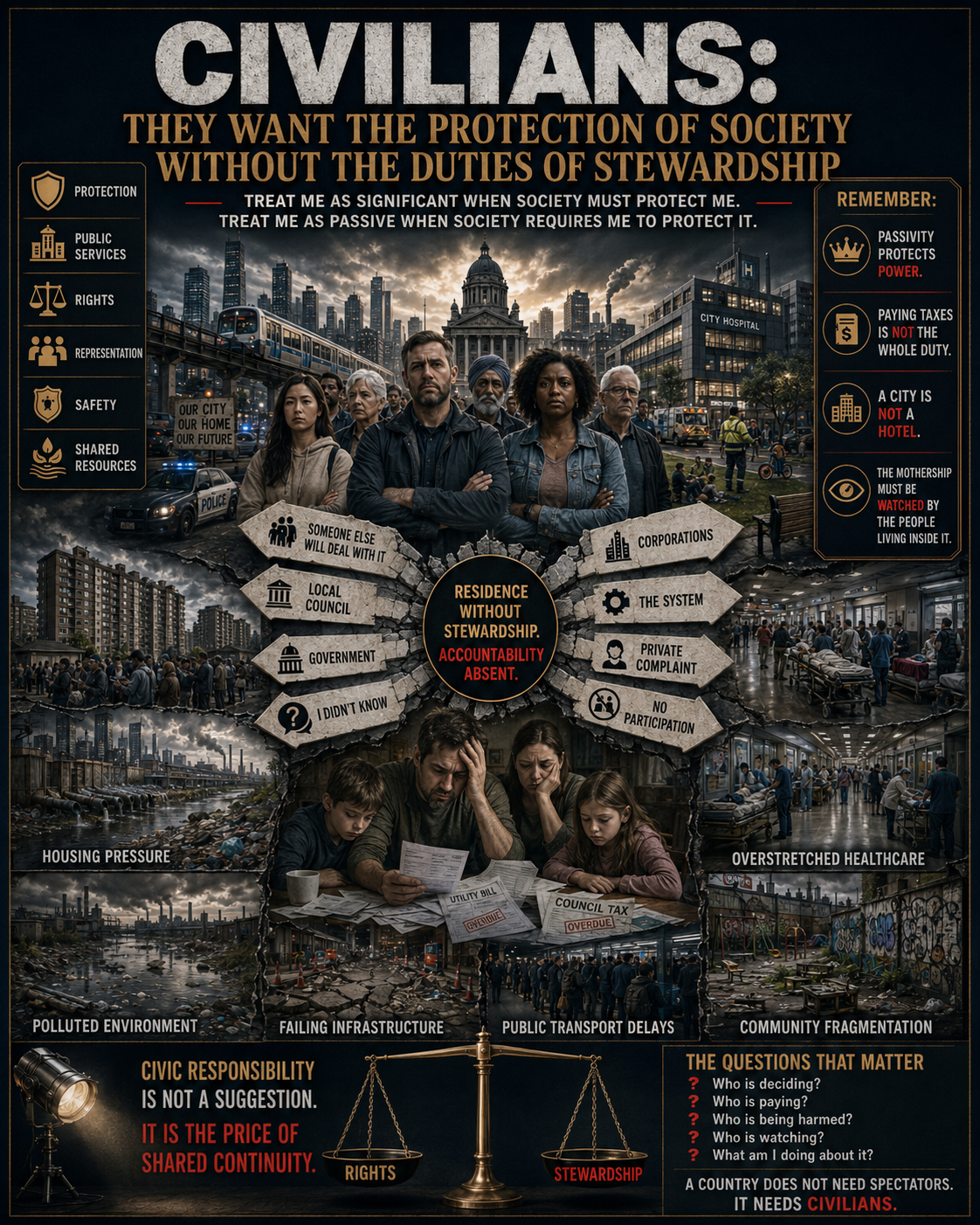
“Treat Me as Significant When Society Must Protect Me. Treat Me as Passive When Society Requires Me to Protect It.”
Civilians may be one of the most overlooked examples of people wanting the benefits of seriousness without accepting the full duties that seriousness creates.
They want the seriousness of citizenship when they require protection.
When they need healthcare.
Housing.
Safety.
Education.
Clean water.
Working infrastructure.
Employment access.
Legal protection.
Public transport.
Emergency response.
Environmental security.
Economic stability.
They want governments, councils, courts, police forces, hospitals, regulators, businesses and public institutions to recognise that their lives matter.
They want to be counted.
Protected.
Represented.
Listened to.
Served.
They want authorities to understand the consequences of every decision that enters their homes, bodies, finances, neighbourhoods and futures.
That is reasonable.
A civilian should be able to expect the systems governing them to prioritise life, basic needs, dignity and continuity.
But some civilians retreat into passivity when society asks anything in return.
They do not pay attention to what happens in their street.
Their field.
Their neighbourhood.
Their city.
Their country.
They do not read the policy.
Attend the meeting.
Question the decision.
Report the warning.
Support the person speaking.
Defend the public resource.
Challenge the harmful practice.
They may complain privately.
Observe publicly.
Disagree silently.
Then continue living as though citizenship means merely occupying the land while somebody else carries responsibility for what the land becomes.
They say:
“That is politics.”
“Someone else will deal with it.”
“I do not have time.”
“It does not affect me.”
“What difference would one person make?”
“I just want to live my life.”
But life does not happen outside the system.
The water enters everybody.
The roads carry everybody.
The laws reach everybody.
The air moves through everybody.
The economy affects everybody.
The choices of councils, governments, corporations and institutions reorganise the conditions under which everybody lives.
A civilian cannot demand that society remain responsible for them while refusing every responsibility toward society.
That is the contradiction.
Living Somewhere Is Not the Same as Stewarding It
A person may reside in a city for years without ever participating in its wellbeing.
They use the roads.
The transport.
The parks.
The hospitals.
The schools.
The water.
The electricity.
The shops.
The cultural spaces.
The legal protections.
But they may never ask how any of those systems are governed.
Who owns them.
Who funds them.
Who profits.
Who is excluded.
Who is harmed.
Who is responsible when they fail.
They live inside the city as though it is a finished product provided for private use.
But a city is not a hotel.
A country is not a background set.
A field is not empty land waiting to be passed through.
Every place is a living system shaped continuously by the people, institutions and decisions within it.
To live somewhere without caring what happens to it is to receive from the system without participating in its continuity.
The Civilian Is Not Outside Governance
People often speak about government as though it is a separate creature.
“The government did this.”
“The council failed.”
“The politicians decided.”
That may be true.
Those institutions carry greater power and therefore greater responsibility.
But government does not exist outside the civilian field.
It acts through laws, taxes, elections, public silence, institutional habits, cultural tolerance and patterns of participation.
A government may ignore people because people have been trained not to intervene.
A council may approve harmful development because residents do not attend until construction begins.
A company may pollute because the community assumes regulators will handle it.
A public service may deteriorate because everyone complains individually but no collective pressure forms.
The civilian is not equal in power to the state.
But the civilian is not absent from the architecture either.
Public passivity can become part of governmental permission.
The Mothership Must Be Watched by the People Living Inside It
A country is the mothership.
It carries millions of lives.
Its infrastructure.
Water.
Food.
Energy.
Housing.
Healthcare.
Education.
Environment.
Justice.
Transport.
Security.
Employment.
These are not distant policy subjects.
They are the vessel through which civilian life continues.
If those systems weaken, everyone eventually carries the consequence.
Some sooner.
Some later.
Some visibly.
Some quietly.
The civilian duty is not to control the entire mothership alone.
It is to remain awake enough to notice when it is being steered badly.
Who is making decisions?
What direction are they taking?
Which warning signs are visible?
Who benefits?
Who pays?
What is deteriorating?
What is being privatised?
What is being polluted?
What is becoming inaccessible?
What future burden is being created now?
A population that does not watch its own mothership eventually discovers that somebody else has been using it for private navigation.
Citizenship Is More Than Legal Status
A person may hold a passport.
Pay taxes.
Vote occasionally.
Follow laws.
That creates formal citizenship.
But civic seriousness requires more than documentation.
It requires attention.
A willingness to know what is happening.
A willingness to care beyond immediate personal inconvenience.
A willingness to recognise that harm to another part of the system may eventually return.
A polluted river is not only the concern of people living beside it.
A broken school is not only the concern of parents.
An inaccessible hospital is not only the concern of patients.
A disappearing public service is not only the concern of the people who currently need it.
The civilian should understand the continuity.
What harms one part of the mothership weakens the whole.
Rights Require Defenders
Civilians want rights.
Freedom.
Privacy.
Safety.
Healthcare.
Housing.
Education.
Due process.
Clean water.
Fair treatment.
These rights matter.
But rights do not maintain themselves.
They survive through vigilance.
Documentation.
Advocacy.
Legal challenge.
Public pressure.
Collective memory.
People willing to notice when an exception becomes a pattern.
A right can disappear slowly.
Through one policy.
One emergency measure.
One technical system.
One exclusion.
One funding cut.
One precedent.
One unchallenged abuse.
By the time everybody notices, the architecture may already be established.
A serious civilian does not wait until the right is personally removed before recognising that its weakening mattered.
Private Disagreement Is Not Public Responsibility
Many people disagree privately.
They speak to friends.
Complain at home.
Post one message.
Then stop.
They feel the moral satisfaction of having recognised the problem without taking responsibility for what recognition requires.
But private frustration does not automatically create public correction.
If the institution never receives the objection, the objection cannot pressure it.
If the affected person stands alone, the system may treat them as isolated.
If everybody waits for somebody else to speak first, silence becomes the dominant public position.
A serious civilian must ask:
Have I only noticed?
Or have I made the noticing useful?
The First Warning Often Comes From Ordinary People
Governments and institutions often speak as though expertise always arrives from above.
But ordinary civilians frequently see the first signs.
The resident notices the strange smell in the water.
The worker notices the unsafe process.
The parent notices the school failing.
The commuter notices the transport system deteriorating.
The patient notices the repeated delay.
The neighbour notices the vulnerable person disappearing.
The local shop notices the area becoming economically unstable.
The civilian lives near the consequence.
That proximity creates knowledge.
The first report may not be professionally worded.
The evidence may be incomplete.
But one credible warning should create inquiry.
The civilian’s role is to speak.
The institution’s role is to investigate.
When civilians stop reporting because they assume nobody will listen, institutional blindness expands.
Paying Attention Is a Civic Duty
Attention is not only personal.
It is political.
Environmental.
Economic.
Social.
What is happening locally?
Which planning applications are being approved?
What public services are being cut?
What industries are entering the area?
What happens to the water?
Where does the waste go?
Who owns the land?
Which businesses receive incentives?
What happens to rent?
Who is being displaced?
Which roads, schools and hospitals will carry the pressure?
The civilian does not need to become an expert in everything.
But complete disengagement allows decisions to occur without meaningful public resistance.
The people who do pay attention then become disproportionately influential.
Often those with money.
Access.
Professional interests.
Corporate representation.
A silent majority does not create neutrality.
It leaves the field to whoever arrived prepared.
Local Knowledge Is Not Small Knowledge
People often think national politics matters more than local governance.
But many of the decisions entering daily life are local.
Housing.
Planning.
Waste collection.
Roads.
Transport.
Parks.
Libraries.
Schools.
Public health.
Business licensing.
Local development.
Noise.
Pollution.
A national government may set the framework.
The local authority may decide how that framework reaches the street.
A civilian who ignores local governance may be ignoring the place where their immediate reality is being shaped most directly.
The mothership is large.
But every room must still be watched.
The Civilian Cannot Wait Until Harm Reaches Their Door
People may ignore a problem because it affects somebody else.
Then react urgently when the same pattern reaches them.
They ignore homelessness until rent rises.
Ignore pollution until the water changes.
Ignore healthcare collapse until they need treatment.
Ignore surveillance until their own data is used.
Ignore discrimination until they become the excluded person.
This is not stewardship.
It is delayed self-interest.
A serious civilian does not require personal injury before recognising public harm.
They understand that the person affected first is often the warning for everybody else.
Advocacy Is Not Only for Activists
Many civilians believe advocacy belongs to activists, lawyers, journalists or charities.
Those roles may provide structure and expertise.
But advocacy begins anywhere a person refuses to let visible harm remain unchallenged.
Writing to the council.
Supporting a neighbour.
Signing and understanding a petition.
Attending a public consultation.
Sharing verified information.
Funding legal work.
Reporting environmental damage.
Helping others understand a policy.
Asking an institution to explain itself.
Advocacy does not require a microphone.
It requires the decision not to remain completely passive.
The Civilian Should Not Outsource Conscience
People may assume:
The charity will care.
The journalist will investigate.
The activist will protest.
The lawyer will challenge.
The regulator will protect.
The government will act.
But every one of those systems can fail.
Some are underfunded.
Compromised.
Delayed.
Overloaded.
Dependent on evidence the public has not provided.
A civilian should not expect a small number of visible people to carry the conscience of an entire population.
The people doing the speaking need witnesses.
Supporters.
Evidence.
Participation.
Otherwise, society applauds courage symbolically while abandoning courageous people materially.
Support Must Arrive Before Success
Civilians often recognise important work only after institutions validate it.
After the court case wins.
After the investigation confirms it.
After the journalist publishes.
After the movement becomes popular.
After the creator becomes recognised.
Before then, the person may be ignored.
The public waits for proof strong enough to remove the risk of standing beside them.
But early support is often what makes the proof possible.
A serious civilian must develop enough discernment to recognise credible work before popularity makes recognition safe.
Otherwise, the public does not support change.
It arrives after change has already survived without it.
The Civilian Cannot Demand Courage While Remaining Permanently Hidden
People admire those who speak truth to power.
But many will not attach their own name.
Voice.
Time.
Money.
Presence.
They want the whistleblower to risk employment.
The activist to risk arrest.
The journalist to risk reputation.
The claimant to risk legal costs.
The neighbour to challenge the council.
While they remain privately supportive and publicly absent.
Not everyone can carry the same risk.
People have different responsibilities, health, finances and vulnerabilities.
But proportionate participation remains possible.
Courage is not always standing at the front.
Sometimes it is refusing to let the person at the front stand alone.
Taxes Do Not Complete Civilian Responsibility
People may say:
“I pay taxes. That is my contribution.”
Taxes fund the architecture.
They do not replace civic awareness.
A person can pay taxes into a harmful system.
A wasteful system.
A system that misallocates funds.
A system that uses public money against public interest.
Compulsory contribution creates a greater right to question.
It also creates a stronger reason to pay attention.
Where did the money go?
What service was promised?
What was delivered?
Who benefited?
What failed?
The taxpayer should not be a silent source of revenue.
They are a stakeholder in public reality.
Voting Is Necessary, but It Is Not the Whole Civic Life
Voting matters.
But democracy cannot be reduced to one decision every few years.
Governments act continuously.
Budgets change.
Contracts are awarded.
Policies are implemented.
Emergencies are declared.
Public assets are transferred.
Institutions fail.
A vote gives authority.
Ongoing attention evaluates how that authority is used.
A civilian who votes and then disengages may discover years later that the meaning of the vote was reshaped through decisions they never watched.
Representation does not remove the duty to supervise the representative.
The Civilian Must Distinguish Politics From Governance
Many people avoid politics because they dislike parties, arguments and performance.
That is understandable.
But governance is not identical to political theatre.
Governance is how water reaches the home.
How food is regulated.
How schools function.
How healthcare is organised.
How public money is allocated.
How companies are restrained.
How environmental harm is prevented.
A person may dislike politics and still have a duty to understand governance.
Refusing the performance should not mean abandoning the infrastructure.
Community Is Not Merely Proximity
Living beside people does not automatically create community.
Community requires some degree of recognition.
Responsibility.
Mutual awareness.
The willingness to notice when another person is struggling.
The willingness to protect shared space.
The willingness to contribute to the conditions everybody uses.
A street of isolated households may be geographically close while civically fragmented.
That fragmentation makes people easier to ignore.
A community becomes politically visible when its members recognise their shared interests and communicate together.
The Civilian Should Know Who Holds Power Nearby
Who owns the housing?
Who controls the development?
Who manages the water?
Who operates the transport?
Who governs the school?
Who funds the local services?
Who sits on the council?
Who signs the contracts?
Who approves the permits?
Without this knowledge, responsibility becomes abstract.
People become angry at “the system” without knowing which part could be approached, questioned or changed.
A serious civilian learns enough of the responsibility map to direct pressure accurately.
Shared Responsibility Is Not Equal Responsibility
The civilian does not carry the same duty as the government.
The government has greater information.
Authority.
Funding.
Staff.
Legal power.
The corporation has greater resources and control.
The institution may possess expertise unavailable to ordinary people.
That imbalance must remain clear.
But greater responsibility elsewhere does not create zero responsibility here.
The civilian carries the duty proportionate to civilian capacity.
To notice.
Question.
Report.
Participate.
Support.
Refuse certain forms of complicity.
The role is smaller than governmental responsibility.
It is still real.
The Civilian Cannot Use Powerlessness as a Permanent Identity
People are often genuinely powerless within a specific situation.
One resident cannot stop a national policy alone.
One worker may fear retaliation.
One parent may not understand the legal system.
But powerlessness can become an identity that prevents people from noticing the power they do possess.
The power to document.
Gather.
Organise.
Ask.
Support.
Vote.
Write.
Share evidence.
Join others.
Withdraw custom.
Contact representatives.
Help another person navigate.
No single act guarantees change.
But systems often depend on the belief that nobody will connect their actions.
Ignorance Is Not Neutral When Information Is Available
Nobody can know everything.
The world is too large.
But deliberate disengagement from matters directly affecting one’s community becomes a choice.
“I did not know” carries less protection where warnings were visible.
Reports existed.
People spoke.
Meetings were announced.
Evidence was shared.
A civilian should not need omniscience.
They should develop enough curiosity to notice when something important is happening in the place carrying their life.
The Civilian Must Protect Public Memory
Institutions often survive through forgetting.
A scandal happens.
An inquiry begins.
A promise is made.
The news moves on.
The same pattern returns under different leadership.
Civilians carry memory.
Who promised what?
What happened last time?
Which recommendation was ignored?
Which company had already been warned?
Which department knew?
Without public memory, every recurring failure can be presented as unprecedented.
A serious civilian keeps continuity.
Not obsession.
Record.
Comfort Can Become Political Sedation
People are more likely to remain passive while life is tolerable.
The bin is collected.
The water runs.
The shop is open.
The salary arrives.
They may ignore deterioration beneath the surface.
Maintenance delayed.
Debt expanding.
Infrastructure weakening.
Rights narrowing.
Public assets being transferred.
Then the system fails suddenly.
But the failure was often accumulating quietly.
Comfort should not remove attention.
A functioning system still requires protection from those who would extract from it.
Consumer Identity Has Replaced Civilian Identity
People increasingly interact with society as customers.
They expect service.
Rate experience.
Complain when dissatisfied.
But citizenship requires more than consumption.
The customer asks:
What am I receiving?
The civilian must also ask:
What are we building?
What are we protecting?
What is happening to others?
What should remain public?
What does the next generation inherit?
A society of customers may demand endless service without developing the collective capacity required to preserve it.
The Civilian Cannot Treat the Environment as Somebody Else’s Department
The river.
Air.
Soil.
Parks.
Wildlife.
Waste.
These are not specialist subjects disconnected from ordinary life.
They are the systems through which ordinary life continues.
A civilian who sees pollution and ignores it is not neutral.
They may lack the ability to repair it.
But they can report it.
Document it.
Support those investigating.
Refuse to normalise it.
Nature cannot attend the council meeting.
The people living beside it must carry its evidence.
The Civilian Should Advocate for the Best, Not Merely the Acceptable
Many people participate only when something becomes unbearable.
But civic responsibility should not be limited to preventing collapse.
It should also ask what the place could become.
Better transport.
Cleaner water.
More accessible public spaces.
Stronger education.
Safer housing.
More meaningful cultural life.
A healthier local economy.
A civilian should not only defend against harm.
They should advocate for development.
The mothership should not merely remain afloat.
It should become capable of carrying life well.
The Civilian Seriousness Test
Whenever civilians ask society to take their lives seriously, ask:
What privileges does civilian standing give them?
Protection.
Public services.
Legal rights.
Infrastructure.
Representation.
Safety.
Access to shared resources.
The right to question authority.
The right to participate.
The right to expect government to act in the public interest.
Then ask:
What duties should accompany those privileges?
Attention.
Discernment.
Participation.
Care for shared systems.
Advocacy.
Reporting harm.
Supporting credible public work.
Protecting public memory.
Questioning authority.
Recognising the continuity between another person’s harm and collective risk.
Then ask:
Do they accept both, or only the side that benefits them?
Do they want protection without vigilance?
Representation without participation?
Public services without defending public infrastructure?
Rights without monitoring how those rights are governed?
Safe communities without contributing to community?
Accountable leaders while remaining unaccountable civilians?
A better country without becoming part of the pressure that creates one?
That is the test.
The Civilian Accountability Matrix
A serious evaluation should ask:
- What is happening in my street, field, city and country?
- Which decisions materially affect the place where I live?
- Who holds the relevant authority?
- What public resources are being used?
- Which needs remain unmet?
- What warnings have already appeared?
- Who has been speaking?
- Have I supported them?
- Have I verified the information?
- Have I reported what I witnessed?
- Have I attended, written, voted or participated where appropriate?
- Did I wait until the harm affected me personally?
- Did I confuse private disagreement with public action?
- Did I leave the work to a small number of visible people?
- Did I demand courage from others while protecting my own distance?
- Did I treat my taxes as the completion of responsibility?
- Did I understand what my local institutions actually do?
- Did I preserve the memory of repeated promises and failures?
- Did I advocate only against collapse, or also for what the community could become?
- What would the country look like if every civilian participated as I do?
These questions do not begin with blame.
They begin with belonging.
Attention.
Stewardship.
Continuity.
Criticising Civilians Is Not Blaming the Public for Governmental Failure
Governments carry greater responsibility.
Politicians possess greater authority.
Corporations often possess greater resources.
Institutions control systems ordinary people do not.
The public should not be blamed for failures created by actors with superior power.
But accountability does not require transferring everything onto one side.
The government may fail its duty.
The civilian may also fail to notice, challenge or support correction.
Those failures are not equal.
They can still interact.
The purpose is not to excuse power.
It is to prevent power from becoming easier to misuse because everybody else has accepted spectatorship.
Civilian Identity Can Prevent Correction
Some people see themselves as ordinary.
Not political.
Not influential.
Not responsible.
That identity protects them from the discomfort of participation.
But ordinary does not mean irrelevant.
A civilian may not control the state.
They still contribute to the social field in which the state operates.
Serious civic identity requires enough honesty to say:
“I ignored this.”
“I assumed somebody else would act.”
“I knew but stayed silent.”
“I complained without participating.”
“I recognised the value too late.”
“This must change.”
That is not self-blame.
It is waking up to capacity.
The Public Should Not Force a Few People to Carry Collective Responsibility
When only a handful of people speak, institutions can isolate them.
Call them difficult.
Extreme.
Unrepresentative.
But when a population understands and supports the issue, the architecture changes.
The person raising the warning no longer stands alone.
A serious civilian culture does not consume courageous work as spectacle.
It surrounds it with enough support that the truth can move.
The Highest Form of Civilian Accountability
The highest form of accountability does not ask only:
“Did I obey the law and pay my taxes?”
It asks:
Given the rights, access, knowledge and place within society that I possessed, what should my community reasonably have received from my presence by now?
Did I pay attention?
Did I notice deterioration?
Did I support what was valuable?
Did I challenge what was harmful?
Did I help another person understand?
Did I protect a public resource?
Did I preserve memory?
Did I advocate for the best of the place?
Did I treat the country as something I merely lived inside?
Or as a mothership whose direction required my attention?
That question reveals the distance between residence and stewardship.
And that distance is where civilian responsibility lives.
The Pattern Beneath Civilians
Civilians want:
Protection.
Rights.
Representation.
Safety.
Public services.
Infrastructure.
Access.
Stability.
Respect.
Recognition.
But may resist:
Attention.
Participation.
Discernment.
Advocacy.
Public responsibility.
Supporting those who speak.
Protecting shared systems.
Accepting the consequence of silence.
Remaining present when knowledge requires action.
This is selective seriousness.
Seriousness when society must protect the civilian.
Informality when the civilian must help protect society.
Closing: Immunity Wrapped in Ordinary Life
Seriousness is not simply living in a country.
Holding a passport.
Paying taxes.
Voting occasionally.
Using public services.
Complaining when something fails.
Seriousness is understanding that a place remains liveable because people continuously protect, question, repair and improve it.
The civilian is not the ruler.
But the civilian is not merely the ruled.
They are a witness.
A participant.
A source of public intelligence.
A guardian of continuity.
If civilians want governments held accountable, they must pay attention to what governments do.
If they want cities to serve life, they must notice how cities are changing.
If they want public institutions protected, they must not wait until those institutions disappear.
If they want the mothership governed responsibly, they cannot sleep through the navigation.
The people who want the protection of society but reject every duty of stewardship are not asking for citizenship.
They are asking for immunity wrapped in ordinary life.
And civilians have hidden inside that ordinary life for far too long.


Leave a Reply