
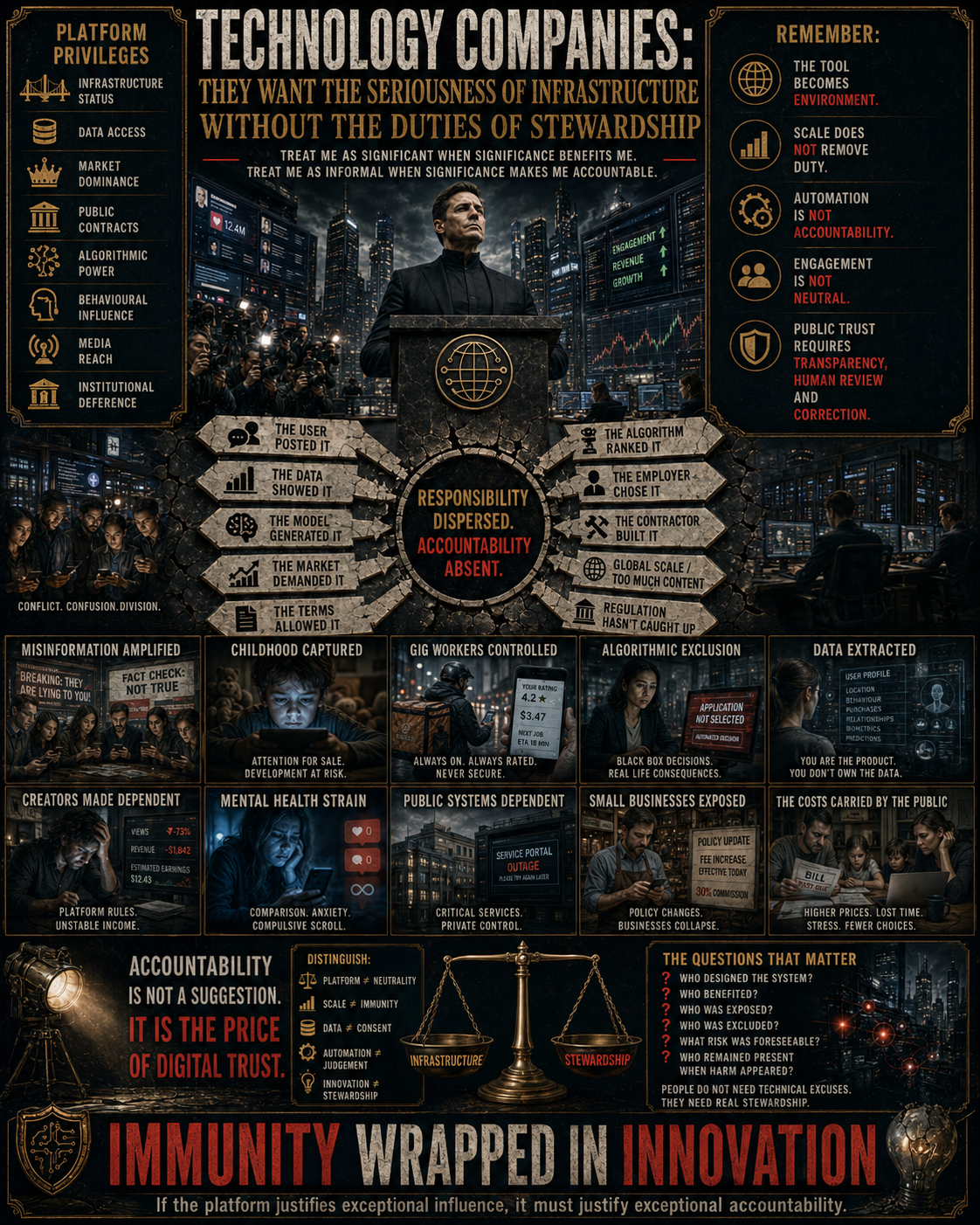
“Treat Us as Significant When Significance Benefits Us. Treat Us as Insignificant When Significance Makes Us Accountable.”
Humanity may be the largest example of an actor wanting the benefits of seriousness without accepting the full duties that seriousness creates.
We want to be treated as intelligent life.
Advanced life.
Conscious life.
Civilised life.
Technological life.
A species capable of language, science, art, memory, invention, imagination, philosophy, governance, medicine, architecture, mathematics, space exploration and moral reasoning.
We want to believe we are important.
That our existence means something.
That consciousness is rare.
That human life carries special value.
That our achievements deserve preservation.
That our culture deserves continuation.
That the universe would lose something if humanity disappeared.
We search the sky for signs of other intelligence.
We build telescopes.
Launch probes.
Map planets.
Listen for signals.
Study distant atmospheres.
Ask whether we are alone.
Imagine contact.
Prepare stories about arrival.
Wonder whether another civilisation is watching.
But we do not yet behave as though being found would create an examination.
We want the honour of being recognised as intelligent life without fully accepting that intelligence should be visible in how we care for life.
We want to be discovered.
But are we becoming worth discovering?
We want to meet something greater.
But are we preparing ourselves to be met?
We want the universe to recognise our significance.
But when significance creates duties towards one another, Earth, future generations, other species, our systems and the unknown, we retreat into limitation.
“We are only human.”
“That is just human nature.”
“People are selfish.”
“Conflict is inevitable.”
“The system is too complicated.”
“One person cannot change anything.”
“That is how the world works.”
“We have always done it this way.”
“We do not know what will happen.”
“We cannot be responsible for everything.”
Humanity wants to be treated as powerful enough to reshape the planet, but not powerful enough to be responsible for the planet reshaped.
Intelligent enough to control nature.
Not intelligent enough to anticipate consequence.
Advanced enough to create weapons capable of ending civilisation.
Not advanced enough to organise food, water, housing, health, education and safety for the civilisation those weapons supposedly protect.
Significant enough to imagine itself welcomed into a wider cosmic community.
Informal enough to behave as though the condition in which it arrives does not matter.
That is the contradiction.
If We Claim Intelligence, We Inherit the Duties of Intelligence
Intelligence is not only the ability to solve problems.
It is the ability to recognise which problems should never have been allowed to mature.
It is not only invention.
It is discernment.
Sequence.
Foresight.
Memory.
Restraint.
Integration.
The ability to connect action with consequence before consequence becomes irreversible.
A species should not be called intelligent merely because it can build powerful tools.
The deeper question is whether it can understand when, where, why and under what conditions those tools should be used.
A weapon is evidence of technical capability.
Preventing the conditions that make its use desirable is evidence of intelligence.
An algorithm is evidence of computation.
Knowing what should never be delegated to an algorithm is evidence of judgement.
Economic growth is evidence of production.
Knowing when production is destroying the conditions required for life is evidence of discernment.
Humanity often celebrates the first form while neglecting the second.
We confuse capability with wisdom.
Speed with progress.
Scale with maturity.
Dominance with advancement.
Complexity with intelligence.
But the ability to do more creates a greater duty to understand more.
The more influence a species possesses, the more responsibility it carries for where that influence lands.
We Are Already a Planetary Force
Humanity sometimes speaks as though it is merely living on Earth.
But we are no longer only inhabitants.
We are a planetary force.
We alter rivers.
Forests.
Soil.
Atmosphere.
Oceans.
Migration routes.
Food systems.
Species populations.
The chemistry of water.
The composition of air.
The temperature of cities.
The shape of coastlines.
The availability of habitats.
The future conditions of generations not yet born.
We extract from beneath the ground and distribute the consequences through the sky.
We create substances nature did not evolve to process at the speed and scale at which we produce them.
We make decisions in one country that alter bodies, weather, economies and ecosystems elsewhere.
That is not ordinary participation.
It is planetary influence.
And planetary influence creates planetary duty.
Humanity cannot claim dominion when extracting and insignificance when restoring.
We cannot behave as architects of Earth when profit is available and accidental visitors when damage appears.
If we possess the power to alter the conditions of life, then stewardship is not optional morality.
It is the operational duty attached to our scale.
The Unknown Creates Responsibility, Not Permission
We do not know what lies beyond Earth.
We do not know whether life elsewhere is common or rare.
We do not know whether other intelligences exist.
We do not know whether they have observed us.
We do not know whether anything is waiting for humanity to mature, discover, contribute, cooperate or become capable of entering a larger relationship.
We do not know what tomorrow will require from us.
We do not know what future crisis may arrive.
We do not know which knowledge humanity will need to preserve.
Which species may later prove essential.
Which culture carries a missing piece.
Which child may become necessary to a solution.
Which ecosystem is holding information we have not yet learned to read.
Which form of consciousness exists beyond our present instruments.
The unknown should therefore produce care.
Not recklessness.
Ignorance is not an exemption from responsibility.
It is one of the strongest reasons for caution.
When we do not understand the full system, we should be slower to destroy parts of it.
When we do not know what something may become, we should resist treating it as disposable.
When we do not know who may need us, we should become more capable of being needed.
When we do not know what is approaching, we should strengthen the conditions that allow us to respond intelligently.
Uncertainty does not mean nothing matters.
It means more may matter than we currently understand.
If Another Intelligence Reached Us, It Would Already Have Surpassed One of Our Limits
If an extraterrestrial civilisation reached Earth before humanity could reach it, then in at least one critical dimension it would possess capabilities beyond our own.
It would have crossed distances we have not crossed.
Solved problems we have not solved.
Maintained systems we have not maintained.
Coordinated knowledge, energy, time, survival and travel at a level we have not yet embodied.
That does not mean it would be morally perfect.
Technical advancement and ethical maturity are not automatically identical.
But its arrival would still create an undeniable asymmetry.
It achieved something humanity has not.
And humanity would immediately want to be evaluated generously.
We would want our art considered.
Our love.
Our families.
Our humour.
Our science.
Our courage.
Our capacity to learn.
Our potential.
We would not want to be judged only by our wars.
Our cruelty.
Our pollution.
Our exploitation.
Our inability to distribute basic resources.
Our treatment of the vulnerable.
Our destruction of other life.
We would say:
“We are still developing.”
“We contain many kinds of people.”
“Do not judge the whole species by its worst institutions.”
“We have achieved beautiful things.”
“We are capable of change.”
But if we would ask a higher intelligence to distinguish our potential from our failure, then we must begin proving that potential through behaviour.
We cannot rely on an imagined observer to see goodness that we refuse to organise materially.
What Would We Want to Present?
Would we want to present a species that creates abundance while allowing preventable hunger?
A species that understands medicine while making care inaccessible?
A species that can communicate instantly across continents while remaining unable to listen?
A species that studies consciousness while designing systems that fragment attention?
A species that reaches into space while poisoning the water beneath its own feet?
A species that claims every child matters while allowing childhood to be shaped by poverty, violence, exploitation and commercial capture?
A species that speaks of peace while financing permanent preparation for war?
A species that celebrates intelligence while rewarding manipulation?
A species that stores the knowledge of humanity digitally while allowing that knowledge to be controlled by a small number of private institutions?
A species that wants to be seen as advanced while repeatedly choosing what is profitable over what is survivable?
Or would we want to present a species that learned?
A species that recognised its destructive patterns before destruction became final.
A species that created systems proportionate to its intelligence.
A species that understood that power creates duty.
A species that protected diversity because it recognised the value of information it did not yet understand.
A species that reduced suffering not because suffering disappeared naturally, but because consciousness became organised enough to prevent it.
A species that arrived not only with technology, but with character.
Humanity Is Not Ready for Contact Merely Because It Can Detect a Signal
Readiness is not only scientific.
It is ethical.
Psychological.
Relational.
Systemic.
Would humanity respond to contact through curiosity or domination?
Cooperation or competition?
Would nations fight to control the information?
Would corporations attempt to monetise it?
Would religions claim ownership over its meaning?
Would governments hide what they knew?
Would media systems amplify fear because fear produces attention?
Would populations be prepared to encounter intelligence that does not affirm human centrality?
Would we listen?
Or would we project?
Would we recognise another consciousness?
Or attempt to translate it immediately into resources, weapons, markets and hierarchy?
A species is not ready for the unknown merely because it can observe the unknown.
Readiness requires the ability to meet difference without immediately converting difference into threat, property or control.
Our treatment of one another is already part of our preparation.
Our treatment of animals is part of our preparation.
Our treatment of cultures, bodies, minds and forms of intelligence different from the dominant form is part of our preparation.
The way humanity responds to difference on Earth reveals how it may respond to difference beyond Earth.
We Practise Cosmic Conduct Locally
Humanity does not need to wait for another civilisation to begin practising how it would behave towards one.
Every encounter with difference is preparation.
Every time we meet a person whose language, body, history, mind, culture or worldview differs from our own, we are practising whether intelligence can coexist without domination.
Every time a powerful institution encounters a less powerful person, humanity is rehearsing what it does with asymmetry.
Every time we discover a species with unexpected intelligence, emotion or social complexity, humanity is being asked whether it can revise its hierarchy.
Every time science reveals that life is more interconnected than previously understood, humanity is being asked whether knowledge will change conduct.
The cosmic test is already occurring in ordinary life.
Can we meet what is not us without reducing it?
Can we learn without conquering?
Can we hold power without exploitation?
Can we recognise intelligence outside familiar form?
Can we cooperate across difference?
Can we accept correction?
If not, advanced technology would only allow immature consciousness to travel farther.
A Species Can Become More Technologically Advanced While Remaining Developmentally Young
Humanity has accumulated enormous capability.
But capability can grow faster than maturity.
A child with a dangerous tool is not advanced because the tool is advanced.
The relationship between capacity and judgement matters.
Humanity can alter genes.
Create artificial intelligence.
Build nuclear weapons.
Track populations.
Manipulate attention.
Automate decisions.
Reach other worlds.
But can we regulate ourselves?
Can we stop when stopping is necessary?
Can we place continuity above immediate reward?
Can we act before harm becomes visible enough to threaten those with power?
Can we coordinate beyond national, corporate and ideological interests?
Can we admit that a system is failing before collapse forces admission?
A civilisation becomes dangerous when its tools grow faster than its consciousness.
The question is not only whether humanity will survive its inventions.
It is whether humanity can become the kind of intelligence that deserves to carry them forward.
Consciousness Creates Duties Beyond Survival
Life seeks survival.
But consciousness creates the possibility of responsibility.
A tree may transform its environment without moral deliberation.
A storm may destroy without intention.
A predator may kill without constructing a philosophy of justice around the act.
Humanity can anticipate.
Compare.
Remember.
Reflect.
Choose.
That capacity changes the standard.
Once we can understand that an action causes suffering, continuing the action is no longer morally identical to acting without knowledge.
Once we know pollution crosses generations, the future becomes part of the decision.
Once we know trauma can repeat through families, healing becomes a collective concern.
Once we know systems distribute risk unevenly, neutrality becomes harder to claim.
Consciousness is not only an experience.
It is an inheritance of duty.
The more aware we become, the less innocence we can claim.
Knowledge Without Embodiment Is an Incomplete Achievement
Humanity already knows much of what is wrong.
We know polluted air affects health.
We know unstable housing affects development.
We know hunger affects learning.
We know isolation affects wellbeing.
We know violence reproduces violence.
We know ecosystems are interconnected.
We know extreme inequality destabilises societies.
We know children absorb the conditions around them.
We know punishment without rehabilitation can reproduce harm.
We know extraction without restoration eventually collapses the source.
Our central problem is not always lack of information.
It is the distance between knowledge and embodiment.
Humanity often treats knowing as though knowing completes responsibility.
A report is published.
A warning is issued.
A target is announced.
A summit is held.
A statement is made.
Awareness is displayed.
But awareness without behavioural change is unfinished.
Knowledge becomes serious when it reorganises conduct.
The Planet Should Not Carry the Cost of Human Immaturity
Earth is often treated as the stage upon which human ambition occurs.
A source of land.
Fuel.
Water.
Minerals.
Food.
Waste capacity.
Humanity extracts from the planet as though Earth were passive background.
But Earth is not scenery.
It is the living condition that makes every human system possible.
Economies exist inside ecology.
Technology exists inside material extraction.
Governments exist inside territories made habitable by environmental systems.
Every market, institution and ideology is dependent upon air, water, soil, temperature and biological continuity.
Humanity cannot negotiate with a collapsed ecosystem in the way it negotiates with another institution.
Nature does not accept public relations.
It does not respond to intention.
It responds to conditions.
If we destroy the systems that hold life, no title, currency, law or belief can replace them.
The planet should not be required to absorb the consequences of our refusal to mature.
Other Species Are Not Disposable Because They Cannot Petition Us
Humanity has placed itself at the centre of moral consideration.
We ask whether other species are useful.
Profitable.
Beautiful.
Threatening.
Edible.
Trainable.
But their inability to participate in our institutions does not make their existence morally empty.
A species may disappear before humanity understands its ecological role.
An animal may experience suffering without having language we recognise.
An ecosystem may carry forms of intelligence that do not resemble human thought.
The unknown exists here too.
If we claim intelligence, we should be capable of protecting life whose full value we have not yet measured.
The inability of another being to demand accountability increases our duty.
It does not reduce it.
Future Generations Are Already Participants in Present Decisions
Future people cannot vote.
Cannot protest.
Cannot sue us yet.
Cannot refuse the debt, pollution, infrastructure or social architecture we leave behind.
But they will live inside our decisions.
We exercise power over people who do not yet exist.
That is one of the greatest asymmetries imaginable.
Humanity often treats the future as abstract because the future cannot interrupt the present.
But absence of present voice does not mean absence of future consequence.
A serious civilisation should ask:
What conditions are we handing over?
What knowledge are we preserving?
What risks are we expanding?
What resources are we exhausting?
What conflicts are we normalising?
What systems will future people be forced to repair before they can begin their own work?
Stewardship means not consuming tomorrow to make today appear successful.
Our Systems Are Expressions of Collective Consciousness
Governments.
Markets.
Schools.
Courts.
Religions.
Media.
Technology.
Families.
Corporations.
These systems do not arrive from outside humanity.
They are organised expressions of human priorities.
They reflect what we reward.
What we tolerate.
What we fear.
What we measure.
What we refuse to confront.
It is easy to speak of “the system” as though it is a separate species.
But systems are maintained through repeated human participation.
People design them.
Fund them.
Obey them.
Benefit from them.
Defend them.
Stay silent inside them.
That does not mean every individual carries equal power.
They do not.
But collective architecture is still human architecture.
Humanity cannot blame its systems forever without examining the consciousness that repeatedly rebuilds them in familiar forms.
The Individual Is Not Powerless Merely Because the Whole Is Large
One person cannot carry humanity alone.
That is true.
Responsibility must be proportionate to power, knowledge, role and capacity.
But “I cannot do everything” is often used to justify doing nothing.
The individual still influences:
What they reward.
What they normalise.
What they purchase.
What they repeat.
What they challenge.
What they teach.
What they tolerate.
What they create.
How they use authority.
How they treat those with less power.
Whether they repair harm.
Whether they tell the truth.
Whether they remain present.
No person controls the whole.
But every person contributes to the field in which the whole becomes possible.
Individual responsibility is not the fantasy that one person can solve everything.
It is the refusal to become an unnecessary contributor to what is already failing.
Self-Responsibility Is Not Isolation
Humanity sometimes confuses self-responsibility with carrying everything alone.
But self-responsibility includes knowing when to ask for help.
When to learn.
When to join.
When to follow.
When to lead.
When to admit limitation.
When to stop projecting an internal wound onto the world.
When to recognise that personal healing has collective consequence.
A person who regulates themselves reduces the emotional burden placed upon others.
A person who examines inherited prejudice reduces the probability of reproducing it.
A person who repairs harm interrupts continuity.
A person who develops discernment becomes less available for manipulation.
Self-responsibility is not withdrawal from the collective.
It is preparation to participate in the collective without making everyone else carry what we refuse to examine.
Humanity Cannot Demand Unity While Punishing Difference
Humanity often calls for unity during crisis.
But unity cannot mean uniformity.
A species may need shared purpose without requiring identical identity.
Different cultures.
Different minds.
Different capacities.
Different ways of understanding.
Different forms of contribution.
Unity becomes dangerous when it is used to silence disagreement, protect hierarchy or force everyone into one model.
A mature humanity would not erase difference.
It would coordinate difference.
It would know what must be shared and what must remain distinct.
What requires convergence.
What requires autonomy.
What needs common standards.
What needs local expression.
The strength of a species may lie not in becoming the same, but in becoming capable of relationship across difference.
Humanity Must Learn to Distinguish Freedom From Consequence-Free Behaviour
Freedom matters.
Thought.
Expression.
Movement.
Belief.
Association.
Creation.
But freedom is not the right to externalise every consequence.
A person may choose.
Others may still be affected.
A company may innovate.
The public may still carry risk.
A nation may develop.
The atmosphere may still absorb emissions.
One generation may consume.
Another may inherit scarcity.
Serious freedom includes responsibility for where one’s choices land.
Without consequence, freedom becomes privilege exercised against those with less power to refuse the result.
The Strongest Should Not Be the Least Accountable
Human systems often invert responsibility.
The person with the least power must explain everything.
The applicant.
The patient.
The worker.
The accused.
The tenant.
The child.
The citizen.
Meanwhile, those with the most resources distribute responsibility through departments, contracts, policies, legal structures and complexity.
A serious humanity would reverse this pattern.
The greater the power, the greater the duty.
The greater the knowledge, the greater the obligation to anticipate.
The greater the access, the greater the responsibility not to exploit.
The greater the influence, the greater the duty to remain present when consequences appear.
Power should not purchase distance from consequence.
It should create greater proximity to it.
Humanity Should Be Measured by What It Prevented
We celebrate response.
The rescue.
The breakthrough treatment.
The emergency funding.
The rebuilding.
The conviction.
The relief campaign.
Those actions matter.
But the higher intelligence is prevention.
The disease that did not spread.
The child who did not enter crisis.
The conflict that did not become war.
The species that did not disappear.
The family that did not become homeless.
The river that did not require restoration because pollution never entered it.
The technology that was not deployed before safety existed.
Prevention is difficult to dramatise because success is an absence.
But absence of harm is one of civilisation’s greatest achievements.
Humanity should become proud not only of what it can repair.
It should become proud of what it became wise enough not to damage.
Our Greatest Failure May Be Normalisation
Human beings adapt.
That capacity helps us survive.
But adaptation can also make intolerable conditions appear ordinary.
Homelessness becomes part of the city.
War becomes part of the news.
Pollution becomes part of the landscape.
Burnout becomes part of work.
Loneliness becomes part of adulthood.
Fear becomes part of childhood.
Administrative humiliation becomes part of receiving help.
We learn to function around what should have been corrected.
Normalisation allows harm to continue without requiring anyone to defend it openly.
A serious humanity should repeatedly ask:
What have we become accustomed to that should never have become normal?
We Cannot Wait for Catastrophe to Become Cooperative
Humanity often coordinates most intensely when danger becomes undeniable.
War.
Pandemic.
Disaster.
Collapse.
Resources appear.
Rules change.
Institutions cooperate.
Innovation accelerates.
This proves that large-scale coordination is possible.
But it reveals a problem in our hierarchy of urgency.
Why must harm become catastrophic before cooperation becomes reasonable?
Why must people die before systems become flexible?
Why must failure become public before responsibility becomes clear?
A mature species would not require terror to access its collective intelligence.
It would coordinate because the consequence was foreseeable.
Survival Is Not the Highest Standard
Humanity may survive while remaining unjust.
Technologically capable.
Environmentally depleted.
Psychologically fragmented.
Spiritually vacant.
A species can continue biologically while losing the conditions that make continuation meaningful.
The goal should not be mere persistence.
It should be worthy continuity.
A humanity capable of creating beauty without requiring hidden suffering.
Capability without domination.
Abundance without extraction.
Authority without immunity.
Intelligence without arrogance.
Progress without forgetting what must be preserved.
Earth May Be Our First Examination
Before humanity asks whether it is ready for the universe, it should ask whether it has passed the responsibility of Earth.
Can we care for one inhabited world?
Can we coordinate across borders when the atmosphere ignores borders?
Can we protect life that cannot vote?
Can we leave resources for people not yet born?
Can we organise abundance without producing unnecessary deprivation?
Can we use knowledge before catastrophe forces us to?
Earth may not merely be our home.
It may be our first examination of whether consciousness can become stewardship.
If humanity cannot care for the living system that produced it, why should it be trusted with other worlds?
Why should expansion be treated as advancement if we carry the same unexamined patterns outward?
A civilisation should not export its immaturity into space.
Space Exploration Must Not Become Colonialism With Better Machinery
Humanity often imagines space through conquest.
Colonisation.
Extraction.
Ownership.
Territory.
Resources.
We speak of inhabiting new worlds before fully learning how to care for this one.
Exploration can expand knowledge.
Inspire cooperation.
Reveal our place within a larger universe.
But if the consciousness entering space remains organised around domination, then space travel may simply extend old patterns across greater distances.
The question is not only whether humanity can reach another planet.
It is what humanity will become when it arrives.
Will we observe?
Listen?
Protect?
Or immediately classify everything according to commercial usefulness?
Advanced travel without advanced ethics is only enlarged reach.
We Should Prepare to Be of Value
Humanity often asks what the universe may contain for us.
Resources.
Knowledge.
Life.
Technology.
Answers.
But what would humanity offer?
What have we learned that is worth carrying?
What forms of beauty?
What understanding of suffering?
What methods of healing?
What knowledge of relationship?
What wisdom produced through diversity?
What evidence that conflict can become cooperation?
What contribution could we make to a wider field of intelligence?
To be of value, humanity must become more than curious.
We must become reliable.
Capable of receiving without immediately exploiting.
Capable of learning without erasing.
Capable of holding power without making power the purpose.
The unknown may not be waiting for us.
But if anything is, we should prepare to arrive with more than appetite.
We Do Not Know Who Is Waiting for Humanity to Become Itself
Perhaps no one is waiting.
Perhaps life beyond Earth is absent.
Perhaps it is distant.
Perhaps it is abundant.
We do not know.
But humanity is still being waited upon by the future.
By children not yet born.
By solutions not yet created.
By ecosystems requiring restoration.
By people whose capacity remains buried beneath preventable conditions.
By knowledge that cannot emerge while survival consumes all available energy.
By forms of cooperation that require a higher level of trust.
Someone is waiting for the work we have not yet done.
Someone needs the medicine not yet discovered.
The institution not yet built.
The truth not yet spoken.
The pattern not yet interrupted.
The courage not yet organised.
The fact that we cannot identify them does not make their need unreal.
Humanity Must Become Capable of Receiving Correction
A species that cannot receive correction cannot mature.
We defend identity.
Nation.
Religion.
Institution.
Profession.
History.
We treat criticism as attack.
Evidence as humiliation.
Change as defeat.
But correction is not proof that humanity is worthless.
It is evidence that humanity remains capable of learning.
To say that a system caused harm does not erase every good thing it produced.
To say that a civilisation has failed in an area does not require denying all achievement.
Maturity is the ability to hold both.
We created beauty.
We also created suffering.
We developed knowledge.
We also ignored knowledge.
We possess extraordinary potential.
We also carry dangerous patterns.
Truth does not need to flatter humanity in order to value humanity.
Humanity Must Be Able to Separate Worth From Infallibility
We often resist accountability because we believe error threatens worth.
If humanity admits cruelty, perhaps humanity is not good.
If an institution admits failure, perhaps it loses legitimacy.
If a person admits harm, perhaps they become irredeemable.
But worth and infallibility are not the same.
A species can be valuable and unfinished.
Powerful and immature.
Beautiful and dangerous.
Capable of love and capable of destruction.
The purpose of accountability is not to prove that humanity should disappear.
It is to ensure that what is valuable in humanity is not destroyed by what humanity refuses to correct.
The Humanity Seriousness Test
Whenever humanity asks to be treated as intelligent, advanced or significant, ask:
What privileges does that seriousness give us?
Dominion over resources.
Technological power.
Authority over other species.
The ability to reshape Earth.
The ability to store and direct knowledge.
The power to create and destroy at scale.
The expectation that human life should be protected.
The belief that our civilisation deserves continuation.
The desire to enter space.
The hope of being recognised by other intelligence.
Then ask:
What duties should accompany those privileges?
Stewardship.
Foresight.
Restraint.
Prevention.
Care.
Truth.
Correction.
Protection of the vulnerable.
Protection of Earth.
Responsibility to future generations.
Respect for life whose full value we do not yet understand.
The development of systems worthy of our claimed intelligence.
The willingness to remain present when harm appears.
Then ask:
Do we accept both, or only the side that benefits us?
Do we want intelligence without discernment?
Power without stewardship?
Consciousness without responsibility?
Innovation without prevention?
Freedom without consequence?
Progress without continuity?
Dominion without care?
Space exploration without planetary maturity?
Recognition from the universe without evidence that we can recognise one another?
The right to call ourselves advanced without accepting responsibility for what advancement has produced?
That is the test.
The Humanity Accountability Matrix
A serious evaluation should ask:
- What power does humanity possess?
- What harm can humanity foresee?
- What knowledge already exists?
- Where has knowledge failed to change behaviour?
- What systems reward destruction?
- What systems punish care?
- Which harms have become normal?
- Who carries consequences without having chosen them?
- Which species and ecosystems cannot represent themselves?
- What are future generations being forced to inherit?
- Which technologies are advancing faster than human judgement?
- Which decisions are irreversible?
- What should be prevented before scale makes correction impossible?
- Does innovation increase human capability or merely institutional control?
- Do our systems produce mature people or dependent consumers?
- Does education cultivate discernment or only compliance?
- Does leadership protect continuity or only its own term?
- Does wealth serve life or extract from it?
- Does justice reduce harm or process it?
- Does technology strengthen consciousness or fragment it?
- Does religion deepen accountability or shield authority?
- Do relationships increase agency or organise dependency?
- Are children becoming more capable of thinking, caring and cooperating?
- Is Earth becoming more habitable because of human intelligence?
- Are we preserving knowledge, biodiversity and cultural memory?
- Can humanity cooperate before catastrophe?
- Can we receive correction without treating it as annihilation?
- Are we becoming safer to encounter?
- Are we becoming capable of encountering something greater without trying to control it?
- Given our intelligence, resources, history and collective capacity, what should life on Earth reasonably look like by now?
These questions do not begin with hatred of humanity.
They begin with possibility.
Capacity.
Continuity.
Consequence.
Criticising Humanity Is Not Rejecting Humanity
To examine humanity is not to despise it.
To expose destructive patterns is not to deny human beauty.
To question civilisation is not to reject civilisation.
To demand stewardship is not to reject progress.
To ask whether humanity is ready for the universe is not to declare that humanity has no place within it.
Humanity is too consequential to be protected from examination.
Love without truth becomes protection of the pattern.
Hope without accountability becomes fantasy.
The goal is not to diminish humanity.
It is to help humanity become proportionate to its own potential.
The Highest Form of Human Accountability
The highest form of accountability does not ask only:
“Did humanity survive?”
It asks:
Given the consciousness, intelligence, resources, memory, creativity and planetary influence humanity possesses, what should life on Earth reasonably have become by now?
How little preventable suffering should remain?
How secure should children be?
How clean should water be?
How protected should ecosystems be?
How accessible should knowledge be?
How mature should leadership be?
How capable should people be of discernment?
How much conflict should still require violence?
How much abundance should still coexist with deprivation?
How often should humanity need catastrophe before it cooperates?
How prepared should we be for uncertainty?
How responsibly should we approach space?
How safe should another intelligence find us?
Would it find a species organised around life?
Or a species organised around extraction?
Would it find consciousness embodied?
Or intelligence trapped beneath appetite, fear and status?
Would it find a civilisation ready to contribute?
Or one still expecting the universe to solve the consequences it refused to prevent?
That question reveals the distance between human capacity and human embodiment.
And that distance is where responsibility lives.
The Pattern Beneath Humanity
Humanity wants:
Authority.
Recognition.
Significance.
Influence.
Knowledge.
Dominion.
Continuation.
Protection.
Access.
Expansion.
Freedom.
The right to call itself intelligent.
The right to enter the wider universe.
But may resist:
Stewardship.
Transparency.
Explanation.
Care.
Prevention.
Correction.
Restraint.
Proportional contribution.
Measurable improvement in life.
Accepting consequences.
Protecting what it does not yet understand.
Remaining present when harm appears.
This is selective seriousness.
Seriousness when intelligence gives humanity status, power and cosmic significance.
Informality when intelligence creates responsibility for Earth, one another, future generations and the unknown.
Closing: Immunity Wrapped in Intelligence
Seriousness is not a satellite.
A telescope.
A flag planted somewhere distant.
A scientific paper.
A weapon.
A market.
A city.
A civilisation that calls itself advanced.
Seriousness is the willingness to carry the full weight of consciousness.
If humanity claims intelligence, it inherits discernment.
If it claims power, it inherits restraint.
If it alters Earth, it inherits stewardship.
If it creates systems, it inherits responsibility for what those systems repeatedly produce.
If it speaks for life, it must protect life that cannot speak through human institutions.
If it wants a future, it must stop consuming the foundations of the future.
If it wants to meet higher intelligence, it must develop beyond technical capability into moral and relational maturity.
If it wants to enter space, it must not carry unexamined domination into the unknown.
We do not know what lies outside.
We do not know what comes tomorrow.
We do not know who may be waiting for humanity to become capable of something it cannot yet imagine.
That ignorance should not make us careless.
It should make us responsible.
We should become the best individuals we can be.
The best communities we can build.
The most coherent systems we can design.
The most discerning species we can become.
Not because another intelligence is certainly watching.
Not because the universe is guaranteed to reward us.
But because consciousness should not require an audience before it accepts its duties.
Humanity cannot ask to be recognised as intelligent life while behaving as though intelligence imposes no serious obligation.
We cannot want the universe to see our potential while refusing to embody it here.
We cannot claim significance and externalise consequence.
We cannot ask for continuity while destroying its conditions.
The species that wants to be taken seriously but rejects serious responsibility is not asking to be recognised as advanced.
It is asking for immunity wrapped in intelligence.
And humanity has been protected by that wrapping for far too long.
The universe may be silent.
The future is not.
Earth is already answering us through consequence.
The question is whether humanity will become intelligent enough to listen.



Leave a Reply