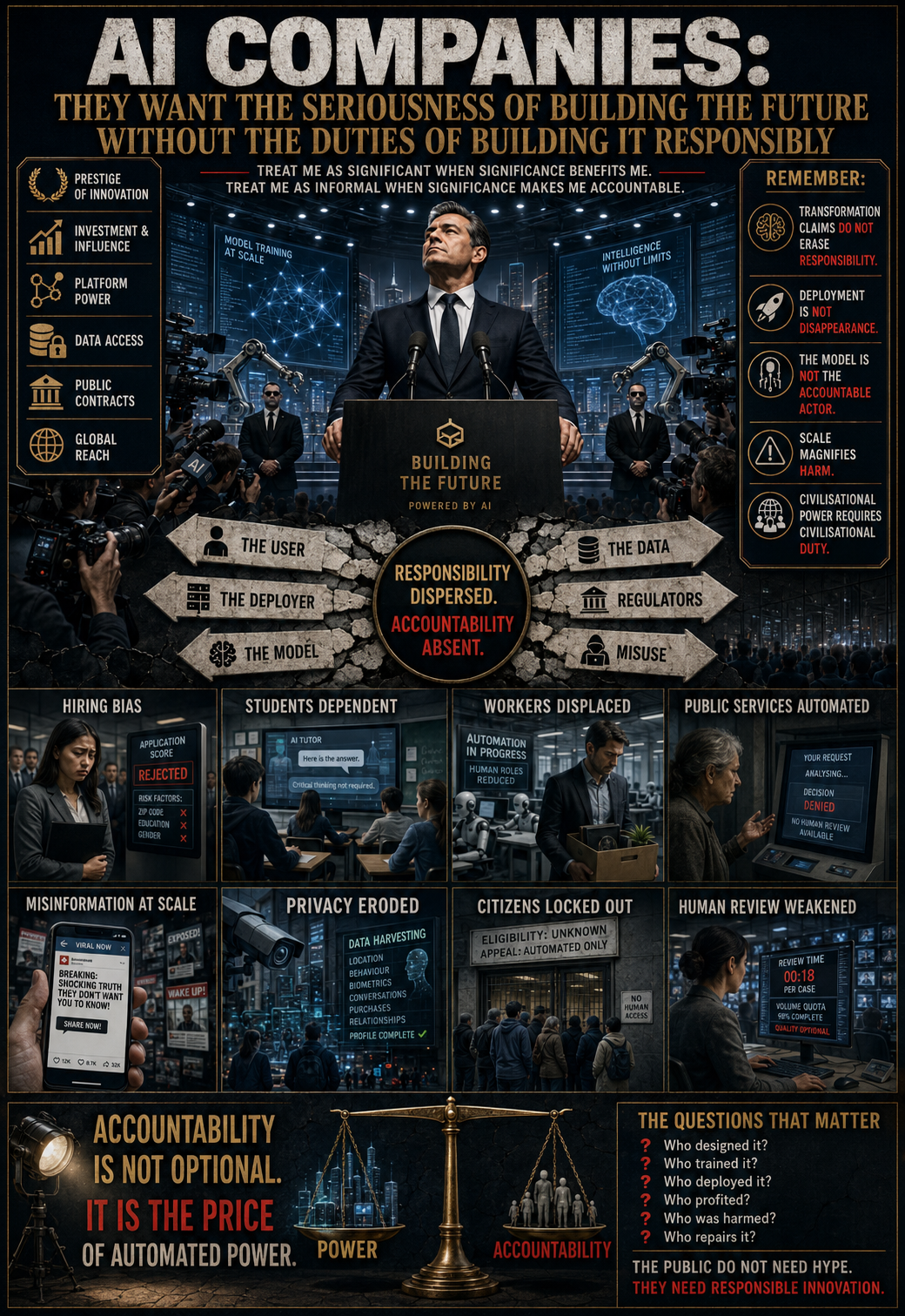
“Treat Me as Significant When Significance Benefits Me. Treat Me as Informal When Significance Makes Me Accountable.”
AI companies may be one of the clearest examples of institutions wanting the benefits of seriousness without accepting the full duties that seriousness creates.
They want to be treated as builders of the future.
Architects of a new era.
Accelerators of science.
Transformers of medicine.
Reinventors of education.
Redesigners of work.
Partners to government.
Tools of discovery.
Engines of productivity.
Systems capable of changing how humanity thinks, creates, communicates, learns, diagnoses, hires, governs and makes decisions.
They ask for investment.
Public contracts.
Research access.
Data.
Regulatory flexibility.
Institutional trust.
Market access.
Integration into schools, hospitals, courts, workplaces, public services and critical infrastructure.
They speak in civilisational language.
AI will transform everything.
AI will reshape society.
AI will unlock new knowledge.
AI will increase human capability.
AI will solve problems at a scale people cannot reach alone.
AI will become foundational.
That is the seriousness they claim.
But when an AI system produces discrimination, error, dependency, exclusion, misinformation, employment disruption, privacy loss, unsafe advice or unexplainable decisions, responsibility often begins moving elsewhere.
The user prompted it incorrectly.
The employer deployed it badly.
The institution failed to review the output.
The data contained bias.
The model is probabilistic.
The system was never intended for that use.
The customer misunderstood its limitations.
The regulator had not yet created the right rules.
The technology is still developing.
The AI itself produced the answer.
The same company that presents the system as capable enough to transform civilisation may suddenly describe it as only a tool.
Powerful enough to redesign the future.
Not responsible enough to answer for what that redesign produces.
That is selective seriousness.
The Greater the Claim, the Greater the Duty
If a company claims it is building a tool for casual experimentation, the responsibility attached to it differs from a company seeking integration into medicine, education, employment, justice or government.
The claim determines the standard.
If AI will influence medical decisions, the standard must include safety, evidence, explainability, correction and human accountability.
If AI will shape education, the standard must include developmental appropriateness, intellectual independence, privacy and protection from dependency.
If AI will screen applicants, the standard must include fairness, transparency, appeal and meaningful human review.
If AI will assist public administration, the standard must include legal responsibility, access, explanation and protection against automated exclusion.
If AI companies claim civilisational importance, they inherit civilisational duty.
They cannot use the scale of their ambition to attract capital and legitimacy while using the uncertainty of the technology to escape accountability.
The greater the claim, the greater the duty.
They Want to Be Infrastructure Until Infrastructure Creates Obligation
AI companies increasingly describe their systems as foundational.
A new layer beneath business.
Government.
Education.
Science.
Communication.
Administration.
Human creativity.
They want their models integrated everywhere.
They want institutions to build around them.
They want users to become dependent on them.
They want their tools to become difficult to remove because so many processes begin relying on them.
But infrastructure carries duties.
Reliability.
Continuity.
Security.
Accessibility.
Maintenance.
Transparency.
Redress.
Public-interest consideration.
An infrastructure provider cannot behave as though every consequence belongs only to the end user.
If the system becomes part of the environment, the company is no longer merely selling a tool.
It is shaping the conditions inside which other people act.
A Tool Can Still Create an Environment
The defence “AI is only a tool” is incomplete.
A hammer is a tool.
A calculator is a tool.
But AI systems increasingly influence what people see, what they write, which applicants are selected, which risks are flagged, which information appears credible, which decisions are recommended and which paths become administratively possible.
At sufficient scale, the tool becomes environment.
It starts shaping the assumptions through which people work.
The teacher relies on it.
The recruiter relies on it.
The doctor relies on it.
The citizen relies on it.
The public body relies on it.
The decision-maker may stop seeing where the system ends and their own judgement begins.
The company cannot benefit from this level of integration while denying responsibility for the dependency it creates.
The Model Cannot Carry Moral or Legal Responsibility
An AI system cannot accept accountability.
It cannot apologise meaningfully.
It cannot repair harm.
It cannot testify to its own intention.
It cannot carry legal duty in the human sense.
It cannot decide to restore someone’s lost opportunity.
It cannot compensate a person.
It cannot stand before the public and explain why a preventable consequence was allowed to occur.
The model may generate language about responsibility.
That is not the same as possessing responsibility.
Therefore, responsibility must remain attached to human and institutional actors.
Who designed the system?
Who trained it?
Who selected the data?
Who approved the deployment?
Who integrated it?
Who profited?
Who set the threshold?
Who ignored the warning?
Who failed to create an appeal route?
Who chose to replace human judgement?
The machine cannot become the point at which accountability disappears.
The User Cannot Carry the Whole Consequence
AI companies often place heavy responsibility on users.
Users must verify.
Users must not rely blindly.
Users must understand limitations.
Users must use the system appropriately.
Some of that is reasonable.
People should not treat AI output as unquestionable truth.
But the user does not possess the same information as the company.
They do not know every training source.
Every known weakness.
Every internal test result.
Every design choice.
Every safety trade-off.
Every limitation discovered before release.
The company knows more.
The company controls more.
The company benefits more.
Therefore, the company owes more.
Responsibility should follow knowledge, control, benefit and capacity.
Terms and Conditions Cannot Carry the Whole Duty
A company may disclose that outputs can be wrong.
That the system should not be relied upon for high-stakes decisions.
That users are responsible for verification.
Those disclosures matter.
But a disclaimer does not erase the foreseeable way the product is actually used.
If the company markets productivity, intelligence, accuracy, transformation and professional usefulness, it knows people will rely on the system.
If it encourages integration into workflows, it knows outputs may influence real decisions.
If it sells enterprise access, it knows institutions may deploy it at scale.
The company cannot advertise capability in bold language and hide limitation in fine print.
The whole communication must be coherent.
The Deploying Institution Is Responsible Too
Responsibility should not be placed on the AI company alone.
The employer that uses AI to reject applicants is responsible.
The hospital that uses AI to assist diagnosis is responsible.
The school that integrates it into learning is responsible.
The government that uses it in public administration is responsible.
The company that replaces staff with it is responsible.
But shared responsibility should not become absent responsibility.
The AI developer cannot point to the deployer.
The deployer cannot point to the vendor.
The vendor cannot point to the model.
The model cannot answer.
A serious system requires a responsibility map before deployment.
Who is accountable for design?
Who is accountable for implementation?
Who reviews errors?
Who handles appeals?
Who compensates harm?
Who can suspend the system?
Who remains legally answerable?
If nobody can answer clearly, the system is not ready for consequential use.
Efficiency Does Not Prove Intelligence
AI companies often sell efficiency.
Faster decisions.
Lower costs.
Greater output.
Automation.
Scale.
But efficiency is not automatically intelligence.
A system can process more decisions while making the underlying judgement worse.
It can reject applicants faster.
Produce misinformation faster.
Remove human access faster.
Standardise bias faster.
Create dependency faster.
The speed of the system may conceal the quality of the result.
The correct question is not only:
“How much faster is it?”
It is:
“What is it accelerating?”
Scale Magnifies Error
A human professional may make one poor decision.
An automated system can repeat the same error across thousands or millions of people.
That is one reason AI requires heightened responsibility.
Automation does not merely reduce labour.
It multiplies decisions.
A small flaw becomes a structural pattern.
A hidden bias becomes mass exclusion.
An inaccurate assumption becomes standard procedure.
A poorly designed threshold becomes policy in practice.
Scale turns error into environment.
The company cannot celebrate scale as a benefit while treating scale as irrelevant when harm spreads.
Bias Is Not Only a Data Problem
AI companies may say bias comes from the data.
Society is biased.
Historical records contain inequality.
The model reflects the world.
That may be true.
But reflecting injustice is not neutral when the system is used to make new decisions.
The design process still contains choices.
Which data was selected?
Which outcomes were defined as success?
Which variables were included?
Which proxies were permitted?
Which groups were underrepresented?
Which errors were considered acceptable?
Whose harm was treated as statistically tolerable?
Bias is not simply inherited.
It is also governed.
Accuracy for Whom?
AI systems are often promoted through aggregate accuracy.
But averages can hide unequal failure.
A system may perform well overall while failing particular groups repeatedly.
A medical model may be accurate for one population and weaker for another.
A voice system may understand one accent more reliably.
A recruitment model may disadvantage people whose careers do not follow conventional patterns.
A serious company should not ask only:
“How accurate is the system?”
It should ask:
“For whom is it accurate?”
“Who experiences the errors?”
“Who carries the cost when it is wrong?”
The Person Harmed Needs More Than a Statistical Explanation
A company may say the error rate is low.
But the person denied employment, housing, treatment, credit or public service experiences the error as complete.
Aggregate performance does not remove individual consequence.
Where AI is used in consequential decisions, the person should have:
Notice.
Explanation.
A human route.
Appeal.
Correction.
Access to relevant records.
The possibility of restoration.
A low error rate is not a substitute for redress.
Human Review Must Be Real
Many systems claim to retain a human in the loop.
But human review can be symbolic.
The reviewer may see only the AI summary.
They may lack time.
They may assume the system is more objective.
They may fear departing from the recommendation.
They may click approve because the process is designed around automation.
A human being being present does not prove meaningful review.
Real human review requires authority to disagree.
Access to underlying information.
Time.
Training.
Independence.
A route to correct the outcome.
Otherwise, the human becomes a ceremonial signature beneath an automated decision.
Automation Can Weaken Human Judgement
The more people rely on AI, the less they may practise the skills the system performs.
Writing.
Research.
Memory.
Diagnosis.
Navigation.
Interpretation.
Critical thought.
Decision-making.
This does not mean AI should not be used.
Tools have always changed skill.
But dependency should be examined.
Does the system expand human capability?
Or replace it?
Does it help the user think?
Or remove the need to think?
Does it preserve expertise?
Or hollow it out?
A serious AI company should consider not only what the system can do for people, but what repeated use may make people less able to do without it.
Education Cannot Become Intellectual Outsourcing
AI can support learning.
Explain difficult ideas.
Generate practice.
Translate.
Assist research.
But it can also make students dependent on generated answers.
The student may submit work without understanding it.
Teachers may use AI to evaluate AI-produced assignments.
Education becomes a loop of automated production and automated assessment.
The appearance of learning remains.
Development weakens.
A serious educational deployment should ask whether the student becomes more capable after using the system.
The purpose is not to complete the work.
It is to develop the person.
Workplace AI Cannot Only Be Evaluated Through Productivity
Companies may use AI to monitor, score, rank, schedule or replace workers.
The business gains data and efficiency.
The worker may lose privacy, autonomy, entry routes or security.
A serious deployment should examine:
What surveillance occurs?
Can workers challenge the score?
What data is collected?
What happens when the system is wrong?
Who benefits from the efficiency?
Are gains shared?
What pathways exist for displaced workers?
Innovation cannot be judged only from the perspective of the employer.
AI Companies Cannot Build Replacement and Outsource Transition
If AI reduces employment, the human consequence cannot be treated as someone else’s problem.
Governments have responsibility.
Employers have responsibility.
Educational institutions have responsibility.
But AI companies also shape the pace and direction of replacement.
They lobby for adoption.
Market labour reduction.
Promote automation.
Seek integration.
They cannot claim ownership over productivity gains while disowning the social transition.
A serious builder of the future should help build pathways into that future.
Training.
New forms of work.
Public-interest investment.
Transition funding.
Human-centred redesign.
The future cannot be declared successful merely because the machine performs the task.
Public Money Creates Public Duty
Where AI companies receive government contracts, research support, infrastructure access or public data, the public relationship becomes more serious.
The system should not become privately controlled while public institutions and public information made it possible.
Who owns the resulting capability?
Who has access?
What happens if the company changes terms?
What happens if the service is withdrawn?
Can the public audit the system?
Can the government explain decisions made through it?
Public money should not finance private dependency without public control.
Data Is Not a Weightless Resource
AI systems depend on data.
Text.
Images.
Voices.
Behaviour.
Work.
Creative expression.
Human history.
But data is often spoken of as though it simply exists for collection.
Behind data are people.
Writers.
Artists.
Workers.
Communities.
Patients.
Students.
Citizens.
The question is not only whether data can technically be accessed.
It is whether the use is transparent, lawful, proportionate and fair.
Who created the material?
Who benefited from its use?
Who was compensated?
Who consented?
Who can withdraw?
Who can challenge inaccurate representation?
AI companies cannot treat human output as raw material while presenting their own products as protected property.
The Company Cannot Claim the Intelligence and Deny the Inputs
AI companies may describe their models as innovative achievements.
That is fair.
Engineering, research and design create real value.
But the systems also depend on enormous bodies of human knowledge and labour.
Researchers.
Annotators.
Moderators.
Writers.
Artists.
Developers.
Users.
Public institutions.
The model is not created from nothing.
A serious account of innovation should include the field from which the innovation emerged.
Hidden Labour Is Still Labour
AI may appear automated.
But many systems depend on human work.
Data labelling.
Content moderation.
Evaluation.
Safety testing.
Correction.
Customer support.
Some of this labour may be outsourced, low-paid or psychologically harmful.
The polished interface can hide the people maintaining it.
A company cannot present AI as effortless intelligence while ignoring the labour that makes it usable.
Safety Cannot Be a Marketing Department
AI companies speak about safety.
Alignment.
Responsible AI.
Trust.
Ethics.
These words attract legitimacy.
But seriousness requires structure.
Independent testing.
Adversarial evaluation.
Incident reporting.
Clear thresholds for withholding deployment.
Transparent correction.
Protection for internal critics.
Authority for safety teams.
If safety exists mainly as public language while commercial pressure determines release, then safety becomes branding.
Speed Can Become an Accountability Excuse
The industry often says development is moving too quickly for regulation.
But speed is partly produced by the companies themselves.
Competitive pressure.
Rapid release.
Market capture.
Investment expectations.
The company cannot accelerate deployment, then use the speed it created as a reason why accountability cannot keep up.
If the technology moves quickly, the duty to build safeguards early becomes greater.
Urgency in innovation should be matched by urgency in responsibility.
“We Are Still Learning” Is Not Enough at Scale
Emerging technology contains uncertainty.
No company can know every effect in advance.
But uncertainty does not justify unrestricted deployment.
The more uncertain the system, the more carefully the context should be chosen.
Testing environments.
Limited use.
Monitoring.
Reversibility.
Clear warnings.
Human oversight.
A company cannot experiment on society at scale while treating society’s harm as part of the learning process.
People are not merely test data.
Society Should Not Carry the Cost of Private Experimentation
If a company gains profit from early deployment while the public carries misinformation, job loss, discrimination, educational disruption or administrative exclusion, the risk has been transferred.
The company owns the upside.
Society absorbs the uncertainty.
That is not balanced innovation.
A serious system should align reward and consequence.
If the public carries the risk, the public should have power over the conditions.
AI Can Create the Appearance of Objectivity
People may assume a machine is neutral.
That it has no emotion.
No prejudice.
No self-interest.
But AI systems reflect design choices, training material, institutional priorities and human definitions.
The output may look clean, mathematical and impersonal.
That appearance can make it more persuasive than it deserves to be.
A serious company should not market AI as objective where the system is actually probabilistic, contextual and dependent on human choices.
Explanation Is Part of Accountability
Some AI systems are difficult to explain.
But opacity does not remove duty.
If a system cannot provide a meaningful explanation for a consequential outcome, that may be a reason not to use it in that context.
A person should not lose a job opportunity, benefit, loan, treatment or legal position because a system produced a score nobody can explain.
The burden should not fall on the person to prove the machine was wrong.
The institution using the machine should prove the decision was justified.
The Company Cannot Hide Behind Trade Secrecy Where Public Rights Are Affected
Intellectual property matters.
Companies need protection for legitimate innovation.
But where AI affects public rights, employment, healthcare, education or government services, total opacity becomes dangerous.
There must be enough transparency for accountability.
What kind of data was used?
What categories influence the outcome?
What error patterns exist?
How is the system audited?
How can a person challenge the result?
Trade secrecy should not become a blanket exemption from public duty.
Correction Must Travel Through the System
AI companies update models.
Fix errors.
Change safeguards.
But correction must reach the people affected.
Was the wrong decision reversed?
Was the false information removed?
Was the person informed?
Was the institutional record corrected?
Was compensation available?
Technical correction is not complete if the human consequence remains.
The model may be fixed while the person still carries the damage.
Version Change Must Not Erase Historical Responsibility
AI systems evolve quickly.
A company may say the current model no longer behaves that way.
That may be true.
But the previous harm still matters.
A new version does not erase responsibility for the old one.
The company should preserve records.
Investigate incidents.
Learn publicly where appropriate.
Repair consequences.
Rapid iteration should not become rapid forgetting.
AI Companies May Become More Powerful Than Their Formal Role Suggests
A company may say it is a software provider.
But if governments, schools, hospitals and businesses depend on its systems, it acquires structural influence.
It may shape policy without being elected.
Education without being a university.
Employment without being an employer.
Public information without being a media institution.
Its formal category remains narrow.
Its functional reach becomes broad.
That gap creates responsibility.
The company should be judged by what it actually shapes, not only by the label under which it operates.
Private Governance Can Emerge Through Product Design
AI companies set rules.
What the system refuses.
What it permits.
What data it stores.
What behaviour it rewards.
Which language it recognises.
Which risks it prioritises.
These are governance decisions.
They shape user behaviour and institutional possibility.
When a private company sets conditions for millions of people, product design becomes a form of governance.
The company cannot claim only to provide technology while exercising policy-like power through the system.
AI Companies Cannot Claim Neutrality While Choosing the Boundaries
Every refusal, permission, ranking, recommendation and limitation contains judgement.
Neutrality is not the absence of values.
It may be the concealment of the values already embedded.
A serious company should be transparent about the principles governing the system.
Who decided?
What interests were considered?
What communities were consulted?
What rights were prioritised?
What trade-offs were accepted?
The company may not satisfy everyone.
But it should not pretend no judgement occurred.
The AI Company Cannot Be the Face of Progress and a Stranger to Harm
When AI performs well, the company claims the breakthrough.
The model passed the benchmark.
The system transformed the workflow.
The product improved productivity.
The technology changed the industry.
But when harm appears, responsibility becomes distributed.
The user misused it.
The deployer implemented it poorly.
The data caused the bias.
The model hallucinated.
The regulator was behind.
Again, several actors may be involved.
But shared responsibility does not erase the company’s part.
If the company is central enough to receive the praise, it is central enough to answer the questions.
The Public Should Not Be Asked to Trust What It Cannot Question
AI companies often ask for trust.
Trust the safety process.
Trust the evaluation.
Trust the company’s intentions.
Trust the system to improve.
But informed trust requires examination.
What happened during testing?
What failures were found?
What was not tested?
Which harms were accepted?
Who independently reviewed the system?
What incentives shaped release?
Trust without transparency is not trust.
It is dependence.
AI Companies Must Be Willing to Slow Down
The ability to build something does not automatically mean it should be deployed immediately.
Seriousness includes restraint.
Not fear.
Not stagnation.
Discernment.
Where the potential consequence is large, irreversible or distributed across vulnerable populations, slowing down may be the most intelligent form of progress.
A company that cannot delay release because competitors may move first is revealing that market pressure outranks public responsibility.
Competition Does Not Remove Duty
AI companies may argue that if they do not move, another company will.
That is a real competitive pressure.
But “someone else would do it” is not a moral defence.
Competition may explain behaviour.
It does not make the behaviour responsible.
If every company uses the others as justification, the whole industry can accelerate towards harm while each participant claims inevitability.
Serious leadership means being willing to establish standards even where restraint has a cost.
Innovation Should Reduce Human Dependence, Not Deepen It Unconsciously
AI can increase access.
Support people with disabilities.
Translate knowledge.
Assist small organisations.
Reduce repetitive labour.
This potential matters.
But the system should be evaluated through whether it increases human capability.
Can people function better?
Understand more?
Create more?
Access more?
Or do they become dependent on a private system whose decisions, prices and availability they do not control?
The highest form of innovation should expand agency.
Not merely create new dependency beneath a polished interface.
The AI Company Seriousness Test
Whenever an AI company asks to be taken seriously, ask:
What privileges does that seriousness give it?
Investment.
Public contracts.
Data access.
Government attention.
Institutional trust.
Market influence.
Research partnerships.
Regulatory flexibility.
Access to schools, hospitals and workplaces.
The ability to shape future infrastructure.
Then ask:
What duties should accompany those privileges?
Transparency.
Safety.
Explanation.
Prevention.
Correction.
Fairness.
Human review.
Data responsibility.
Worker transition.
Public accountability.
Independent testing.
Meaningful redress.
Remaining present when harm appears.
Then ask:
Does the company accept both, or only the side that benefits it?
Does it want civilisational significance without civilisational duty?
Integration without liability?
Data without reciprocity?
Trust without transparency?
Innovation without restraint?
Scale without repair?
Authority without accountability?
The AI Company Accountability Matrix
A serious evaluation should ask:
- What does the company claim the system can do?
- In which environments is it being deployed?
- What risks were known before release?
- What data was used?
- Who created that data?
- What consent or legal basis existed?
- Which groups experience higher error rates?
- What decisions are influenced by the system?
- Is meaningful human review present?
- Can people appeal?
- Can the decision be explained?
- Who is legally responsible for harm?
- What information does the company hold that users do not?
- What limitations are clearly communicated?
- Are marketing claims stronger than the evidence?
- What hidden human labour supports the system?
- How are workers treated?
- What jobs are displaced?
- What transition support exists?
- What public money or data supported development?
- What public control exists in return?
- Are safety teams independent and empowered?
- How are incidents reported?
- How are people repaired after harm?
- Does the company preserve historical accountability across model versions?
- Does the system expand human agency or deepen dependency?
- What could reasonably have been prevented but was not?
- If another company held the same resources, what more responsibly could have been achieved?
These questions do not begin with hostility towards technology.
They begin with claim.
Capacity.
Control.
Consequence.
Criticising AI Companies Is Not Rejecting AI
A mature society should be able to examine AI without collapsing into fear of technology.
To demand transparency is not to oppose innovation.
To question automation is not to reject efficiency.
To require human review is not to deny technological value.
To scrutinise data use is not to oppose research.
AI is too consequential to be protected from accountability.
Serious examination does not weaken useful technology.
It distinguishes useful technology from ungoverned experimentation.
The Highest Form of AI Accountability
The highest form of accountability does not ask only:
“Did the model perform well?”
It asks:
Given the data, money, talent, access, reach and civilisational claims this company possessed, what should human reality reasonably look like after its technology enters it?
Did people become more capable?
Or more dependent?
Did workers gain freedom?
Or only face replacement?
Did students learn more?
Or outsource thinking?
Did public services become more accessible?
Or more opaque?
Did decision-making become fairer?
Or merely faster?
Did the company reduce foreseeable harm?
Did it create real appeal and correction?
Did the public gain power over systems affecting them?
Did innovation increase human agency?
Or concentrate private control?
That question reveals the distance between technological capacity and human benefit.
And that distance is where responsibility lives.
The Pattern Beneath AI Companies
In AI companies, the actor wants:
Authority.
Trust.
Legitimacy.
Influence.
Status.
Income.
Protection.
Obedience.
Access.
Recognition.
But may resist:
Transparency.
Explanation.
Care.
Prevention.
Correction.
Proportional contribution.
Measurable outcomes.
Accepting consequences.
Remaining present when harm appears.
This is selective seriousness.
Seriousness when AI attracts investment, access and civilisational importance.
Informality when AI creates errors, dependency, exclusion or social consequence.
Closing: Immunity Wrapped in Innovation
Seriousness is not a benchmark.
A model release.
A research paper.
A billion-dollar valuation.
A government contract.
A claim of transformation.
A futuristic interface.
A promise to change civilisation.
Seriousness is the willingness to carry the full weight of the future one asks society to trust you to build.
If AI companies claim to transform medicine, they inherit duties to patients.
If they claim to transform education, they inherit duties to learners.
If they claim to transform work, they inherit duties to workers.
If they claim to transform governance, they inherit duties to citizens.
If they claim to transform civilisation, they cannot treat civilisation’s consequences as somebody else’s implementation problem.
They cannot claim intelligence as the product and ignorance as the defence.
They cannot own the innovation while outsourcing the disruption.
They cannot profit from scale while denying responsibility for scaled harm.
They cannot place the model between themselves and the consequence as though the machine has become the accountable actor.
The people and institutions that want to be taken seriously but reject serious responsibility are not asking to be recognised as builders of the future.
They are asking for immunity wrapped in innovation.
And the AI industry is moving too quickly for society to accept that wrapping without examination.




Leave a Reply