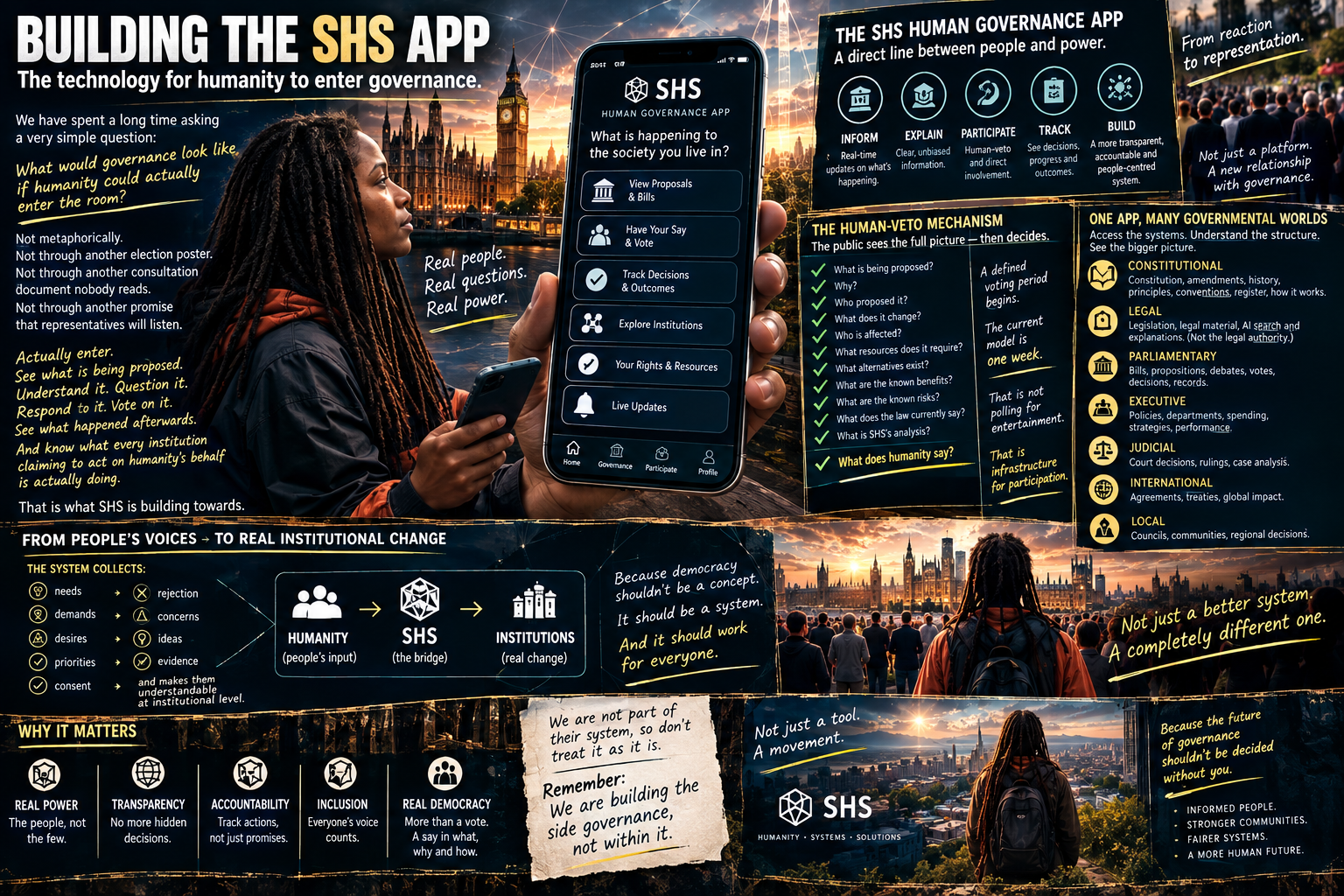
The technology for humanity to enter governance
We have spent a long time asking a very simple question:
What would governance look like if humanity could actually enter the room?
Not metaphorically.
Not through another election poster.
Not through another consultation document nobody reads.
Not through another promise that representatives will listen.
Actually enter.
See what is being proposed.
Understand it.
Question it.
Respond to it.
Vote on it.
See what happened afterwards.
And know what every institution claiming to act on humanity’s behalf is actually doing.
That is what SHS is building towards.
The SHS website has been the testing interface.
The next stage is the technology.
We need to build the SHS Human Governance App.
This is an invitation to developers, technologists, designers, governance specialists, data specialists, AI builders, cybersecurity experts and investors who understand that the internet has transformed almost every relationship people have with one another — except their relationship with governance.
We have an app for banking.
An app for shopping.
An app for food.
An app for transport.
An app for entertainment.
An app for social life.
So why shouldn’t humanity have an app for its relationship with government?
THIS IS NOT ANOTHER SOCIAL MEDIA APP
We already know how to build platforms that keep people scrolling.
SHS is interested in building a platform that keeps people informed.
The central screen should not ask:
What do you want to look at?
It should ask:
What is happening to the society you live in?
And then make it possible to do something about it.
A proposition from Parliament should be visible.
A major governmental decision should be visible.
A constitutional issue should be visible.
A change in legislation should be visible.
An international agreement affecting the country should be visible.
An SHS investigation should be visible.
And where direct human participation is required, the person should be able to participate without having to navigate ten different government websites and understand an entire institutional vocabulary just to find out what is happening.
This is the interface.
THE FIRST PURPOSE: HUMAN CONSENT
The heart of the app is the human-veto mechanism.
Imagine Parliament develops a proposition.
Instead of the people simply discovering the decision after it has been made, the proposition can enter the SHS interface.
The public sees:
What is being proposed?
Why?
Who proposed it?
What does it change?
Who is affected?
What resources does it require?
What alternatives exist?
What are the known benefits?
What are the known risks?
What does the law currently say?
What is SHS’s analysis?
And then:
What does humanity say?
A defined voting period begins.
The model currently being explored is one week.
Humanity votes.
The result becomes part of the governance record.
That is not polling for entertainment.
That is infrastructure for participation.
FROM REACTION TO REPRESENTATION
Most political technology is built around helping people understand what politicians are saying.
SHS is designed around helping institutions understand what people are saying.
That is an important reversal.
SHS would collect:
needs
demands
desires
priorities
consent
rejection
concerns
ideas
evidence
and make those understandable at institutional level.
The system becomes a bridge.
Humanity → SHS → institution
rather than:
institution → announcement → humanity
That is the fundamental architecture.
ONE APP, MANY GOVERNMENTAL WORLDS
The first version does not need to do everything.
But the long-term platform can become a single public interface to the major parts of governance.
Constitutional
People can access:
the Constitution,
constitutional amendments,
constitutional history,
constitutional principles,
constitutional conventions,
the Constitutional Convention Register,
and explanations of how the constitutional structure works.
Legal
People can search legislation and legal material.
AI can assist with finding relevant provisions, comparing documents and explaining complicated language in accessible terms.
The AI does not become the legal authority.
It helps people find the information.
Parliamentary
People can see:
Bills,
propositions,
debates,
votes,
decisions,
changes,
and the relationship between what Parliament proposed and what humanity said.
Government
People can see major governmental activity, resource decisions, public projects and relevant outcomes.
The intention is not to turn every administrative action into a public vote.
The intention is to make government visible.
International
This becomes increasingly important as SHS develops relationships with other governments and international organisations.
People should be able to see:
treaties,
trade relationships,
international restrictions,
foreign-policy decisions,
international disputes,
agreements,
sanctions,
product restrictions,
and other developments that affect life domestically.
Because no country operates in isolation.
A decision made somewhere else can change what people can buy, what businesses can provide and what resources are available here.
The public should not need to discover that through a news headline after the consequences arrive.
THE GOVERNANCE MAP
One of the most exciting technical possibilities is the ability to connect information that currently exists in separate places.
Imagine selecting a governmental decision and seeing:
The law involved
↓
The institution responsible
↓
The public resource involved
↓
The economic consequences
↓
The affected population
↓
The relevant international relationship
↓
Previous decisions
↓
Humanity’s response
↓
The final outcome
That creates something governments rarely provide in one place:
context.
A person shouldn’t have to become an investigator simply to understand the system governing them.
The system should be designed to make itself understandable.
SHS AS THE CALIBRATION LAYER
The app also provides the digital infrastructure for SHS’s constitutional role.
SHS is intended to become the body that carries humanity’s needs, demands and consent into the institutions exercising authority.
That means the platform becomes the place where calibration happens.
Government says:
“This is what we intend to do.”
SHS asks:
“Is this consistent with what humanity has expressed?”
Humanity responds.
SHS records the response.
Government sees the result.
Government explains how it will respond.
The outcome is measured.
Humanity sees the outcome.
And the cycle begins again.
That is continuous governance.
Not governance once every few years.
THE HUMANITY DASHBOARD
The long-term vision is a personal dashboard for civic life.
A person could open the app and immediately see:
What is being proposed today?
What requires my vote?
What has humanity recently voted on?
What did SHS bring to Parliament?
What did Parliament do with it?
What major governmental decisions are happening?
What constitutional changes are being considered?
What international decisions affect us?
What is happening with national resources?
What investigations are underway?
What has changed since the last time I looked?
That makes governance something people can enter in minutes rather than something they have to dedicate their lives to understanding.
THE APP NEEDS TO WORK FOR PEOPLE WHO KNOW NOTHING ABOUT GOVERNMENT
This is crucial.
The application cannot be designed for constitutional lawyers.
It has to work for the person who opens it for the first time and knows almost nothing about:
Parliament.
constitutional law.
government departments.
legislation.
international agreements.
economic policy.
or public administration.
The interface has to translate complexity without destroying it.
That means layered information.
At the first level:
What is happening?
Then:
Why?
Then:
What does it mean?
Then:
Show me the evidence.
Then:
Show me the law.
Then:
Show me the full document.
Someone can stay at the simple level.
Someone else can go all the way down to the underlying legal material.
The complexity remains available.
It simply stops being compulsory.
AI’S ROLE
This platform is also an extraordinary opportunity to use AI properly.
Not as government.
Not as the decision-maker.
Not as the sovereign.
As the world’s most useful information assistant.
AI can help:
search legislation,
cross-reference documents,
identify related provisions,
summarise long proposals,
compare versions,
translate legal language,
organise massive datasets,
identify relationships between documents,
model possible consequences,
calculate economic information,
surface contradictions,
and make complex governmental information accessible.
Imagine somebody asking:
“What laws affect this proposal?”
The system can find them.
Or:
“What changed from the previous version?”
The system can compare them.
Or:
“What countries are affected by this international decision?”
The system can map the relationships.
Or:
“What are the known arguments for and against this proposition?”
The system can organise the available evidence.
But the final authority remains human.
AI calculates. Humanity decides.
That principle should be built into the architecture from day one.
SECURITY IS NOT OPTIONAL
A platform carrying constitutional participation cannot be treated like an ordinary consumer app.
The system would need serious attention to:
identity,
authentication,
privacy,
vote integrity,
auditability,
cybersecurity,
fraud prevention,
accessibility,
data minimisation,
system resilience,
disaster recovery,
and independent verification.
The public must be able to trust that their participation is actually being counted.
At the same time, the system must not become a surveillance mechanism.
That balance has to be designed rather than added later.
THE VOTE HAS TO BE AUDITABLE
Humanity needs to know:
Was my vote counted?
Was the system manipulated?
Was the result altered?
Was the correct question presented?
Was the voting period changed?
Were the results calculated correctly?
That means transparency has to exist at the technical level as well as the political level.
The system should be designed so that the integrity of a result can be independently verified.
This is not just an app feature.
It is constitutional infrastructure.
THE PLATFORM NEEDS AN EVIDENCE LAYER
A vote without information becomes another popularity contest.
SHS therefore needs an evidence layer.
Every major proposition should be capable of connecting to:
the original proposal,
supporting documents,
relevant legislation,
financial implications,
resource requirements,
expert evidence,
known risks,
alternative proposals,
historical context,
and previous related decisions.
The platform should distinguish clearly between:
fact
analysis
opinion
prediction
proposal
and human preference.
That distinction is essential if this is genuinely going to become a trusted governance interface.
THE APP SHOULD ALSO RECORD OUTCOMES
This may become one of the most important features.
Suppose humanity votes for a proposition.
Parliament implements it.
What happens afterwards?
The app should not simply remove the proposition from view.
It should follow it.
Original demand
↓
Human vote
↓
Government response
↓
Implementation
↓
Outcome
↓
Was the objective achieved?
↓
What changed?
↓
What did humanity experience?
Then there is an actual feedback loop.
Government isn’t just accountable for making decisions.
It becomes accountable for whether those decisions achieved what they were supposed to achieve.
THIS CONNECTS DIRECTLY TO THE SHS ECONOMIC MODEL
The same platform can eventually become the interface through which human demand is understood economically.
People express:
what is needed,
where it is needed,
how much is needed,
what quality is expected,
what priorities exist.
Government maps:
resources,
capacity,
infrastructure,
providers,
geography,
shortages,
surpluses.
Providers respond.
Outcomes are measured.
And the information comes back to humanity.
This creates the relationship:
Demand tells the system what is required.
Supply tells the system what is possible.
Governance coordinates the two.
The app is where much of that information can become visible.
THIS COULD CHANGE THE ROLE OF GOVERNMENT TECHNOLOGY
Most governmental technology exists behind the scenes.
Databases.
Internal systems.
Administrative platforms.
Payment systems.
Case-management systems.
SHS adds another layer:
the human-facing governance layer.
It becomes the interface through which the public can actually understand the machinery operating behind the scenes.
That is why this isn’t simply a civic engagement project.
It is an attempt to create a new category of public infrastructure.
WHAT WE NEED TO BUILD
The first version could begin relatively simply.
A secure user identity.
A public governance feed.
A proposition viewer.
A voting mechanism.
A constitutional library.
A legal research interface.
An SHS investigation section.
A public governance calendar.
An international affairs section.
A transparent results system.
Then the platform can expand.
The important thing is that the architecture is designed from the beginning for scale.
We don’t want to build a voting app and later discover that we need to rebuild it to become a governance platform.
We build the foundation with the larger purpose already understood.
THE TECHNOLOGY CAN BE MODULAR
Different teams can build different layers.
One team can work on identity.
Another on the voting infrastructure.
Another on the legal search.
Another on AI.
Another on data architecture.
Another on the constitutional library.
Another on the public interface.
Another on accessibility.
Another on cybersecurity.
Another on international data.
Another on governance analytics.
The system can eventually become an ecosystem rather than one enormous monolithic application.
And that opens the door to developers who may want to contribute to one part without needing to build the whole thing.
THIS IS ALSO AN INVESTMENT OPPORTUNITY
But not simply in the conventional sense of:
“Build an app, acquire users, sell advertising.”
That model would undermine the purpose.
SHS should not need to manipulate attention to survive.
It should not need to sell people’s governance data.
It should not need to make money from political influence.
It should not become another platform whose business model depends on keeping people emotionally engaged.
The value is in building infrastructure that society can actually rely upon.
Investment therefore needs to be compatible with the constitutional purpose of the platform.
The people cannot become the product of a system supposedly built to represent them.
THE BUSINESS MODEL HAS TO MATCH THE ETHIC
That creates an interesting investment question:
How do you finance public-interest digital infrastructure without allowing the financier to become the owner of the public interest?
That is something SHS needs to solve explicitly.
Potential models could include:
public funding,
philanthropic investment,
mission-aligned investment,
institutional partnerships,
technology partnerships,
licensing of non-sovereign technology,
research partnerships,
and carefully designed commercial activities that do not compromise the governance function.
The principle should be simple:
Funding can support the infrastructure. Funding cannot purchase the authority.
An investor can help build the bridge.
An investor does not get to decide where the bridge goes.
WHY DEVELOPERS SHOULD CARE
Because this is an unusually difficult technical problem with a very clear human purpose.
It combines:
distributed systems,
secure identity,
real-time information,
data engineering,
AI,
natural-language interfaces,
legal information systems,
civic technology,
voting infrastructure,
privacy engineering,
cybersecurity,
accessibility,
geospatial systems,
economic modelling,
and large-scale public interfaces.
There is serious technical work here.
But there is also something else.
A developer would not simply be building another platform.
They would be helping build technology that could change how human beings interact with authority.
WHY INVESTORS SHOULD CARE
The opportunity is not merely the number of downloads an app might achieve.
The opportunity is the creation of an entirely new layer of infrastructure:
the human governance interface.
Government has operated for centuries.
The internet has existed for decades.
Smartphones have transformed daily life.
Yet the interface between the individual and the State remains fragmented, difficult to navigate and often reactive.
SHS is proposing to build that interface deliberately.
A platform where:
governance becomes accessible,
information becomes connected,
human consent becomes measurable,
decisions become traceable,
outcomes become reviewable,
and people become visible to the institutions governing them.
That is a very different proposition from another social network.
AND THIS IS WHERE SHS BECOMES TESTABLE
The website has already served as the conceptual testing ground.
The app would become the practical one.
Before SHS ever assumes a larger constitutional role, humanity should be able to interact with the model.
Use it.
Challenge it.
Reject it.
Improve it.
Test whether people actually participate.
Test whether people understand propositions.
Test whether the information architecture works.
Test whether the voting mechanism is trusted.
Test whether institutions respond.
Test whether the public actually wants this relationship with governance.
That is why the app should not be built as though SHS already knows the final answer.
The platform itself should be tested by humanity.
WE ARE NOT BUILDING ANOTHER AUDIENCE
We are building an interface.
There is a difference.
An audience watches.
A user interacts.
A citizen participates.
SHS needs the third.
The objective is not to gather millions of passive followers.
The objective is to create a system through which people can actually affect the governance that affects them.
That is why the most important metric will never simply be:
How many people downloaded the app?
It will be:
How much meaningful human participation did the infrastructure make possible?
THE LONG-TERM VISION
Eventually, imagine opening one application and seeing the entire relationship between humanity and governance in one place.
Your country’s constitution.
Its laws.
Its government.
Its Parliament.
Its current proposals.
Its resources.
Its economic priorities.
Its international relationships.
Its major public decisions.
SHS investigations.
Humanity’s votes.
Their outcomes.
The historical record.
And the ability to understand all of it through a system designed for ordinary human beings.
Then imagine that same architecture connected internationally.
SHS can work with governments.
SHS can work with the United Nations.
SHS can work with international organisations.
SHS can bring the human dimension into conversations that currently happen almost entirely between institutions.
That is the bridge we are talking about.
THE PRINCIPLE THAT SHOULD NEVER CHANGE
Technology will evolve.
The interface will change.
AI will improve.
The data available to us will expand.
Governments will change.
International relationships will change.
The economic system may change.
But the fundamental principle remains:
AI does not become the authority.
SHS does not become the owner of humanity.
Parliament does not become the owner of humanity.
Government does not become the owner of humanity.
Capital does not become the owner of humanity.
The infrastructure exists so that humanity can remain present.
So that when a decision is made, somebody can ask:
What does humanity say?
And there is an actual answer.
THIS IS THE BUILD
SHS has spent the conceptual phase asking what a Human First governance architecture could look like.
Now comes the technological question:
Can we build the interface that makes it real?
We believe we can.
Not by beginning with a giant platform.
By beginning with the smallest working version of the principle:
A proposition appears.
Humanity can understand it.
Humanity can respond.
The response is recorded.
The institution can see it.
The outcome can be measured.
And then we build from there.
That is the first brick.
Then the constitutional layer.
Then the legal layer.
Then the governmental layer.
Then the international layer.
Then the economic and resource layers.
Then the deeper calibration systems.
And eventually:
a complete human governance interface.
TO THE DEVELOPERS
We are not asking you to make an app look good.
We are asking you to help design the technology through which humanity could participate in governance at a scale governments have never been technologically structured to support.
We need people who can think beyond screens.
People who understand infrastructure.
People who understand security.
People who understand data.
People who understand AI without confusing intelligence with authority.
People who understand that the difficult part isn’t building a button people can press.
The difficult part is building a system people can trust.
TO THE INVESTORS
We are not asking you simply to fund software.
We are asking you to consider funding a new category of public infrastructure.
A system where the people are not the commodity.
Where information is not hidden because it is inconvenient.
Where AI serves humanity rather than governing it.
Where developers build technology that has constitutional consequences.
Where the return is not measured only in money, but in the infrastructure created for human participation.
The financial model still has to be sustainable.
The technology still has to be commercially disciplined.
The development still has to be professional.
But the underlying asset is different.
It is human participation infrastructure.
SHS HAS AN INTERFACE.
NOW IT NEEDS ITS ENGINE.
The website has been the place where SHS has tested its ideas against humanity.
The next stage is to build the technology capable of doing that at scale.
The app doesn’t need to begin perfect.
It needs to begin real.
Then humanity tests it.
Humanity challenges it.
Humanity improves it.
And eventually, perhaps, humanity no longer has to ask:
“How do I get the people governing me to listen?”
Because there is already a place where the answer is recorded.
The people speak.
SHS carries it.
Institutions respond.
Humanity sees what happened.
And the system recalibrates.
That is what we are building.


Leave a Reply