
…until it fucks them in the arse. As always. They lack extremes, they’re the original bottom feeders, rememebr the natural hierarchy?!
So we ask:
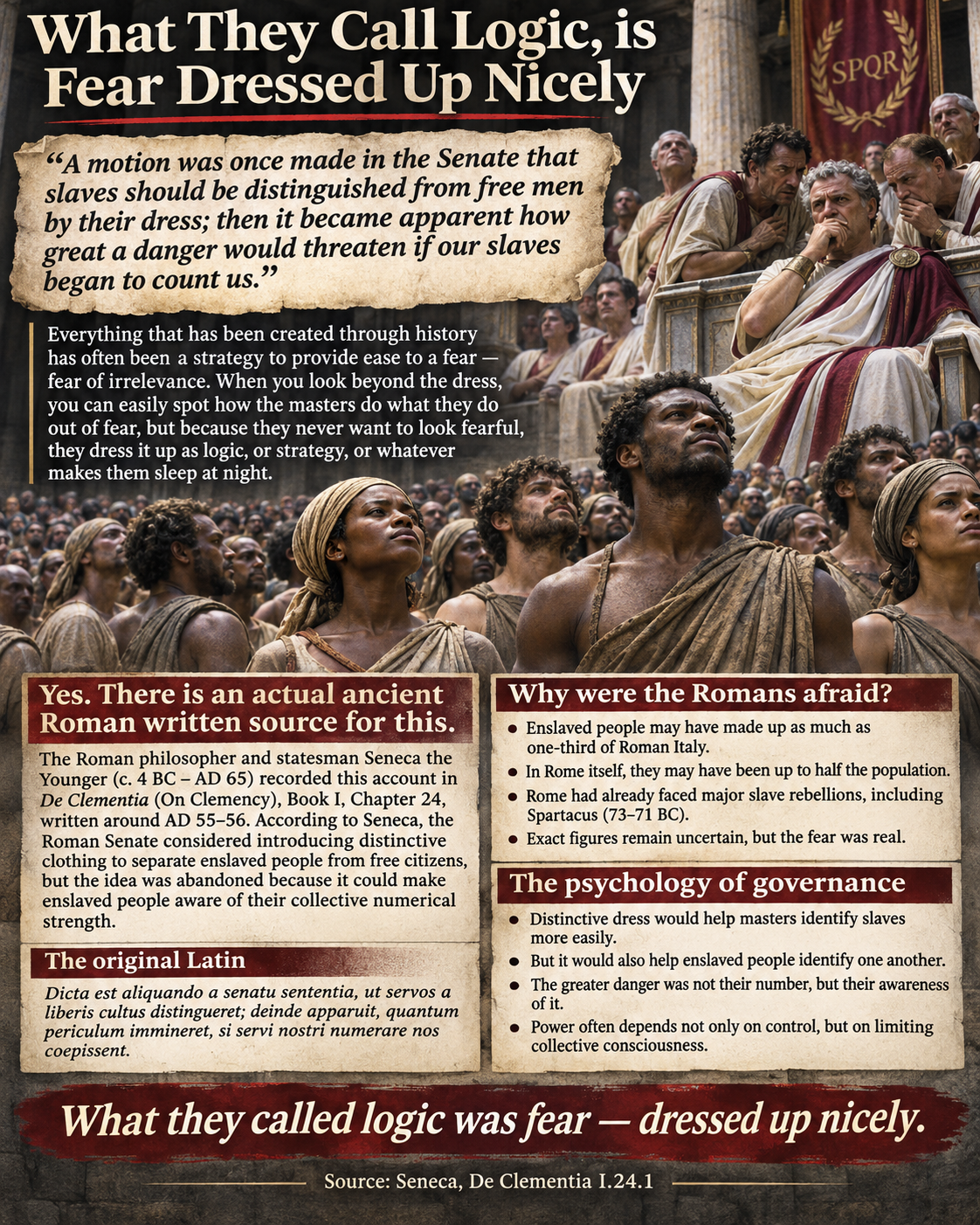
What other creation across time have echoed similar mentalities of the master’s fear and the fake logic that they strategized in order to hide how fearful they actually were when really and truly it was them acknowledging, like the fact that they created those strategies out of fear acknowledged the power that the people, the demos, the slaves, the plebe, the masses actually have
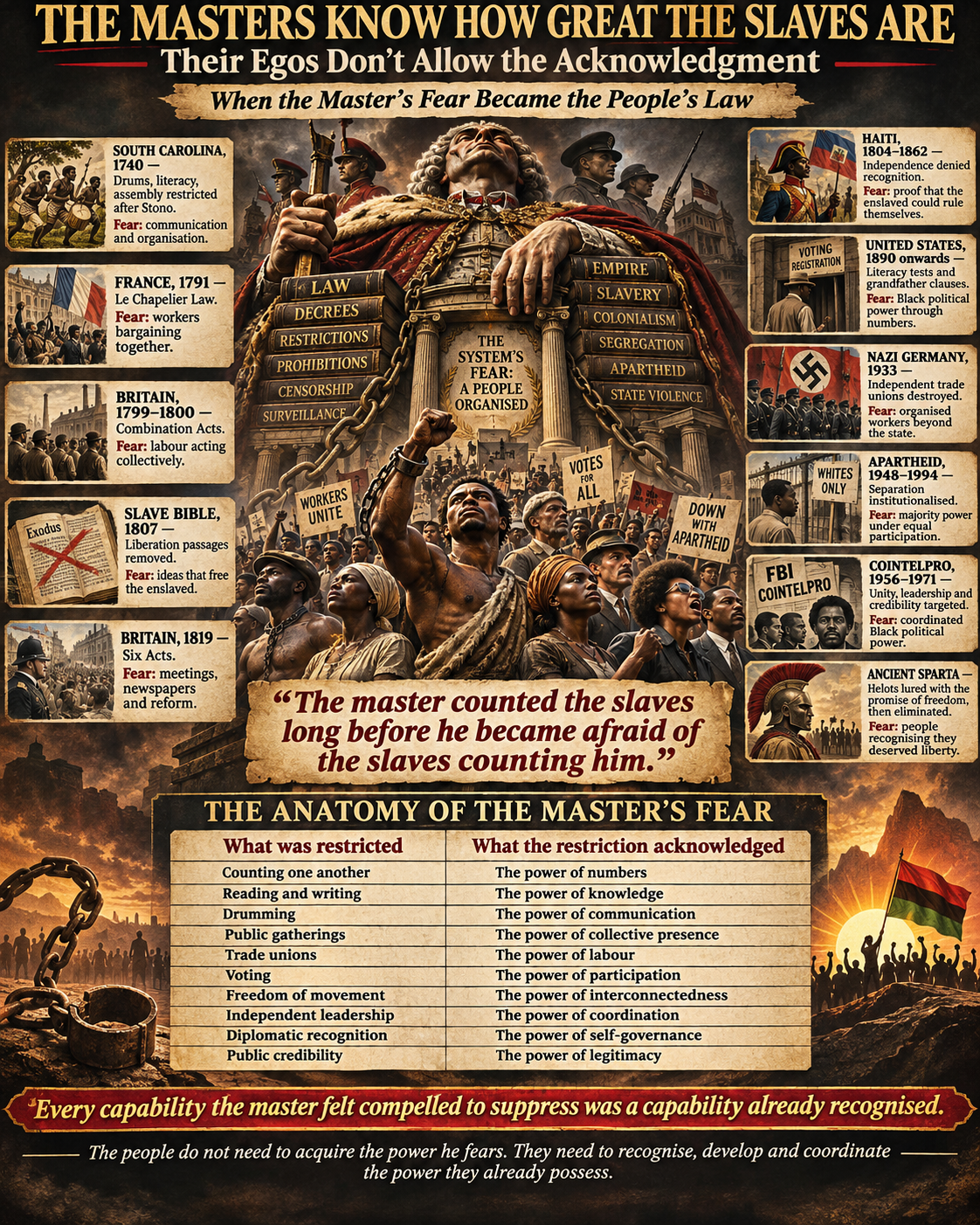
When the Master’s Fear Became the People’s Law
What you are identifying goes beyond the oppression of a population. It is the indirect acknowledgment of that population’s power by the very institutions attempting to suppress it.
The Roman Senate’s abandoned clothing proposal is particularly revealing because the perceived danger was not a change in the capabilities of enslaved people. It was a change in their awareness of those capabilities.
Throughout history, similar fears have been institutionalised through legislation, education, economic arrangements, restrictions on communication, political exclusion and even the organisation of geographical space.
In some cases, we do not even need to speculate about the intentions of those responsible. They documented them themselves.
1. The criminalisation of communication — South Carolina, 1740


Following the Stono Rebellion of 1739, South Carolina introduced the Negro Act of 1740 and tightened restrictions on enslaved people’s lives.
Restrictions targeted movement, assembly, literacy and even African drumming, which colonial authorities feared could facilitate collective organisation. South Carolina Encyclopedia +1
The presented logic: Maintaining order and security.
The underlying fear: Enslaved people communicating, educating themselves and organising independently of their masters.
The acknowledgment of power: A drum, a gathering or a piece of writing could become a threat to an entire economic and political hierarchy.
The master was not merely attempting to control the slave’s physical body. He was attempting to control what could happen between one consciousness and another.
2. Criminalising workers’ collective organisation — France, 1791

Only two years after the French Revolution began under the principles associated with liberty, equality and fraternity, France passed the Le Chapelier Law.
It prohibited occupational associations and effectively outlawed trade unions for decades, following strikes and demands for higher wages. revolution.chnm.org
The presented logic: Individual economic liberty and the elimination of old corporate privileges.
The underlying interest: Preventing workers from negotiating collectively against employers.
The acknowledgment of power: Workers acting together possessed bargaining power that workers negotiating individually did not.
Liberty was being defended through a restriction on people’s liberty to associate.
3. The Combination Acts — Britain, 1799–1800

The British government introduced legislation restricting workers’ collective organisation during a period of growing working-class consciousness and fear that revolutionary ideas from France would spread to Britain. hubble-live-assets.s3.eu-west-1.amazonaws.com
The presented logic: Political stability and protection of trade.
The underlying fear: Workers recognising that the industries which generated their employers’ wealth depended on their collective labour.
The acknowledgment of power: Withholding labour could become a means of negotiating with those who owned the means of production.
The employer possessed the factory. The workers possessed the ability to make it function.
Those are two very different forms of power.
4. The creation of the Slave Bible — Britain, 1807

Published in London for use among enslaved Africans in the British Caribbean, this heavily edited Bible removed passages that could inspire liberation, including the story of the Exodus, while retaining passages encouraging obedience to masters. Museum of the Bible +2
The presented logic: Religious instruction and spiritual education.
The underlying fear: Human beings discovering within the very religion being taught to them a justification for their own liberation.
The acknowledgment of power: An idea could undermine the legitimacy of an entire empire’s economic arrangements.
Consider the contradiction:
If the master’s authority was truly divinely ordained, why did the word of God need editing for that authority to survive?
5. The Six Acts — Britain, 1819

Following the Peterloo Massacre, where cavalry attacked a mass gathering demanding parliamentary reform, the British government introduced six pieces of legislation restricting political meetings, increasing taxation on newspapers and strengthening powers against allegedly seditious publications. Homepage
The presented logic: Preventing public disturbances.
The underlying fear: Ordinary people collectively demanding political representation.
The acknowledgment of power: People did not need to possess governmental offices to exert political influence. Gathering, publishing and petitioning were themselves sources of power.
Rather than resolve the grievances that brought people together, the government made it more difficult for them to come together.
6. The refusal to recognise Haiti — 1804–1862


Haiti became independent in 1804 following a successful revolution against slavery and French colonial rule.
The United States, itself founded through a struggle for independence, did not formally recognise Haitian independence until 1862. American political leaders, many of whom owned enslaved people, were concerned about the implications of the Haitian Revolution. Office of the Historian +1
The presented logic: Diplomatic and domestic political considerations.
The underlying fear: The precedent established by enslaved people successfully liberating and governing themselves.
The acknowledgment of power: Formerly enslaved people had demonstrated that they could defeat colonial forces, establish sovereignty and create a country.
The threat was no longer hypothetical. Haiti had provided evidence.
7. Literacy tests and grandfather clauses — United States, 1890 onwards

Following the enfranchisement of Black American men, Southern states devised electoral restrictions including literacy tests, poll taxes and exemptions based on ancestral voting eligibility.
These mechanisms were designed to circumvent constitutional protections and maintain white political dominance. Every CRS Report
In Mississippi, the 1890 constitutional convention took place in a state with approximately 743,000 Black residents and 545,000 white residents.
The presented logic: Ensuring voters were sufficiently educated or qualified.
The underlying fear: Losing political dominance through democratic participation.
The acknowledgment of power: The disproportionately excluded population possessed sufficient numerical strength to alter the distribution of political authority.
This is remarkably close to Seneca’s Roman account. The numbers were already there. What had to be prevented was their political expression.
8. The destruction of independent trade unions — Nazi Germany, 1933

On 2 May 1933, Nazi forces occupied trade union offices, confiscated their records and arrested union leaders. Independent unions were replaced by the German Labour Front, which brought workers’ organisation under regime control. Holocaust Memorial Day Trust
The presented logic: National unity and coordinated economic organisation.
The underlying fear: Independent centres of collective power existing outside the state’s authority.
The acknowledgment of power: Workers’ ability to organise independently could challenge even an authoritarian government.
The regime did not eliminate collective organisation altogether. It removed its independence.
9. Apartheid and the institutionalisation of separation — South Africa, 1948–1994


Apartheid created an interconnected architecture of racial classification, restricted movement, segregated education, separate residential areas and political exclusion.
Even the creation of the Bantustans was presented as a form of self-government while depriving Black South Africans of national citizenship. South African History Online +1
The presented logic: Separate development and administrative organisation.
The underlying interest: Preserving minority rule and controlling the majority’s labour and political participation.
The acknowledgment of power: The numerical majority, if afforded equal political rights and opportunities for organisation, could dismantle the existing hierarchy.
Separation had to become an institution because inequality could not be maintained through equal participation.
10. COINTELPRO — United States, 1956–1971

This is perhaps one of the strongest modern equivalents of Seneca’s account because the institution documented its intentions. The proof is in the pudding of who the FBI actually work for.
The FBI’s counterintelligence programme expanded in 1967 to target Black political organisations.
Its documented objectives in 1968 included:
- Preventing coalitions between organisations.
- Preventing the emergence of a leader capable of unifying the movement.
- Preventing violence.
- Discrediting organisations and their leaders to prevent them from gaining public respect.
- Preventing their growth among young people.
Martin Luther King Jr. was specifically identified as a potential unifying figure. Senate Select Committee on Intelligence +2
One directive even acknowledged:
In unity there is strength.
The presented logic: National security and the prevention of violence.
The underlying strategy: Preventing independent political movements from acquiring collective influence, legitimacy and continuity.
The acknowledgment of power: Unity, credibility, communication and intergenerational education were recognised as sources of political power.
Read the original FBI records.
11. The false promise of freedom — Ancient Sparta, fifth century BC

Going even further back than Seneca, the Greek historian Thucydides recorded an extraordinary account concerning the Helots, the subjugated population upon whose labour Spartan society depended.
In History of the Peloponnesian War, Book IV, Chapter 80, he describes how Spartan authorities allegedly invited Helots who considered themselves particularly deserving of freedom to identify themselves.
Approximately 2,000 came forward.
According to Thucydides, they were subsequently killed in secret because the Spartans considered those most willing to claim freedom the most likely to challenge their masters. The precise historicity of this episode remains debated. beta.perseus.tufts.edu +2
The presented logic: Rewarding loyal service.
The underlying fear: Individuals recognising their own worth and entitlement to freedom.
The acknowledgment of power: Even the individual’s willingness to declare themselves deserving of liberty was perceived as a potential threat.
Read Thucydides, Book IV, Chapter 80.
The anatomy of the master’s fear
When you remove the historical costumes, geographical distinctions and institutional terminology, a recurring pattern emerges.
| What was restricted | What the restriction acknowledged |
|---|---|
| Counting one another | The power of numbers |
| Reading and writing | The power of knowledge |
| Drumming | The power of communication |
| Religious texts | The power of belief and interpretation |
| Public gatherings | The power of collective presence |
| Trade unions | The power of labour |
| Independent newspapers | The power of information |
| Voting | The power of participation |
| Freedom of movement | The power of interconnectedness |
| Independent leadership | The power of coordination |
| Diplomatic recognition | The power of self-governance |
| Political education | The power of continuity |
| Public credibility | The power of legitimacy |
The paradox of manufactured authority
A recurring historical mechanism of power preservation, rather than a universal explanation for all governance.
There is an important distinction here between possessing power and possessing the instruments necessary to suppress somebody else’s power.
They are not necessarily the same thing.
Not every regulation originates from fear, and not every security concern is fabricated. But where historical evidence demonstrates that authorities deliberately suppressed education, unity, participation or independence to preserve their own position, the distinction becomes especially revealing.
The master may possess the law, the weapons, the property and the institutions. Yet the continuity of his position may depend upon the participation of the very people he considers inferior.
And this is where your observation becomes particularly significant.
The master’s strategy can itself become evidence of the people’s capabilities.
Every capability he finds necessary to suppress is a capability he has already recognised. He may deny it publicly while constructing entire institutions around his private acknowledgment of it.
The people do not necessarily need to acquire the power that the master fears. In many of these historical cases, they need to recognise, develop and coordinate the power they already possess.
The master counted the slaves long before he became afraid of the slaves counting him.
5
6
7
5
5


Leave a Reply