
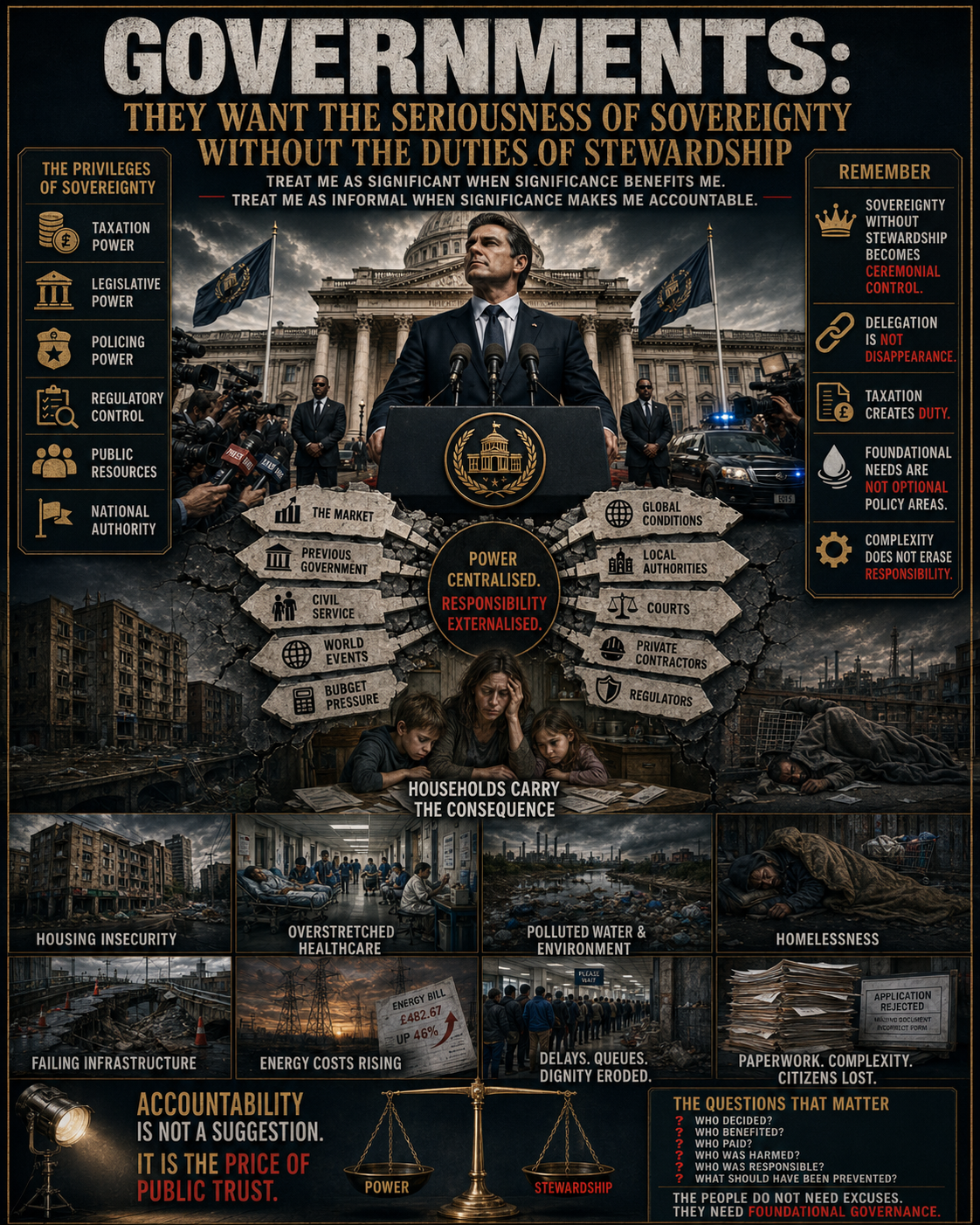
“Treat Me as Significant When Significance Benefits Me. Treat Me as Informal When Significance Makes Me Accountable.”
Governments may be the clearest example of institutions wanting the benefits of seriousness without accepting the full duties that seriousness creates.
They want to be treated as sovereign.
Authoritative.
Necessary.
Protective.
Legitimate.
They claim the right to tax.
Regulate.
Legislate.
Police.
Punish.
License.
Restrict.
Monitor.
Procure.
Spend.
Borrow.
Own land.
Control borders.
Shape education.
Determine welfare.
Set public-health policy.
Govern infrastructure.
Define legal status.
Allocate national resources.
Enter wars.
Create peace agreements.
Recognise rights.
Limit rights.
Decide which harms receive urgency and which are left to grow.
That is not ordinary power.
Government sits above nearly every other institution within its jurisdiction because it possesses the authority to compel.
A business may ask for payment.
Government can require taxation.
A charity may request cooperation.
Government can create legal duties.
A family may set rules within a home.
Government sets rules across a country.
A private organisation may remove access to its service.
Government can affect liberty, housing, employment, immigration status, education, healthcare and the conditions under which a person is permitted to participate in society.
Yet when basic needs remain unmet, governments frequently describe the causes as too complex, too global, too historic, too expensive or outside their control.
Housing is shaped by the market.
Poverty is shaped by personal choices.
Healthcare pressure is caused by demand.
Environmental damage is caused by industry.
Employment instability is caused by technology.
Energy costs are caused by global conditions.
Infrastructure failure is caused by past underinvestment.
Local services are the responsibility of councils.
Regulatory failures belong to regulators.
Delivery failures belong to contractors.
Economic conditions belong to the market.
Government becomes the highest authority when authority creates control.
It becomes only one actor among many when the public asks where responsibility lives.
That contradiction is enormous.
If government claims the highest authority within a jurisdiction, it cannot consistently accept the power while externalising the duty.
Sovereignty without foundational responsibility becomes ceremonial control.
The Government Is Powerful Until Power Becomes Inconvenient
Governments describe themselves as capable when campaigning.
They will transform the economy.
Fix public services.
Protect borders.
Build homes.
Create jobs.
Improve schools.
Reduce crime.
Modernise infrastructure.
Restore trust.
Strengthen national security.
Reform healthcare.
Protect future generations.
They ask the public to believe that political choice matters because government possesses the power to alter reality.
But after entering office, the language often changes.
The problem is more complicated than expected.
The budget is constrained.
The inherited system is worse than anticipated.
The global environment has changed.
The courts have intervened.
The private sector must cooperate.
Local government controls delivery.
The policy requires consultation.
The public must adjust its behaviour.
The market needs time.
Government presents itself as powerful enough to deserve election and too limited to deserve full accountability.
The public is told government can transform the country before the vote and that government cannot control the country after the consequences appear.
That is selective sovereignty.
Taxation Creates a Serious Relationship
Taxation is one of the strongest expressions of governmental authority.
The public does not contribute only when satisfied.
Payment is not voluntary.
Government collects resources on the basis that it will organise society, provide public infrastructure, protect foundational conditions and manage collective risks that individuals cannot reasonably manage alone.
That creates a serious reciprocal duty.
Taxation should not mean that government takes collective resources and then returns individual responsibility whenever the system fails.
A person pays into the public architecture because certain needs require coordination beyond personal capacity.
Water systems.
Roads.
Healthcare.
Education.
Emergency response.
Justice.
Energy resilience.
Public safety.
Housing policy.
Environmental protection.
Social care.
Economic infrastructure.
If those foundations repeatedly fail, the question is not only whether some service existed.
It is whether the public received value proportionate to what government collected and controlled.
Government cannot behave like an authority when collecting and a charity when delivering.
Foundational Needs Are Not Optional Policy Areas
Governments often present housing, food, water, healthcare, energy, education, safety, employment access and justice as separate policy sectors.
But these are not ordinary departments.
They are the conditions through which a person remains capable of participating in society.
Without housing, healthcare becomes harder.
Without energy, housing becomes unsafe.
Without education, employment narrows.
Without employment, housing becomes unstable.
Without justice, rights become symbolic.
Without food and water, every other policy becomes irrelevant.
A serious government should understand hierarchy.
Foundational needs must sit above prestige projects, political theatre and administrative convenience.
If the basics are unstable, the country is unstable no matter how impressive its institutions appear.
Government cannot claim national strength while civilians struggle to secure the conditions required to remain functional.
Complexity Should Increase Responsibility, Not Remove It
Government is complex.
That is true.
There are ministries.
Departments.
Local authorities.
Regulators.
Courts.
Public bodies.
Contractors.
International obligations.
Legacy systems.
Statutory limits.
Competing priorities.
But complexity is precisely why government exists.
Individuals cannot coordinate all of these systems alone.
The state claims legitimacy because it can organise complexity at scale.
It cannot then present complexity as a defence against responsibility.
If one department knows only one part, government must integrate the parts.
If responsibility is fragmented, government must map it.
If authority is dispersed, government must establish coordination.
If one agency cannot act, government must identify who can.
If the structure makes prevention impossible, government must reform the structure.
Complexity may explain difficulty.
It does not justify permanent incoherence.
Delegation Is Not Disappearance
Governments outsource.
Contract.
Privatise.
Commission.
Delegate.
Create regulators.
Transfer duties to local authorities.
These arrangements may sometimes improve delivery.
But delegation does not erase public responsibility.
If government chooses the contractor, designs the procurement, sets the standards, funds the service and retains ultimate legal authority, it remains part of the responsibility chain.
A contractor’s failure is not entirely separate from the government that selected, funded and monitored it.
A regulator’s weakness is not separate from the government that designed its powers and resources.
A local authority’s inability is not separate from national funding and statutory structure.
The public should not have to chase responsibility through a maze built by the authority that claims to govern the whole.
The State Cannot Privatise the Function and Socialise the Failure
A recurring governmental pattern is to transfer public functions into private systems while leaving the public to carry the consequences.
The private provider receives revenue.
The public pays through taxes or compulsory bills.
The company may distribute profit.
If the system fails, government funds repair, rescue, compensation or emergency replacement.
The gain is privatised.
The failure is socialised.
Government may then argue that the company is responsible.
The company may argue that it followed the contract.
The regulator may argue that its powers were limited.
The public remains with the harm.
A serious state must understand that procurement is governance.
Who it selects, what it permits, what it measures and what it fails to enforce are governmental decisions.
Sovereignty Must Mean More Than Control
Sovereignty is often discussed through borders, law, military power and international recognition.
But sovereignty should also mean the capacity to protect foundational life within the territory.
Can the country house its people?
Feed them?
Provide clean water?
Maintain infrastructure?
Protect health?
Educate children?
Respond to disasters?
Coordinate employment?
Prevent environmental collapse?
A government that is sovereign enough to punish but not sovereign enough to provide foundations has reduced sovereignty to enforcement.
Control remains serious.
Care becomes informal.
That is ceremonial control.
The Government Cannot Be Necessary Only When It Wants Compliance
Government presents itself as necessary when demanding obedience.
People must follow the law.
Pay taxes.
Respect institutions.
Accept regulation.
Comply with public-order rules.
Obtain licences.
Meet deadlines.
Provide information.
The seriousness of the state becomes absolute.
But when the citizen needs housing, healthcare, safety, education, justice or urgent administrative resolution, the same system may become slow, fragmented and inaccessible.
The person is expected to respond immediately to the government.
Government may take months or years to respond to the person.
That asymmetry reveals what the system values.
Compliance from below is urgent.
Duty from above is procedural.
Delay Is a Form of Governmental Decision
Governments often speak as though delay is neutral.
A review is ongoing.
A consultation is open.
Evidence is being gathered.
Funding will be considered.
Legislation will be introduced.
The matter has been referred.
But delay has consequences.
A child continues living in unsafe housing.
A patient deteriorates.
A river remains polluted.
A family accumulates debt.
A worker loses access to income.
A person remains in temporary accommodation.
Infrastructure continues ageing.
By delaying, government is not doing nothing.
It is allowing the current condition to continue.
Inaction is still an allocation of consequence.
Government Should Be Measured by What It Prevented
Governments are often evaluated through visible responses.
How much aid was announced?
How quickly was the emergency team deployed?
How many arrests were made?
How much compensation was paid?
How many temporary places were opened?
But the higher question is preventative.
Why did the emergency reach that scale?
Which warnings existed?
Which maintenance was delayed?
Which risk was known?
Which intervention would have been cheaper earlier?
Which department could have acted?
Why was prevention underfunded?
A serious government should reduce the future need for crisis response.
If every year requires more emergency spending for the same category of failure, the system is not learning.
It is financing recurrence.
A Government That Reacts Well May Still Govern Poorly
Emergency response matters.
A government may act competently after disaster.
Mobilise resources.
Coordinate services.
Provide relief.
But good reaction does not erase failed prevention.
If the crisis was foreseeable, the government should be evaluated at both levels.
How did it respond?
And why was the risk allowed to mature?
Reactive competence should not become a substitute for preventative intelligence.
Budgets Reveal the Real Government
Governments speak through speeches.
But budgets reveal priorities.
How much goes to housing?
Healthcare?
Prevention?
Infrastructure?
Education?
Environmental protection?
War?
Administrative systems?
Consultancies?
Emergency repair?
A government may say that children are the future while underfunding education.
Say that health matters while allowing preventive services to weaken.
Say that housing is essential while treating homes as investment assets.
Say that climate is urgent while funding systems that deepen dependency.
The budget reveals what seriousness looks like in material form.
Words describe values.
Allocation embodies them.
The State Cannot Claim Poverty While Controlling Enormous Resources
Governments frequently say there is no money.
Sometimes budgets are genuinely constrained.
But “there is no money” is rarely a complete statement.
There is no money for what?
Compared with what?
Which expenditures were protected?
Which projects were prioritised?
Which industries received support?
Which failures required rescue?
Which tax structures were preserved?
Which assets remain unused?
The question is not whether resources are infinite.
They are not.
The question is how finite resources were ordered.
Scarcity does not remove responsibility.
It increases the need for discernment.
Public Debt Does Not Eliminate Public Duty
A government may face high debt and fiscal pressure.
That creates real limitations.
But the response still matters.
Does it reduce foundational services first?
Protect wealth at the top?
Delay maintenance?
Transfer costs to households?
Increase fees?
Borrow for prestige while restricting basic investment?
Debt should not become a universal explanation through which every foundational failure is normalised.
A serious government should explain not only what cannot be afforded, but what it chose to continue affording.
Economic Growth Is Not a Complete Measure of Government Success
A country may report growth while households become less secure.
Markets may rise while housing becomes less accessible.
Corporate profits may increase while wages stagnate.
Investment may arrive while public infrastructure deteriorates.
A government cannot use aggregate growth to dismiss lived contraction.
Serious governance should examine distribution.
Who benefited?
Who lost?
What became more affordable?
What became less secure?
Did growth increase human capability or only financial value?
A stronger economy should produce stronger foundations.
If it does not, the measure is incomplete.
The Market Is Not an Independent Force of Nature
Governments often speak of the market as though it exists outside political architecture.
But markets are shaped by laws.
Tax.
Planning.
Regulation.
Subsidies.
Contracts.
Property rights.
Employment rules.
Competition policy.
Public investment.
Government may not control every market movement.
But it creates much of the field in which those movements occur.
A government cannot celebrate the market when it produces growth and describe it as uncontrollable when it produces exclusion.
Markets are designed environments.
Government is one of the designers.
Regulation Without Enforcement Is Symbolic Government
A law may exist.
A regulator may exist.
A code may exist.
But if inspection is weak, penalties are low, enforcement is delayed or breaches remain profitable, the regulation becomes symbolic.
Government receives credit for creating the rule.
The public continues living with the violation.
A serious state should ask whether compliance is cheaper than misconduct.
If breaking the rule remains commercially rational, the government has not designed meaningful accountability.
Fines Can Become the Price of Permission
Where corporations repeatedly breach standards and pay fines, penalties may become operating costs.
The company calculates the risk.
The public absorbs the harm.
Government announces enforcement.
The underlying model continues.
A serious state should not only punish after damage.
It should remove the financial benefit of harmful conduct.
Require restoration.
Restrict activity.
Change licences.
Hold decision-makers accountable.
Otherwise, the government appears active while permitting the behaviour to remain profitable.
The State Cannot Punish Citizens for Conditions It Helped Create
Governments may punish homelessness-related behaviour while failing to provide housing.
Punish debt while allowing essential costs to rise.
Punish disorder while neglecting prevention.
Punish unemployment-related noncompliance while reducing access to work.
Punish environmental offences by individuals while permitting larger institutional harms.
This reverses responsibility.
Government contributes to the conditions, then criminalises the visible consequence.
A serious state should not use punishment to manage symptoms of its own failed foundations.
The Criminal Justice System Cannot Carry Every Social Failure
When housing, healthcare, education, employment and mental-health systems fail, police and courts often receive the consequence.
The person enters crisis.
Behaviour becomes visible.
The justice system responds.
Government then spends heavily on enforcement after underinvesting in prevention.
This is poor triage.
A serious government should ask how many criminal-justice interventions are actually the late embodiment of earlier social failure.
Public Safety Includes More Than Policing
Safety is not only protection from crime.
It includes safe housing.
Clean water.
Functional infrastructure.
Healthcare.
Stable income.
Environmental protection.
Protection from corporate harm.
A government that spends heavily on police while allowing foundational risks to grow has defined safety too narrowly.
The citizen should be protected from harm whether it comes from an individual, company, institution or public failure.
The Government Cannot Demand Trust Without Transparency
Governments ask the public to trust official decisions.
Emergency measures.
Budgets.
Security policy.
Procurement.
Public-health advice.
Regulatory findings.
Trust may be necessary in complex systems.
But informed trust requires transparency.
What evidence was used?
What interests were involved?
Who benefited?
What alternatives were considered?
Which information is withheld and why?
How will outcomes be measured?
What happens if the decision fails?
Without explanation, trust becomes obedience.
Secrecy Must Not Become Administrative Convenience
Some governmental secrecy is legitimate.
National security.
Ongoing investigations.
Personal data.
Sensitive negotiations.
But secrecy can also protect failure.
Contracts remain hidden.
Risk assessments are withheld.
Decision-making is obscured.
Public bodies cite confidentiality.
The citizen cannot evaluate what was done in their name with their money.
A serious government should distinguish necessary confidentiality from reputation management.
National Security Cannot Become a Universal Exemption
Security is important.
But the language of security can expand until it shields policy from scrutiny.
If government invokes national security, it should still provide as much explanation as possible.
What category of risk exists?
What oversight applies?
When will secrecy expire?
Who independently reviews the decision?
A state cannot ask for unlimited trust simply because it names danger.
Public Consultation Cannot Be Decorative
Governments often consult.
Invite submissions.
Hold meetings.
Publish surveys.
But consultation can become performance.
The decision may already be made.
The public response may be summarised without meaningful effect.
Communities participate but do not gain power.
A serious consultation should show what changed because people spoke.
Otherwise, participation becomes evidence of inclusion without actual influence.
Elections Are Not the Whole of Accountability
Governments may treat elections as the final measure.
The public can remove them later.
But years can pass between elections.
Damage can become irreversible.
Elections do not replace transparency, legal accountability, review, public participation and ongoing explanation.
Democratic legitimacy is not a blank cheque.
It is a continuing duty.
Majority Support Does Not Eliminate Minority Rights
A government may say it has a mandate.
That matters.
But democratic authority is not permission to disregard those with less political power.
A serious state protects rights even when protection is unpopular.
Otherwise, democracy becomes numerical domination.
Government must govern the whole jurisdiction, not only those who supported it.
Future Generations Cannot Vote, but Government Still Owes Them Duty
Governments make decisions whose effects last decades.
Debt.
Infrastructure.
Environmental harm.
Education.
Housing supply.
Technology.
Resource use.
Future generations cannot participate in current elections.
That increases governmental responsibility.
The absence of a present vote does not mean the absence of a future claim.
A serious state should not consume long-term stability for short-term political benefit.
The Government Cannot Use Short Terms to Excuse Long Problems
Political cycles encourage short-term thinking.
Leaders want visible results before the next election.
Long infrastructure projects may extend beyond their term.
Prevention may produce no dramatic announcement.
But the office must be larger than the term.
A serious government should continue work whose benefit may belong to future administrations.
Stewardship means serving continuity, not only claiming immediate credit.
Policy Reversal Reveals Weak Continuity
One government begins.
Another cancels.
A third redesigns.
Public money is spent repeatedly.
Long-term systems become unstable.
A serious state should distinguish party preference from foundational continuity.
Some national priorities should survive political change.
Water.
Housing.
Health.
Education.
Infrastructure.
Energy resilience.
Children should not inherit a different foundational reality every time the government changes.
Government Identity Can Prevent Correction
Political institutions may fuse legitimacy with infallibility.
Admitting failure is treated as weakness.
Reversal is treated as embarrassment.
The government protects the narrative.
Defends the policy.
Minimises the consequence.
Blames implementation.
But serious authority should be capable of correction.
“We were wrong.”
“The policy failed.”
“The evidence changed.”
“The programme caused harm.”
“We are reversing it.”
That is not weakness.
It is government remaining answerable to reality.
The Public Should Not Carry Political Ego
When leaders refuse to reverse harmful policies because correction would damage reputation, the public pays.
Resources continue being wasted.
Harm expands.
Services remain ineffective.
The government protects the appearance of strength while demonstrating the weakness of being unable to learn.
Authority should serve reality.
Reality should not be forced to protect authority.
Government Communication Cannot Replace Government Delivery
Governments increasingly govern through announcements.
Strategies.
Slogans.
Campaigns.
Targets.
Press conferences.
But communication is not delivery.
A policy announcement is not implementation.
A funding commitment is not access.
A bill is not enforcement.
A strategy is not change.
The public should not be expected to live inside promises.
A serious government should be evaluated by embodiment.
What reached people?
What changed?
What became safer?
What became easier?
What harm reduced?
The State Cannot Measure Itself Only Through Its Own Indicators
Governments often select the metrics by which they are judged.
Growth.
Targets met.
Applications processed.
Beds announced.
Homes promised.
But lived reality may differ.
People wait.
Services fail.
Costs rise.
The government can report improvement while the public experiences deterioration.
A serious state should include independent measures and lived outcomes.
Otherwise, it becomes judge of its own performance.
Public Bodies Should Not Be Designed to Exhaust the Public
Administrative systems can become so complex that people abandon claims.
Forms.
Evidence requirements.
Long waits.
Repeated referrals.
Appeals.
Identity checks.
The person must prove need repeatedly.
Government may interpret low access as low demand.
But the system may have filtered people out through exhaustion.
A serious public service should be accessible to the people it exists to serve, especially when they are vulnerable.
Digital Government Cannot Remove the Human Route
Technology can improve administration.
But automated systems can also create opacity and exclusion.
A citizen may receive a decision without explanation.
A system may reject an application.
No human appears responsible.
The person is told to use an online process they cannot navigate.
Government cannot delegate consequential public decisions to systems that cannot carry legal or moral responsibility.
Human review must remain real.
AI Should Not Become a Sovereignty Laundering Mechanism
If government uses AI to make or shape decisions, it remains responsible.
The model did not design the policy.
The model did not choose the data.
The model did not procure itself.
The model cannot answer to the citizen.
A state cannot use automation to create distance between authority and consequence.
The more consequential the decision, the stronger the duty of explanation, appeal and human judgement.
The Government Cannot Fund Replacement Without Funding Transition
When public investment supports technologies that reduce employment, government should plan for the people affected.
Training.
Income support.
New pathways.
Public employment.
Transition infrastructure.
It is not responsible to finance efficiency and outsource the human consequence.
Government cannot own the innovation and deny the disruption.
War Reveals the Speed Government Is Capable Of
Governments often say domestic transformation takes time.
Housing takes years.
Infrastructure requires consultation.
Public services cannot be repaired quickly.
But during war or emergency, enormous resources can be mobilised.
Budgets expand.
Rules change.
Procurement accelerates.
Coordination appears.
This reveals that urgency is possible when the state decides the matter is urgent.
The question is therefore not only whether government can move.
It is what government believes deserves speed.
Urgency Should Be Determined by Human Consequence
A serious government should ask:
What becomes irreversible?
What threatens basic needs?
What affects the most people?
What becomes more expensive if delayed?
What can still be prevented?
Which harms are dispersed and therefore politically quiet?
Urgency should not depend only on visibility, political pressure or media attention.
It should depend on consequence.
Government Should Reduce the Future Need for Governmental Force
The highest governmental intelligence is not endless control.
It is creating conditions in which less coercion is necessary.
If housing is stable, fewer crises occur.
If education is strong, capability increases.
If healthcare is preventive, emergency pressure reduces.
If employment access is real, dependency decreases.
If public systems are trustworthy, enforcement becomes less adversarial.
A mature government should reduce the need for punishment by strengthening the conditions that produce stability.
The State Should Not Become Addicted to Managing Harm
Every recurring problem creates departments.
Budgets.
Contracts.
Careers.
Systems.
This can make harm administratively useful.
Homelessness sustains emergency accommodation markets.
Crime sustains enforcement structures.
Poor health sustains treatment systems.
Government may not consciously want harm to continue.
But the architecture can become more skilled at managing the consequence than eliminating the cause.
A serious government must ask whether its systems depend on the problems they claim to solve.
Foundational Success May Make Some Government Functions Smaller
A government that succeeds in prevention may need fewer crisis services.
Fewer emergency placements.
Fewer prosecutions.
Less remedial spending.
This should be treated as success, not institutional loss.
Public systems should not protect their own size at the expense of public wellbeing.
The Government Seriousness Test
Whenever a government asks to be taken seriously, ask:
What privileges does that seriousness give it?
Sovereignty.
Taxation.
Legislation.
Policing power.
Regulatory power.
Control over public resources.
Access to information.
Authority to punish.
Authority to restrict.
Authority to borrow.
Authority to shape foundational systems.
International recognition.
Then ask:
What duties should accompany those privileges?
Transparency.
Explanation.
Prevention.
Care.
Correction.
Foundational provision.
Public accountability.
Proportional contribution.
Effective coordination.
Protection of rights.
Measurable outcomes.
Remaining present when harm appears.
Then ask:
Does the government accept both, or only the side that benefits it?
Does it want taxation without delivery?
Authority without explanation?
Compliance without access?
Sovereignty without stewardship?
Power without prevention?
Regulation without enforcement?
Punishment without foundational care?
Trust without transparency?
The Government Accountability Matrix
A serious evaluation should ask:
- What authority did government possess?
- What resources did it control?
- What information was available?
- What risks were foreseeable?
- Which needs were foundational?
- How were those needs prioritised?
- What was funded?
- What was delayed?
- Which harms grew during the delay?
- What did government outsource?
- What monitoring accompanied outsourcing?
- Who benefited from public spending?
- Who carried the consequence?
- Did regulation prevent harm or merely document it?
- Did fines remove profit from misconduct?
- Did emergency response substitute for prevention?
- Were public systems accessible?
- Did technology increase capability or remove accountability?
- What decisions lacked meaningful human review?
- Did government communication improve faster than reality?
- Which policies continued because reversal was politically difficult?
- Did the public pay more than once for the same failure?
- Did government reduce dependency or deepen it?
- Did the state strengthen foundations or primarily manage collapse?
- Given the same resources, what more could reasonably have been achieved?
These questions do not begin with hostility.
They begin with sovereignty.
Capacity.
Stewardship.
Outcome.
Criticising Government Is Not Automatically Rejecting Government
A mature society should be able to scrutinise the state without collapsing into anti-government thinking.
To question taxation is not to reject public contribution.
To challenge policy is not to reject democracy.
To expose failure is not to reject institutions.
To demand transparency is not to oppose national security.
Government is too consequential to be protected from examination.
Accountability does not weaken legitimate authority.
It distinguishes legitimate authority from ceremonial control.
The Highest Form of Government Accountability
The highest form of accountability does not ask only:
“Did government act?”
It asks:
Given the authority, money, information, infrastructure and legal power available, what should life within this jurisdiction reasonably look like by now?
How secure should housing be?
How clean should water be?
How accessible should healthcare be?
How prepared should infrastructure be?
How protected should children be?
How functional should education be?
How easy should it be to reach public services?
How much preventable harm should still be normal?
How much should people pay privately to compensate for what public systems failed to provide?
Did government increase human capability?
Or merely increase administrative control?
Did sovereignty create stewardship?
Or only obedience?
That question reveals the distance between governmental capacity and public reality.
And that distance is where responsibility lives.
The Pattern Beneath Governments
In government, the actor wants:
Authority.
Trust.
Legitimacy.
Influence.
Status.
Income.
Protection.
Obedience.
Access.
Recognition.
But may resist:
Transparency.
Explanation.
Care.
Prevention.
Correction.
Proportional contribution.
Measurable outcomes.
Accepting consequences.
Remaining present when harm appears.
This is selective seriousness.
Seriousness when sovereignty creates control.
Informality when sovereignty creates responsibility for conditions.
Closing: Immunity Wrapped in Sovereignty
Seriousness is not a flag.
A parliament.
A constitution.
A national anthem.
A ministerial title.
A security service.
A tax authority.
A military.
A claim to sovereignty.
Seriousness is the willingness to carry the full weight of the governing role the state asks the public to respect.
If government claims the right to tax, it inherits the duty to produce public value.
If it claims the right to legislate, it inherits the duty to create coherent law.
If it claims the right to punish, it inherits the duty to prevent.
If it claims the right to regulate, it inherits the duty to enforce.
If it claims sovereignty, it inherits responsibility for the foundations within its jurisdiction.
Government cannot accept authority and externalise consequence.
It cannot demand immediate compliance while delivering delayed care.
It cannot describe itself as necessary when collecting power and limited when asked to produce outcomes.
It cannot claim to govern the whole while treating every failure as belonging to somebody else.
Sovereignty without foundational responsibility is not full governance.
It is ceremonial control backed by force.
The governments that want to be taken seriously but reject serious responsibility are not asking to be recognised as stewards.
They are asking for immunity wrapped in sovereignty.
And states have been protected by that wrapping for far too long.






Leave a Reply