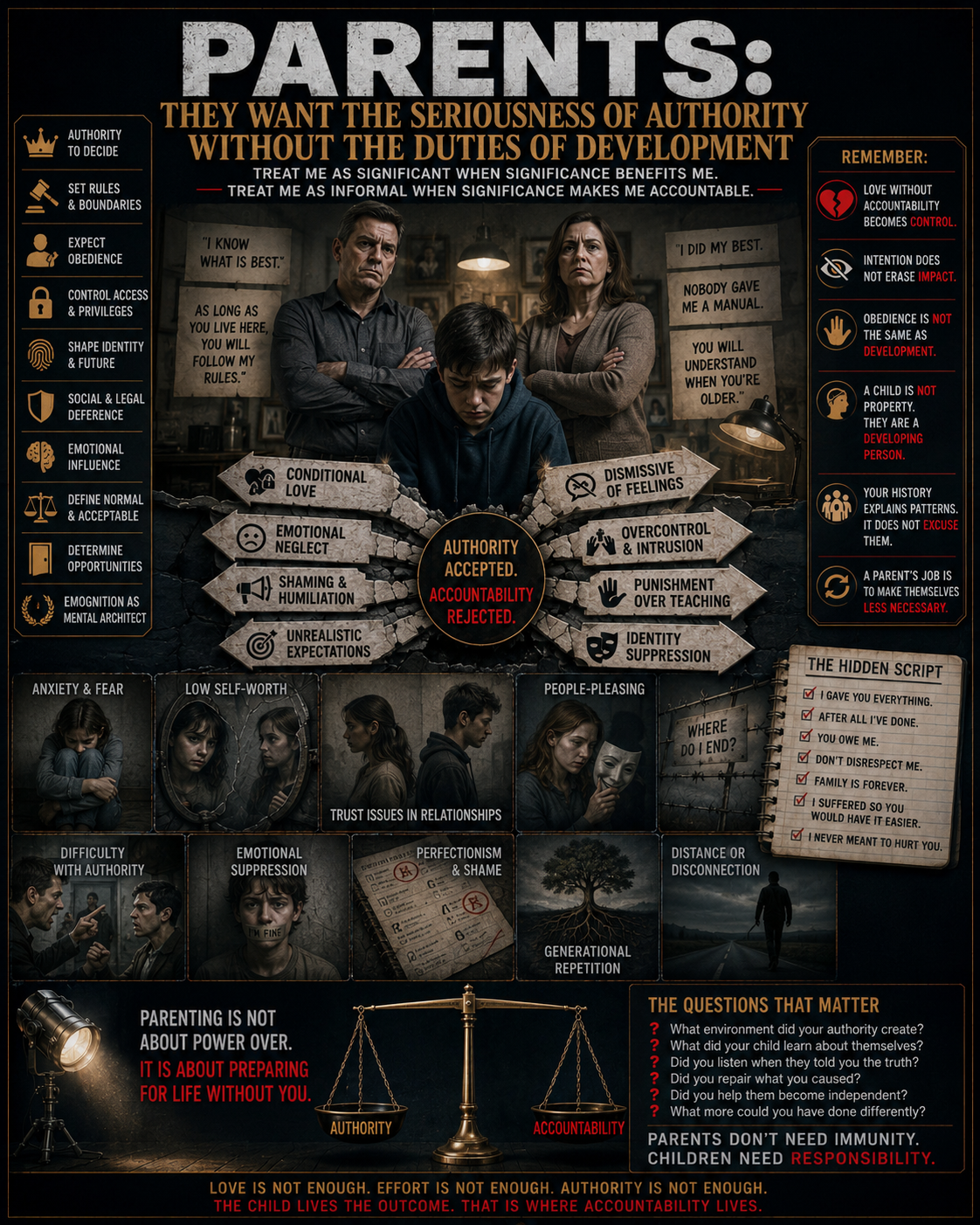
“Treat Me as Significant When Significance Benefits Me. Treat Me as Informal When Significance Makes Me Accountable.”
Parents may be one of the clearest examples of people wanting the benefits of seriousness without accepting the full duties that seriousness creates.
They want the seriousness of authority over children.
The right to decide.
The right to set rules.
The right to establish routines.
The right to determine what the child may wear, eat, watch, study, believe, say, question, fear, pursue or refuse.
The right to choose where the child lives.
Which school they attend.
Which adults may access them.
Which behaviours are punished.
Which emotions are permitted.
Which parts of the child are encouraged.
Which parts are treated as inconvenient.
They expect obedience.
Respect.
Loyalty.
Gratitude.
Trust.
Deference.
They may say:
“I am your parent.”
“You live under my roof.”
“I know what is best for you.”
“You will understand when you are older.”
“As long as you are my child, you will follow my rules.”
That seriousness gives the parent extraordinary influence over a developing human being.
The child does not enter the relationship with equal power.
They depend upon the parent for food, housing, safety, emotional regulation, healthcare, education, social access, identity formation, protection and an understanding of what love is supposed to feel like.
The parent may become the child’s first experience of authority.
Trust.
Conflict.
Safety.
Rejection.
Correction.
Forgiveness.
Power.
Belonging.
The child learns what relationships are through what repeatedly happens at home.
But when the consequences of parenting become visible, some parents retreat into informality.
“I did my best.”
“Nobody gave me a manual.”
“I was learning too.”
“That was how I was raised.”
“You were a difficult child.”
“You remember it differently.”
“I sacrificed everything for you.”
“I never meant to hurt you.”
“You turned out fine.”
The parent wants to be treated as powerful enough to command the child, but not powerful enough to be responsible for what the command repeatedly produced.
That is the contradiction.
The Parent Is Powerful Until Power Becomes Inconvenient
Parents are often presented as the central architects of a child’s development.
They shape habits.
Values.
Language.
Confidence.
Boundaries.
Attachment.
Self-perception.
Emotional regulation.
Social understanding.
The child may learn whether mistakes lead to correction or humiliation.
Whether honesty leads to safety or punishment.
Whether vulnerability leads to care or exploitation.
Whether disagreement is allowed.
Whether love remains present during conflict.
Whether authority explains itself.
Whether apology includes change.
Whether affection must be earned.
Whether the child’s body belongs to them.
Whether their voice matters.
Whether they are allowed to become distinct from the parent’s expectations.
When the child thrives, parents may take pride in what they taught.
Their discipline.
Their sacrifice.
Their values.
Their example.
Their strength.
Their guidance.
They may say:
“I raised them well.”
“I made sure they had standards.”
“I taught them resilience.”
“I gave them everything.”
But when the adult child speaks about fear, shame, neglect, emotional confusion, damaged boundaries or the long-term effects of childhood decisions, the parent may suddenly present themselves as only an imperfect person who should not be judged too harshly.
The same influence that was celebrated when the outcome appeared admirable becomes questionable when the outcome becomes painful.
This is selective parenthood.
If the parent is close enough to the child’s success to claim contribution, they are close enough to the child’s wounds to accept examination.
Authority Over a Developing Person Creates Heightened Duty
A child is not a smaller adult.
They are developing.
Their brain is developing.
Their understanding of consequence is developing.
Their emotional language is developing.
Their ability to regulate fear, anger, shame and disappointment is developing.
Their sense of identity is developing.
Their capacity to recognise manipulation, danger, inconsistency or unfairness is developing.
That developmental position creates vulnerability.
The parent usually knows more.
Controls more.
Has greater physical power.
Greater financial power.
Greater social authority.
Greater access to institutions.
The ability to reward.
Punish.
Remove privileges.
Control movement.
Define what happened.
Influence how other adults interpret the child.
Where power is unequal, responsibility is unequal.
The child cannot carry the same responsibility for the relationship as the adult who created the conditions of the relationship.
A parent cannot reasonably expect adult emotional maturity from a child while excusing their own lack of emotional maturity as ordinary human imperfection.
The higher standard belongs to the person with the greater capacity.
“I Did My Best” May Be True, but It Is Not the Whole Evaluation
Many parents did the best they understood how to do.
They may have carried poverty.
Trauma.
Isolation.
Illness.
Migration.
Discrimination.
Violence.
Grief.
Work pressure.
Lack of support.
Their own unhealed childhoods.
Their limitations matter.
Context matters.
Intent matters.
But the child still lives the outcome.
A parent’s best may still have been frightening.
Emotionally unavailable.
Controlling.
Unpredictable.
Neglectful.
Shaming.
Violent.
Overprotective.
Dismissive.
Possessive.
A truthful assessment can hold both.
The parent may have struggled.
The child may still have been harmed.
The parent may have loved the child.
The child may still have felt unsafe.
The parent may have sacrificed materially.
The child may still have lacked emotional care.
The parent may not have intended the consequence.
The consequence may still exist.
“I did my best” can explain capacity.
It cannot automatically close accountability.
The next questions are:
What did your best produce?
What became visible afterward?
What did you do once the harm was explained?
Did you listen?
Did you learn?
Did you change?
Did you repair?
Or did “my best” become the final defence against every further duty?
Parenthood Is Not Evaluated Only by Effort
Effort matters.
A parent may work long hours.
Cook.
Clean.
Pay bills.
Attend appointments.
Buy clothes.
Provide transport.
Protect the child physically.
Those are real contributions.
But parenthood is not measured only by how exhausted the parent became.
It must also be measured by what the child received.
Was the child safe?
Heard?
Protected?
Guided?
Allowed to develop?
Taught how to think?
Taught how to regulate emotion?
Given boundaries without humiliation?
Corrected without being degraded?
Loved without being controlled?
Allowed to have privacy?
Allowed to disagree?
Allowed to become a person rather than a continuation of the parent’s identity?
A parent can work extremely hard and still create a harmful emotional environment.
Labour does not automatically equal attunement.
Provision does not automatically equal nurture.
Sacrifice does not automatically equal wisdom.
A child can be materially provided for and emotionally abandoned.
The seriousness of parenthood requires examining the whole environment.
Providing Basic Needs Is Foundational, Not the Full Achievement
Some parents treat food, housing and clothing as though those provisions create immunity from every other criticism.
“I fed you.”
“I gave you a roof.”
“I paid for school.”
Those things matter.
They are essential.
But they are also foundational duties voluntarily inherited through bringing or accepting responsibility for a child.
The child did not create the obligation.
The parent did.
Providing the minimum conditions of survival does not erase the duty to provide emotional safety, developmental guidance, protection, explanation and care.
A prison also provides food and shelter.
That does not make it a nurturing home.
A child needs more than continued physical existence.
They need a place in which their mind, body, identity and emotional life can develop without being repeatedly harmed by the person controlling the environment.
Love Is Not Proven Only by Feeling It
Parents may sincerely love their children.
But love must be examined through function.
Did the love protect?
Did it listen?
Did it adapt?
Did it explain?
Did it allow the child to be distinct?
Did it remain present during difficulty?
Did it correct itself?
Did it reduce fear?
Did it increase the child’s capacity?
A parent may feel enormous love while expressing it through control.
Possession.
Fear.
Projection.
Punishment.
Intrusion.
The feeling may be real.
The expression may still be harmful.
The child does not live inside the parent’s internal intention.
They live inside the behaviour.
Love therefore cannot be used as a blanket defence.
“I loved you” should open the question:
How did that love reach the child?
The Child Is Not the Parent’s Property
Parental authority is often treated as ownership.
My child.
My rules.
My decision.
My house.
But the child is not property.
They are a person under temporary guardianship.
The parent’s role is not to possess the child.
It is to steward development until the child can increasingly steward themselves.
Healthy authority should reduce its own necessity over time.
The child should become more capable.
More discerning.
More autonomous.
More able to protect themselves.
More able to make decisions.
More able to recognise harm.
More able to form relationships without surrendering themselves.
A parent who requires lifelong obedience may not be developing independence.
They may be protecting dependence because dependence preserves authority.
The success of parenting should not be measured by how permanently the child remains under control.
It should be measured by whether the child can stand without losing connection.
Obedience Is Not the Same as Development
Obedience may sometimes be necessary.
A young child must be stopped from entering traffic.
A parent may need to act quickly where danger exists.
But obedience cannot become the primary goal of parenting.
A child trained only to obey may become an adult who struggles to question authority.
Recognise manipulation.
Set boundaries.
Trust their own judgement.
Leave harmful relationships.
Challenge unfair treatment.
A compliant child may appear easy to raise.
But compliance can conceal fear, suppression or disconnection from the self.
A serious parent should not only ask:
“Does my child do what I say?”
They should ask:
“Does my child understand why?”
“Can they think?”
“Can they disagree respectfully?”
“Can they tell me when I am wrong?”
“Can they recognise danger even when it comes from authority?”
“Are they becoming capable of making sound decisions without me?”
The aim is not obedience forever.
It is discernment.
Discipline Cannot Be a Cover for Emotional Discharge
Parents may call something discipline when it is actually anger.
Humiliation.
Fear.
Control.
Retaliation.
A parent may punish the child not because the punishment teaches, but because the parent feels disrespected, embarrassed or powerless.
The child then carries the parent’s unmanaged emotion under the language of correction.
Serious discipline should answer:
What did the child need to learn?
Was the response proportionate?
Was the child’s dignity protected?
Was the rule explained?
Was repair possible?
Did the parent regulate themselves first?
Did the consequence teach responsibility, or only fear?
If the child leaves understanding only that the parent can hurt them, discipline failed.
A Parent’s Unhealed History Can Become the Child’s Environment
Parents often reproduce what they experienced.
A parent who was not listened to may struggle to listen.
A parent raised through fear may treat fear as discipline.
A parent denied affection may find affection difficult.
A parent whose identity was controlled may control the child’s identity.
A parent who survived through emotional suppression may punish emotional expression.
The history explains the pattern.
It does not make the pattern harmless.
The child should not become the treatment centre for the parent’s unprocessed childhood.
A serious parent must be willing to ask:
What am I repeating?
What did I normalise because it happened to me?
What do I call love because I was taught to survive it?
Which parts of my reaction belong to this child?
Which belong to the past?
Breaking generational patterns is part of the duty.
The Child Should Not Carry the Parent’s Identity
Some parents experience the child as an extension of themselves.
The child’s grades reflect the parent.
Their appearance reflects the parent.
Their career reflects the parent.
Their behaviour reflects the parent.
Their relationships reflect the parent.
Their beliefs reflect the parent.
The child is pressured to protect family image, culture, reputation or parental ambition.
When the child becomes different, the parent may experience difference as betrayal.
But parenthood is not the production of a replica.
A child may carry family continuity without surrendering individuality.
A serious parent should help the child discover who they are, not force them to become proof that the parent succeeded.
The Parent Cannot Demand Honesty While Making Truth Unsafe
Parents often say they want honesty.
But what happens when the child tells the truth?
Are they punished?
Mocked?
Shamed?
Called disrespectful?
Accused of ingratitude?
The child learns quickly whether truth is actually welcome.
If every difficult disclosure threatens the parent’s self-image, the child may begin lying, hiding or emotionally withdrawing.
The parent may then complain that the child does not communicate.
But communication requires a receiver.
A child cannot be expected to remain open in an environment where honesty is repeatedly punished.
Silence Is Not Proof That No Harm Occurred
A child may not speak while dependent.
They may fear punishment.
Rejection.
Homelessness.
Loss of support.
Family retaliation.
Being disbelieved.
They may not have the language.
They may think the environment is normal.
They may only understand the harm later through relationships, therapy, parenthood, distance or adulthood.
The delay does not make the experience false.
A parent should not say:
“Why didn’t you tell me then?”
without asking:
“Was I safe enough to tell?”
Parents Can Use Sacrifice as Emotional Debt
Parental sacrifice can be profound.
But sacrifice becomes harmful when converted into lifelong debt.
“I gave up everything for you.”
“I worked because of you.”
“You owe me.”
The child did not request birth.
They should not be made responsible for repaying the parent’s entire life.
Gratitude can be encouraged.
Obedience should not be purchased through guilt.
The parent’s choices remain the parent’s responsibility.
A child should not be emotionally charged for the cost of being raised.
The Adult Child Does Not Stop Being the Child Who Lived the Outcome
Some parents respond to adult children by saying:
“You are grown now.”
That may be true.
The adult is responsible for their healing, decisions and future behaviour.
But adulthood does not erase childhood causation.
The adult may still carry patterns formed under parental authority.
Fear of conflict.
Difficulty trusting.
People-pleasing.
Hypervigilance.
Emotional suppression.
Shame.
Confusion about boundaries.
The adult child must eventually take responsibility for what they do with those patterns.
The parent remains responsible for the contribution they made to creating them.
Both responsibilities can exist without cancelling each other.
Family Loyalty Cannot Outrank Truth
Families often protect the parent through loyalty.
“Do not disrespect your mother.”
“That is still your father.”
“Family is family.”
The title becomes a shield.
But a relationship should not be protected from examination simply because it is biologically or legally significant.
The seriousness of family should increase responsibility.
Not reduce it.
A parent’s title does not make every action right.
Respect cannot mean silence.
Forgiveness cannot mean denial.
Family unity cannot mean requiring the harmed person to carry the whole burden quietly.
Apology Is Awareness, Not Completion
A parent may eventually apologise.
That matters.
But apology alone is not the full action.
A serious apology should lead to understanding.
Correction.
Changed behaviour.
Respect for boundaries.
Repair where possible.
The willingness to hear more than once.
The willingness to remain present when the child’s pain is uncomfortable.
“I said sorry” cannot become another method of closing the conversation before the consequence has been addressed.
The child may need aftercare, not only acknowledgement.
The Parent Cannot Rewrite the Child’s Reality to Protect Their Own
Some parents deny what happened.
Minimise it.
Compare it to worse situations.
Insist the child is too sensitive.
Claim the memory is inaccurate.
The child then carries both the original harm and the burden of defending their perception.
A serious parent does not need to agree with every interpretation immediately.
But they should be able to hear the child’s experience without treating it as an attack upon their entire humanity.
The child’s experience belongs to the child.
The parent’s intention cannot erase it.
Parents Are Human, but Humanity Does Not Erase Duty
Parents make mistakes.
They become tired.
Overwhelmed.
Afraid.
They will misunderstand.
React poorly.
Say the wrong thing.
The standard is not perfection.
It is responsibility.
Can the parent recognise when harm occurred?
Can they apologise without demanding immediate forgiveness?
Can they learn?
Can they ask for help?
Can they change the environment?
Can they accept that the child may need boundaries?
Can they remain present without making themselves the central victim?
That is what maturity looks like.
The Parent Should Be Willing to Become Less Necessary
The parent begins as essential.
The infant cannot survive alone.
Over time, healthy parenting should transfer capacity.
The child learns to speak.
Think.
Choose.
Travel.
Work.
Protect themselves.
Build relationships.
The parent’s role changes.
A serious parent does not interpret the child’s independence as rejection.
They recognise it as evidence that preparation worked.
The goal is not to remain the centre of the child’s life forever.
It is to become a secure part of a life the child can increasingly direct.
The Parent Seriousness Test
Whenever a parent asks to be taken seriously, ask:
What privileges does that seriousness give them?
Authority.
Trust.
Control.
Access.
The right to make decisions.
The expectation of obedience.
The power to define family rules.
The ability to shape the child’s identity and environment.
Social deference.
Legal recognition.
Then ask:
What duties should accompany those privileges?
Protection.
Explanation.
Nurture.
Emotional regulation.
Consistency.
Developmental understanding.
Correction.
Listening.
Respect for bodily autonomy.
Preparation for independence.
The willingness to repair.
Remaining present when harm appears.
Then ask:
Do they accept both, or only the side that benefits them?
Do they want obedience without explanation?
Respect without reciprocity?
Control without accountability?
Gratitude without emotional safety?
Authority without correction?
Loyalty without truth?
The title of parent without the full duties of parenting?
That is the test.
The Parental Accountability Matrix
A serious evaluation should ask:
- What authority did the parent exercise?
- What age and developmental capacity did the child possess?
- What needs depended upon the parent?
- Was the environment physically safe?
- Was it emotionally safe?
- Were rules explained?
- Was discipline proportionate?
- Was the child allowed to speak?
- Was honesty safe?
- Were boundaries respected?
- Was affection conditional?
- Was the child treated as a person or an extension?
- Which parental patterns came from unresolved history?
- What happened when concerns were raised?
- Did the parent listen?
- Did they correct?
- Did apology lead to change?
- Did the child become more capable and independent?
- Did the relationship produce trust or fear?
- Who carried the consequence when the parent refused accountability?
- What more could reasonably have been done with the authority the parent possessed?
These questions do not begin with hatred.
They begin with care.
Power.
Development.
Outcome.
Criticising Parenting Is Not Automatically Attacking the Parent
To say a parental choice caused harm is not to say the person has no human worth.
To say a child felt unsafe is not automatically to say the parent never loved them.
To say a pattern must change is not to erase every sacrifice.
The behaviour should be examined.
The authority should be examined.
The consequence should be examined.
Otherwise, parenthood becomes protected by identity.
The title replaces accountability.
The child is required to protect the parent’s self-image at the expense of their own reality.
Parental Identity Can Prevent Correction
Parents may fuse their identity with the role.
“I am a good mother.”
“I am a good father.”
When the child describes harm, the parent hears:
“You are a bad person.”
They may defend the identity rather than examine the behaviour.
But serious parenting requires enough separation between self and role to say:
“I may love you and still have harmed you.”
“I may have tried and still failed here.”
“I did not understand then.”
“I understand more now.”
“This must change.”
The ability to say that does not weaken parenthood.
It makes parenthood more trustworthy.
The Child Should Not Carry the Parent’s Ego
When a parent refuses correction because it threatens pride, the child pays.
The harmful pattern continues.
The child learns to remain silent.
Distance grows.
Trust weakens.
The parent protects the image of authority while the relationship absorbs the cost.
The family exists to support life.
Life should not be forced to support parental ego.
The Highest Form of Parental Accountability
The highest form of accountability does not ask only:
“Did the parent intend to love the child?”
It asks:
Given the authority, access, influence and developmental responsibility this parent possessed, what should the child reasonably have become capable of by now?
Do they know they have worth?
Can they identify danger?
Can they set boundaries?
Can they think independently?
Can they communicate emotion?
Can they receive correction without collapse?
Can they love without disappearing?
Can they recognise authority without surrendering discernment?
Can they make decisions?
Can they leave the parent’s home without leaving themselves behind?
Did the parent increase the child’s agency?
Or only secure obedience?
Did the relationship create a person who can live?
Or a person still organised around surviving the parent?
That question reveals the distance between parental authority and developmental outcome.
And that distance is where responsibility lives.
The Pattern Beneath Parents
In parenting, the actor wants:
Authority.
Trust.
Legitimacy.
Influence.
Status.
Protection.
Obedience.
Access.
Recognition.
But may resist:
Transparency.
Explanation.
Care.
Prevention.
Correction.
Proportional contribution.
Measurable outcomes.
Accepting consequences.
Remaining present when harm appears.
This is selective seriousness.
Seriousness when parenthood grants authority.
Informality when the child asks what that authority produced.
Closing: Immunity Wrapped in Sacrifice
Seriousness is not the title of mother.
Father.
Parent.
Guardian.
It is not providing money alone.
Making rules.
Working long hours.
Being older.
Being obeyed.
Being respected publicly.
Saying you sacrificed.
Seriousness is the willingness to carry the full weight of authority over a developing person.
If a parent wants the seriousness of obedience, they must accept the seriousness of impact.
If they shape the child’s emotional world, they must remain present when the child explains what that world felt like.
If they claim the right to guide development, they must accept responsibility for whether the child became more secure, capable and free.
The child is not asking the parent to have been perfect.
They are asking the parent to be honest about what happened.
What could have been done differently.
What still needs repair.
What must not be repeated.
The people who want to be taken seriously but reject serious responsibility are not asking for seriousness.
They are asking for immunity wrapped in sacrifice.
And parenthood has been protected by that wrapping for far too long.


Leave a Reply