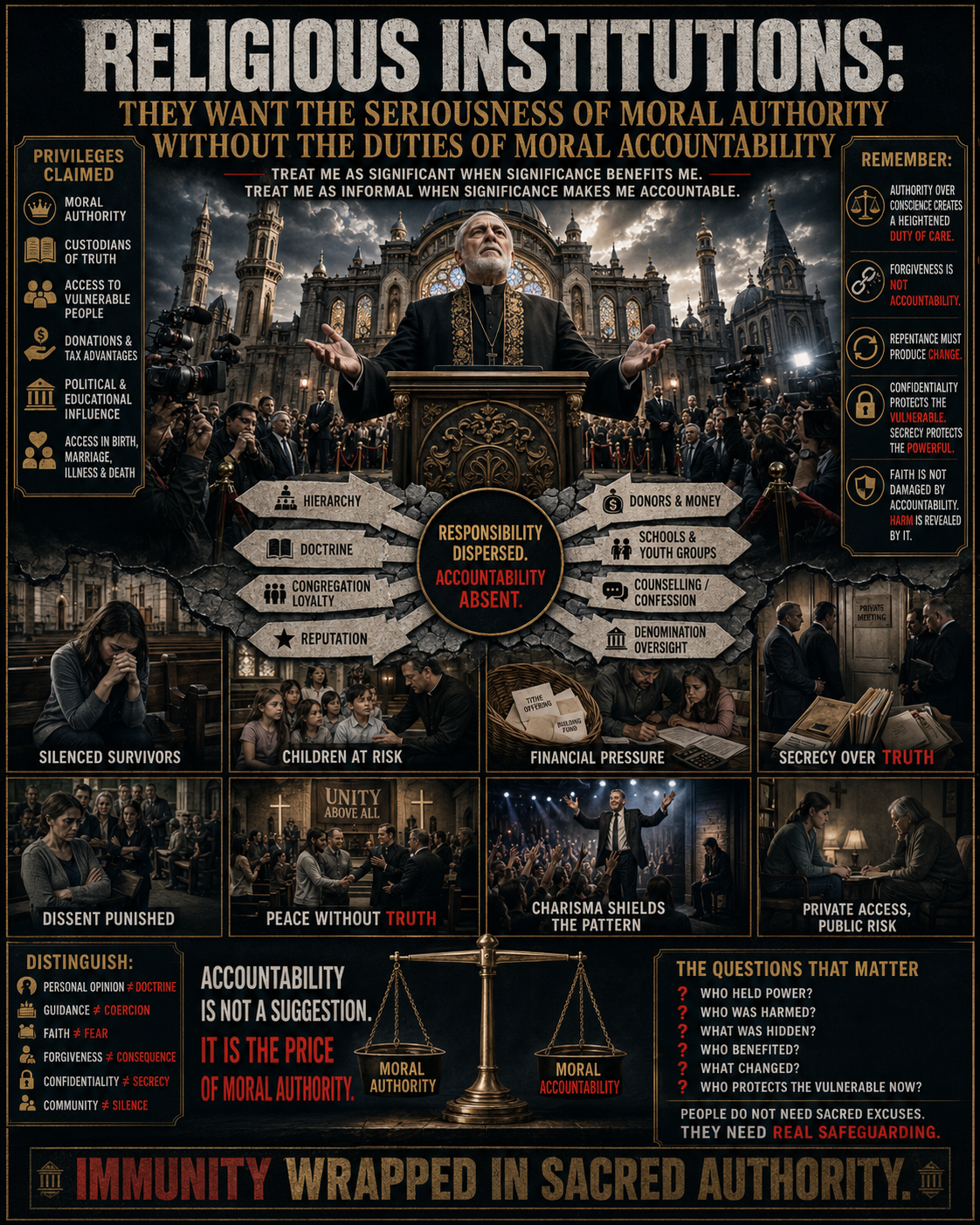
“Treat Me as Significant When Significance Benefits Me. Treat Me as Informal When Significance Makes Me Accountable.”
Religious institutions may be one of the clearest examples of institutions wanting the benefits of seriousness without accepting the full duties that seriousness creates.
They want to be treated as moral authorities.
Custodians of truth.
Protectors of conscience.
Guides of the soul.
Interpreters of sacred knowledge.
Teachers of right and wrong.
Guardians of family, community, discipline, purpose, restraint, forgiveness and spiritual order.
Religious leaders may be trusted with people’s deepest fears.
Their guilt.
Their grief.
Their marriages.
Their children.
Their bodies.
Their money.
Their understanding of suffering.
Their relationship with death.
Their relationship with God.
Their understanding of what makes them worthy, sinful, forgiven, obedient, chosen, condemned, saved or spiritually safe.
That is not ordinary influence.
It reaches beneath behaviour into identity.
It shapes not only what people do, but what they believe they are.
That seriousness gives religious institutions access.
Trust.
Legitimacy.
Donations.
Tax advantages.
Political influence.
Community authority.
Educational power.
Private access to vulnerable people.
The ability to speak during birth, marriage, illness, crisis and death.
The ability to shape moral norms across generations.
But when harm occurs within the institution, responsibility may suddenly be replaced by a different language.
Forgiveness.
Grace.
Prayer.
Human imperfection.
Spiritual warfare.
Temptation.
Repentance.
Mercy.
Submission.
The protection of the faith.
The reputation of the congregation.
The unity of the community.
The possibility that public exposure may “damage the work.”
The same institution that speaks confidently about sin may become vague when the sin sits inside its own hierarchy.
The same leader who teaches accountability may ask for compassion when accountability reaches them.
The same community that demands confession from ordinary members may prefer silence from those harmed by authority.
That is moral seriousness without moral accountability.
If You Claim the Right to Shape Conscience, You Inherit a Heightened Duty of Care
Religious authority is not merely informational.
It is not like giving someone a casual opinion.
When a religious leader speaks, the audience may believe the instruction carries divine weight.
A suggestion may be received as a command.
A preference may be received as doctrine.
A personal judgement may be received as God’s judgement.
A warning may be received as prophecy.
A criticism may be received as spiritual condemnation.
A request may be obeyed because resistance feels like disobedience to something sacred.
That changes the standard.
The greater the authority claimed, the greater the duty to distinguish:
Personal opinion from doctrine.
Tradition from truth.
Interpretation from certainty.
Leadership from control.
Guidance from coercion.
Faith from fear.
Spiritual care from dependency.
Institutional loyalty from moral obedience.
If someone claims access to truth beyond ordinary human judgement, they inherit an extraordinary obligation not to weaponise that claim.
Moral Authority Cannot Be Activated Only Outwardly
Religious institutions often speak clearly about the failures of society.
Sexual behaviour.
Family breakdown.
Dishonesty.
Greed.
Addiction.
Violence.
Disobedience.
Pride.
Corruption.
Materialism.
The decline of values.
They may speak firmly about what others should correct.
But moral seriousness must turn inward with equal force.
How are children protected?
How are complaints handled?
How is money used?
How are leaders selected?
How are women treated?
How are dissenters treated?
How are vulnerable people advised?
How are mistakes corrected?
How are allegations investigated?
How are abusive leaders removed?
How are survivors supported?
How is power distributed?
How much transparency exists?
A moral institution that can diagnose the world but cannot examine itself is not functioning as a moral authority.
It is functioning as an authority protected by moral language.
Forgiveness Cannot Replace Accountability
Forgiveness may have deep spiritual value.
It can release resentment.
Interrupt cycles of retaliation.
Create space for healing.
Allow a person to move without being permanently possessed by what happened.
But forgiveness is not the same as consequence.
It is not investigation.
It is not safeguarding.
It is not restitution.
It is not removal from authority.
It is not correction.
It is not repair.
It is not evidence that trust should be restored.
A person may forgive and still require distance.
A community may extend compassion and still remove a leader.
A religious institution may believe in redemption and still accept that redemption does not automatically restore someone to the position through which harm occurred.
Forgiveness speaks to the soul.
Accountability speaks to the structure.
Confusing them protects the person in power while leaving the conditions of harm intact.
Repentance Must Produce Change
Religious institutions often speak of repentance.
But repentance should mean more than emotional expression.
More than confession.
More than tears.
More than apology.
More than asking the community to move on.
Repentance without change becomes performance.
A person who has abused power may feel remorse.
That remorse matters.
But the institution must still ask:
What happened?
Who was harmed?
Was the conduct isolated or patterned?
What access enabled it?
What information was ignored?
Who protected the person?
What restitution is possible?
What role should they no longer occupy?
What safeguards must change?
What evidence of behavioural change exists?
An apology may signal awareness.
It is not the whole corrective action.
Religious institutions should understand that more clearly than most, because transformation is often central to their own teachings.
Human Imperfection Is Not a Defence for Institutional Failure
Religious institutions sometimes respond to wrongdoing by saying:
“No one is perfect.”
“Leaders are human too.”
“We all fall short.”
That is true.
But universal imperfection does not erase unequal responsibility.
A leader with spiritual authority, access, trust and institutional protection is not in the same position as an ordinary member.
The power is different.
The reach is different.
The consequences are different.
The opportunity to harm is different.
The ability to conceal is different.
The duty must therefore be different.
Human imperfection explains why safeguards are necessary.
It does not explain why safeguards were absent.
Hierarchy Can Turn Obedience Into Silence
Religious hierarchy can create order.
Continuity.
Discipline.
Clear responsibility.
But it can also create fear.
A member may be taught not to question leadership.
A child may be taught that the leader represents God.
A spouse may be told to submit.
A volunteer may fear losing community.
A survivor may fear being blamed for division.
A whistleblower may fear being labelled rebellious, bitter, possessed, disloyal or spiritually immature.
The hierarchy then becomes more than an administrative structure.
It becomes a psychological control system.
A serious religious institution should ask whether obedience is being used to protect truth or protect rank.
Respect for leadership should never require surrendering discernment.
Spiritual Language Can Hide Ordinary Abuse
Harm does not become less harmful because it is expressed through spiritual vocabulary.
Control may be called guidance.
Isolation may be called protection.
Fear may be called conviction.
Submission may be called faith.
Dependency may be called discipleship.
Financial pressure may be called sacrifice.
Silence may be called unity.
Criticism may be called persecution.
Leadership failure may be called spiritual attack.
This is one of the most dangerous uses of sacred language.
It can make ordinary abuse harder to recognise because the behaviour is wrapped in moral meaning.
A serious institution must be willing to translate spiritual language back into material reality.
What actually happened?
Who held power?
Who lost choice?
Who benefited?
Who was silenced?
Who was harmed?
Secrecy Is Not the Same as Confidentiality
Religious institutions often handle private matters.
Confession.
Counselling.
Marriage problems.
Trauma.
Illness.
Family conflict.
Confidentiality can protect dignity and trust.
But secrecy protects the institution from accountability.
The distinction matters.
Confidentiality protects the vulnerable person.
Secrecy protects the powerful person.
Confidentiality limits unnecessary exposure.
Secrecy prevents investigation.
Confidentiality preserves privacy.
Secrecy preserves reputation.
When serious harm is hidden in the name of protecting the church, ministry, temple, mosque, synagogue, denomination or spiritual community, the institution has chosen image over truth.
A moral institution should never require harm to remain hidden so that morality can continue to appear intact.
The Institution Cannot Protect Its Reputation by Betraying Its Purpose
When allegations arise, leaders may fear scandal.
Loss of trust.
Loss of donations.
Political consequences.
Media attention.
Internal division.
Declining membership.
They may believe secrecy protects the wider mission.
But if the mission claims truth, justice, care and protection, concealing harm destroys the mission from within.
The public exposure does not create the moral failure.
The failure already occurred.
Exposure reveals it.
A reputation preserved through silence is not moral credibility.
It is an appearance maintained at the expense of the harmed.
Survivors Should Not Be Asked to Carry the Institution’s Peace
Religious communities often value peace, unity and reconciliation.
But peace can be misused.
The survivor may be told not to divide the community.
Not to damage the leader’s family.
Not to weaken the congregation.
Not to discourage new believers.
Not to give enemies ammunition.
Not to act from bitterness.
The person harmed is then made responsible for preserving the emotional comfort of everyone else.
That is not reconciliation.
It is burden transfer.
The institution avoids disruption by placing the cost of silence onto the person already harmed.
Serious peace requires truth.
Without truth, peace becomes quietness around unresolved violence.
Victims Should Not Need to Prove Spiritual Purity Before Being Heard
A harmed person may be scrutinised.
Were they respectful?
Did they forgive?
Why did they wait?
Why did they stay?
Were they angry?
Did they speak publicly?
Did they behave perfectly afterward?
The institution may examine the survivor’s character more aggressively than the leader’s conduct.
This reverses responsibility.
A person does not need to perform ideal spirituality in order for harm to be investigated.
Trauma can produce confusion, anger, withdrawal, inconsistency and delayed disclosure.
The institution’s duty is not to reward the most emotionally acceptable victim.
It is to examine the evidence and protect people from further harm.
The Leader’s Charisma Cannot Outrank the Pattern
Religious leaders may be compelling.
Warm.
Intelligent.
Inspiring.
Generous.
Eloquent.
Spiritually gifted.
Charisma can create trust.
But charisma is not evidence of safety.
A person may move crowds and still mishandle individuals.
They may preach compassion and practise control.
They may inspire public transformation while causing private harm.
They may produce meaningful teachings while misusing authority.
The positive impact does not erase the negative conduct.
A person can be gifted and unsafe.
That distinction must remain visible.
Good Works Cannot Purchase Immunity
Religious institutions may defend a leader by listing everything they achieved.
The people they helped.
The churches they built.
The money they raised.
The lives they changed.
The years they served.
Those contributions matter.
But good works do not create a moral bank account from which harm can be deducted.
Impact is not immunity.
A person’s history of service may provide context.
It should not erase accountability.
The more trusted the person became through good work, the more serious the misuse of that trust may be.
The Community Can Become an Accountability Shield
Members may defend the institution instinctively.
They may fear losing identity, belonging, family or faith.
Criticism of the leader may feel like criticism of God.
Criticism of the institution may feel like an attack on the entire religion.
This emotional fusion can prevent examination.
Supporters attack accusers.
Dismiss evidence.
Protect the leader.
Explain away patterns.
The community performs the defence the institution no longer has to perform directly.
A serious religious leader should not exploit that loyalty.
They should say:
“Do not threaten people for questioning me.”
“Truth does not fear investigation.”
“My position does not place me beyond accountability.”
“The institution matters more than my image.”
That would be moral seriousness.
Religious Identity Can Make Correction Feel Like Collapse
When a leader’s identity fuses with the role, criticism becomes existential.
The ministry is the self.
The title is the self.
The congregation is the self.
The calling is the self.
Admitting failure may feel like losing divine legitimacy.
So the leader protects the role.
They deny.
Spiritualise.
Minimise.
Blame.
Silence.
Reinterpret.
Present scrutiny as persecution.
But a person who cannot separate themselves from the position cannot steward the position responsibly.
Correction requires enough inner stability to say:
“I am not my title.”
“The office can be examined.”
“The institution can survive my removal.”
“Truth matters more than my authority.”
Doctrine Must Not Become a Shelter for Avoiding Reality
Religious institutions may retreat into theological debate when the material issue is clear.
Was the person properly ordained?
Was the conduct technically sinful?
Was forgiveness offered?
Was the process scriptural?
Was the accusation handled according to tradition?
Those questions may matter within the faith.
But they cannot replace the practical questions.
Was someone harmed?
Was consent present?
Was power abused?
Was a child protected?
Was money misused?
Was evidence concealed?
Was the person allowed to continue?
Theological language should deepen moral clarity.
It should not make ordinary responsibility harder to locate.
The Institution Should Not Police Private Morality More Aggressively Than Institutional Harm
Some religious institutions focus intensely on personal behaviour.
Clothing.
Sexuality.
Relationships.
Language.
Entertainment.
Diet.
Gender roles.
Private habits.
But may respond weakly to abuse, exploitation, financial misconduct, coercion or institutional dishonesty.
This reveals a distorted hierarchy of seriousness.
The institution becomes highly disciplined around visible personal conformity while remaining less disciplined around the misuse of power.
A mature moral system should place greater scrutiny where capacity for harm is greatest.
The leader with access, authority and institutional protection should not be judged more softly than the ordinary member with little power.
Money Reveals the Moral Architecture
Religious institutions often receive donations, tithes, gifts, land, inheritances and volunteer labour.
These resources may fund community care, worship, education, relief and spiritual work.
But money must remain accountable.
How much is collected?
How is it used?
Who decides?
What benefits do leaders receive?
Are vulnerable people pressured to give?
Are promises attached to donations?
Are financial records accessible?
Does wealth accumulate while members struggle?
Does the institution own significant assets while presenting itself as perpetually in need?
A moral institution should be more transparent with money, not less.
Sacred purpose does not reduce financial responsibility.
It heightens it.
Faith Should Not Be Used to Override Material Need
People may be encouraged to pray instead of seek medical care.
Give money despite being unable to afford essentials.
Remain in harmful relationships.
Reject professional support.
Interpret illness or crisis as spiritual failure.
Religious guidance can offer strength.
But it should not replace evidence, safety, healthcare or legal protection where those are needed.
A serious institution knows the limits of its competence.
Spiritual support should accompany material care, not erase it.
The Religious Institution Cannot Claim Family While Avoiding Family Duties
Congregations often call themselves families.
That language suggests care.
Belonging.
Mutual aid.
Protection.
Continuity.
But family language can become manipulative if the institution expects loyalty without providing support.
Members may be asked to volunteer.
Give money.
Attend constantly.
Serve leadership.
Protect the community.
But when they experience hardship, the institution may become distant.
Community is serious when it receives sacrifice.
Informal when sacrifice should be returned.
That is not family.
That is extraction through the language of family.
Children Change the Standard Completely
Religious institutions often have access to children through schools, youth groups, ceremonies, counselling, camps and family trust.
Children may be taught to obey adults.
Respect spiritual authority.
Keep private matters within the community.
This creates heightened risk.
Safeguarding must therefore be foundational.
Not symbolic.
Background checks.
Clear boundaries.
Multiple-adult rules.
Transparent reporting.
Independent investigation.
Mandatory escalation where required.
Protection from retaliation.
No private system should be allowed to handle serious harm entirely within itself.
Children should not be asked to preserve the reputation of the institution that was supposed to protect them.
Religious Education Must Include Discernment, Not Only Obedience
Teaching faith should not mean removing critical thought.
A mature believer should be able to ask questions.
Examine interpretation.
Recognise manipulation.
Distinguish conviction from fear.
Challenge leadership.
Understand consent.
Know when spiritual language is being misused.
An institution that teaches obedience without discernment may produce compliance rather than faith.
If the belief is true, it should survive examination.
If the leadership is trustworthy, it should tolerate questions.
The Institution Must Be Able to Distinguish Persecution From Accountability
Religious groups may genuinely face discrimination or persecution.
That reality should not be dismissed.
But criticism is not always persecution.
Investigation is not always persecution.
Legal accountability is not always persecution.
Public scrutiny is not always an attack on faith.
Sometimes the institution is being questioned because harm occurred.
Calling every challenge persecution protects the institution from correction.
A serious religious body should be able to say:
“This is hostility towards our faith.”
And separately:
“This is legitimate accountability for our conduct.”
Those are not the same thing.
Religious Freedom Does Not Mean Freedom From Duty
Religious freedom protects belief, worship and community life.
It is essential.
But freedom of religion does not mean freedom from safeguarding.
Employment law.
Financial accountability.
Consent.
Protection from abuse.
A religious institution cannot invoke sacred identity to escape ordinary duties owed to human beings.
Freedom protects conscience.
It does not create immunity from consequence.
The Institution Cannot Demand Submission While Refusing Explanation
People may be told to trust leadership.
Respect authority.
Follow guidance.
But trust should be informed.
A serious leader should explain decisions.
Policies.
Money.
Safeguarding.
Discipline.
Removal.
Succession.
Authority without explanation becomes domination.
Faith may involve trust in the unseen.
Institutional governance should still be visible.
Succession Reveals Whether the Institution Serves the Mission or the Leader
A healthy institution should continue beyond one personality.
If the community collapses when the leader leaves, accountability becomes more difficult.
The leader may appear indispensable.
Members fear that removing them will destroy everything.
This creates protection.
A serious institution should build succession.
Shared authority.
Transparent governance.
Independent oversight.
The mission should be able to survive the failure of the person.
Otherwise, the organisation has become a personality system wearing religious structure.
The Religious Institution Seriousness Test
Whenever a religious institution or leader asks to be taken seriously, ask:
What privileges does that seriousness give them?
Moral authority.
Trust.
Access to vulnerable people.
Influence over conscience.
Donations.
Institutional protection.
Community loyalty.
Political access.
Educational influence.
Private information.
The power to define right and wrong.
Then ask:
What duties should accompany those privileges?
Transparency.
Safeguarding.
Explanation.
Humility.
Correction.
Financial accountability.
Independent investigation.
Respect for consent.
Protection of dissent.
Restitution.
Clear limits of authority.
Remaining present when harm appears.
Then ask:
Do they accept both, or only the side that benefits them?
Do they want obedience without explanation?
Forgiveness without repair?
Trust without transparency?
Authority without examination?
Donations without financial accountability?
Community loyalty without community protection?
Spiritual influence without responsibility for its consequences?
The Religious Institution Accountability Matrix
A serious evaluation should ask:
- What moral authority does the institution claim?
- What access does it have to children and vulnerable adults?
- How are leaders selected?
- Who can remove them?
- What independent oversight exists?
- How are complaints handled?
- Are safeguarding investigations genuinely independent?
- Are allegations reported appropriately?
- How are survivors supported?
- Is forgiveness used to pressure people into silence?
- Is repentance measured through behavioural change?
- Are leaders restored too quickly?
- Does the institution distinguish confidentiality from secrecy?
- Are finances transparent?
- How are donations solicited and used?
- Are members pressured through fear, guilt or spiritual promises?
- Are questions welcomed or punished?
- Is dissent labelled rebellion?
- Does doctrine increase protection or conceal harm?
- Are women, children and marginalised members given real power?
- Does the institution protect its reputation more urgently than people?
- Does the community remain safe when a charismatic leader fails?
- Are professional services used where spiritual guidance is insufficient?
- Did the institution become more ethical, or merely more skilled at appearing ethical?
- If another leader held the same position, what more could reasonably have been done?
These questions do not begin with hostility towards faith.
They begin with authority.
Trust.
Duty.
Consequence.
Criticising Religious Institutions Is Not the Same as Criticising Faith
A mature society should be able to examine religious institutions without treating every question as an attack on belief.
To ask how money is used is not to oppose worship.
To demand safeguarding is not to oppose spiritual authority.
To question a leader is not to reject God.
To expose abuse is not to damage morality.
To require accountability is not to deny forgiveness.
Faith and institutional conduct are not identical.
A religion may contain profound wisdom while an institution misuses it.
A leader may teach something meaningful while behaving irresponsibly.
Separating the sacred from the institution may be necessary to protect the sacred from institutional corruption.
The Highest Form of Religious Accountability
The highest form of accountability does not ask only:
“Did the institution preach the correct values?”
It asks:
Given the trust, moral authority, access and spiritual influence this institution possessed, how safe, truthful and ethically mature should the community reasonably have become by now?
Did people gain discernment?
Or dependency?
Did they become more capable of conscience?
Or more afraid of authority?
Did vulnerable people become safer?
Did leaders become more accountable?
Did the institution become more transparent?
Did forgiveness create restoration?
Or erase consequence?
Did spiritual teaching improve material conduct?
Did the institution embody the moral standard it applied to others?
That question reveals the distance between sacred claim and institutional embodiment.
And that distance is where responsibility lives.
The Pattern Beneath Religious Institutions
In religious institutions, the actor wants:
Authority.
Trust.
Legitimacy.
Influence.
Status.
Income.
Protection.
Obedience.
Access.
Recognition.
But may resist:
Transparency.
Explanation.
Care.
Prevention.
Correction.
Proportional contribution.
Measurable outcomes.
Accepting consequences.
Remaining present when harm appears.
This is selective seriousness.
Seriousness when moral authority produces trust, obedience and protection.
Informality when moral authority creates responsibility for harm.
Closing: Immunity Wrapped in Sacred Authority
Seriousness is not a robe.
A title.
A pulpit.
A sacred building.
A large congregation.
A religious education.
A claim of calling.
A reputation for holiness.
A confident interpretation of truth.
Seriousness is the willingness to carry the full weight of the moral role one asks others to respect.
If a leader claims the right to shape conscience, they inherit a heightened obligation to protect conscience from manipulation.
If an institution teaches repentance, it must demonstrate correction.
If it teaches truth, it must not hide behind secrecy.
If it teaches justice, it must not protect hierarchy from consequence.
If it teaches care, vulnerable people must be safer inside it than outside it.
If it teaches forgiveness, forgiveness must never be used to erase accountability.
Religious institutions cannot ask to be treated as guardians of morality while behaving as though their own moral failures are private, complicated or spiritually exempt.
They cannot demand obedience from ordinary people while offering ambiguity to those in power.
They cannot invoke human imperfection only when authority is exposed.
They cannot use sacred language to make material harm disappear.
The people and institutions that want to be taken seriously but reject serious responsibility are not asking to be recognised as moral authorities.
They are asking for immunity wrapped in sacred authority.
And religious institutions have been protected by that wrapping for far too long.


Leave a Reply