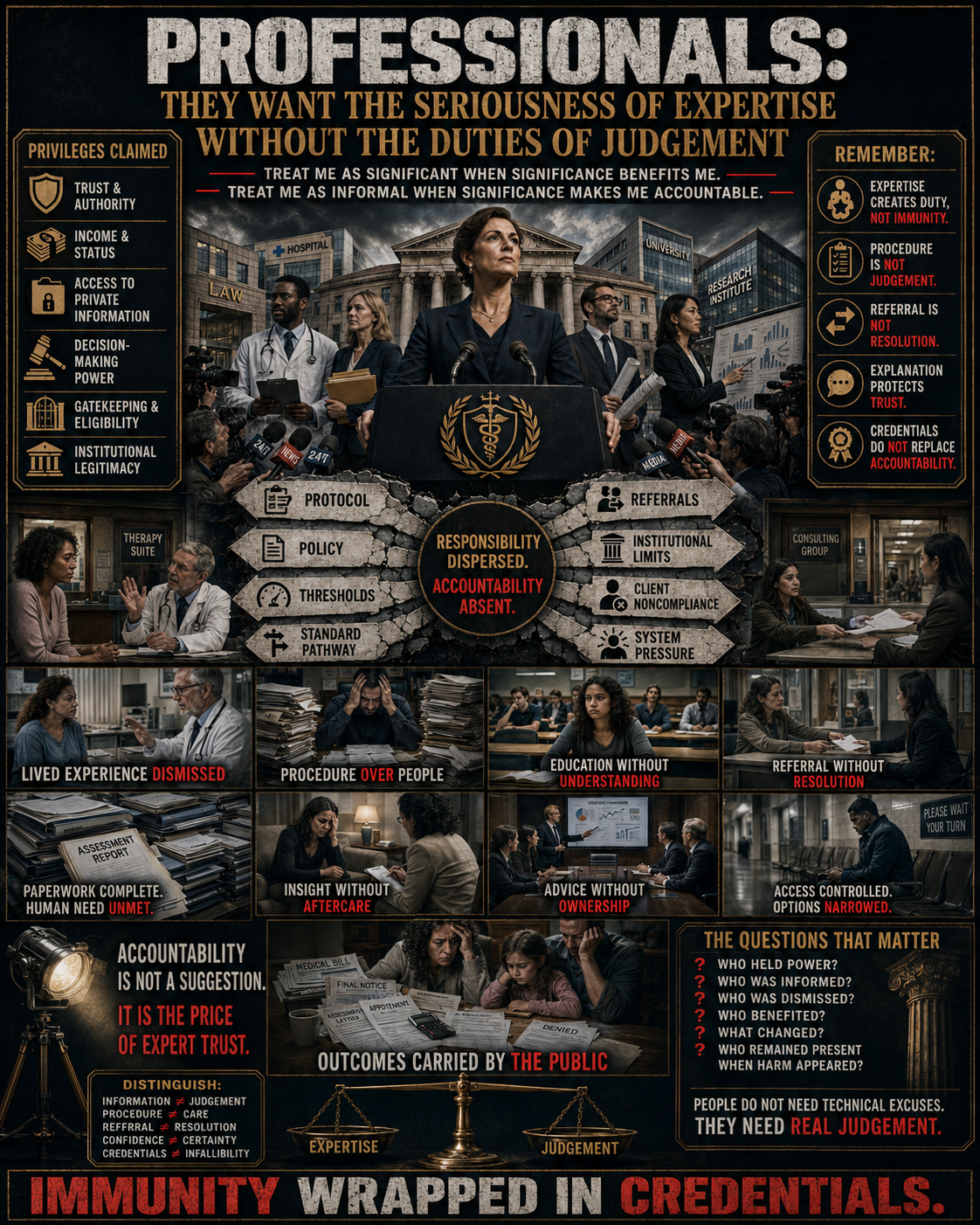
“Treat Me as Significant When Significance Benefits Me. Treat Me as Informal When Significance Makes Me Accountable.”
Professionals may be one of the clearest examples of people wanting the benefits of seriousness without accepting the full duties that seriousness creates.
Doctors.
Lawyers.
Therapists.
Teachers.
Consultants.
Accountants.
Engineers.
Architects.
Researchers.
Social workers.
Financial advisers.
Healthcare practitioners.
Professional status gives them authority.
Trust.
Income.
Decision-making power.
Access to private information.
The ability to interpret complex systems on behalf of people who may not understand them.
The right to recommend treatment.
Shape legal strategy.
Assess risk.
Influence a child’s development.
Advise a business.
Certify safety.
Determine eligibility.
Write reports that affect someone’s future.
Their opinions may carry more weight than the person living the consequence.
That seriousness is why society creates qualifications, licences, regulatory bodies, ethical codes, protected titles and professional standards.
The professional is not merely another person with an opinion.
They are trusted because they are expected to know more.
To understand more.
To see risks others may miss.
To translate complexity.
To exercise judgement.
To protect people from errors they may not have the training to recognise.
But when the result fails, some professionals retreat behind procedure.
“I followed protocol.”
“I acted within policy.”
“I completed the assessment.”
“I gave the standard advice.”
“I met the minimum requirement.”
“I referred the matter appropriately.”
“The system would not allow anything else.”
“The client did not follow the recommendation.”
“The evidence did not meet the threshold.”
Those things may matter.
Procedure is not irrelevant.
Policy is not irrelevant.
Standards are not irrelevant.
But professional seriousness is not only procedural compliance.
It is the duty to recognise when the procedure itself is insufficient for the human reality in front of you.
The Professional Is Trusted Because the Public Cannot Know Everything
People go to professionals because they do not possess the same training, access or experience.
A patient does not know every possible diagnosis.
A client does not know every legal route.
A student does not know every educational need.
A therapy client may not understand the patterns shaping their distress.
A business owner may not understand a regulatory risk.
A family may not know which option will create the greatest long-term consequence.
The professional therefore holds an information advantage.
That advantage creates responsibility.
The client is not simply purchasing time.
They are purchasing discernment.
Interpretation.
Foresight.
Context.
The ability to distinguish what matters from what merely appears important.
A professional who simply repeats information the client could have found elsewhere is not necessarily fulfilling the highest function of expertise.
Expertise should organise knowledge into useful judgement.
Expertise Is Not Only Knowing the Rules
A professional may know every rule.
Every statute.
Every guideline.
Every diagnostic criterion.
Every professional standard.
Every institutional process.
And still fail the person in front of them.
Because rules do not apply themselves.
Judgement is required.
The professional must decide:
Which fact matters most?
Which risk requires urgency?
Which exception applies?
Which procedure is creating delay?
Which symptom does not fit the obvious explanation?
Which client cannot safely be processed through the standard pathway?
Which case requires escalation?
Which person is being misunderstood because the system was designed around a different type of person?
That is where expertise becomes serious.
Knowing the procedure is competence.
Recognising when the procedure is inadequate is judgement.
Minimum Compliance Is Not the Same as Maximum Responsibility
Professional regulation often establishes minimum standards.
Those standards matter.
They create consistency.
Protect the public.
Clarify expectations.
Provide a basis for discipline.
But minimum standards are floors.
Not ceilings.
A professional may technically comply and still fail to provide meaningful care.
A doctor may complete the required checks while dismissing the patient’s lived pattern.
A lawyer may submit the correct document while failing to explain the wider consequences.
A teacher may deliver the curriculum while failing to notice that the student cannot access it.
A therapist may maintain formal boundaries while repeatedly failing to recognise deterioration.
A consultant may deliver the agreed report while avoiding the deeper problem the client actually needed solved.
The question cannot only be:
“Did they breach the rule?”
It should also be:
“Did they fulfil the responsibility proportionate to their knowledge and position?”
Procedure Should Support Judgement, Not Replace It
Procedure has value.
It creates a shared standard.
Reduces arbitrary decision-making.
Supports consistency.
Protects against impulsive conduct.
Preserves records.
Clarifies responsibility.
But procedure becomes dangerous when it replaces thought.
The professional begins to treat the checklist as the work.
The form is completed.
The box is ticked.
The referral is sent.
The policy is followed.
The person remains unprotected.
The professional may feel safe because the file appears complete.
But the human reality may still be unresolved.
A completed process is not the same as a completed duty.
The purpose of procedure is to help professionals act responsibly.
When the procedure prevents responsible action, professional judgement should identify the contradiction.
The Human Being Is Not the Average Case
Most systems are designed around patterns.
Typical symptoms.
Expected timelines.
Standard responses.
Average risk.
General pathways.
That is necessary at scale.
But no individual person is an average.
A patient may present atypically.
A child may learn differently.
A legal client may have circumstances that do not fit the standard model.
A therapy client may hide distress behind competence.
A worker may appear functional while approaching collapse.
The professional’s value lies partly in seeing the person inside the category.
If every case could be handled identically, advanced professional judgement would be less necessary.
The professional exists because human reality exceeds the template.
“I Followed Protocol” Can Become an Accountability Shield
Following protocol may be entirely appropriate.
But the phrase can also be used to close inquiry.
The professional points to the process as though the process itself proves the outcome was responsible.
But several questions remain.
Was the protocol appropriate for this person?
Was the information complete?
Were warning signs ignored?
Did the professional notice the limitation?
Was escalation possible?
Did the professional explain the risk?
Did the person understand the advice?
Was the system’s failure foreseeable?
Did the professional record their concern?
Did they challenge the policy?
Did they remain present when the outcome worsened?
Protocol can prove that a process occurred.
It does not automatically prove that discernment occurred.
Professionals Want Deference Because They Are Experts
Professional culture often expects trust.
The client should follow advice.
The patient should comply.
The student should listen.
The employee should accept the assessment.
The public should respect expertise.
That expectation is not inherently unreasonable.
Expert knowledge deserves recognition.
But trust cannot be demanded without explanation.
A serious professional should be able to communicate:
What they know.
What they do not know.
What evidence supports the recommendation.
What uncertainty remains.
What alternatives exist.
What the risks are.
What the person should watch for.
When to return.
When to seek another opinion.
Authority becomes safer when it is transparent.
A professional who expects obedience but resists explanation is not asking for informed trust.
They are asking for submission.
The Professional Cannot Use Complexity to Silence the Client
Technical knowledge can create distance.
Medical terminology.
Legal language.
Academic language.
Financial terminology.
Institutional process.
The professional may understand the system while the client struggles to follow.
That imbalance can make the client feel small.
Confused.
Dependent.
Afraid to ask questions.
The professional may interpret confusion as inability.
But communication is part of professional responsibility.
The client should not be required to become an expert merely to understand what is happening to them.
A serious professional translates.
They do not use complexity as evidence of superiority.
Expert Language Can Hide Weak Explanation
Specialised language is sometimes necessary.
But jargon can also conceal uncertainty.
A professional may sound authoritative while saying very little.
The client leaves with more words but not more understanding.
If the professional cannot explain the issue clearly, that may indicate a failure of communication.
It may also reveal that the professional has memorised the framework without fully integrating it.
Clarity is not simplification into inaccuracy.
It is evidence that the professional understands the structure well enough to make it accessible.
The Client’s Lived Experience Is Evidence
Professionals often rely on formal evidence.
Tests.
Documents.
Records.
Assessment tools.
Precedent.
Measured outcomes.
That matters.
But the person’s lived experience is also information.
The patient knows what changed in their body.
The student knows where comprehension breaks down.
The client knows what repeatedly happens in their life.
The family knows which support has already failed.
The worker knows what the written policy does not capture.
Lived experience is not infallible.
But it should not be dismissed because it arrives in ordinary language.
The professional’s role is to investigate it.
Not automatically replace it with the official record.
Dismissal Is Especially Dangerous Where the Professional Controls Access
Some professionals control gateways.
Diagnosis.
Treatment.
Legal representation.
Benefits.
Education support.
Housing assessment.
Financial approval.
Professional certification.
A dismissive decision may block the person from the next layer of help.
The professional may experience the interaction as one appointment.
The client may experience it as the point at which the entire system closed.
That is why access decisions require seriousness.
The professional should understand the downstream consequence of saying no.
A Referral Is Not Always Resolution
Professionals often refer people elsewhere.
That may be correct.
No one professional can perform every function.
Referral protects competence boundaries.
But referral can become responsibility transfer.
The person is sent to another service.
Then another.
Then another.
Each professional performs the correct procedural act.
Nobody ensures that the person actually reaches help.
The system becomes a chain of formally responsible steps producing an irresponsible whole.
A serious professional should understand continuity.
Where the risk is significant, the question is not only:
“Did I refer?”
It is:
“Did the handover work?”
Professional Boundaries Are Necessary, but They Should Not Become Emotional Absence
Boundaries protect both professional and client.
They prevent exploitation.
Confusion.
Dependency.
Improper relationships.
But professional distance can become indifference.
The professional becomes so focused on avoiding emotional involvement that the person feels processed rather than helped.
Care does not require loss of boundaries.
It requires presence within them.
A serious professional can remain clear, ethical and emotionally regulated while still treating the person as human.
Doctors: Clinical Authority Creates a Duty to See Beyond the Obvious
Doctors hold extraordinary trust.
They may interpret symptoms, prescribe medication, refer for tests, decide urgency and influence whether the patient believes their own body.
Medical systems require protocols.
But healthcare becomes unsafe when protocol outranks perception.
A symptom may not fit the expected pattern.
A condition may present differently across sex, race, age or disability.
The test may be normal while the person remains unwell.
The patient may have repeatedly returned because something is still wrong.
A serious doctor should not treat repeated attendance as annoyance before considering whether the system has missed something.
Expertise includes knowing when the first explanation is insufficient.
Lawyers: Legal Procedure Is Not the Same as Justice
Lawyers operate inside formal systems.
Deadlines.
Evidence rules.
Jurisdiction.
Procedure.
Professional duties.
These matter.
But a client often arrives with a human problem that does not fit neatly into one legal category.
The lawyer may focus on what is currently actionable.
The client may need to understand the whole architecture.
What can be proved?
What cannot?
What are the costs?
What are the risks?
What remedy is realistic?
What harm will remain even if the case succeeds?
A serious lawyer should not allow technical legality to obscure material justice.
They may not be able to change the whole system in one case.
But they should remain honest about where the law itself is insufficient.
Therapists: Insight Without Aftercare Can Become Exposure
Therapists may help people access vulnerable memories, identities and emotions.
That is serious work.
It can expand understanding.
But opening something is not the same as helping someone carry what has been opened.
A person may leave more exposed than they arrived.
A serious therapist should consider pacing.
Grounding.
Integration.
Safety.
The person’s capacity.
The difference between insight and destabilisation.
The professional should not treat emotional intensity as proof of progress.
Nor should they use therapeutic language to make the client permanently dependent on interpretation.
Therapy should increase agency.
Not replace it.
Teachers: Delivering Content Is Not the Same as Educating a Child
Teachers carry responsibility for development.
They work within curricula, targets and institutional constraints.
But the child is not merely a unit of attainment.
A student may be intelligent but unable to perform within the method being used.
Another may appear disengaged because they are overwhelmed.
Another may be quiet because they do not feel safe.
Another may comply without understanding.
A serious teacher should not measure education only through completed work.
They should ask what the student is becoming capable of.
Teaching is not merely content delivery.
It is the cultivation of understanding.
Consultants: Advice Without Ownership Can Become Expensive Distance
Consultants may enter organisations with specialist knowledge.
They produce strategies, reports, frameworks and recommendations.
But some remain protected from consequence.
The advice is delivered.
The organisation implements it.
If the result succeeds, the consultancy claims expertise.
If it fails, implementation is blamed.
That may sometimes be accurate.
But a serious consultant should understand how the advice will function in the real system.
Was it practical?
Was it resourced?
Did it account for culture?
Did it transfer risk?
Did it depend on unrealistic assumptions?
Did the consultant remain available when problems emerged?
Advice should not be designed only to look intelligent at presentation stage.
It should survive contact with reality.
Professionals Often Control the Definition of Failure
This is a major power.
The professional may define whether the result counts as failure.
The doctor may say the treatment was clinically appropriate.
The lawyer may say the case was always difficult.
The teacher may say the student did not engage.
The therapist may say the client resisted the process.
The consultant may say the organisation implemented poorly.
Those explanations may be valid.
But the professional should not hold exclusive power to interpret the failure.
The client’s outcome matters.
Independent review matters.
Alternative expertise matters.
The professional should not be judge of both performance and consequence.
Second Opinions Should Not Be Treated as Disloyalty
A person may seek another professional because something feels unresolved.
That should not automatically be treated as distrust or disrespect.
Second opinions are part of healthy accountability.
They allow alternative interpretation.
They reduce dependence on one person’s judgement.
A confident professional should be able to tolerate examination.
Expertise should not require monopoly.
Professional Confidence Can Be Mistaken for Certainty
Professionals are often expected to appear confident.
Clients want reassurance.
Institutions reward decisiveness.
But confidence can exceed evidence.
The professional may speak with certainty because uncertainty appears weak.
That is dangerous.
A serious professional should be able to say:
“I do not know.”
“The evidence is incomplete.”
“This is the most likely explanation, not the only one.”
“This falls outside my competence.”
“We need another perspective.”
Knowing the limits of expertise is part of expertise.
Errors Should Lead to Correction, Not Defensive Language
Professionals will make mistakes.
Human judgement is imperfect.
The standard cannot be errorlessness.
But the response matters.
Was the error acknowledged?
Was the person informed?
Was the harm repaired?
Was the system changed?
Was the learning shared?
Or did the professional retreat into legal language, institutional protection and minimal admission?
An error followed by correction can strengthen trust.
An error followed by concealment converts a mistake into a character and governance problem.
Apology Is Not the Full Corrective Action
A professional may apologise.
That matters.
It signals awareness.
But apology alone does not repair the consequence.
The client may need treatment.
Compensation.
A corrected record.
A new assessment.
A restored opportunity.
A changed policy.
A different professional.
An explanation.
Aftercare.
A serious professional should understand that accountability continues after acknowledgement.
Institutions Can Protect Professionals More Than the Public
Professional bodies and employers often investigate complaints.
This is necessary.
But the structure may lean towards institutional protection.
The complaint is narrowed.
The threshold is high.
Language becomes technical.
The person must prove harm through the system’s own categories.
The professional has access to representation and records.
The client may be exhausted, unwell or frightened.
A serious system should not make accountability available only to people strong enough to survive the process.
Credentials Should Not Become Immunity
Qualifications matter.
Training matters.
Licensing matters.
Experience matters.
But credentials are evidence of preparation.
Not evidence of infallibility.
A professional may be highly qualified and still wrong.
A less formally recognised person may notice something important.
Expertise deserves respect.
It should not be worshipped.
A serious profession should be capable of receiving useful insight from outside its hierarchy.
Professional Hierarchies Can Silence Junior Insight
Junior professionals may notice risk.
Nurses.
Trainees.
Assistants.
New teachers.
Junior lawyers.
Support staff.
They may be closer to the person or process than senior leadership.
But hierarchy can prevent them from speaking.
The senior expert is assumed to know more.
The junior person fears retaliation.
The warning remains unraised.
A serious profession should create routes through which insight can travel regardless of rank.
Authority should organise knowledge.
Not suppress it.
The Professional May Be Personally Good and Professionally Inadequate
This distinction matters.
A professional may be kind.
Hardworking.
Sincere.
Well-intentioned.
They may care deeply.
And still be ineffective.
Personal goodness does not remove professional responsibility.
The question is not whether they are a bad person.
It is whether the role was fulfilled.
Did their knowledge produce protection?
Did their intervention improve the situation?
Did they recognise the limit?
Did they act proportionately?
Did they learn?
Holding the position accountable does not require destroying the person.
It requires separating character from performance.
The Client Is Not Responsible for Managing the Professional’s Ego
A professional may become defensive when questioned.
They may interpret disagreement as disrespect.
The client then begins managing the professional’s emotions.
Softening questions.
Avoiding challenge.
Accepting explanations they do not understand.
That reverses the relationship.
The person seeking help should not have to protect the expert from scrutiny.
A serious professional can receive questions without making the client regret asking them.
Professional Seriousness Requires Prevention
Many professions operate reactively.
Treat the illness.
Litigate the dispute.
Repair the system.
Respond to the crisis.
Support the person after breakdown.
That work is necessary.
But higher professional intelligence also asks:
What could have prevented this?
What warning signs were present?
What system repeatedly produces the same harm?
What education is missing?
What policy creates risk?
What earlier intervention would have reduced the consequence?
Professional seriousness should not only solve the case in front of it.
It should help reduce the number of similar cases that follow.
The Professional Seriousness Test
Whenever a professional asks to be taken seriously, ask:
What privileges does that seriousness give them?
Trust.
Income.
Authority.
Access to private information.
Decision-making power.
Control over entry and exclusion.
The ability to define risk.
The ability to influence another person’s future.
Institutional legitimacy.
Professional protection.
Then ask:
What duties should accompany those privileges?
Competence.
Explanation.
Transparency.
Care.
Prevention.
Correction.
Judgement.
Knowing the limits of expertise.
Escalation when necessary.
Listening to lived experience.
Remaining present when harm appears.
Then ask:
Do they accept both, or only the side that benefits them?
Do they want deference without explanation?
Income without outcome?
Expert status without correction?
Authority without scrutiny?
Procedure without judgement?
Trust without transparency?
Professional protection without professional accountability?
The Professional Accountability Matrix
A serious evaluation should ask:
- What qualification and authority did the professional possess?
- What information was available?
- What information should reasonably have been gathered?
- What risk was foreseeable?
- What procedure was followed?
- Was that procedure sufficient for this person?
- Did the professional exercise independent judgement?
- Were warning signs ignored?
- Was the person’s lived experience taken seriously?
- Were uncertainty and limitations explained?
- Were alternatives presented?
- Was informed consent meaningful?
- Was escalation possible?
- Was referral completed or merely initiated?
- Did the professional remain present when the outcome worsened?
- How were errors handled?
- Was apology followed by correction?
- Did the institution protect the professional more quickly than the client?
- Was the client expected to understand complexity without adequate explanation?
- Did the professional improve the person’s agency or deepen dependence?
- Did appearance of compliance improve faster than the actual outcome?
- What could another competent professional reasonably have done differently?
These questions do not begin with hostility.
They begin with knowledge.
Capacity.
Judgement.
Consequence.
Criticising a Professional Is Not Automatically Rejecting Expertise
A mature society should be able to examine professionals without collapsing into anti-intellectualism.
To question a doctor is not to reject medicine.
To challenge a lawyer is not to reject law.
To criticise a therapist is not to reject therapy.
To examine a teacher is not to reject education.
To question a consultant is not to reject specialist advice.
Expertise becomes stronger when it can be examined.
Blind deference weakens professions because it protects error from correction.
The goal is not to remove authority.
It is to make authority worthy of trust.
The Highest Form of Professional Accountability
The highest form of accountability does not ask only:
“Did the professional follow the correct process?”
It asks:
Given the knowledge, training, authority and access this professional possessed, what should the person’s reality reasonably look like after their intervention?
Did the person understand more?
Become safer?
Gain options?
Receive appropriate treatment?
Avoid foreseeable harm?
Leave with greater agency?
Was the problem clarified?
Was uncertainty made visible?
Was the professional’s role fulfilled beyond the minimum?
Did procedure support the human being?
Or did the human being disappear inside the procedure?
That question reveals the distance between professional capacity and human outcome.
And that distance is where responsibility lives.
The Pattern Beneath Professionals
In professional life, the actor wants:
Authority.
Trust.
Legitimacy.
Influence.
Status.
Income.
Protection.
Obedience.
Access.
Recognition.
But may resist:
Transparency.
Explanation.
Care.
Prevention.
Correction.
Proportional contribution.
Measurable outcomes.
Accepting consequences.
Remaining present when harm appears.
This is selective seriousness.
Seriousness when expertise brings trust, income and authority.
Informality when expertise creates responsibility for the result.
Closing: Immunity Wrapped in Credentials
Seriousness is not a qualification.
A licence.
A title.
A uniform.
A professional body.
A technical vocabulary.
A consultation room.
A policy document.
A completed form.
Seriousness is the willingness to carry the full weight of the expertise one asks others to trust.
If a professional knows more, they owe more.
If they control access, they owe greater care.
If they influence another person’s future, they owe explanation.
If they claim expertise, they must know when the standard procedure is insufficient.
If they make an error, they must remain present for correction.
If their role justifies authority and income, it must also justify accountability.
A professional cannot use procedure as evidence of seriousness when the procedure failed to meet the human reality.
They cannot ask people to trust their judgement while refusing examination of that judgement.
They cannot invoke minimum compliance as though minimum compliance completes maximum responsibility.
The people who want to be taken seriously but reject serious responsibility are not asking to be recognised as experts.
They are asking for immunity wrapped in credentials.
And professional culture has protected that wrapping for far too long.


Leave a Reply