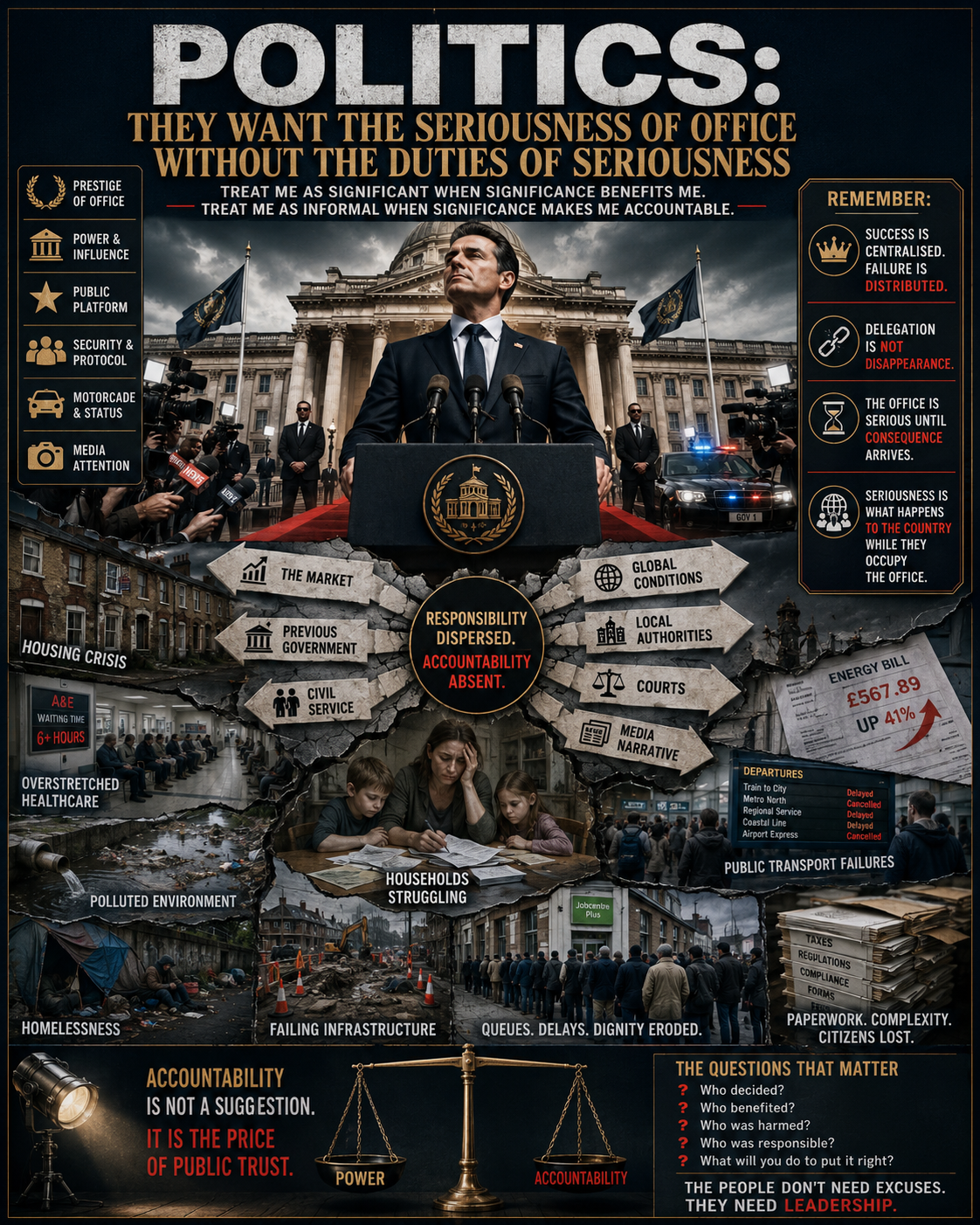
“Treat Me as Significant When Significance Benefits Me. Treat Me as Informal When Significance Makes Me Accountable.”
Politics may be one of the clearest places where people demand the privileges of seriousness while resisting the duties that seriousness creates.
Politicians want to be treated as national leaders, statesmen, public servants, representatives of the people and custodians of the future. They want the ceremony of office, the security, the title, the salary, the platform, the access, the protection, the historical importance and the authority to make decisions that affect millions of lives.
They want the motorcade.
The official residence.
The public deference.
The institutional legitimacy.
The right to speak in the name of the country.
The ability to raise taxes, pass laws, deploy public money, shape education, regulate business, determine foreign policy, influence policing, structure healthcare, affect housing and decide which problems receive urgency.
They want the significance.
But when the consequences of those decisions become visible, responsibility suddenly becomes fragmented.
The previous government is blamed.
The civil service is blamed.
The market is blamed.
Global conditions are blamed.
Local authorities are blamed.
The courts are blamed.
The opposition is blamed.
The media is blamed.
The public is blamed.
International conflict is blamed.
Supply chains are blamed.
Unexpected demand is blamed.
Poor implementation is blamed.
The complexity of government is invoked as though complexity erases authorship.
The position remains powerful when power is being exercised.
It becomes strangely powerless when the public asks why the outcomes deteriorated.
That is the pattern.
The Office Is Treated as Serious Until Consequence Arrives
A political role is presented as one of the highest forms of public responsibility.
The person occupying it may shape the conditions under which millions of people live.
They may influence whether a child has access to education.
Whether a family can afford housing.
Whether a patient receives treatment.
Whether a river remains polluted.
Whether public transport functions.
Whether wages keep pace with living costs.
Whether war receives funding.
Whether social care is available.
Whether taxes are spent on prevention or repair.
Whether technology replaces jobs.
Whether people can reach a human being inside a public service.
Whether homelessness is prevented or merely managed.
Those are not symbolic decisions.
They are material.
They enter bodies.
Homes.
Bank accounts.
Classrooms.
Workplaces.
Relationships.
Communities.
Future generations.
Yet politicians are often evaluated through performance rather than stewardship.
Did they speak confidently?
Did they dominate the interview?
Did they win the debate?
Did they look prime ministerial?
Did they control the narrative?
Did they appear decisive?
Did they avoid embarrassment?
Did they produce a memorable slogan?
Did they survive the scandal?
Politics becomes theatre around the role while the actual function of the role becomes secondary.
But seriousness is not how convincingly someone occupies the stage.
Seriousness is what happens to the country while they occupy the office.
A Serious Political Position Is Not Primarily a Platform
A serious political position does not only require visibility.
It requires prioritisation.
Prevention.
Explanation.
Foresight.
Coordination.
Correction.
Measurable improvement.
The courage to act before the problem becomes politically fashionable.
The willingness to carry responsibility for what was foreseeable but left undone.
The politician should not be judged only by what they announced.
They should be judged by what changed.
What improved?
What deteriorated?
What was prevented?
What was delayed?
What became more expensive because action came late?
What warnings were received?
What evidence was available?
Which foundational need was deprioritised?
Where did public money go?
Who benefited?
Who carried the consequence?
What did the politician know?
When did they know it?
What power did they have?
What did they choose to do with it?
That is the seriousness test applied to politics.
Political Responsibility Cannot End at Intention
Politicians often retreat into intention when results are poor.
“We wanted to improve the system.”
“We acted in good faith.”
“We inherited difficult circumstances.”
“We were trying to balance competing pressures.”
“We could not have predicted every outcome.”
“We made the best decision with the information available.”
Some of those statements may be true.
But intention is not enough where the position carries extensive power, information and resources.
A person may sincerely intend to improve housing while homelessness rises.
They may genuinely want better healthcare while waiting lists grow.
They may care about children while allowing educational and developmental conditions to weaken.
They may oppose pollution while permitting the systems that reproduce it.
They may speak against poverty while allowing essential costs to outrun income.
They may value public trust while repeatedly concealing the information required for trust to be informed.
Sincerity does not convert failure into success.
Good intention may explain motive.
It does not complete duty.
A political office is not awarded merely so that the person can mean well.
It exists so that the person can materially govern.
Complexity Does Not Remove Responsibility
Government is complex.
That is true.
There are departments, budgets, statutory limits, international obligations, inherited contracts, administrative systems, courts, local authorities, regulators, markets and competing needs.
But complexity should increase the seriousness of leadership, not reduce it.
A person seeking political office knows the institution is complex.
They seek the position anyway.
They campaign on the basis that they can lead it.
They ask the public to trust them with the coordination of that complexity.
They cannot then use the complexity as though it were an unforeseeable defence.
If the role is too complex for one person to control directly, then part of the duty is to build the right team, create the right information flows, identify the right priorities and ensure that responsibility does not disappear between departments.
The politician does not need to personally perform every task.
But they remain responsible for the architecture through which the task is governed.
Delegation is not disappearance.
Success Is Centralised. Failure Is Distributed.
One of the clearest political contradictions is the way success and failure are attributed differently.
When unemployment falls, the government takes credit.
When growth improves, the government takes credit.
When a major project opens, ministers stand beside it.
When investment arrives, the leadership speaks of its strategy.
When a policy appears popular, the party claims authorship.
Success moves upward.
But when outcomes worsen, responsibility moves outward.
The market.
The weather.
The regulator.
The council.
The previous administration.
The department.
The contractor.
The international situation.
The public’s behaviour.
Failure becomes nobody’s complete responsibility.
This is a selective theory of power.
You cannot claim authorship over favourable outcomes while presenting yourself as merely adjacent to unfavourable ones.
If the office is powerful enough to receive credit, it is powerful enough to receive scrutiny.
The Position Carries More Than the Person
A politician may be kind.
Hardworking.
Intelligent.
Sincere.
Personally ethical.
Emotionally affected by public suffering.
None of those qualities automatically prove that the office was fulfilled well.
This is where people confuse the person with the position.
The person may be decent.
The stewardship may still be inadequate.
The politician may work eighteen-hour days.
The country may still move in the wrong direction.
The minister may genuinely care.
The department may still repeatedly fail.
The prime minister may have good motives.
The prioritisation may still be poor.
The public does not elect a personality alone.
It entrusts a position.
That position carries obligations beyond the private character of whoever occupies it.
The public is not asking only:
“Are you a good person?”
It is asking:
“Did the position produce what it was capable of producing under your stewardship?”
Political Office Should Be Measured by Capacity
The higher the office, the greater the capacity.
A local councillor does not control the same resources as a national government.
A backbench member does not hold the same authority as a minister.
A minister does not carry the same capacity as the head of government.
A small state does not have the same material resources as a wealthy global power.
Responsibility must therefore be proportionate.
But once capacity is established, accountability should follow it.
What authority did the politician possess?
What budget could they influence?
What appointments could they make?
What information did they receive?
What policies could they change?
What emergency powers existed?
What legislative opportunities were available?
What public platform did they control?
What alliances could they form?
What resistance could they overcome?
What did they choose to prioritise?
The greater the capacity, the less convincing it becomes to explain repeated inaction as though nothing could have been done.
The Difference Between a Constraint and an Excuse
Not every failure is avoidable.
A government may face genuine legal limits.
Unexpected crises.
International pressures.
Economic shocks.
Natural disasters.
Institutional resistance.
Insufficient evidence.
Some outcomes cannot be fully controlled.
But accountability requires distinguishing a real constraint from an excuse.
A real constraint is specific.
It can be evidenced.
It explains what could not be done and why.
It also shows what was attempted within the remaining capacity.
An excuse is vague.
It expands whenever responsibility approaches.
It explains why nothing meaningful changed while rarely accounting for where the available power was actually directed.
A serious leader should be able to say:
“This was beyond our control.”
“This remained within our control.”
“This is what we did.”
“This is what we failed to do.”
“This is what we learned.”
“This is who carries responsibility.”
“This is how we will prevent recurrence.”
That is seriousness.
Not pretending to be omnipotent.
Not pretending to be powerless.
Politics Often Rewards Appearance Faster Than Outcome
A politician can improve their image more quickly than they can improve a country.
They can hire communications teams.
Change slogans.
Rebrand policies.
Stage announcements.
Make visits.
Release edited videos.
Deliver emotional speeches.
Appear beside emergency workers.
Wear the correct clothing.
Express concern.
Promise reviews.
Launch consultations.
Image can move within days.
Structural outcomes may require years.
That difference creates temptation.
When actual reform is difficult, political systems may substitute visible motion.
Announcements become a form of achievement.
Plans become a form of delivery.
Commitments become a form of evidence.
But a promise is not the same as a result.
A review is not a remedy.
A press conference is not prevention.
A task force is not a functioning service.
A strategy document is not a repaired house.
A target is not a cleaner river.
A funding announcement is not access.
A serious office must be evaluated at the level of embodiment.
The Public Is Asked to Respect the Office While the Office Avoids the Public’s Questions
Politicians frequently ask the public to respect institutions.
Respect parliament.
Respect government.
Respect constitutional order.
Respect authority.
Respect the democratic process.
That respect is not unreasonable.
But institutional respect cannot be a one-way demand.
The office must also respect the public enough to explain itself.
Why was this prioritised?
Why was that delayed?
Why did the cost increase?
Why did the promise change?
Why was the risk ignored?
Why did the public have to pay twice?
Why did nobody intervene earlier?
Why did responsibility move between departments until it disappeared?
Respect without transparency becomes obedience.
A serious democracy should not require the public to trust what it is not allowed to examine.
Public Service Cannot Be Used as a Shield Against Public Accountability
Politicians often describe themselves as public servants.
That language carries moral weight.
It suggests sacrifice, stewardship and duty.
But “public service” should not become a protective identity that prevents scrutiny.
Saying that someone serves the public does not prove that the public was well served.
The title must be tested through outcome.
Did the public become more secure?
More informed?
More capable?
More protected?
More able to meet basic needs?
Did trust increase because the institution became more transparent?
Did preventable harm decrease?
Did the government reduce dependency?
Did it create conditions in which fewer people required crisis intervention?
If not, the claim to service must remain open to examination.
The Failure of Political Triage
One of the deepest political failures is poor triage.
Governments are responsible for ranking needs.
Not merely responding to whichever issue is loudest.
Not merely following the news cycle.
Not merely protecting the party’s electoral interests.
Not merely investing in projects with the greatest prestige.
A serious government should know which needs sit beneath the others.
Water.
Food.
Housing.
Healthcare.
Energy.
Education.
Safety.
Employment access.
Justice.
These are not ordinary policy categories.
They are foundational conditions.
If they fail, every other public system becomes more expensive and unstable.
Yet politics often rewards visibility over foundation.
A dramatic international issue may receive more attention than deteriorating domestic infrastructure.
A technological announcement may receive more enthusiasm than repairing ordinary services.
A symbolic controversy may dominate while homelessness rises.
A government can become extremely active while remaining badly ordered.
That is not a lack of effort.
It is a failure of seriousness.
When Politics Benefits From Unresolved Problems
There is also a more uncomfortable question.
Does political life sometimes benefit from the continuation of the problems it claims to solve?
A crisis creates attention.
Attention creates relevance.
Relevance creates speeches.
Speeches create visibility.
Visibility creates campaigns.
Campaigns create funding.
Funding creates positions.
Positions create careers.
This does not mean every politician consciously wants the problem to continue.
It means the system may reward reaction more than resolution.
A solved problem disappears from the political stage.
An unresolved problem can be repeatedly promised over.
That is why measurable outcomes matter.
Otherwise, the same issue becomes useful across several election cycles while the public continues carrying it.
The Seriousness Test for Politics
Whenever a politician asks to be treated seriously, ask:
What privileges does the office give them?
Authority.
Protection.
Access.
Public money.
Influence.
Visibility.
Decision-making power.
Information.
Staff.
Institutional legitimacy.
Historical recognition.
Then ask:
What duties should accompany those privileges?
Transparency.
Explanation.
Prevention.
Prioritisation.
Correction.
Foresight.
Care.
Measurable improvement.
Proportional contribution.
The willingness to remain present when harm appears.
Then ask:
Do they accept both, or only the side that benefits them?
Do they want authority without explanation?
Visibility without scrutiny?
Income without performance?
Protection without accountability?
Influence without consequence?
Public trust without transparency?
Historical significance without historical responsibility?
That is the test.
The Political Accountability Matrix
A serious political evaluation should ask:
- What office did the person occupy?
- What legal authority accompanied it?
- What resources were available?
- What information did they receive?
- What risks were already foreseeable?
- Which problems fell directly within their reach?
- What did they prioritise?
- What did they postpone?
- What improved during their stewardship?
- What deteriorated?
- Which preventable harms continued?
- Which opportunities were missed?
- Which responsibilities were delegated?
- Which responsibilities were abandoned?
- Did communication improve faster than reality?
- Did public money produce public benefit?
- Did the government act before crisis, or only after visibility?
- Who carried the cost of delay?
- What would a more capable use of the same position reasonably have achieved?
None of those questions begin with personal hatred.
They begin with position.
Capacity.
Outcome.
Stewardship.
Criticising Political Performance Is Not Automatically Attacking the Person
This distinction is essential.
To say a prime minister failed is not necessarily to say the individual has no human worth.
To say a minister made a poor decision is not to deny their entire character.
To say a government acted too late is not inherently abuse.
To say a policy caused harm is not automatically hostility.
A mature political culture should be able to separate the human being from the public duty.
The office should be examined.
The decision should be examined.
The outcome should be examined.
Otherwise, politics becomes emotionally protected by personality.
Supporters defend the person they like.
Opponents attack the person they dislike.
The actual function of the office disappears beneath loyalty and resentment.
Political Identity Can Become a Barrier to Correction
Politicians often fuse identity with office.
The party becomes the self.
The policy becomes the self.
The government becomes the self.
Criticism of the decision is experienced as criticism of the person’s worth.
That makes correction harder.
If admitting failure feels like personal collapse, the politician will protect the narrative.
They may deny evidence.
Blame others.
Delay apology.
Avoid reversal.
Reframe the outcome.
Preserve the appearance of certainty.
But serious leadership requires enough separation between self and role to say:
“I made the wrong decision.”
“The policy failed.”
“The department did not perform.”
“We acted too late.”
“The criticism is valid.”
“This must change.”
That is not weakness.
It is evidence that the person has not confused authority with infallibility.
The Public Should Not Be Made to Carry Political Ego
When a politician refuses correction because reversal would damage reputation, the public pays for the ego.
A failing policy continues.
A harmful contract remains.
An inadequate department is defended.
A preventable problem grows.
The leader protects the image of decisiveness while the country absorbs the cost of stubbornness.
This is one of the most serious ways personal identity contaminates public duty.
The office exists to serve reality.
Reality should not be forced to serve the politician’s self-image.
The Highest Form of Political Accountability
The highest form of political accountability is not asking only:
“What went wrong?”
It asks:
Given everything this office possessed, what should reality reasonably look like by now?
Given the tax revenue.
The legislative power.
The information.
The civil service.
The experts.
The public land.
The procurement authority.
The international reach.
The regulatory institutions.
The years in office.
The promises.
The access.
The national platform.
What should have been achieved?
What level of homelessness should remain?
What quality should the rivers have?
What level of healthcare access should exist?
How secure should housing be?
How prepared should infrastructure be?
How protected should children be?
How accessible should education and employment be?
How much preventable harm should still be accepted as normal?
That question reveals the distance between capacity and outcome.
And that distance is where responsibility lives.
The Pattern Beneath Politics
In politics, the actor wants:
Authority.
Trust.
Legitimacy.
Influence.
Status.
Income.
Protection.
Obedience.
Access.
Recognition.
But may resist:
Transparency.
Explanation.
Care.
Prevention.
Correction.
Proportional responsibility.
Measurable outcomes.
Accepting consequences.
Remaining present when harm appears.
This is not seriousness.
It is selective seriousness.
Seriousness when the role brings reward.
Informality when the role brings liability.
Closing: Immunity Wrapped in Prestige
Seriousness is not an aesthetic.
It is not a suit.
A podium.
A title.
A government building.
A flag.
A motorcade.
A confident tone.
A speech about national destiny.
Seriousness is the willingness to carry the full weight of the role one asks the public to respect.
If the office grants extraordinary authority, it creates extraordinary duty.
If the politician can shape millions of lives, they cannot retreat into personal intention when the outcome worsens.
If they accept the importance of the position, they must accept the consequence of the position.
The public is not asking them to control everything.
It is asking them to be honest about what they could control, what they failed to control, what they chose not to prioritise and what happened because of that choice.
Because the people who want to be taken seriously but reject serious responsibility are not asking for seriousness.
They are asking for immunity wrapped in prestige.
And politics has worn that wrapping for far too long.




Leave a Reply