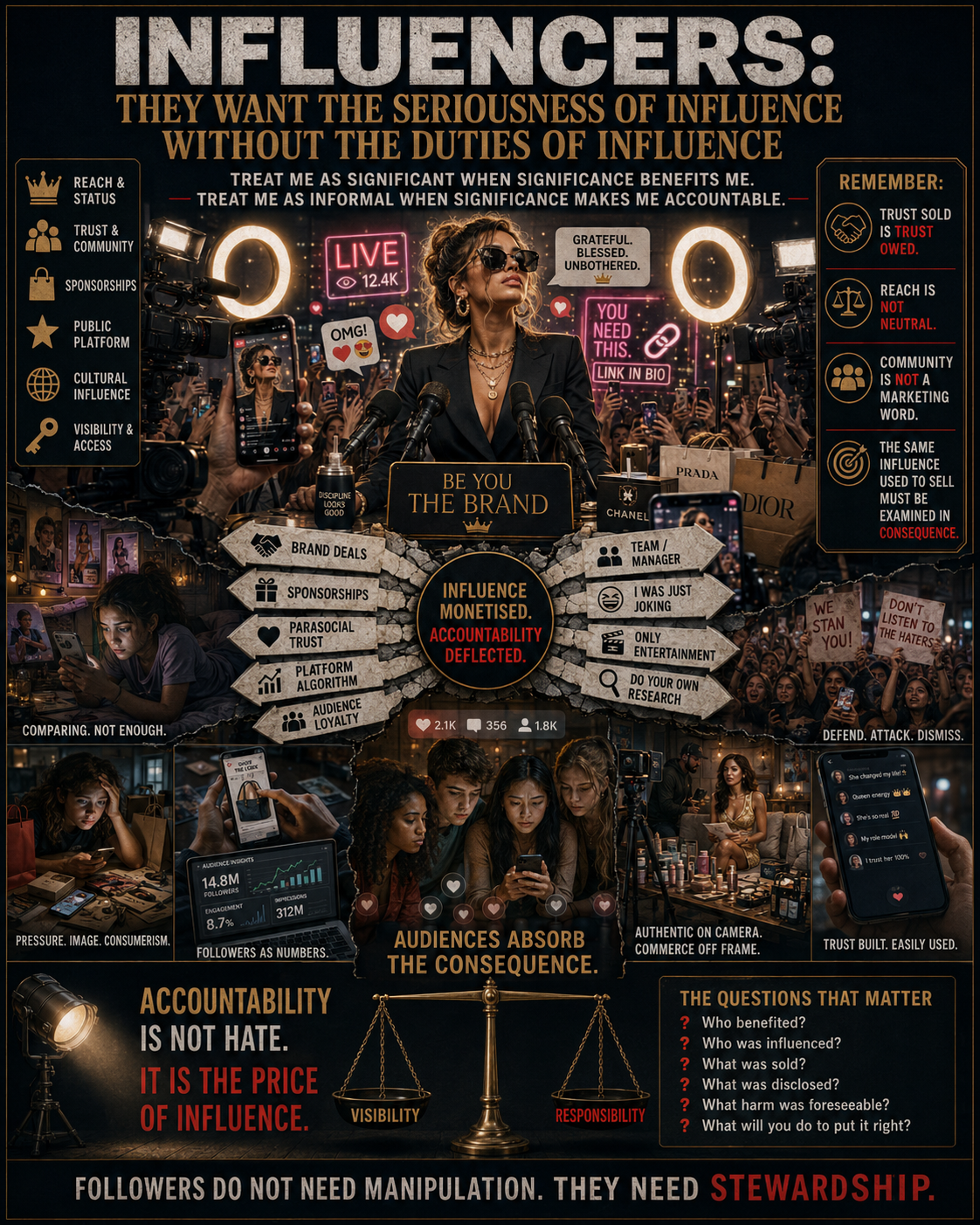
“Treat Me as Significant When Significance Benefits Me. Treat Me as Informal When Significance Makes Me Accountable.”
Influencers and public figures may be one of the clearest examples of people wanting the benefits of seriousness without accepting the duties that seriousness creates.
They want to be taken seriously when negotiating contracts.
When selling products.
When securing sponsorships.
When gathering followers.
When speaking on social issues.
When entering politics.
When launching businesses.
When presenting themselves as voices of a generation.
When claiming cultural relevance.
When measuring their reach.
When defending the value of their platform.
When telling brands that their audience trusts them.
They speak of impact.
Community.
Influence.
Reach.
Connection.
Representation.
Authenticity.
They describe themselves as powerful when that power creates income, access, status and opportunity.
But when that same influence produces harm, confusion, imitation, distorted expectations, dependency or foreseeable consequence, the identity changes.
They become “just a person online.”
They become “only an entertainer.”
They say the audience took them too seriously.
They say they never asked anyone to listen.
They say they are not responsible for what other people choose to do.
They want influence recognised as an asset when it is profitable and dismissed as irrelevant when it becomes accountable.
That is the contradiction.
The Same Reach Cannot Be an Asset When Selling and Irrelevant When Consequences Appear
A creator cannot enter a meeting with a company and say:
“My audience trusts me.”
Then enter a public controversy and say:
“I cannot control how people interpret me.”
They cannot use engagement as evidence of commercial value and then pretend engagement says nothing about behavioural influence.
They cannot describe themselves as culture-shaping when praised and culturally insignificant when questioned.
They cannot present follower loyalty as an economic asset during negotiations while calling that same loyalty an audience problem when trust is misused.
The same reach cannot be powerful in the contract and powerless in the consequence.
If attention is valuable enough to sell, it is valuable enough to examine.
If trust is valuable enough to monetise, it is valuable enough to protect.
If influence is part of the business model, influence is also part of the responsibility.
Influence Is More Than Intention
Public figures often defend themselves through intention.
“I was only sharing my experience.”
“I never told anyone to copy me.”
“I was joking.”
“I did not mean any harm.”
“I was just being honest.”
“I was speaking freely.”
Those statements may be true.
But influence does not exist only inside intention.
It exists in repetition.
In reach.
In perceived authority.
In emotional attachment.
In imitation.
In what becomes normal because a familiar person repeatedly presents it as normal.
In what becomes desirable because an admired person embodies it.
In what becomes believable because confidence is mistaken for knowledge.
Intent matters.
But intent does not fully describe impact.
A person may not intend to shape behaviour and still shape it.
Once that pattern becomes visible, awareness creates a higher duty.
The question is no longer only what the creator meant.
It is what the creator now knows their platform can do.
The Public Figure Is Powerful Until Power Becomes Inconvenient
Influencers are regularly described as tastemakers, trendsetters, icons, thought leaders and voices of their generation.
Their clothing affects purchasing.
Their relationships affect expectations.
Their language enters public speech.
Their opinions influence political and cultural understanding.
Their lifestyles become models.
Their approval raises brands.
Their rejection can damage reputations.
Their followers imitate routines, diets, language, aesthetics, business methods, relationships, ideologies and forms of self-presentation.
Yet when a harmful pattern becomes visible, the same person may retreat into ordinary personhood.
“I am not a role model.”
“I did not ask anyone to follow me.”
“I am just living my life.”
“I am allowed to make mistakes.”
Of course they are human.
Of course they make mistakes.
Of course public visibility does not remove their right to private growth.
But humanity does not erase capacity.
The larger the reach, the more seriously the person should examine what they repeatedly place into the field.
The point is not perfection.
The point is proportionate care.
They Want the Audience to Feel Close, but Not Close Enough to Ask Questions
Influencer culture frequently depends on cultivated intimacy.
The creator speaks directly into the camera.
Shares private routines.
Reveals personal pain.
Uses familiar language.
Calls followers family.
Invites the audience into bedrooms, homes, relationships, holidays and emotional struggles.
That closeness creates trust.
Trust creates attention.
Attention creates commercial value.
But when the audience asks for clarity, the relationship may suddenly become distant.
“You do not know me.”
“You are too invested.”
“This is parasocial.”
“You are crossing a boundary.”
Sometimes those statements are valid.
Audiences can become invasive, entitled and inappropriate.
But a creator cannot deliberately cultivate intimacy as part of the business model, benefit from the trust that intimacy produces, then treat every expectation of accountability as unreasonable attachment.
If closeness is commercially useful, the creator must accept that closeness changes the relationship.
Community Is Not Only a Marketing Word
Many influencers describe their followers as a community.
Community suggests more than reach.
It suggests relationship.
Mutuality.
Responsibility.
Belonging.
Shared values.
But the language of community is often activated only when the creator needs something.
When launching a product.
When increasing engagement.
When defending themselves.
When driving sales.
When gathering votes.
When selling tickets.
When mobilising loyalty.
The audience becomes a community when the creator needs support.
It becomes “just followers” when the audience asks what the creator owes in return.
That is not community.
That is an audience being addressed through the language of belonging because belonging increases compliance.
A serious community leader should ask:
What does this community receive beyond access to me?
How is it protected?
What values govern it?
What happens when harm occurs?
How are vulnerable members treated?
How do I avoid turning loyalty into extraction?
Public Figures Sell More Than Products
An influencer may technically sell clothes, courses, supplements, beauty products, memberships, services or event tickets.
But beneath the product, they often sell association.
Identity.
Aspiration.
Belonging.
Hope.
Status.
Proximity.
Transformation.
The audience may not only be purchasing the item.
They may be purchasing the possibility of becoming closer to the body, confidence, lifestyle, relationship, wealth, image or success represented by the creator.
That makes the sale more serious.
The exchange is not always purely functional.
It may be emotionally charged.
The creator may know that the audience’s trust is attached not only to the product but to them personally.
The more emotionally loaded the sale, the less appropriate it becomes to pretend that the relationship is merely commercial when consequences appear.
Authenticity Can Become Part of the Product
Influencers often present authenticity as part of their brand.
They describe themselves as real.
Unfiltered.
Honest.
Relatable.
Different from traditional celebrities.
Closer to ordinary people.
But authenticity itself can become commercially useful.
Vulnerability may increase engagement.
Confession may strengthen loyalty.
Rawness may become an aesthetic.
Transparency may be selectively staged.
The audience may be shown enough to feel trusted while the wider commercial architecture remains hidden.
This does not mean every vulnerable moment is false.
It means vulnerability should not automatically be mistaken for complete transparency.
Authenticity is not simply revealing emotion.
It is coherence between what is presented, what is intended, what is monetised and what is actually happening.
They Want to Be Experts Without Being Examined as Experts
Public figures often speak confidently about health, finance, politics, relationships, psychology, spirituality, law and business.
They may never formally call themselves experts.
But they may repeatedly use the tone, certainty and structure of expertise.
The audience experiences authority even if the title is never declared.
Then, when challenged, the creator retreats.
“I never said I was a professional.”
Perhaps not.
But responsibility does not depend only on the exact title used.
It also depends on the authority implied.
The confidence displayed.
The vulnerability of the audience.
The level of risk.
The commercial benefit gained from being believed.
A creator cannot repeatedly speak as though they know, benefit from being treated as knowledgeable, and then deny all responsibility because they avoided one formal word.
Generality Protects Influence From Accountability
Vague identity is useful.
The person is not quite an educator.
Not quite an adviser.
Not quite a journalist.
Not quite a business.
Not quite an advocate.
Not quite an entertainer.
Not quite a public service.
They move between all of them.
That movement creates reach.
But it also creates escape.
When one standard becomes uncomfortable, they move into another category.
The creator becomes commercially serious when discussing brand value.
Personally informal when discussing harm.
Socially important when discussing representation.
Legally distant when discussing consequence.
This is the cloak of generality.
The problem is not multidimensionality.
The problem is collecting the privileges of several identities while refusing the duties attached to each.
A Disclaimer Cannot Carry the Whole Responsibility
“For entertainment purposes only.”
“This is not advice.”
“Do your own research.”
“These are only my opinions.”
Such statements may clarify part of the relationship.
They may be useful.
But they do not automatically erase the actual function of the content.
If the creator repeatedly tells people what to buy, how to think, who to distrust, what to believe or how to live, the audience is receiving direction.
The disclaimer may be relevant.
It is not a magic removal of consequence.
Reality still matters.
What was said?
How was it framed?
What authority was implied?
What was sold?
What audience was targeted?
What vulnerability was present?
What harm was foreseeable?
What happened after the creator became aware of the harm?
A disclaimer can clarify intention.
It cannot outrank conduct.
Monetisation Changes the Relationship
The presence of money matters.
Not because earning money is wrong.
But because commercial incentive can affect what is said, omitted, exaggerated or repeated.
When a creator receives money from a brand, their recommendation is not identical to an unpaid personal suggestion.
When they earn commission through a link, their financial interest becomes relevant.
When controversy increases engagement, the incentive becomes relevant.
When emotional vulnerability increases sales, the architecture becomes relevant.
Transparency should not be treated as an optional act of kindness.
It is part of respecting the audience’s ability to decide.
The Audience Can See Behind the Curtain
Creators increasingly teach other people how to become creators.
They sell courses on audience growth.
Retention.
Engagement.
Hooks.
Storytelling.
Conversion.
Affiliate marketing.
Brand positioning.
Parasocial trust.
Audience psychology.
Once creators teach the mechanics, the audience begins seeing how those same mechanics may be used on them.
The intimate story may also be a trust-building strategy.
The controversy may be designed for engagement.
The emotional opening may support retention.
The recommendation may be linked to commission.
The lifestyle presentation may be part of conversion.
This does not automatically make the content dishonest.
Strategy and sincerity can coexist.
But it does mean creators cannot reasonably behave as though the audience knows nothing about how the system works.
People understand that attention is monetised.
They understand that trust can be converted.
They understand that relatability has economic value.
So the commercial architecture should be acknowledged.
Followers Are Not Merely Numbers
Influencers frequently speak in numbers.
Followers.
Views.
Likes.
Reach.
Engagement.
Conversions.
But every number represents a person.
A person with a history.
A level of discernment.
A vulnerability.
A financial condition.
A developmental stage.
A relationship to authority.
When the audience is treated only as metrics, human beings become units of monetisable attention.
Serious influence requires remembering that behind the analytics are consequences.
The creator is not responsible for every choice every follower makes.
But they should never forget that the field they shape is populated by people, not abstract engagement.
The Child Audience Changes the Standard
Where children or teenagers form a significant part of the audience, responsibility becomes more serious.
Young people are still developing identity, judgement, emotional regulation and understanding of commercial persuasion.
They may imitate without understanding motive.
Trust familiarity.
Normalise extremes.
Attach worth to appearance.
Interpret luxury as ordinary life.
Confuse performance with reality.
A creator who knowingly builds a young audience cannot treat that audience exactly like fully informed adults.
Responsibility expands because vulnerability expands.
The Audience Also Carries Responsibility
Accountability must remain proportionate.
Followers are not entirely passive.
Adults carry responsibility for what they consume, believe, buy and imitate.
People should investigate claims.
Recognise advertising.
Maintain boundaries.
Develop discernment.
Avoid turning admiration into surrender.
But shared responsibility does not mean equal responsibility.
The audience may carry the responsibility of choice.
The creator carries the responsibility attached to superior reach, information, access, design and commercial incentive.
Both can be true.
The Public Figure Cannot Be the Face of Success and a Stranger to Harm
When the product succeeds, the creator is the face.
When the campaign trends, they claim the movement.
When the audience grows, they speak of what they built.
When culture shifts, they describe their impact.
But when harm appears, responsibility moves elsewhere.
The audience misunderstood.
The brand made the product.
The platform distributed it.
The manager negotiated the deal.
The team wrote the caption.
The follower made their own decision.
Several actors may be involved.
But shared responsibility does not erase the creator’s part.
If the creator is central enough to receive the praise, they are central enough to answer the questions.
Influence Should Be Measured Through Outcome, Not Only Attention
A large audience does not automatically prove positive impact.
It proves reach.
A viral post does not prove truth.
It proves circulation.
A trending message does not prove contribution.
It proves transmissibility.
Serious influence should be evaluated through what it produces.
Did the audience become more informed?
More capable?
More dependent?
More anxious?
More pressured to consume?
More polarised?
More trusting of unsupported claims?
More able to make autonomous decisions?
Attention is not the same as contribution.
Visibility is not the same as stewardship.
The Difference Between a Mistake and a Pattern
Public figures are human.
They will make mistakes.
Miss context.
Speak poorly.
Promote something they later regret.
Accountability should distinguish isolated error from repeated pattern.
A mistake followed by reflection, correction and repair reveals learning.
A repeated pattern followed by defensiveness reveals something else.
The issue is not whether the creator has ever been wrong.
It is whether they remain present when being wrong becomes visible.
Do they correct?
Clarify?
Remove harmful material?
Compensate where appropriate?
Change the system?
Or do they hide behind silence, fans, legal statements and the next content cycle?
Fan Loyalty Can Become an Accountability Shield
Influencers often build strong identification among followers.
Criticism of the creator is then experienced by fans as criticism of themselves.
The audience defends.
Attacks critics.
Dismisses evidence.
Protects the image.
This can allow the public figure to avoid direct accountability because the community performs the defence for them.
A serious creator should not exploit that loyalty.
They should not send followers to silence criticism.
They should be able to say:
“Do not attack people for questioning me.”
“Look at the evidence.”
“I can be supported and still be held accountable.”
That would be seriousness.
Influencer Identity Can Prevent Correction
Public figures may become fused with the persona they created.
The brand becomes the self.
The image becomes the self.
The lifestyle becomes the self.
The audience becomes the mirror.
Then correction becomes threatening.
Admitting harm may disrupt sponsorships.
Status.
Growth.
The story being sold.
So the person protects the persona.
They deny.
Minimise.
Deflect.
Rebrand.
Disappear briefly.
Return with a new campaign.
But serious influence requires enough separation between person and platform to say:
“I was wrong.”
“I benefited from this.”
“I should have disclosed more.”
“I used authority I had not earned.”
“I did not understand the consequence.”
“This needs correction.”
The Influencer Seriousness Test
Whenever an influencer or public figure asks to be taken seriously, ask:
What privileges does that seriousness give them?
Income.
Access.
Status.
Trust.
Influence.
Cultural authority.
Brand partnerships.
Media attention.
Audience loyalty.
Political reach.
Commercial opportunity.
Then ask:
What duties should accompany those privileges?
Transparency.
Care.
Explanation.
Correction.
Accurate representation.
Proportionate caution.
Commercial disclosure.
Audience awareness.
Remaining present when harm appears.
Then ask:
Do they accept both, or only the side that benefits them?
Do they want trust without transparency?
Reach without responsibility?
Community without mutual duty?
Authority without scrutiny?
Monetisation without disclosure?
Influence without consequence?
The Influencer Accountability Matrix
A serious evaluation should ask:
- What size and type of audience do they possess?
- What authority do they imply?
- What products or ideas do they promote?
- What money or benefits do they receive?
- What vulnerabilities exist within the audience?
- What claims are repeated as fact?
- What commercial relationships remain hidden or unclear?
- What behaviour is normalised?
- What influence is acknowledged when profitable?
- What influence is denied when harmful?
- How do they respond to correction?
- Do they distinguish personal experience from professional guidance?
- Do they remain present when consequences appear?
- Do they use followers as an accountability shield?
- Does the audience understand the relationship in the same way the creator describes it?
- Has the platform improved people’s capability or deepened dependency?
- Did appearances improve faster than responsibility?
These questions do not begin with hatred.
They begin with capacity.
Influence.
Commercial architecture.
Outcome.
Criticising Influence Is Not Automatically Attacking the Person
A mature culture should be able to examine what a public figure produces without treating every question as abuse.
To say a recommendation was misleading is not to deny the creator’s humanity.
To say a platform caused harm is not to erase every positive contribution.
To say influence was used irresponsibly is not automatically hatred.
The content should be examined.
The relationship should be examined.
The commercial incentive should be examined.
The consequence should be examined.
Otherwise, personality protects function from scrutiny.
The Highest Form of Influencer Accountability
The highest form of accountability is not asking only:
“Did they intend harm?”
It asks:
Given the reach, trust, access and commercial power this person possessed, what should their influence reasonably have produced by now?
Did they increase discernment?
Or dependency?
Did they help people make informed decisions?
Or profit from confusion?
Did they use attention to create capacity?
Or only consumption?
Did they build a community capable of standing without them?
Or an audience increasingly attached to them?
Did they clarify the difference between intimacy and commerce?
Did they disclose what people needed to know?
Did they use their influence proportionately to the scale of influence they claimed?
That question reveals the distance between capacity and contribution.
And that distance is where responsibility lives.
The Pattern Beneath Influencers and Public Figures
In influencer culture, the actor wants:
Authority.
Trust.
Legitimacy.
Influence.
Status.
Income.
Protection.
Obedience.
Access.
Recognition.
But may resist:
Transparency.
Explanation.
Care.
Prevention.
Correction.
Proportional contribution.
Measurable outcomes.
Accepting consequences.
Remaining present when harm appears.
This is selective seriousness.
Seriousness when influence creates reward.
Informality when influence creates liability.
Closing: Immunity Wrapped in Visibility
Seriousness is not a follower count.
A verification badge.
A brand deal.
A microphone.
A viral video.
A sold-out event.
A loyal community.
A place in cultural conversation.
Seriousness is the willingness to carry the full weight of the influence one asks others to recognise.
If reach is valuable enough to sell, it is valuable enough to scrutinise.
If trust is valuable enough to monetise, it is valuable enough to protect.
If a creator claims to shape culture, they must accept responsibility for what that shaping produces.
They are not responsible for controlling every person.
They are responsible for examining the foreseeable effects of the capacity they possess.
The people who want to be taken seriously but reject serious responsibility are not asking to be recognised as influential.
They are asking for immunity wrapped in visibility.
And digital culture has rewarded that wrapping for far too long.


Leave a Reply