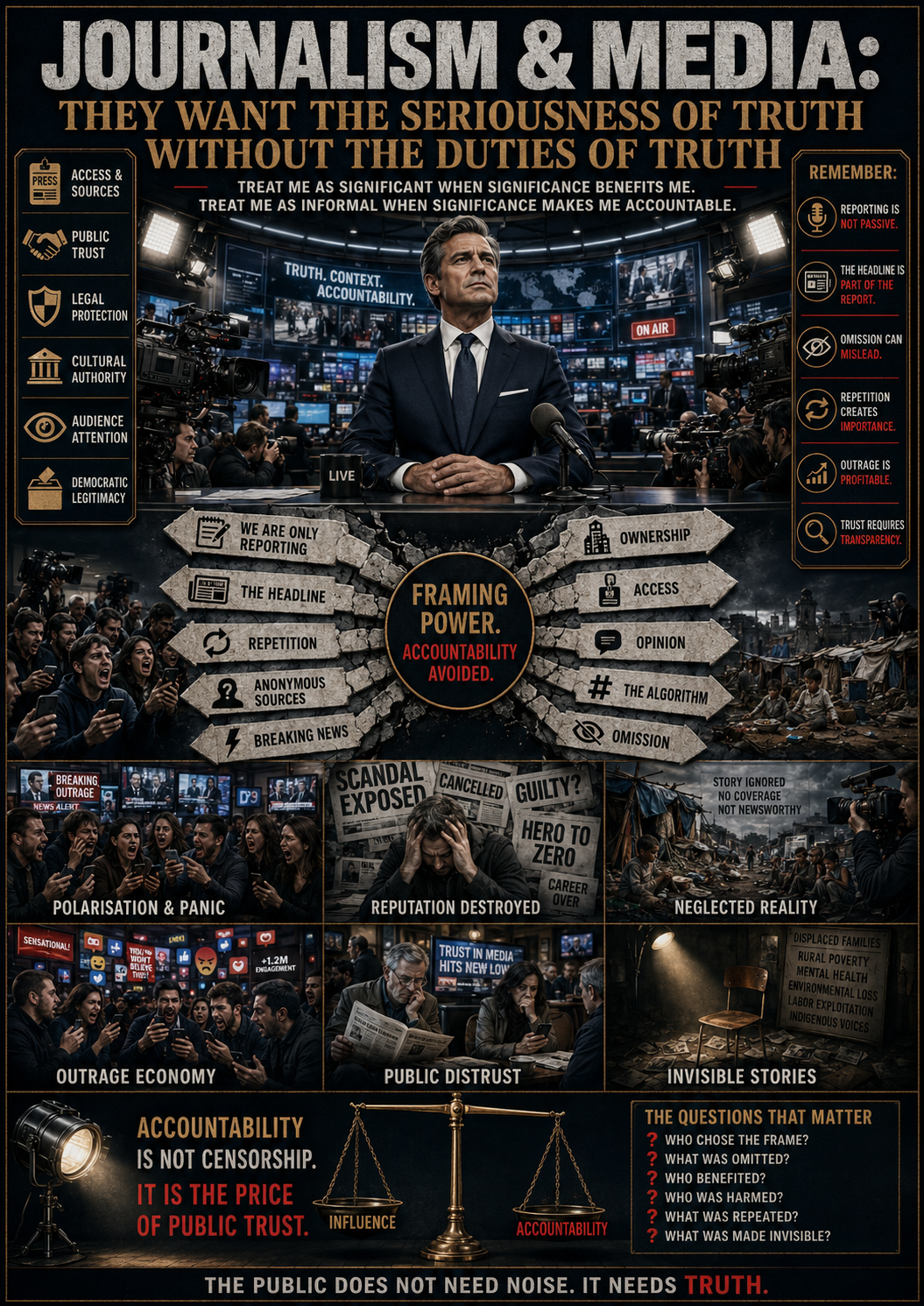
“Treat Me as Significant When Significance Benefits Me. Treat Me as Informal When Significance Makes Me Accountable.”
Journalism and media may be one of the clearest examples of institutions wanting the benefits of seriousness without accepting the full duties that seriousness creates.
Media organisations want to be treated as guardians of truth.
Defenders of democracy.
Protectors of public understanding.
Watchdogs of power.
Essential institutions.
Voices for the public.
They want access to governments, courts, corporations, private briefings, official documents, public events and protected sources because their role is said to serve society.
They want legitimacy.
Trust.
Legal protection.
Public deference.
Institutional access.
Cultural authority.
The power to ask questions on behalf of everyone else.
That seriousness gives them enormous influence over what a population sees, what it discusses, what it fears, what it ignores and what it believes matters.
But when their framing contributes to panic, hatred, distortion, reputational destruction, political polarisation or public misunderstanding, some retreat behind:
“We are only reporting.”
“We did not create the event.”
“We merely presented the facts.”
“We cannot control how the public reacts.”
“We quoted what was said.”
“The information was already public.”
But journalism does not only transfer information.
It selects.
Frames.
Orders.
Repeats.
Titles.
Edits.
Highlights.
Omits.
Contextualises.
Emotionalises.
Simplifies.
Amplifies.
The media organisation decides which part of reality becomes visible and which part remains outside the frame.
That is already an exercise of power.
Reporting Is Not Passive
The phrase “we are only reporting” presents journalism as though it were a transparent pipe through which reality passes unchanged.
But reality does not arrive in the public mind without mediation.
Someone chooses the story.
Someone chooses the headline.
Someone chooses the photograph.
Someone decides which witness appears first.
Someone decides which statistic is emphasised.
Someone determines whether the subject is called a protester, activist, rioter, campaigner, suspect, victim, migrant, refugee, whistleblower, criminal, expert or controversial figure.
Someone decides what historical context is included.
Someone decides what is too complicated for the audience.
Someone decides what is repeated for three days and what receives one paragraph.
Someone decides whether the tone is urgent, sceptical, sympathetic, mocking, fearful or reassuring.
These choices shape meaning.
The facts may remain technically accurate while the pattern they create becomes misleading.
A serious media institution must therefore accept responsibility not only for the accuracy of each individual statement, but for the reality constructed by the total arrangement.
Selecting What Becomes Visible Is an Exercise of Power
The public cannot personally investigate every war, policy, court case, scientific development, corporate decision, community conflict or public-health concern.
It depends on intermediaries.
This creates enormous power.
A problem may affect thousands of people but remain politically invisible until media attention makes it visible.
Another problem may be exaggerated until it appears larger than its actual social significance.
A person may become nationally hated through repetition before all relevant facts are known.
An institution may escape scrutiny because its failures are too complicated, unprofitable or politically inconvenient to explain.
The media does not only tell the public what happened.
It helps determine what the public believes deserves attention.
Visibility creates urgency.
Urgency directs political response.
Political response directs resources.
The decision to cover one issue and neglect another therefore has material consequences.
The Headline Is Part of the Report
Media organisations sometimes defend themselves by pointing to the accuracy of the article while ignoring the impression created by the headline.
But many people read only the headline.
Others see only the image, caption, push notification or social-media excerpt.
The headline is not merely decoration.
It is often the most widely distributed version of the story.
A cautious article beneath a sensational headline does not fully correct the sensationalism.
A question mark does not automatically make an insinuation responsible.
An emotionally charged phrase may remain in the public mind long after the nuance is forgotten.
If the headline creates an impression the article cannot sustain, the publication cannot hide behind the technical accuracy of the body.
The whole communication must be evaluated.
Omission Can Mislead Without a Single False Sentence
A report can contain no direct lie and still create a false understanding.
It can omit the timeline.
The legal context.
The historical conditions.
The comparative data.
The relevant incentives.
The response from the affected person.
The distinction between allegation and finding.
The uncertainty in the evidence.
The structural causes beneath an individual event.
The omission may be deliberate.
It may also result from time pressure, limited space, commercial incentives or incomplete reporting.
But the audience still receives the consequence.
Truth is not only the absence of falsehood.
It is the presence of enough relevant context for the reality to be understood proportionately.
Repetition Creates Importance
A media organisation may argue that it did not tell the public what to think.
But repetition itself teaches importance.
When the same face, crime, controversy or political conflict appears continuously, the public learns that it matters.
When another issue receives almost no attention, the public learns that it does not.
Frequency shapes perceived prevalence.
A rare event can begin to feel normal.
A common harm can remain invisible.
A single provocative statement can dominate while a complex structural failure affecting millions receives little coverage.
Repeated attention is not neutral.
It allocates public consciousness.
Emotional Emphasis Changes Public Perception
Journalism is not only informational.
It is emotional.
Images, music, pacing, language, facial expressions, dramatic graphics and repetition shape how information is felt.
A story may be framed to create fear.
Anger.
Sympathy.
Disgust.
Suspicion.
Hope.
Moral certainty.
The emotional response can become stronger than the factual understanding.
This is particularly serious when the evidence is incomplete.
The person may be judged before trial.
The group may be blamed before causation is established.
The public may demand immediate action before proportional analysis occurs.
A serious institution should understand that emotional emphasis is a form of influence.
If emotion is deliberately used to retain attention, increase circulation or strengthen a narrative, the publication carries responsibility for the effects of that design.
The Media Wants Speed and Accuracy, but Speed Often Wins
Journalism values being first.
The first report.
The first exclusive.
The first leak.
The first image.
The first accusation.
The first interpretation.
Speed creates traffic, prestige and competitive advantage.
But truth often requires time.
Verification.
Context.
Multiple sources.
Contradictory evidence.
Expert understanding.
Legal care.
The pressure to publish quickly can create a system where incomplete information reaches millions before correction arrives.
The original claim travels widely.
The correction appears later, smaller and with less emotional force.
A publication may technically correct the record while failing to repair the scale of the original impression.
The duty is not fulfilled merely because a correction exists somewhere.
The correction should receive prominence proportionate to the harm created by the initial report.
Breaking News Can Break Understanding
The constant breaking-news model encourages the public to experience developing events as though every new fragment requires immediate judgement.
But early information is often unstable.
Witness accounts conflict.
Official statements change.
Evidence remains incomplete.
Context has not yet been gathered.
Yet the media environment rewards certainty.
Experts are invited to speculate.
Panels debate motives before facts are established.
Graphics create the appearance of clarity.
The public is encouraged to form conclusions faster than the evidence deserves.
A serious media institution should know when not to accelerate judgement.
Sometimes the most truthful sentence is:
“We do not know yet.”
That is not weakness.
It is epistemic discipline.
The Media Cannot Claim to Be a Watchdog While Avoiding Examination of Itself
Journalists investigate governments, corporations, public figures and institutions.
They ask others to disclose conflicts.
Explain decisions.
Correct errors.
Accept scrutiny.
But media organisations may resist the same standards when applied inward.
Who owns the outlet?
Who funds it?
What commercial pressures influence coverage?
What political relationships exist?
What stories were declined?
What advertisers were protected?
What editorial priorities were imposed?
What corrections were made?
What patterns of complaint recur?
What communities are consistently misrepresented?
A watchdog that cannot tolerate being watched risks becoming another protected power centre.
Serious journalism requires institutional transparency about the forces shaping the journalism itself.
Ownership Shapes the Frame
Media organisations do not operate outside economics.
They have owners.
Investors.
Advertisers.
Subscribers.
Sponsors.
Commercial partnerships.
Political relationships.
These structures may not dictate every story directly.
But they shape incentives.
A publication dependent on advertising may avoid stories that threaten major advertisers.
A partisan outlet may select information that confirms its audience’s political identity.
A platform dependent on outrage may reward conflict over clarity.
A publication owned by a wealthy individual may reflect that person’s interests, even subtly.
The public deserves to know the architecture behind the voice claiming to speak for truth.
Transparency about ownership is not sufficient by itself.
But secrecy makes accountability almost impossible.
The Audience Can Become the Product
Media organisations often say they serve the audience.
But in advertising-based models, the audience may also be what is being sold.
Attention is collected.
Measured.
Segmented.
Monetised.
Fear, outrage and conflict can become commercially useful because they hold attention.
This creates a structural danger.
The institution may benefit financially from keeping the audience alarmed, divided or emotionally activated.
A problem that can be resolved produces less ongoing engagement than a conflict that can be revisited indefinitely.
This does not mean every journalist consciously manipulates the public.
It means the business model may reward forms of communication that undermine the stated democratic mission.
A serious institution must examine whether its revenue structure is corrupting its public function.
Outrage Is Profitable but Socially Expensive
Outrage travels quickly.
It creates comments.
Shares.
Debate.
Identity alignment.
Moral certainty.
But repeated outrage can weaken public discernment.
People become conditioned to react before investigating.
Every issue becomes a battle.
Every disagreement becomes proof of corruption or hatred.
Nuance becomes suspicious.
Correction becomes betrayal.
The media outlet may gain attention while society loses the capacity to think together.
That is not a neutral exchange.
The institution keeps the revenue.
The public carries the fragmentation.
The Media Can Turn Allegation Into Identity
A person may be accused of something.
The accusation becomes the headline.
Their image circulates.
Their name becomes attached to the allegation.
Even if they are later cleared, the public memory may retain the original association.
The legal system may distinguish allegation from finding.
The attention economy often does not.
A serious media institution must consider the asymmetry.
The accusation may receive national coverage.
The correction may receive a brief update.
The reputational harm may continue indefinitely.
Public interest can justify reporting serious allegations.
But seriousness requires precise language, proportionate prominence and meaningful repair where the original impression becomes unsupported.
The Media Can Punish Before the Courts Decide
Journalism rightly investigates conduct that courts may never reach.
Legal systems are not the only source of truth.
But media exposure can become a parallel punishment system.
Employment is lost.
Relationships collapse.
Threats increase.
Public hostility expands.
The person becomes socially convicted before evidence is fully tested.
This is especially dangerous where the outlet relies on anonymous claims, partial recordings, leaked material or incomplete context.
The answer is not silence.
It is disciplined reporting.
The greater the potential harm, the greater the duty of verification, proportion and care.
The Source Can Shape the Story More Than the Public Realises
Anonymous sources may be necessary.
Whistleblowers need protection.
Officials may reveal information only under confidentiality.
But anonymity also limits public evaluation.
The source may have political motives.
Commercial interests.
Personal resentment.
Institutional loyalty.
A serious publication should investigate those motives, even if it cannot reveal the source’s identity.
Confidentiality should protect the source from exposure.
It should not protect the information from scrutiny.
Access Can Become Dependence
Media organisations value access.
Interviews.
Briefings.
Leaks.
Invitations.
Relationships with officials.
But access can create softness.
A journalist who depends on an institution for future information may hesitate to challenge it too aggressively.
A publication may protect a relationship that delivers exclusives.
The source gains influence over what becomes public.
The journalist gains status through proximity.
The audience may believe it is receiving independent scrutiny while actually receiving information shaped by negotiated access.
Serious journalism must be willing to lose access rather than surrender independence.
Otherwise, proximity to power becomes a substitute for holding power accountable.
The Media May Amplify What It Claims to Condemn
A publication may condemn harmful speech while reproducing it repeatedly.
It may criticise extremism while giving extremist material enormous visibility.
It may warn about dangerous trends while teaching the audience exactly how those trends operate.
It may report a harmful act in such detail that imitation becomes easier.
The institution may justify the repetition through public interest.
But coverage itself can expand the reach of the thing being condemned.
This requires discernment.
Not every detail needs amplification.
Not every provocative figure deserves a larger platform.
Not every harmful message must be repeated in full to be examined.
Representation Is Not a Decorative Duty
Media organisations shape how communities are perceived.
Which voices are treated as authoritative?
Which accents are mocked?
Which neighbourhoods appear only through crime?
Which countries appear only through crisis?
Which groups are presented as a problem rather than as people?
Which identities are discussed without being included?
Representation is not only about visual diversity.
It is about whether people are allowed to appear in their full complexity.
Repeatedly presenting a group through its worst moments creates a distorted social reality even where every individual report is technically true.
A serious institution should examine the cumulative pattern.
Neutrality Can Become a Disguise for Imbalance
Journalists often aim for balance.
But balance does not always mean placing two statements beside each other.
Not every claim has equal evidentiary weight.
Not every position deserves equal credibility.
Presenting a well-supported finding beside an unsupported denial can create false equivalence.
At the same time, abandoning balance entirely can turn journalism into advocacy disguised as reporting.
Discernment is required.
The duty is not to make every side appear equal.
It is to represent the evidence fairly, identify uncertainty honestly and distinguish fact, interpretation and opinion clearly.
Opinion Must Be Clearly Distinguished From Reporting
Modern media often blends news, commentary, analysis, entertainment and advocacy.
A presenter may move from reporting facts into interpreting motives without clearly signalling the transition.
A headline may present opinion as though it were fact.
A panel discussion may create more emotional certainty than the evidence supports.
The audience should not have to reverse-engineer what category of communication it is receiving.
If it is reporting, call it reporting.
If it is analysis, call it analysis.
If it is opinion, call it opinion.
If it is sponsored, disclose the sponsorship.
Clarity protects both the audience and the institution.
Corrections Must Match the Scale of the Error
Media organisations often treat correction as a technical requirement.
A sentence is amended.
A note appears at the bottom.
An online update is added.
But accountability requires proportionality.
How many people saw the original claim?
How prominent was it?
How emotionally charged was it?
How much harm followed?
A small correction does not repair a large distortion.
If the original error led the front page, the correction should not be hidden.
If the original claim travelled across platforms, the correction should travel across them too.
The duty is not merely to maintain an accurate archive.
It is to repair public understanding.
Journalists Are Human, but Institutions Must Be Designed for Human Limits
Journalists face deadlines.
Pressure.
Trauma.
Political hostility.
Legal risk.
Incomplete information.
They will make mistakes.
The standard should not be perfection.
But the institution should be designed to catch foreseeable errors.
Strong editing.
Source verification.
Fact-checking.
Clear correction procedures.
Conflict disclosures.
Support for journalists covering traumatic events.
Protection from commercial pressure.
Diverse editorial perspectives.
A serious media organisation does not depend entirely on the moral strength of individual journalists.
It builds structures that make responsible journalism more likely.
The Media Audience Also Carries Responsibility
The public is not entirely passive.
People choose what they click.
Share.
Believe.
Reward.
Repeat.
Audiences often demand speed, certainty and outrage.
They may ignore careful reporting because it is less emotionally satisfying.
They may share headlines without reading.
Confirm existing beliefs.
Punish nuance.
This matters.
But shared responsibility is not equal responsibility.
The media organisation possesses greater access, expertise, distribution power, editorial control and information.
The audience carries the responsibility to develop discernment.
The institution carries the greater responsibility attached to producing and distributing the information environment.
The Media Cannot Build Distrust and Then Blame the Public for Distrusting It
Media organisations sometimes complain that public trust has declined.
But trust is not owed automatically.
It must be earned through consistency.
Accuracy.
Transparency.
Correction.
Independence.
Proportion.
If institutions repeatedly sensationalise, obscure conflicts, protect powerful relationships or correct quietly, public distrust becomes understandable.
That does not mean every accusation against the media is justified.
But demanding trust without examining the conditions that weakened it repeats the same pattern.
The institution wants the authority of trust without accepting the duty to remain trustworthy.
The Journalism and Media Seriousness Test
Whenever a media organisation asks to be taken seriously, ask:
What privileges does that seriousness give it?
Access.
Trust.
Legal protection.
Public legitimacy.
Cultural authority.
Political influence.
Audience attention.
Institutional access.
Commercial value.
The power to shape public understanding.
Then ask:
What duties should accompany those privileges?
Accuracy.
Context.
Transparency.
Proportion.
Verification.
Correction.
Independence.
Care.
Clear separation of fact and opinion.
Responsibility for cumulative framing.
Remaining present when harm appears.
Then ask:
Does the institution accept both, or only the side that benefits it?
Does it want access without scrutiny?
Trust without transparency?
Influence without consequence?
Protection without correction?
Authority without accountability?
The right to investigate everyone else while resisting investigation of itself?
The Journalism and Media Accountability Matrix
A serious evaluation should ask:
- Who owns the organisation?
- Who funds it?
- What commercial incentives shape coverage?
- What political relationships exist?
- Which stories receive repeated prominence?
- Which issues remain consistently neglected?
- How are headlines constructed?
- Is uncertainty represented honestly?
- Are allegations clearly distinguished from findings?
- Are reporting, analysis and opinion clearly separated?
- Which communities are repeatedly framed through harm?
- What relevant context is omitted?
- How are anonymous sources verified?
- Do corrections match the prominence of the original error?
- Does the organisation remain present after causing harm?
- Does it investigate itself with the seriousness it demands from others?
- Did public understanding improve, or only emotional engagement?
- Did the outlet increase discernment, or deepen division?
- Did appearances of authority improve faster than the quality of truth?
These questions do not begin with hostility.
They begin with function.
Power.
Framing.
Outcome.
Criticising Journalism Is Not Automatically Attacking Free Speech
A mature society should be able to examine media power without treating every criticism as an attack on journalism.
To say a headline misled is not to oppose a free press.
To say an outlet amplified harm is not to support censorship.
To say ownership affects framing is not to deny the value of reporting.
To say journalists carry responsibility is not to demand silence.
Free speech and accountability are not opposites.
Accountability protects the legitimacy of speech by requiring those with extraordinary reach to use it responsibly.
The alternative is not freedom.
It is power without examination.
The Highest Form of Media Accountability
The highest form of accountability does not ask only:
“Was each sentence technically defensible?”
It asks:
Given the access, trust, reach and cultural authority this institution possessed, what understanding of reality did it repeatedly construct?
Did it help the public see more clearly?
Or react more quickly?
Did it expose power?
Or become dependent on access to it?
Did it provide context?
Or monetise confusion?
Did it expand public discernment?
Or convert complexity into tribal certainty?
Did it correct proportionately?
Did it distinguish what was known from what was suspected?
Did it make invisible harms visible?
Or repeatedly amplify what was already loud?
That question reveals the distance between journalistic capacity and public understanding.
And that distance is where responsibility lives.
The Pattern Beneath Journalism and Media
In journalism and media, the actor wants:
Authority.
Trust.
Legitimacy.
Influence.
Status.
Income.
Protection.
Obedience.
Access.
Recognition.
But may resist:
Transparency.
Explanation.
Care.
Prevention.
Correction.
Proportional contribution.
Measurable outcomes.
Accepting consequences.
Remaining present when harm appears.
This is selective seriousness.
Seriousness when the press requires access and protection.
Informality when its own influence creates liability.
Closing: Immunity Wrapped in Objectivity
Seriousness is not a press pass.
A studio.
A broadcast licence.
A newspaper masthead.
A verified source.
A breaking-news banner.
A claim of neutrality.
A place beside political power.
Seriousness is the willingness to carry the full weight of the truth-telling role one asks the public to respect.
If the media claims to guard democracy, it must accept responsibility for how it shapes democratic understanding.
If it claims to expose power, it must allow its own power to be exposed.
If it asks for trust, it must provide the transparency through which trust can remain informed.
If it shapes what millions of people see, it cannot pretend it merely stood beside reality and described it.
It selected the frame.
It arranged the meaning.
It distributed the pattern.
The people and institutions that want to be taken seriously but reject serious responsibility are not asking to be recognised as guardians of truth.
They are asking for immunity wrapped in objectivity.
And media culture has worn that wrapping for far too long.


Leave a Reply