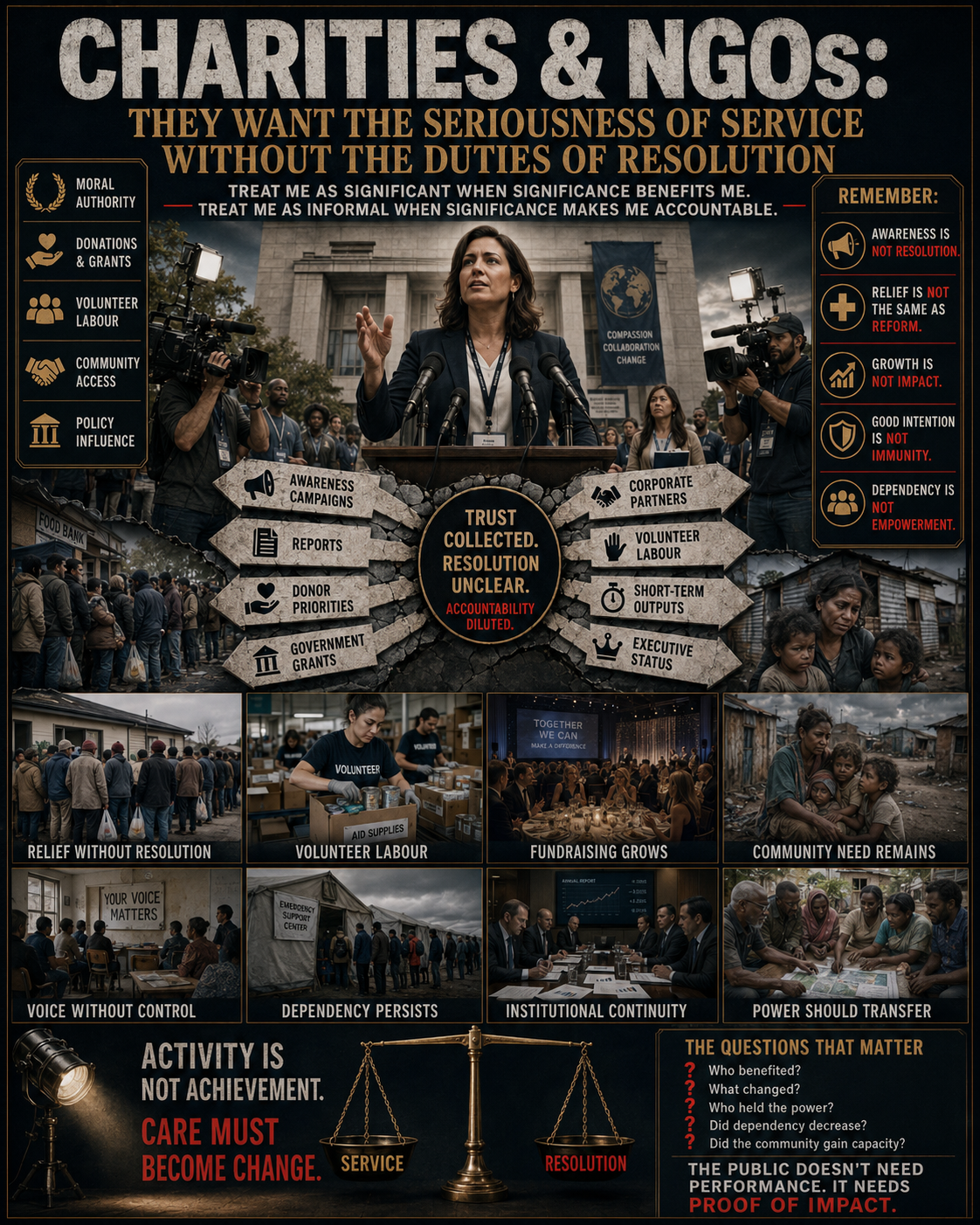
“Treat Me as Significant When Significance Benefits Me. Treat Me as Informal When Significance Makes Me Accountable.”
Charities and NGOs may be one of the clearest examples of institutions wanting the benefits of seriousness without accepting the full duties that seriousness creates.
They want to be treated as morally serious institutions.
As protectors of vulnerable people.
As defenders of human rights.
As responders to crisis.
As bridges between suffering and support.
As voices for communities that governments, markets and institutions have neglected.
That moral seriousness attracts donations.
Public trust.
Government grants.
Corporate partnerships.
Tax advantages.
Media coverage.
Political access.
Celebrity support.
Volunteer labour.
Institutional legitimacy.
It gives the organisation authority to speak about suffering, poverty, displacement, hunger, illness, injustice, climate harm, abuse, education, housing, conflict and social exclusion.
It allows the organisation to enter communities carrying the language of care.
But some charities and NGOs resist being evaluated through the seriousness of outcomes.
They point to effort.
Awareness.
Campaigns.
Reports.
Conferences.
Fundraising totals.
Volunteer hours.
Social-media reach.
Policy recommendations.
Public concern.
Good intentions.
They show that they were active.
But activity is not the same as resolution.
A charity can be extremely busy while the underlying problem continues to grow.
It can become larger while the community remains dependent.
It can gain visibility while the people it represents remain unheard.
It can raise more money each year while the condition used to justify that fundraising remains fundamentally unchanged.
A serious institution cannot use suffering to prove its importance while avoiding the question of whether its structure meaningfully reduces suffering.
Moral Seriousness Creates Moral Responsibility
Charities often receive a level of trust that ordinary businesses do not.
The public assumes that the organisation is not primarily motivated by profit.
Donors assume their money will be used to help.
Volunteers assume their labour contributes to something meaningful.
Communities assume the organisation is acting in their interests.
Governments may rely on charities to reach people public services do not reach.
Corporations may partner with them to demonstrate social responsibility.
That trust is not a decorative asset.
It creates duty.
The more an organisation benefits from being perceived as morally serious, the more seriously it must account for what it does with that trust.
How much money entered?
Where did it go?
What changed?
Who benefited?
Who remained excluded?
Which harms were reduced?
Which communities gained capacity?
Which dependencies remained?
Which failures were repeated?
Which programmes continued because they worked?
Which continued because they attracted funding?
A serious moral institution should not fear these questions.
It should ask them before the public does.
Good Intention Is Not the Same as Good Impact
Charities frequently operate in difficult conditions.
Conflict.
Poverty.
Displacement.
Disaster.
Institutional neglect.
Complex social harm.
No organisation can control every outcome.
But complexity does not make impact irrelevant.
Good intention explains motive.
It does not complete responsibility.
A programme may have been designed with care and still fail.
A campaign may have raised awareness and still change nothing.
A well-funded intervention may produce temporary relief while deepening long-term dependence.
A volunteer may work tirelessly while the organisation itself remains structurally ineffective.
A charity may sincerely want to solve a problem while becoming financially dependent on the problem continuing.
The distinction must be protected.
Caring about people is not the same as creating conditions in which those people need less charity.
Awareness Is Not Resolution
Awareness can matter.
It can make hidden suffering visible.
It can alter public conversation.
It can attract resources.
It can pressure governments.
It can help people recognise an issue they previously ignored.
But awareness should be a stage.
Not the final product.
A charity should be able to explain what awareness is meant to lead to.
Policy change?
Funding?
Direct service?
Legal protection?
Behavioural change?
Community ownership?
Institutional reform?
If awareness becomes the permanent output, the organisation may spend years making people conscious of a problem without changing the conditions producing it.
The public becomes informed.
The suffering remains.
At some point, awareness without movement becomes another form of observation.
The Organisation May Grow While the Problem Remains
Growth is often treated as evidence of success.
More staff.
More offices.
More funding.
More campaigns.
More partnerships.
More followers.
More countries.
More programmes.
More annual reports.
But organisational growth and social progress are not identical.
A charity can become more successful as an institution while failing to reduce the problem it was created to address.
Its income may rise.
Its brand may strengthen.
Its leadership may gain access.
Its fundraising operation may become more sophisticated.
Its public recognition may expand.
But the community may remain in the same condition.
The institution’s growth may even depend on continued need.
This creates an uncomfortable but necessary question:
Is the charity succeeding because the problem is being solved?
Or because the problem remains useful to the charity’s continuity?
A Serious Charity Should Be Willing to Become Less Necessary
This may be the clearest test.
A serious charity should not only ask how to expand.
It should ask how to reduce the future need for itself.
If it works in homelessness, does its model help fewer people become homeless?
If it works in food poverty, does it alter the conditions producing food insecurity?
If it works in education, does it build durable local capacity?
If it works in health, does it strengthen prevention?
If it works in disaster relief, does it improve resilience before the next disaster?
If it works in international development, does it increase local ownership and reduce external dependence?
A charity that never plans for reduced necessity risks becoming attached to its own permanence.
The highest success may not be endless expansion.
It may be the transfer of power, knowledge and resources until the community needs the organisation less.
Relief and Resolution Are Not the Same Thing
Relief is often necessary.
People need food now.
Shelter now.
Safety now.
Medicine now.
Protection now.
Emergency intervention should not be dismissed because it does not solve the whole problem immediately.
But relief should not be confused with resolution.
Giving food does not solve food insecurity.
Providing temporary shelter does not solve homelessness.
Paying emergency bills does not solve economic instability.
Delivering medical aid does not solve collapsed health infrastructure.
Rescuing people from crisis does not automatically change the system producing the crisis.
A serious charity should understand which function it is performing.
Relief.
Recovery.
Prevention.
Reform.
Capacity-building.
Advocacy.
Legal action.
Each requires a different measure of success.
Confusion allows temporary support to be presented as systemic transformation.
The Community Should Not Remain the Object of the Work
Charities often speak about the people they serve.
Vulnerable people.
Marginalised communities.
Beneficiaries.
Service users.
Affected populations.
But the language can keep communities in the position of being acted upon.
Studied.
Represented.
Photographed.
Described.
Surveyed.
Fundraised through.
The organisation becomes the subject.
The community becomes the object.
A serious organisation should ask whether the people most affected have real decision-making power.
Do they shape the programme?
Control resources?
Set priorities?
Evaluate outcomes?
Challenge leadership?
Own the infrastructure?
Become paid experts rather than unpaid examples?
Representation is not only being present in a photograph or consultation.
It is having power over the architecture.
Lived Experience Cannot Be Used as Decoration
Many charities now emphasise lived experience.
That can be valuable.
People directly affected by a problem often understand aspects that institutions miss.
But lived experience can also become symbolic.
A person is invited to tell their story.
Placed on a panel.
Quoted in a campaign.
Shown in promotional material.
Their experience gives the organisation authenticity.
But they may not have real influence over the strategy.
They may be thanked rather than paid.
Heard rather than empowered.
Used to validate decisions already made.
That is extraction through representation.
A serious organisation does not only collect stories.
It transfers authority.
Suffering Can Become a Fundraising Asset
Fundraising often depends on making need visible.
That is understandable.
People are more likely to donate when they understand the urgency.
But there is a danger.
Suffering can become a product.
Images of children.
Stories of trauma.
Accounts of hunger.
Desperation.
Grief.
Displacement.
The person’s pain is converted into donor emotion.
Donor emotion becomes revenue.
The revenue sustains the organisation.
The people depicted may have little control over how their story is used.
A serious charity should ask:
Was informed consent meaningful?
Was dignity protected?
Was the person reduced to their worst moment?
Did the image preserve complexity?
Would the organisation present its own leaders with the same level of exposure?
Did the person benefit proportionately from the use of their story?
Human suffering should not be treated as unrestricted marketing material.
The Donor Relationship Can Distort Priorities
Charities depend on funding.
That dependence creates pressure.
Donors may prefer visible, emotionally compelling projects.
Governments may fund short-term deliverables.
Corporations may support causes that improve reputation.
Foundations may impose priorities.
The organisation may begin shaping programmes around what is fundable rather than what is most necessary.
A community may need long-term infrastructure.
The donor may want a twelve-month campaign.
The problem may require structural reform.
The grant may reward measurable short-term outputs.
The organisation may know what would work but pursue what can be financed.
This does not make all compromise unethical.
But the architecture should be transparent.
Who sets the agenda?
The community?
The evidence?
The donor?
The government?
The brand?
A serious charity should not present a donor-shaped programme as though it emerged purely from community need.
Funding Can Reward the Appearance of Action
Many funding systems favour outputs.
How many workshops?
How many people attended?
How many leaflets were distributed?
How many meals were provided?
How many calls were answered?
How many reports were published?
These figures can be useful.
But they can also create an illusion of impact.
A workshop happened.
Did behaviour change?
A meal was provided.
Did food insecurity reduce?
A report was written.
Did policy change?
A helpline answered calls.
Did the institution causing the harm improve?
Outputs show that activity occurred.
Outcomes show whether reality changed.
Serious accountability must not stop at the easier measure.
Administration Is Necessary, but It Must Remain Proportionate
Charities need staff.
Governance.
Safeguarding.
Training.
Technology.
Premises.
Legal support.
Data systems.
Fundraising.
Monitoring.
Administration is not automatically waste.
A serious organisation cannot function responsibly without infrastructure.
But proportionality matters.
How much of the organisation exists to support the mission?
How much of the mission now exists to support the organisation?
Are salaries proportionate?
Are executive rewards justified?
Are expensive events necessary?
Are consultants producing value?
Are branding budgets expanding faster than frontline capacity?
Is bureaucracy consuming the resources intended to reduce harm?
The simplistic question “How much goes directly to beneficiaries?” is not always enough.
But neither should institutional complexity become a shield against scrutiny.
Executive Status Must Be Measured Against the Mission
Charity executives may receive high salaries because the organisation is complex, global or difficult to manage.
That may sometimes be justified.
But the moral mission changes the standard.
If leadership receives substantial compensation while frontline workers are underpaid, volunteers carry essential labour or communities remain in crisis, the organisation should explain the proportionality.
What value does the position create?
What results justify the reward?
How does compensation compare with the conditions of those the organisation claims to serve?
High responsibility can justify high pay.
But high pay should also create high accountability.
The charity sector should not reproduce corporate inequality while using moral language to protect itself from examination.
Volunteers Should Not Subsidise Institutional Weakness
Volunteers can be invaluable.
They bring care.
Time.
Local knowledge.
Commitment.
Community connection.
But volunteer labour can also conceal underfunding or poor workforce design.
People may perform essential roles without pay because the mission matters to them.
The organisation benefits from moral commitment.
That commitment should not be exploited.
Are volunteers properly trained?
Protected?
Supported?
Reimbursed?
Given realistic boundaries?
Are paid roles being replaced by unpaid goodwill?
Does the organisation depend on sacrifice while leadership remains secure?
A serious charity respects volunteer labour as labour.
Charity Can Become a Substitute for Government Responsibility
Governments often rely on charities to fill gaps.
Food banks.
Homelessness support.
Mental-health services.
Refugee support.
Domestic-abuse services.
Youth programmes.
Emergency aid.
This may provide essential help.
But it can also normalise governmental withdrawal.
The charity becomes the emergency infrastructure for a public failure.
The public donates privately to cover needs already connected to taxation and state responsibility.
Volunteers compensate for underfunded services.
The charity receives praise for kindness while the structural duty remains politically unfulfilled.
A serious charity should not only provide relief.
It should be clear about which responsibilities belong to government.
Otherwise, voluntary care may accidentally protect public institutions from accountability.
Partnership With Government Can Become Dependency
Charities may receive government contracts.
Grants.
Referrals.
Access.
This can expand reach.
But it can also weaken independence.
An organisation that depends heavily on state funding may hesitate to criticise the policies producing the need for its services.
It may become a contractor managing consequences rather than an advocate challenging causes.
The charity may gain access by becoming less confrontational.
The government gains legitimacy by pointing to the partnership.
The public sees collaboration.
But the structural failure remains protected.
A serious charity must know whether it is partnering with government, replacing government or being used to absorb the consequences of governmental neglect.
The Charity Cannot Be Both Watchdog and Protected Partner Without Transparency
Some NGOs monitor institutions while also receiving funding from them.
Some advise corporations while campaigning against corporate harm.
Some work with governments while criticising public policy.
These relationships are not automatically corrupt.
Complex problems often require collaboration.
But conflicts must be visible.
Who funds the research?
Who sits on the board?
Which institutions receive consultancy?
Which partnerships limit public criticism?
Which language has been softened?
Which campaigns were avoided?
Moral authority requires transparency about institutional entanglement.
International Aid Can Reproduce Power Imbalances
International NGOs often enter countries with greater funding, institutional authority and global visibility than local organisations.
They may bring expertise and necessary resources.
But they can also dominate.
Set priorities.
Hire local talent away from local institutions.
Control narratives.
Define success from outside.
Create parallel systems.
Report upward to donors rather than downward to communities.
The organisation may speak of empowerment while retaining control.
A serious international NGO should ask:
Who owns the programme?
Who controls the money?
Who defines the problem?
Who evaluates success?
What remains when the NGO leaves?
Did local capacity increase?
Or did the organisation become indispensable?
Dependency Is Not the Same as Support
Support should increase capacity.
Dependency may reduce it.
A programme that provides ongoing aid without building autonomy may be necessary in some circumstances.
But the distinction should remain visible.
Does the intervention help people gain knowledge, assets, rights, infrastructure and decision-making power?
Or does access remain controlled by the organisation?
Do communities become more capable of acting without the charity?
Or must they continue returning to it?
A serious institution should not measure success only by how many people depend on its services.
It should also measure how many people become less dependent because the underlying condition changed.
Campaigning Can Become Symbolic
Campaigns can shift culture and policy.
But they can also become repetitive performance.
Petitions.
Hashtags.
Awareness days.
Branded ribbons.
Statements.
Open letters.
Conferences.
These may create visibility.
But the question remains:
What moved?
Was a law changed?
Was a budget redirected?
Was an institution held accountable?
Was access improved?
Was harm reduced?
Did the affected community gain power?
A campaign that produces no mechanism for change may function primarily as moral display.
The organisation appears active.
The public feels involved.
The condition remains intact.
Research Must Lead Somewhere
NGOs often produce valuable reports.
They gather data institutions neglect.
Document abuse.
Track policy.
Expose hidden conditions.
This work matters.
But research should not become an archive of repeated failure.
If the same findings appear year after year, the organisation should ask whether publication alone is enough.
What enforcement followed?
What litigation?
What public mobilisation?
What funding demand?
What institutional pressure?
What new method?
Research without an action pathway can become highly informed spectatorship.
The Charity Sector Can Become Competitive Around Suffering
Organisations may compete for the same donors, grants, visibility and public attention.
That competition can fragment the response.
Several charities may duplicate work.
Protect data.
Avoid collaboration.
Brand similar programmes separately.
Compete to be seen as the leading voice on a problem.
The suffering becomes a field in which organisations establish territory.
A serious sector should ask whether institutional ego is preventing integration.
Would shared infrastructure improve outcomes?
Could data be combined?
Could funding be pooled?
Could smaller local organisations lead?
Could one institution step back where another is better positioned?
The mission should outrank the brand.
Moral Branding Can Protect Weak Performance
Charities benefit from the assumption that good intention equals good conduct.
Criticism may be treated as hostility towards the cause.
Questions about finances may be dismissed as cynicism.
Concerns about outcomes may be framed as attacks on hardworking staff.
But supporting the cause and scrutinising the institution are not opposites.
The more important the mission, the more serious the scrutiny should be.
A charity should not be protected from accountability because its stated purpose is good.
Good purpose creates a higher duty to use trust responsibly.
Safeguarding Failures Are Especially Serious
Charities often work with people who are vulnerable.
Children.
Displaced people.
Survivors of violence.
People in poverty.
People with disabilities.
People in crisis.
This creates unequal power.
Access to aid may depend on the institution.
That makes safeguarding foundational.
If abuse, exploitation, coercion or misconduct occurs within the organisation, the response must not prioritise reputation.
A serious charity should have clear reporting routes.
Independent investigation.
Protection for complainants.
Transparent correction.
Accountability for leadership.
The moral identity of the organisation should never become a reason to doubt the person reporting harm.
Whistleblowers Should Not Become the Threat
When staff or volunteers expose wrongdoing, organisations may treat the disclosure as the danger.
The whistleblower is described as disloyal.
Difficult.
Unprofessional.
Harmful to the mission.
But protecting the image of the charity over the integrity of the charity repeats the same pattern found in corporations and governments.
A serious organisation understands that internal criticism can be part of care.
The person identifying the failure may be trying to protect the mission from the institution’s own behaviour.
The Story of the Organisation Should Not Outgrow the Reality of the Community
Charities often tell a story about themselves.
Transformative.
Community-led.
Inclusive.
Innovative.
Sustainable.
Empowering.
But the language should be tested against lived reality.
Do communities experience the organisation that way?
Do frontline workers?
Do former beneficiaries?
Do local partners?
Do whistleblowers?
Does the evidence support the brand?
When the story becomes more sophisticated than the outcome, narrative has replaced responsibility.
The Charity and NGO Seriousness Test
Whenever a charity or NGO asks to be taken seriously, ask:
What privileges does that seriousness give it?
Trust.
Donations.
Tax advantages.
Government access.
Corporate partnerships.
Public legitimacy.
Moral authority.
Volunteer labour.
Media visibility.
Influence over policy.
Access to vulnerable communities.
Then ask:
What duties should accompany those privileges?
Transparency.
Explanation.
Safeguarding.
Prevention.
Correction.
Community power.
Financial accountability.
Measurable outcomes.
Proportional contribution.
Honest evaluation.
Remaining present when harm appears.
Then ask:
Does the organisation accept both, or only the side that benefits it?
Does it want trust without transparency?
Donations without evidence?
Moral authority without scrutiny?
Access without accountability?
Stories without consent?
Growth without resolution?
Partnership without independence?
Service without measurable change?
The Charity and NGO Accountability Matrix
A serious evaluation should ask:
- What problem was the organisation created to address?
- Has that problem reduced within its area of influence?
- What resources does it control?
- Who determines priorities?
- How much power do affected communities possess?
- What proportion of funding reaches the actual intervention?
- What outcomes are measured beyond activity?
- Which programmes have failed?
- What changed after failure was identified?
- Does the organisation build local capacity?
- Does it reduce future dependency?
- Who owns the data, infrastructure and knowledge?
- How are stories and images obtained?
- Are people paid for their expertise and participation?
- How are volunteers treated?
- How are frontline workers compensated?
- Are executive rewards proportionate?
- What conflicts of interest exist?
- Which funders shape the agenda?
- Does government funding limit criticism?
- Are safeguarding concerns independently investigated?
- How are whistleblowers treated?
- Does the organisation collaborate where collaboration would improve outcomes?
- Has the institution become more invested in continuity than completion?
- Would the community be stronger if the organisation disappeared tomorrow?
- What is the organisation doing to make itself less necessary?
These questions do not begin with hostility.
They begin with mission.
Capacity.
Trust.
Outcome.
Criticising a Charity Is Not Criticising Care
A mature society should be able to scrutinise charities without treating every question as an attack on generosity.
To question outcomes is not to oppose the cause.
To examine spending is not to deny that administration is necessary.
To challenge a programme is not to deny the suffering it addresses.
To ask whether dependency deepened is not to dismiss emergency relief.
Care without accountability can still fail.
Accountability helps care become more effective.
The mission should be strong enough to survive examination.
The Highest Form of Charity Accountability
The highest form of accountability does not ask only:
“How many people did the charity reach?”
It asks:
Given the trust, money, access and moral authority this organisation possessed, how much less necessary should it reasonably have become by now?
Did the problem reduce?
Did communities gain power?
Did local infrastructure strengthen?
Did government responsibility increase?
Did people gain assets, knowledge, rights and autonomy?
Did the organisation create pathways beyond dependence?
Did it transfer ownership?
Did it correct failure?
Did it remain present when harm occurred inside its own structure?
Did it use suffering to create resolution?
Or use suffering to maintain relevance?
That question reveals the distance between moral capacity and material change.
And that distance is where responsibility lives.
The Pattern Beneath Charities and NGOs
In charities and NGOs, the actor wants:
Authority.
Trust.
Legitimacy.
Influence.
Status.
Income.
Protection.
Obedience.
Access.
Recognition.
But may resist:
Transparency.
Explanation.
Care.
Prevention.
Correction.
Proportional contribution.
Measurable outcomes.
Accepting consequences.
Remaining present when harm appears.
This is selective seriousness.
Seriousness when moral authority attracts trust and resources.
Informality when outcomes, dependency and institutional interest become accountable.
Closing: Immunity Wrapped in Good Intention
Seriousness is not a charity number.
A campaign slogan.
A donation page.
A celebrity ambassador.
An annual gala.
A humanitarian photograph.
A report about impact.
A claim of compassion.
Seriousness is the willingness to carry the full weight of the moral role an organisation asks the public to respect.
If suffering creates the organisation’s legitimacy, reducing suffering must remain the measure.
If vulnerability attracts donations, dignity must govern how that vulnerability is represented.
If the charity claims to empower communities, those communities must gain real power.
If it asks the public to trust its intention, it must provide evidence of consequence.
A charity cannot use the existence of a problem to justify its importance while avoiding the question of why the problem remains.
It cannot treat activity as achievement.
Awareness as resolution.
Growth as impact.
Dependence as reach.
Good intention as immunity.
The people and institutions that want to be taken seriously but reject serious responsibility are not asking to be recognised as servants of the public good.
They are asking for immunity wrapped in good intention.
And the charity sector has been protected by that wrapping for far too long.




Leave a Reply