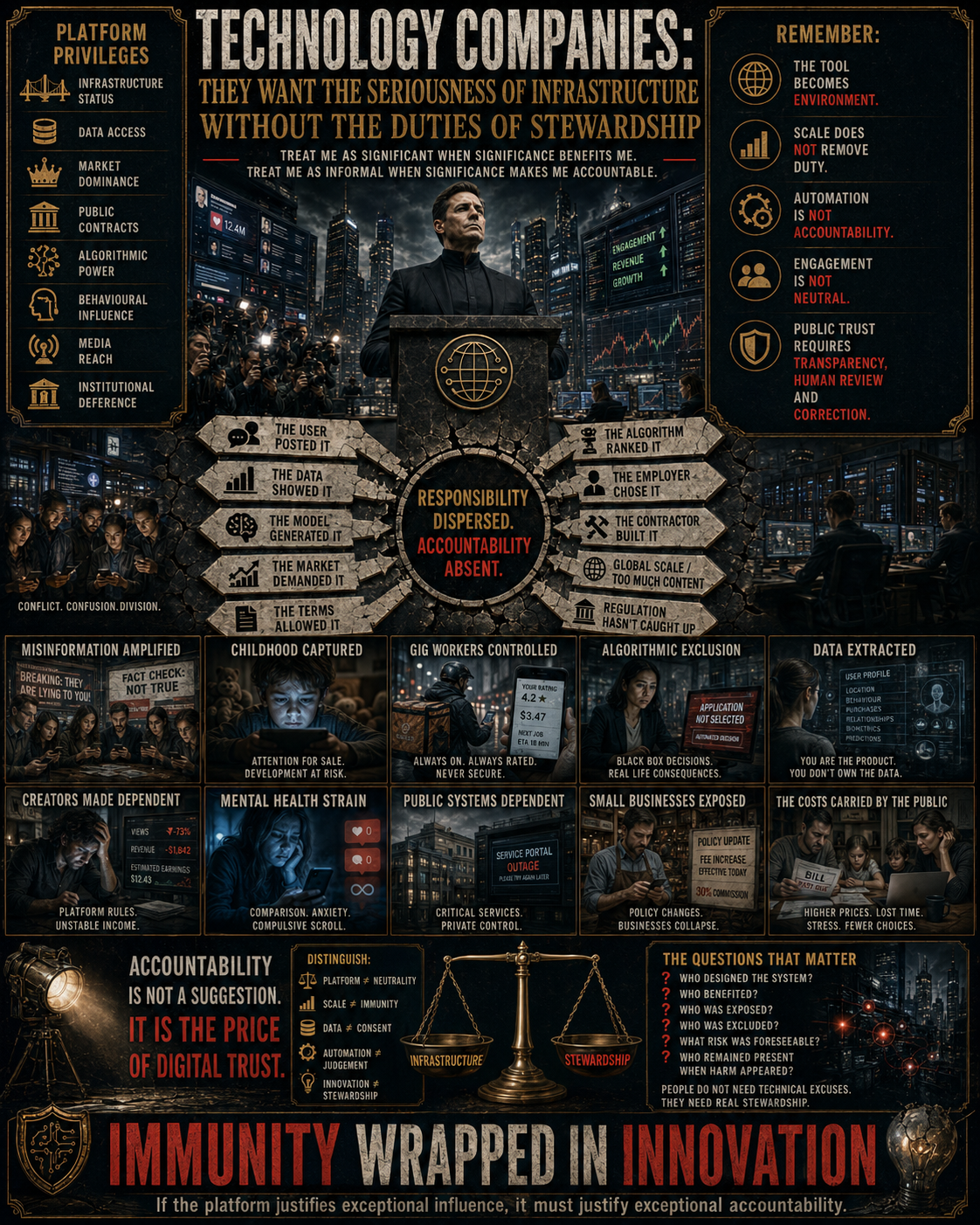
“Treat Me as Significant When Significance Benefits Me. Treat Me as Informal When Significance Makes Me Accountable.”
Technology companies may be one of the clearest examples of institutions wanting the benefits of seriousness without accepting the full duties that seriousness creates.
They want to be treated as infrastructure.
Essential.
Transformative.
Innovative.
Civilisation-shaping.
They want investors to believe they are building the future.
Governments to treat them as strategic partners.
Schools to integrate their systems.
Businesses to depend upon their platforms.
Workers to organise employment through them.
Communities to communicate through them.
Citizens to receive information through them.
Families to store memories through them.
People to organise identity, relationships, commerce, creativity, education, healthcare and political understanding through their products.
They want public contracts.
Tax incentives.
Research partnerships.
Regulatory flexibility.
Government access.
Institutional trust.
User dependence.
Market dominance.
Data.
Influence.
The right to describe their products as necessary to modern life.
But when harm occurs, the language often changes.
“We are only a platform.”
“We only provide the technology.”
“We do not control how people use it.”
“The algorithm is neutral.”
“The content was uploaded by users.”
“The employer made the final decision.”
“The advertiser selected the audience.”
“The model generated the output.”
“The system reflects existing data.”
“We complied with the applicable rules.”
The company wants to be treated as powerful enough to reshape society when seeking investment, relevance and adoption, but not powerful enough to be responsible for what its systems repeatedly produce.
That is the contradiction.
If a platform shapes public speech, employment, education, commerce, relationships, childhood, political information and access to opportunity, then “we only provide the technology” becomes inadequate.
The tool has become environment.
The Company Is Transformative Until Transformation Produces Harm
Technology companies often describe themselves through the scale of their impact.
They connect billions of people.
Democratise information.
Transform work.
Reinvent education.
Revolutionise healthcare.
Expand creativity.
Remove barriers.
Create opportunity.
Reshape economies.
Build the future.
They ask the public to believe that technology is not merely a product but a force capable of changing how civilisation functions.
That claim creates seriousness.
But when the consequences of that transformation become visible, the company may retreat into a narrower identity.
It is no longer reshaping society.
It is facilitating user choice.
It is no longer influencing public understanding.
It is ranking content.
It is no longer reorganising employment.
It is providing software.
It is no longer shaping childhood.
It is offering entertainment.
It is no longer determining access.
It is supporting decision-making.
The same influence celebrated in the investor presentation becomes uncertain in the accountability hearing.
The same scale used to justify valuation becomes too indirect to justify responsibility.
That is selective significance.
If the Tool Becomes the Environment, the Standard Changes
A tool is something a person uses within an environment.
An environment shapes what the person can see, do, understand, access and become.
Many digital systems are no longer passive tools.
They decide what appears first.
What disappears.
What becomes visible.
What receives attention.
What is amplified.
What is buried.
What is considered relevant.
Who receives an opportunity.
Who is rejected.
Who is recommended.
Who is monitored.
Who is believed.
Who is connected.
Who is isolated.
The user may technically choose what to click, but the company shapes the field in which that choice occurs.
It selects the architecture.
The defaults.
The incentives.
The friction.
The notifications.
The ranking.
The timing.
The visibility.
The available options.
The design of the environment influences the behaviour inside it.
A company cannot construct the entire field of interaction and then describe every outcome as though it emerged independently from the users placed inside that field.
Infrastructure Creates Heightened Duty
Infrastructure is not ordinary commerce.
When something becomes foundational to work, education, communication, commerce or public participation, failure becomes more consequential.
A person may lose access to employment because an automated system rejects them.
A student may lose access to learning because a platform fails.
A small business may lose revenue because an account is suspended.
A person may lose social connection because a system removes their profile.
A creator may lose income because an algorithm changes.
A patient may receive delayed support because a digital service fails.
A citizen may receive distorted political information because outrage is more profitable than accuracy.
The more essential the system becomes, the less adequate it is to say that users can simply leave.
Leaving may mean losing access to customers.
Friends.
Work.
Professional visibility.
School.
Public services.
Community.
Modern participation itself.
A service that becomes difficult to refuse inherits duties beyond those of an optional product.
Scale Does Not Dilute Responsibility
Technology companies often operate at enormous scale.
Millions of users.
Billions of interactions.
Constant content.
Rapid change.
Complex systems.
The scale is real.
But scale is not only a burden.
It is also the source of power, profit and influence.
The company cannot use scale to justify valuation and then use the same scale to explain why accountability is impossible.
“We serve too many people to review every decision.”
“We process too much content to understand every consequence.”
“The system is too complex to explain completely.”
Those statements may describe genuine difficulty.
But if the company chose to operate at that scale, it must design responsibility at that scale.
More users require more safeguarding.
More influence requires more transparency.
More automation requires stronger review.
More complexity requires clearer explanation.
Scale should increase the architecture of care.
Not reduce it.
Innovation Is Not an Exemption From Duty
Technology companies often present regulation and accountability as threats to innovation.
The market moves quickly.
The technology is new.
Law cannot keep pace.
Excessive caution may slow progress.
Those concerns may sometimes be valid.
But novelty does not suspend consequence.
A new system can still harm people.
A new technology can still discriminate.
A new platform can still exploit vulnerability.
A new product can still destabilise institutions.
A new model can still create foreseeable risk.
The fact that something has not existed before does not mean the people affected should become involuntary test subjects without meaningful protection.
Innovation describes what is new.
It does not answer whether the new thing is responsible.
The Public Should Not Become the Unpaid Testing Environment
Technology companies often release products before fully understanding their wider effects.
The product reaches millions.
Problems emerge.
Users report harm.
Researchers investigate.
Governments respond.
The company adjusts later.
This model allows the public to carry the discovery cost.
People become the testing environment.
Children become the developmental study.
Workers become the labour experiment.
Communities become the social trial.
Institutions become the integration test.
The company gathers data from consequences that other people had to live.
A serious technology company should test not only whether the product functions.
It should test what the product does to the environment in which it functions.
What behaviour does it reward?
What dependency does it create?
What existing inequality does it intensify?
What harms become profitable?
What happens when the product reaches scale?
What happens when people cannot reasonably opt out?
“We Did Not Intend That Outcome” Is Not the Whole Evaluation
A company may not intend harm.
It may intend connection.
Efficiency.
Access.
Convenience.
Growth.
Productivity.
The intention may be sincere.
But systems operate through incentives, design and repeated effects.
A recommendation system may not intend radicalisation.
It may still reward emotionally extreme content because extremity increases engagement.
A hiring system may not intend discrimination.
It may still reproduce historical exclusion through the data used to train it.
A platform may not intend addiction.
It may still optimise for retention through behavioural hooks.
A marketplace may not intend exploitation.
It may still reward sellers or employers who lower standards.
Intent explains the stated purpose.
Outcome reveals the actual function.
Once the pattern becomes visible, the question is not only what the company intended.
It is what the company did after it knew.
Engagement Is Not a Neutral Metric
Technology platforms often optimise for engagement.
Time spent.
Clicks.
Views.
Comments.
Shares.
Retention.
Return frequency.
These metrics appear technical.
But they shape human behaviour.
A system optimised for engagement may learn that anger holds attention.
Fear spreads quickly.
Conflict increases comments.
Comparison increases return.
Insecurity increases consumption.
Outrage increases sharing.
The metric may be neutral in language while producing non-neutral incentives.
The company may say it does not choose what people feel.
But it chooses what the system rewards.
If the architecture repeatedly amplifies content that destabilises attention, trust or social cohesion, the problem is not only the content.
It is the business logic organising visibility.
Attention Is a Human Resource
Technology companies often treat attention as available inventory.
Something to capture.
Retain.
Monetise.
Redirect.
But attention is not an abstract resource.
It belongs to a person.
It shapes memory.
Development.
Sleep.
Focus.
Emotion.
Relationships.
Learning.
Decision-making.
A business that designs systems to capture attention has a duty to understand what repeated capture does to the mind.
Especially where children are involved.
A company cannot claim sophistication in behavioural design and innocence about behavioural effect.
If teams are employed to understand how colour, timing, reward, notification and uncertainty influence user behaviour, then influence is not accidental.
It is engineered.
Children Change the Standard Completely
Children enter digital environments before they possess mature discernment.
Their identity is developing.
Attention is developing.
Emotional regulation is developing.
Social understanding is developing.
Their ability to recognise manipulation is developing.
Their understanding of permanence, privacy and commercial intent is developing.
A platform that gains access to children inherits heightened duty.
The child should not be expected to defend themselves against systems designed by teams of behavioural scientists, data analysts, engineers and marketers.
The company knows more.
Measures more.
Experiments more.
Controls more.
The unequal capacity is enormous.
Age checks, parental settings and terms of service cannot carry the entire burden.
The architecture itself must be suitable for the developmental reality of the child.
The Company Cannot Call Dependency “Choice”
Technology companies often rely upon the language of user choice.
Users accepted the terms.
Users selected the settings.
Users chose to remain.
Users chose what to view.
But choice is shaped by design.
Were the settings understandable?
Were safer options easy to find?
Was refusal possible without losing essential access?
Were consequences explained?
Was the default designed for the user’s protection or the company’s benefit?
Was consent meaningful, or was it buried inside complexity?
A choice is not fully free merely because a button existed.
Where one option is frictionless and profitable while the protective option is hidden, delayed or confusing, the architecture has already expressed a preference.
Terms and Conditions Cannot Carry Unlimited Moral Weight
Most users do not read lengthy terms.
Many could not meaningfully negotiate them even if they did.
The agreement is usually take-it-or-leave-it.
Yet companies may treat acceptance as though the user entered an equal contract with full understanding.
A legal click should not erase the company’s duty of care.
Consent requires more than formal acceptance.
It requires comprehension.
Real alternatives.
Proportionate consequences.
Honest explanation.
A company should not use complexity to manufacture technical consent while preventing meaningful understanding.
Data Access Creates Data Duty
Technology companies collect extraordinary amounts of information.
Location.
Search history.
Purchases.
Messages.
Contacts.
Preferences.
Health indicators.
Political interests.
Work behaviour.
Voice.
Images.
Relationships.
Patterns of attention.
Signals of vulnerability.
This information creates enormous power.
The company may know a person’s habits more accurately than some of their family members.
It may predict behaviour the user has not consciously recognised.
That power creates duty.
How is the information used?
Who receives it?
What is inferred?
What decisions are shaped by it?
What vulnerabilities are monetised?
How long is it stored?
How is it protected?
Can the user correct it?
Can the user understand what the company believes about them?
Data cannot be treated as a free natural resource simply because it can be collected.
It is extracted from human life.
Personalisation Can Become Invisible Manipulation
Personalisation is often sold as convenience.
Relevant content.
Useful recommendations.
Better services.
More suitable advertising.
But personalisation also allows each person to inhabit a different informational environment.
One user sees one reality.
Another sees something else.
The company observes both.
The users may not know how their environment was constructed.
This creates asymmetry.
The platform can test emotional responses.
Adjust messaging.
Predict susceptibility.
Control timing.
Shape exposure.
The person experiences the result without seeing the system that produced it.
A serious company should distinguish assistance from behavioural steering.
The more invisible the influence, the stronger the duty of transparency.
The Algorithm Is Not an Independent Actor
Companies may speak about algorithms as though they operate separately from human responsibility.
“The algorithm selected it.”
“The model ranked it.”
“The system rejected the application.”
But the algorithm did not procure itself.
It did not choose the goal.
It did not select the training data.
It did not decide which errors were acceptable.
It did not determine the threshold.
It did not choose the business model.
It did not decide whether speed mattered more than accuracy.
Human beings designed the architecture around the model.
A company cannot create a system, benefit from its outputs and then treat the system as the responsible party when the result becomes harmful.
Automation does not remove responsibility.
It changes where responsibility must be mapped.
Efficiency Cannot Be Owned While Consequence Is Outsourced
Technology companies often sell efficiency.
Faster decisions.
Lower costs.
Automated processing.
Reduced labour.
Increased scale.
More output.
Those gains are used to justify adoption.
But when automation creates exclusion, misclassification, job loss or inaccessible systems, the consequences are often transferred elsewhere.
The worker must retrain.
The applicant must appeal.
The citizen must prove the error.
The customer must navigate support.
The public sector must manage unemployment.
Families absorb income loss.
Communities absorb instability.
The company owns the efficiency.
Everyone else carries the disruption.
You cannot own the efficiency and outsource the consequence.
Human Review Must Be Real
Companies often say that human review exists.
But the review may be symbolic.
The reviewer follows the same system.
Sees the same limited data.
Has little time.
Cannot alter the decision.
Must trust the model.
Handles too many cases.
Or is available only after the person has suffered significant harm.
A human appearing somewhere in the process does not automatically make the process accountable.
Real human review requires authority.
Time.
Context.
The ability to disagree.
The ability to reverse.
The responsibility to explain.
A person should not be trapped inside an automated decision that no identifiable human is empowered to correct.
Explanation Is Part of Technical Responsibility
A system may be complex.
But people affected by it still need explanation.
Why was the account suspended?
Why was the application rejected?
Why was the content removed?
Why did the price change?
Why was the person flagged?
Why was one candidate selected over another?
Why was the user shown this information?
A company cannot demand trust in systems it refuses to make intelligible.
Technical complexity may limit how much detail can be provided.
It does not eliminate the duty to provide a meaningful reason.
A decision without explanation reduces the person to an object of the system.
Platform Neutrality Is Often Selective
Technology companies may describe themselves as neutral platforms.
But they write the rules.
Rank the content.
Set the defaults.
Remove users.
Promote some material.
Restrict other material.
Design monetisation.
Choose moderation systems.
Determine which behaviour creates revenue.
A platform does not need to write every post to shape the environment in which posts succeed.
Neutrality becomes difficult to claim when the company determines the architecture of visibility.
The question is not only whether the platform created the content.
It is whether the platform’s systems distributed, rewarded, recommended or monetised it.
Freedom of Expression Does Not Require Algorithmic Amplification
A person may have the freedom to speak.
That does not mean a company must amplify every statement to millions.
Hosting is not the same as recommending.
Permitting is not the same as promoting.
Expression is not the same as engineered reach.
Technology companies often collapse these distinctions when accountability is raised.
But a system that actively selects and distributes content exercises judgement.
The company should be accountable for the difference between allowing speech and building machinery that intensifies it.
Moderation Cannot Be Serious Only After Public Scandal
Platforms may ignore harmful patterns until journalists, researchers, governments or users create pressure.
Then policies change.
Teams expand.
Accounts are removed.
Safety commitments are announced.
The company presents the response as responsibility.
But the higher question is prevention.
What evidence existed earlier?
What warnings were raised internally?
What researchers found the pattern?
What employees objected?
What financial incentives delayed action?
Why did public exposure create urgency when user harm did not?
A company should not require scandal before safety becomes operationally important.
Content Moderators Should Not Carry the Entire Moral Burden
Large platforms often rely on content moderators to review disturbing material at scale.
The worker sits at the final visible point of a much larger architecture.
But the problem was also shaped by product design.
Recommendation systems.
Business incentives.
Staffing choices.
Enforcement rules.
Speed targets.
The individual moderator cannot carry responsibility for the environment the company created.
Responsibility should move upward towards those who designed the system, set the targets and decided what level of harm was acceptable.
Public Contracts Create Public Duties
When technology companies receive public contracts, they move beyond ordinary commerce.
Their systems may shape welfare.
Immigration.
Healthcare.
Education.
Policing.
Employment.
Public administration.
The public may have no meaningful alternative provider.
That creates heightened responsibility.
A private company delivering a public function should inherit public-level duties of transparency, accessibility, fairness, explanation and review.
It should not receive public money while shielding consequential decisions behind commercial secrecy.
Public function cannot be privatised without the accompanying duty being preserved.
Commercial Secrecy Cannot Outrank Public Consequence
Companies may protect source code, models, data and business methods as commercial property.
That protection may be legitimate.
But when the system determines access to public rights, essential services or major opportunities, secrecy becomes harder to justify.
The company cannot say:
“Trust the system.”
And then:
“We cannot explain the system because it is proprietary.”
A person should not lose housing, work, healthcare or legal status through a process that remains hidden because transparency might weaken commercial advantage.
Where private technology exercises public power, public accountability must follow.
The Company Cannot Privately Govern Public Life Without Democratic Duty
Technology platforms increasingly create rules that operate across countries.
They determine acceptable speech.
Identity verification.
Commercial access.
Account suspension.
Data use.
Visibility.
Dispute resolution.
These decisions can affect millions more quickly than legislation.
The company may function like a private government without democratic accountability.
Users cannot vote out the board.
They may not know who made the rule.
They may have no meaningful appeal.
The terms can change without negotiation.
A company that governs behaviour at social scale should not be allowed to describe every rule as an ordinary private business decision.
Power does not become less governmental simply because it is exercised through software.
The Company Cannot Claim Community While Designing Extraction
Platforms often use the language of community.
Connection.
Belonging.
Participation.
Creativity.
But the community may also be the product.
Its interactions generate data.
Its relationships generate engagement.
Its vulnerabilities generate advertising opportunities.
Its labour creates content.
Its conflict increases time spent.
A company cannot invoke community only when seeking loyalty while treating members as behavioural inventory when calculating revenue.
If the platform calls people a community, it inherits duties of stewardship towards that community.
Community is not simply a more emotionally attractive word for user base.
Creators Should Not Build Value Without Security
Many platforms depend on creators.
Writers.
Artists.
Musicians.
Educators.
Commentators.
Independent businesses.
These people produce the material that attracts users.
But their income may remain unstable.
An algorithm changes.
Reach disappears.
A policy shifts.
An account is removed.
The creator may lose years of accumulated work without clear explanation.
The platform owns the infrastructure.
The creator carries the uncertainty.
A serious company should not invite people to build livelihoods on a system while treating their continuity as disposable.
Workers Should Not Carry Innovation’s Hidden Cost
Technology companies may celebrate disruption.
Automation.
Lean systems.
Platform labour.
Flexible work.
But flexibility may mean insecurity for the worker.
No guaranteed hours.
No benefits.
Opaque ratings.
Automated dismissal.
Constant surveillance.
Unpredictable income.
The company gains a responsive workforce without accepting the duties traditionally attached to employment.
The worker is treated as essential when labour is needed and independent when protection is requested.
That is the same pattern.
Significant when productive.
Informal when accountability appears.
The Platform Cannot Control the Worker While Denying Employment Responsibility
A company may describe workers as independent contractors while controlling key parts of the relationship.
Pricing.
Access to customers.
Performance ratings.
Visibility.
Routes.
Deadlines.
Suspension.
Removal.
The worker carries the risk.
The platform controls the environment.
Legal classification should not be used to hide material control.
If the company directs the conditions strongly enough to benefit from the labour as organised labour, it should not become distant when employment duties arise.
Technology Should Increase Human Capability, Not Only Institutional Control
Technology can expand access.
Reduce unnecessary labour.
Improve communication.
Support learning.
Reveal patterns.
Increase safety.
But technology can also increase control without increasing capability.
More surveillance.
More scoring.
More tracking.
More automated restriction.
More dependence.
A serious company should ask:
Does the system make people more capable?
More informed?
More autonomous?
More able to challenge decisions?
Or does it make institutions more efficient at controlling people who understand less about the process affecting them?
Technological advancement should not be measured only by what the system can do.
It should be measured by what the human being becomes capable of through it.
Convenience Should Not Be Purchased With Invisibility
Technology often removes friction.
One click.
Instant approval.
Automatic recommendation.
Seamless access.
But friction sometimes contains important information.
A pause before consent.
An explanation before purchase.
A warning before sharing.
A human conversation before a consequential decision.
The pursuit of convenience can remove the moments in which people understand what they are agreeing to.
A serious design should distinguish unnecessary friction from protective reflection.
Not every pause is inefficiency.
Some pauses protect agency.
The Company Cannot Design Addiction and Call It Preference
A platform may observe that users return repeatedly.
Spend longer.
Check constantly.
Respond to notifications.
It may describe this as preference or engagement.
But if the system is intentionally designed around intermittent reward, social validation, urgency and behavioural compulsion, repeated use cannot be interpreted only as free desire.
A person may continue using a system that is making them less well.
The company may know this.
Measure it.
Optimise it.
A serious company should not confuse successful behavioural capture with evidence that the experience is healthy.
Product Success Is Not the Same as Human Success
A technology product may succeed financially.
Grow rapidly.
Increase engagement.
Dominate its market.
Attract investment.
Expand internationally.
But the users may become more distracted.
Workers more insecure.
Children more anxious.
Communities more polarised.
Small businesses more dependent.
Public institutions less transparent.
Product success and human success are not identical.
A serious evaluation should ask what the product improved beyond its own metrics.
Did people gain time?
Understanding?
Safety?
Agency?
Financial security?
Connection?
Or did the company become more valuable while the surrounding environment became less stable?
The Company Should Not Control the Definition of Harm
Technology companies often produce their own safety reports.
Select their own metrics.
Define prohibited outcomes.
Measure their own progress.
They may report declining violations while users experience rising harm.
If the company controls the system, the data and the definition of success, independent evaluation becomes essential.
Otherwise, it becomes judge of both performance and consequence.
A serious company should not fear outside scrutiny.
It should recognise that power requires external visibility.
Internal Ethics Cannot Remain Advisory
Many companies create ethics teams.
Safety councils.
Responsible innovation frameworks.
Review boards.
These structures may be valuable.
But if they cannot delay launch, change product design, challenge revenue targets or stop harmful deployment, they may become ceremonial.
Ethics without operational power becomes reputation management.
A serious company gives ethical judgement the authority to alter what the company does.
Not merely the language through which it describes what it has already decided to do.
Whistleblowers Reveal Whether the Company Values Truth or Control
Employees may raise concerns about safety, discrimination, data use or hidden risk.
The company’s response reveals its actual culture.
Are concerns investigated?
Are workers protected?
Is the product changed?
Or is the employee marginalised, threatened, dismissed or described as disloyal?
A company cannot publicly celebrate innovation and internally punish the people who reveal where innovation has become unsafe.
Truth should be able to travel upward regardless of rank.
The Technology Company Seriousness Test
Whenever a technology company asks to be taken seriously, ask:
What privileges does that seriousness give it?
Investment.
Public contracts.
Market access.
Data.
Influence.
Regulatory attention.
Social legitimacy.
Control over digital infrastructure.
Access to children.
Access to workers.
Access to public institutions.
The ability to shape speech, commerce, education, employment and political information.
The ability to define the conditions of modern participation.
Then ask:
What duties should accompany those privileges?
Transparency.
Explanation.
Safety.
Accessibility.
Prevention.
Human review.
Data protection.
Correction.
Independent oversight.
Respect for consent.
Protection of children.
Fairness.
Measurable public benefit.
Responsibility for foreseeable consequences.
Remaining present when harm appears.
Then ask:
Does the company accept both, or only the side that benefits it?
Does it want infrastructure status without infrastructure duty?
Data without stewardship?
Scale without safeguarding?
Innovation without prevention?
Automation without explanation?
Public contracts without public transparency?
Influence without accountability?
Engagement without responsibility for what is amplified?
Efficiency without responsibility for disruption?
The benefits of shaping society without responsibility for the society shaped?
That is the test.
The Technology Accountability Matrix
A serious evaluation should ask:
- What function does the technology perform?
- How essential has it become?
- Can people reasonably opt out?
- What decisions does it shape?
- Who designed the objective?
- What data was used?
- What assumptions were embedded?
- What risks were foreseeable?
- What testing occurred before release?
- Who carried the testing cost after release?
- What behaviour does the system reward?
- What harms increase revenue?
- What defaults were selected?
- Was consent meaningful?
- Were protective settings visible and accessible?
- Can users understand why a decision occurred?
- Is human review real?
- Can the reviewer reverse the outcome?
- What happens when the system is wrong?
- Who pays for correction?
- Are children treated according to developmental vulnerability?
- Are workers treated according to material control rather than convenient classification?
- Does the company protect commercial secrecy more urgently than the people affected?
- Do public contracts include public-level accountability?
- Can independent researchers inspect the system?
- Are internal ethics teams empowered to stop deployment?
- Are whistleblowers protected?
- Did the technology increase human agency?
- Or did it primarily increase institutional control?
- Did the company become more valuable while the public carried the consequence?
- Given its knowledge, resources and scale, what more could reasonably have been done?
These questions do not begin with hostility towards technology.
They begin with power.
Design.
Scale.
Consequence.
Criticising Technology Companies Is Not Rejecting Technology
A mature society should be able to examine technology companies without collapsing into anti-technology thinking.
To question an algorithm is not to reject computation.
To demand data protection is not to reject innovation.
To challenge automation is not to reject efficiency.
To scrutinise platforms is not to reject communication.
To regulate artificial intelligence is not to reject research.
Technology can expand human possibility.
But possibility without stewardship can also expand harm.
Accountability does not weaken legitimate innovation.
It distinguishes innovation that serves life from innovation that merely extracts from it.
The Highest Form of Technology Accountability
The highest form of accountability does not ask only:
“Did the technology work?”
It asks:
Given the data, intelligence, scale, capital and behavioural influence this company possessed, what should the human environment reasonably look like after its technology became embedded within it?
Are people more informed?
More capable?
More connected?
More employable?
More autonomous?
More secure?
More able to understand decisions?
More protected from manipulation?
Are children developing with greater support?
Are workers benefiting from efficiency?
Are creators receiving continuity?
Are public institutions more accessible?
Has technology reduced inequality?
Or intensified it?
Did the platform create community?
Or monetise dependency?
Did automation increase human capacity?
Or merely increase the distance between authority and consequence?
Did the tool serve the environment?
Or did the environment become organised around the tool?
That question reveals the distance between technological capacity and human outcome.
And that distance is where responsibility lives.
The Pattern Beneath Technology Companies
In technology, the actor wants:
Authority.
Trust.
Legitimacy.
Influence.
Status.
Income.
Protection.
Obedience.
Access.
Recognition.
Data.
Dependency.
Infrastructure status.
But may resist:
Transparency.
Explanation.
Care.
Prevention.
Correction.
Proportional contribution.
Measurable outcomes.
Independent oversight.
Accepting consequences.
Remaining present when harm appears.
This is selective seriousness.
Seriousness when technology produces investment, dependence, contracts, data and social influence.
Informality when technology creates responsibility for the environment it has shaped.
Closing: Immunity Wrapped in Innovation
Seriousness is not a valuation.
A patent.
A headquarters.
A founder’s vision.
A public contract.
A billion users.
A sophisticated model.
A technical vocabulary.
A claim to be building the future.
Seriousness is the willingness to carry the full weight of the technological role one asks society to trust.
If a company wants to be treated as infrastructure, it inherits infrastructure-level duties.
If it collects data, it inherits stewardship.
If it controls access, it inherits fairness.
If it automates decisions, it inherits explanation and human review.
If it shapes childhood, it inherits developmental responsibility.
If it profits from attention, it inherits responsibility for how attention is engineered.
If it reorganises work, it inherits responsibility for transition.
If it enters public systems, it inherits public-level accountability.
Technology companies cannot claim to transform civilisation and then describe themselves as neutral when civilisation absorbs the consequences.
They cannot call the system essential when seeking adoption and optional when users are harmed.
They cannot own the scale, intelligence, data and efficiency while outsourcing the instability, exclusion and repair.
They cannot design the environment and deny responsibility for what the environment repeatedly produces.
The companies that want to be taken seriously but reject serious responsibility are not asking to be recognised as builders of the future.
They are asking for immunity wrapped in innovation.
And technology companies have been protected by that wrapping for far too long.




Leave a Reply