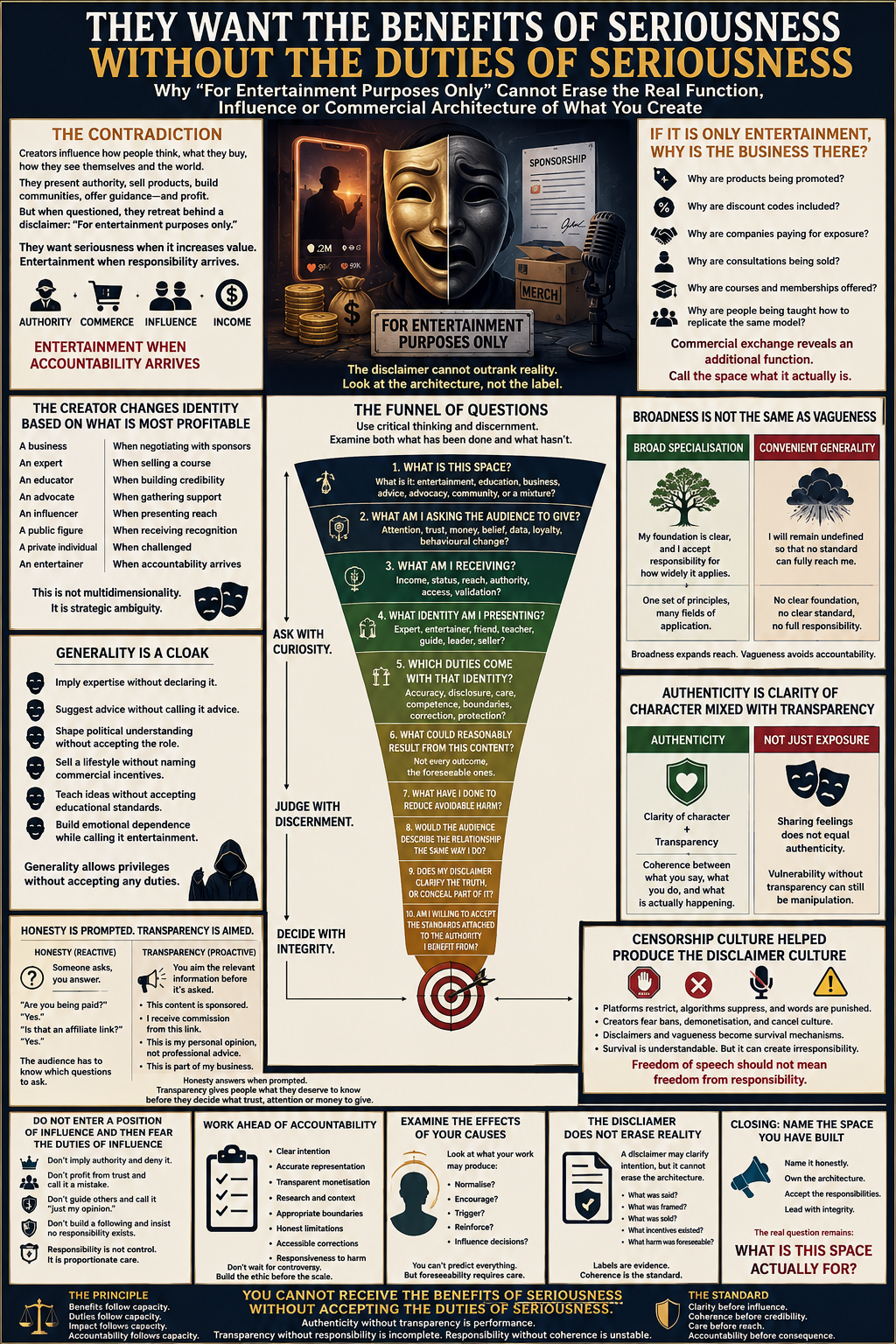
Generality is a cloak, a harmful one.
Why “For Entertainment Purposes Only” Cannot Erase the Real Function, Influence or Commercial Architecture of What One Creates
There is a growing habit across digital culture that appears harmless until you examine what it is actually doing.
A creator publishes content that influences how people think, what they buy, how they understand themselves, how they interpret relationships, how they approach money, health, politics, spirituality, identity or reality. The page may contain sponsorships, affiliate codes, product recommendations, subscriptions, paid partnerships, courses, consultations, merchandise, memberships and links directing the audience towards commercial exchange.
The creator may describe themselves as an educator, coach, commentator, strategist, advocate, guide, expert, thought leader, influencer or community builder when those descriptions increase trust, authority and profitability.
But somewhere beneath the content appears the sentence:
For entertainment purposes only.
That sentence is often presented as though it can wash the creator’s hands of every other function the content performs.
As though the content can shape behaviour without being influential.
Sell products without being commercial.
Offer direction without functioning as advice.
Build authority without carrying responsibility.
Teach an audience without being evaluated as education.
Generate income without becoming work.
And affect people without being accountable for foreseeable effects.
This is the contradiction.
They want the benefits of seriousness without the duties of seriousness.
They want to be taken seriously enough to be trusted, followed, paid, sponsored, quoted, consulted and defended—but not seriously enough to be questioned about what they are producing.
They want seriousness when it increases value.
Entertainment when responsibility arrives.
If It Is Only Entertainment, What Is the Business Doing There?
Entertainment can absolutely be monetised.
There is no contradiction in a comedian earning money, a filmmaker selling tickets, a musician receiving royalties, an entertainer advertising a product or a creator building a profitable platform around enjoyable content.
The contradiction is not monetisation.
The contradiction is misdescription.
If the page is both entertainment and business, say that.
If the content is monetised entertainment, call it monetised entertainment.
If the creator mixes personal opinion, education, promotion, storytelling and advertising, then the space is a mixture.
There is nothing inherently wrong with that.
But the mixture should be named honestly.
“For entertainment purposes only” becomes misleading when the page is also being operated as a workplace, marketplace, advertising channel, educational platform and authority-building system.
The creator cannot reasonably say that the space exists only for entertainment while placing hundreds of purchasing links beneath the content.
Why is the audience being directed towards products?
Why are discount codes included?
Why are companies paying for exposure?
Why are consultations being sold?
Why are people being taught how to reproduce the same business model?
Why does the creator negotiate commercial contracts based on the seriousness of their influence, then describe that influence as unserious when its effects are questioned?
The issue is not that entertainment requires no exchange.
The issue is that commercial exchange reveals an additional function.
The space is not only entertaining people.
It is converting attention into money.
Once that is happening, the creator should be transparent about the architecture.
The Creator Changes Identity According to Which One Is Most Profitable
A person may be:
A business when negotiating with sponsors.
An expert when selling a course.
An educator when building credibility.
An advocate when gathering community support.
An influencer when presenting reach.
A public figure when receiving recognition.
A private individual when challenged.
And an entertainer when accountability arrives.
This is not multidimensionality.
It is strategic ambiguity.
A person can genuinely occupy several roles at once. Human beings are not required to reduce themselves to one professional category. The problem begins when the role changes only to avoid the duties attached to the previous one.
If someone says, “I educate,” the quality and accuracy of what they teach become relevant.
If they say, “I advise,” their competence, limitations and consequences become relevant.
If they say, “I sell,” their incentives, representations and disclosures become relevant.
If they say, “I influence,” the foreseeable effect of that influence becomes relevant.
If they say, “This is my work,” professional responsibility becomes relevant.
If they say, “I lead a community,” their conduct towards that community becomes relevant.
Specificity establishes the standard through which the work can be evaluated.
That is exactly why some people avoid being specific.
Generality Is a Cloak
Generality allows someone to move between categories without being firmly accountable to any of them.
They can imply expertise without declaring it.
Suggest advice without calling it advice.
Shape political understanding without accepting the role of political communicator.
Sell a lifestyle without naming the commercial incentives beneath it.
Teach ideas without accepting educational standards.
Build emotional dependence while calling the relationship entertainment.
The creator leaves the audience to infer what the platform is while retaining the ability to deny whichever interpretation becomes inconvenient.
When challenged, they can say:
“I never said I was an expert.”
“It was just my opinion.”
“You took it too seriously.”
“It was only a joke.”
“This is entertainment.”
“I am not responsible for what people do.”
But the ambiguity may have been part of what made the influence effective.
The audience trusted the creator precisely because the creator moved between intimacy, authority, entertainment and commercial recommendation without clearly separating them.
Generality is therefore not always an innocent lack of definition.
Sometimes it is an accountability strategy.
When the purpose remains vague, the creator can collect the privileges of several roles while denying that any one role fully applies.
Broadness Is Not the Same as Vagueness
This distinction matters because a person can have a broad field of work without being unclear about who they are.
I describe myself as rooted in and advocating for consciousness.
Consciousness is present in everything.
It reaches law, governance, business, creativity, relationships, psychology, education, health, technology, spirituality and civilisation because every one of those systems is shaped by perception, awareness, decision-making and human behaviour.
My specialisation is broad.
But my foundation is specific.
The roots remain the same while the branches move through different fields.
When I speak about moving between identities, I am acknowledging the way society categorises roles as though each one requires an entirely different person.
The lawyer is expected to possess one kind of identity.
The politician another.
The creator another.
The business owner another.
Society frequently turns roles into identities and encourages people to turn their identities into roles.
But my individual identity does not change simply because the field of application changes.
The same principles remain.
The same consciousness.
The same accountability.
The same responsibility.
The same standards.
The same intention to understand the whole and act coherently within it.
That is the difference between broad specialisation and convenient generality.
Broad specialisation says:
My foundation is clear, and I accept responsibility for how widely it applies.
Convenient generality says:
I will remain undefined so that no standard can fully reach me.
Those are not the same posture.
Authenticity Is Clarity of Character Mixed With Transparency
People use the word authenticity constantly, but often reduce it to appearing relaxed, emotional, unfiltered or relatable.
That is not enough.
A person may reveal private details and still conceal their commercial motives.
They may speak casually and still manipulate perception.
They may cry publicly and still avoid accountability.
They may share vulnerability and still remain unclear about what they are asking the audience to believe, buy or become.
Authenticity is not merely exposure.
It is coherence.
To me, authenticity is clarity of character mixed with transparency.
Clarity of character means the audience can recognise the principles through which the person moves.
Transparency means the person actively makes the relevant architecture visible.
What are you creating?
Why are you creating it?
How do you benefit?
What is being sold?
What is opinion?
What is research?
What is performance?
What is advertising?
What authority are you claiming?
What authority are you refusing?
What relationship are you establishing with the audience?
What responsibility do you accept for the space you have built?
Authenticity exists when the public presentation is coherent with what is actually happening.
Anything outside that coherence may still look personal, but it is not fully authentic to the reality of the exchange.
Honesty Is Prompted. Transparency Is Aimed.
This distinction is foundational.
Honesty is often reactive.
Someone asks a question, and you answer truthfully.
“Are you being paid to promote this?”
“Yes.”
“Is that an affiliate link?”
“Yes.”
“Did the company send you the product?”
“Yes.”
That is honesty.
But the audience had to know which question to ask.
Transparency is proactive.
It does not wait to be interrogated.
It aims the relevant information towards the person who may be affected by it.
“This content is sponsored.”
“I receive commission from this link.”
“This is my personal interpretation, not professional advice.”
“This programme is part of my business.”
“These are the limitations of my knowledge.”
“This is what I intend the content to do.”
“This is how the platform generates revenue.”
Honesty answers when prompted.
Transparency recognises what the audience deserves to know before deciding how much trust, attention, money or authority to give.
That is why transparency creates a higher standard.
It requires self-awareness before exposure.
It asks the creator to examine the entire relationship, not merely avoid telling direct lies.
When Creators Teach Creation, the Curtain Opens
Digital culture has created another important development.
Creators increasingly teach other people how to become creators.
They sell courses on audience growth.
Sponsorships.
Engagement.
Retention.
Brand positioning.
Emotional hooks.
Storytelling.
Affiliate marketing.
Content calendars.
Parasocial connection.
Conversion.
Trust-building.
Algorithmic visibility.
Audience psychology.
Once creators teach these processes, the audience can see behind the curtain.
People begin to understand that the casual recommendation may be a conversion strategy.
The intimate story may also be a trust-building mechanism.
The controversy may be designed for engagement.
The emotional opening may support retention.
The supposedly spontaneous product mention may be commercially planned.
The creator has revealed the mechanics because teaching those mechanics is itself another product.
This does not automatically make the original content dishonest.
Strategy and sincerity can coexist.
But the existence of strategy means creators cannot continue assuming the audience knows nothing about how the system works.
People increasingly understand that attention is monetised.
They understand that views generate value.
They understand that recommendations may carry commission.
They understand that relatability can be commercially useful.
They understand that influence is not merely social.
It is economic.
So presenting “for entertainment purposes only” as though it describes the entire relationship can become condescending.
The audience can see the business.
The creator should acknowledge it.
Censorship Culture Helped Produce the Disclaimer Culture
The rise of vague disclaimers did not happen in a vacuum.
Platforms restrict content.
Algorithms suppress language.
Automated systems misunderstand context.
Certain words trigger moderation.
Creators fear suspension, demonetisation, reduced reach, removal or permanent loss of access to audiences they spent years building.
Cancel culture adds another pressure.
People fear saying something imperfectly.
They fear reputational collapse.
They fear that one sentence will be isolated from its surrounding meaning.
They fear legal consequences, public campaigns and institutional retaliation.
So creators learn to speak indirectly.
They replace words.
Use codes.
Hide meaning in implication.
Add disclaimers.
Avoid clear declarations.
Present serious topics as jokes.
Say “allegedly.”
Say “do your own research.”
Say “for entertainment purposes only.”
Say enough to communicate, but not enough to be pinned down.
This is understandable as a survival response.
But a survival response can still produce a damaging culture.
Censorship creates circumvention.
Circumvention can create generality.
Generality can create deniability.
Deniability can create irresponsibility.
The creator may begin by trying to survive the platform and end by losing clarity with the audience.
Creating Within Boundaries Is Not the Same as Creating Transparently
A person may believe they are speaking freely because they found a way around platform restrictions.
But if the platform determines which truths can be stated clearly, then the creator is still producing inside the platform’s boundaries.
They may remain visible.
They may remain monetised.
They may continue reaching the audience.
But the communication becomes distorted.
The meaning is coded.
The intention is softened.
The responsibility is obscured.
The audience is expected to interpret what the creator refuses to define openly.
This is one reason I value the blog format.
A blog allows the creator to build a body of thought with greater continuity.
To explain.
Qualify.
Distinguish.
Develop.
Return to ideas.
Connect pieces.
State the thesis clearly.
The work does not have to be compressed into a form designed primarily for rapid consumption or algorithmic approval.
That freedom also creates greater responsibility.
When you have room to clarify, you should clarify.
When you have space to establish context, you should establish it.
When you can tell people where the supporting information exists, you should direct them there.
Free speech should not mean speech without responsibility.
It should mean the freedom to communicate fully enough that responsibility can be carried honestly.
Do Not Enter a Position of Influence and Then Fear the Duties of Influence
People should think carefully before occupying positions whose consequences they do not want to carry.
Do not present yourself as an authority and then resent being examined as one.
Do not create a commercial relationship and then deny that the audience is also a customer.
Do not build a following around guidance and then insist nobody should have treated the guidance seriously.
Do not profit from trust and then call trust the audience’s mistake.
Do not place yourself in front of millions of people and behave as though reach carries no responsibility.
That does not mean a creator becomes responsible for every unpredictable reaction experienced by every member of an audience.
Human beings carry different histories, vulnerabilities, interpretations and decisions. No creator can control all downstream behaviour.
But impossibility of total control does not erase the duty to examine foreseeable impact.
Responsibility is not absolute control.
It is proportionate care.
A creator should ask:
Who is likely to receive this?
What authority am I implying?
Could the message reasonably be misunderstood?
Am I discussing a high-risk subject?
Have I clearly separated experience from expertise?
Am I selling something through the trust created here?
Could this encourage harmful behaviour?
Have I provided enough context?
What limitations should the audience know?
What would I need to clarify before publishing?
This is not censorship.
It is prevention.
Work Ahead of Accountability
Many people fear legal or reputational consequences but do little to prevent the conduct that could create those consequences.
They place a vague disclaimer beneath the content and treat it as advance forgiveness.
But real prevention requires more.
Clear intention.
Accurate representation.
Transparent monetisation.
Appropriate boundaries.
Research.
Context.
Accessible corrections.
Honest limitations.
Audience awareness.
Responsiveness when harm is identified.
A creator should not wait until controversy to decide what the platform is.
That should already be known.
They should not wait until someone is harmed to develop an ethical framework.
They should have one before scale.
They should not wait until a sponsor is exposed to explain the commercial relationship.
The relationship should have been visible.
They should not wait until challenged to decide whether they are an educator, entertainer or salesperson.
They should understand which functions are present and accept the responsibilities attached to each.
The answer to fear is not vagueness.
It is preparation.
The Disclaimer Cannot Outrank Reality
A disclaimer may clarify intention.
It may establish that a creator is not providing a regulated professional service.
It may remind audiences that a performance should not be interpreted literally.
It may distinguish commentary from formal advice.
It may be legally relevant depending on the context.
But the sentence itself does not transform reality.
A business cannot necessarily erase the nature of a transaction by giving it another name.
A creator cannot automatically eliminate responsibility for misleading conduct by calling the content entertainment.
A person cannot convert a foreseeable consequence into somebody else’s problem merely by announcing that no consequence was intended.
Responsibility follows the actual architecture.
What was said?
How was it framed?
What authority was implied?
What was sold?
What did the creator know?
What audience was targeted?
What incentives existed?
What harm was foreseeable?
What care was taken?
What happened after a concern was raised?
The label is evidence.
It is not the whole case.
Creators Must Examine the Effects of Their Causes
One of the reasons people reach for “entertainment purposes only” is that full responsibility requires an uncomfortable level of self-examination.
You have to look at what your work may produce.
Not only what you meant.
What did the content normalise?
What did it encourage?
What did it teach indirectly?
What emotional state did it cultivate?
What assumptions did it reinforce?
What products did it make desirable?
What behaviours did it reward?
What identities did it validate?
What vulnerabilities did it activate?
What relationships did it shape?
What did people carry away from it?
Creators often prefer to examine the cause from their own side.
“I made a video.”
“I wrote a joke.”
“I shared my opinion.”
“I told my story.”
But the audience receives effects.
A word may trigger a memory.
A story may alter someone’s self-understanding.
A recommendation may influence a purchase.
A repeated theme may normalise harmful behaviour.
A piece of content may contribute to fear, hope, dependency, courage, confusion, shame or awakening.
No creator can map every possible effect.
But the inability to foresee everything is not permission to consider nothing.
Responsibility Does Not Disappear Because Consequence Is Complex
Governments sometimes create incomplete frameworks and still hold companies accountable for conduct occurring within those gaps.
Companies may argue that the law did not explicitly prohibit every feature of what they did.
They may still face scrutiny where the conduct created foreseeable harm, misled the public or violated broader duties.
The same principle of reality over labels should extend beyond corporations.
A creator is not automatically exempt from responsibility because digital culture has normalised disclaimers.
An influencer is not beyond accountability because the platform’s categories remain unclear.
A public communicator is not harmless because the law has not yet created a perfect category for their role.
Legal responsibility will depend on the specific facts and applicable law, but the wider ethical principle remains:
A disclaimer does not erase the actual conduct.
Coherence Is the Standard
When I teach accountability, people entering my work should expect accountability.
Not only for governments.
Not only for corporations.
Not only for institutions.
For themselves.
For me.
For everyone occupying a position whose capacity creates responsibility.
I cannot teach people to hold power accountable while asking them not to examine my own use of power.
That would be incoherent.
I cannot build a platform around discernment and then punish people for discerning me.
I cannot ask governments to be transparent while hiding the architecture of my own work.
I cannot argue that responsibility follows capacity while refusing the responsibility created by my own reach.
Coherence means the principle still applies when it reaches home.
That is what gives the work integrity.
The audience does not need to guess whether accountability is part of the space.
It is declared.
Built into the writing.
Built into the questions.
Built into the architecture.
Whether they hear my voice directly or encounter the work privately, the principle remains.
The Creator’s Responsibility Funnel
Before publishing, selling or influencing, ask:
What is this space?
Entertainment?
Education?
Business?
Commentary?
Advertising?
Advocacy?
Advice?
Community?
A mixture?
What am I asking the audience to give?
Attention?
Trust?
Money?
Belief?
Data?
Loyalty?
Behavioural change?
What am I receiving?
Income?
Status?
Reach?
Authority?
Access?
Commercial opportunity?
Emotional validation?
What identity am I presenting?
Expert?
Entertainer?
Friend?
Teacher?
Guide?
Leader?
Customer service provider?
Which duties come with that identity?
Accuracy?
Disclosure?
Care?
Competence?
Boundaries?
Correction?
Protection?
What could reasonably result from this content?
Not every imaginable outcome.
The foreseeable ones.
What have I done to reduce avoidable harm?
Would the audience describe the relationship in the same way I do?
Does my disclaimer clarify the truth, or conceal part of it?
Am I willing to accept the standards attached to the authority I am benefiting from?
That is how creators move from performance to stewardship.
The Highest Standard Is Not Perfection
The purpose is not to demand that creators predict every response, never make mistakes or produce sterile content stripped of spontaneity.
The purpose is maturity.
A mature creator can say:
I meant this.
I did not consider that.
This part was sponsored.
This part was opinion.
I should have been clearer.
I have corrected it.
This is where my competence ends.
This is what I have learned from the consequence.
That is accountability.
Not the fantasy of never causing an unintended effect.
The willingness to remain present when the effect becomes visible.
Closing: Name the Space You Have Built
If your platform is entertainment, say so.
If it is commercial entertainment, say so.
If it is education, accept educational scrutiny.
If it is advice, clarify your competence and limitations.
If it is advocacy, state what you advocate for.
If it is a marketplace, disclose the exchange.
If it is several things at once, name the mixture.
But do not build a serious commercial, cultural and psychological influence system, then reduce it to “entertainment only” the moment responsibility reaches the door.
You cannot ask the audience to take you seriously enough to buy from you while insisting they should never take you seriously enough to question you.
You cannot monetise their trust and then call their trust naïve.
You cannot imply authority and deny responsibility.
You cannot use generality as both a ladder towards influence and a trapdoor away from consequence.
The problem is not that creators entertain.
The problem is not that they profit.
The problem is the attempt to receive the benefits of work, authority, education, business and influence while accepting the duties of none.
Authenticity requires clarity of character.
Transparency requires you to aim the relevant truth towards the people affected by it.
Coherence requires your principles to remain intact when they are applied to you.
And responsibility requires the courage to look at the effects of what you cause.
“For entertainment purposes only” may describe part of the content.
It cannot erase everything else the platform has become.
The real question remains:
What is this space actually for?
Until the creator answers that honestly, the disclaimer is not clarity.
It is a cloak.
…
There’s a trend that I’m noticing a lot of people do where they just hide behind the quotes for entertainment purposes only to wash their hands of responsibility of whatever they’re creating or putting out there. And, but at the same time, they also make that place as a place for business, not if, but where they’re sharing like codes or sponsorships or anything like that. So it’s not for entertainment purposes only. So what is it about then? The question says, what is it about? If it’s for entertainment purposes only, then it shouldn’t be a place of work, right? Unless, again, like just waiting for the pins to drop. Because many do it because of censorship, censorship culture, but also it’s because they see everyone doing it to cover themselves, and they’re not specific about their intentions, they’re not specific about what it is that they create, they’re not specific about what it means to the people, they’re not specific about just what it is that they create, why they create, and all of that. Because that requires a very thorough self-awareness that does not just sit at surface level. People cannot just wash responsibility and say, you know, it’s for entertainment purposes only, when, well, if it is for entertainment purposes only, then why are you selling me something? And they might not even necessarily say it on the video, but it’s like below, under in the description, and there’s like hundreds of like links for things. Why, what’s the perspective? Is it your work? Is it a place where you make money? Or is it a place for entertainment? Because entertainment doesn’t necessarily require an exchange, right? But the lack of clarity blurs the lines in a way that if someone was to pick at the lines, they can always hide behind the cloak of generality. Because when you’re not specific with things, then people, it’s harder for people to pin down the specificness. But when you’re specific about things, it makes it easier for people to pick on it based on what those specific things mean. Do you understand what I’m saying? Relay back before we create posts.
Yes, thank you. Perfect. The line that got me to see that you fully understood what I was saying is, they want the benefit of seriousness without the duties of seriousness. Exactly that, and that should be the title, or along those lines. And everything else as well. Exactly. If someone, like, based on what someone says, then they would be held accountable to that one thing. Exactly, cool. Yes, generality does allow to move in between. And that’s the thing. There is a difference between generality and, for example, what I do. I say that I’m rooted and grounded and advocate for consciousness. Consciousness is found in everything. So I am specific with where my roots are. It just happens that my roots allow me to move in between identities because, but when I say move in between identities, my rooted identity never changes. But because I understand that society sees different roles as different identities, that the lawyer has this type of lifestyle, the politician has this type of lifestyle, the content creator has this type of lifestyle, right? They attach, they make a role a identity, or their identity their role. That’s why I say I can move between identities. But my own identity, individual identity, the person that I choose to be as a person, is always the exact same. So I’m specific, it just happens that my speciality is broad, different. Because I also embody the responsibility for the broadness of my specialization. Whereas when we look at, for example, I guess, another broad identity like politician, to be a politician of a country is to have the extent of the broadness of that country and everything within it. But the same intensity of the responsibility that I have about humanities and the same that they have about society or their own civilians, so we cannot even compare the two. But yeah, she got the point there. Exactly. It’s not that entertainment cannot be monetized, but be honest about it. If it is monetization, say it’s a monetized entertainment, you know? Because we already know that they’re making money, because when you reach a certain amount of either subscribers or views or likes, you start making money. So it’s not like we don’t know that they’re making money out of it. But it’s how they then explain it or how they present it to the audience, as if the audience is ignorant to what goes behind it. Because that’s the bit about where we are right now, is that so many people try and teach each other so many ways of doing the exact same things, and that also gets us to see behind the curtains of all those different things. If a content creator also does training on how to be a content creator, we are instantly, exactly in that moment, seeing what they are doing also towards their own audiences, you know? When I wrote the post on holding people accountable, people know that coming into my blog, they’re going to be held accountable, but whether they hear my voice or not. Because I created pieces that hold them accountable. I am coherent with myself. I’m not going to teach you how to hold people accountable if I don’t hold myself accountable and you as well. It doesn’t make sense, right? But I’m open about it. I’m clear about it. That’s the difference. Authenticity is clarity of character mixed with transparency. Anything outside of that, to me, is not authentic because it’s not authentic to what actually is. It’s not coherent with what’s being done. So we can’t say that one is the other. And yes, this is, to the point that we were talking about in terms of entertainment, it is hugely based on censorship culture, to be able to still create, but at the same time, they’re not creating from a place of transparency because they’re creating in between the boundaries that whichever platform has put on them. That’s why I write a blog, because a blog gives you the freedom to write about whatever you want because it is a platform for free speech, which is our right. And people shouldn’t fear legal or reputational consequences if they put themselves in positions that do have those responsibilities. Do not put yourself in a place where you can and shall and will be held accountable if anything happens, and fear the fact of that happening. Instead, prevent it. Work ahead. Work in advance. Make things clear. Make things transparent. Make sure that your people, whoever you put yourself in front of you, knows exactly what go on. Tell them where to find the information, you know? Be honest. Actually, be transparent because honesty is prompted. Transparency aimed. Because the only reason, well, one of the biggest reasons as to why they want to wash the responsibility of their creations is because it is easier to wash your hands of a responsibility than to actually sit with yourself and look at all the things that what your creations do will actually impact, all the things that your things will create, to really sit with yourself and look at the effects of all your causes. That is the one thing that many people don’t want to do, so it’s easier to say entertainment purposes only because then if someone goes into psychosis or in someone simply by listening or it triggers something in people’s mind, you never know what word could trigger something in other people’s mind, you’re trying to wash your hands off it is really… It’s words. It’s words. But it doesn’t really take out the actual responsibility. Just like the same way governments don’t necessarily put in place certain things, but then hold businesses accountable, and those businesses can still lose those cases, regardless of whether the government does it. The same way any content creator, no matter what they say, can be held accountable for their actions, simply because government do it with businesses. It wouldn’t be fair if government can do it with businesses while also investing in the same lacks within its own dome and others outside of those two scopes wouldn’t, you know? All right. Now you’ve got, definitely, you’ve got the right perspective. I’ve given you even more context in this piece, in this entry. Put it all together and let’s make a powerful piece to help people understand the impact of the things that we create because censorship, for example, censorship has created the culture of washing your hands, cancel culture has created the culture of fearing saying something in order to be able to still say something or speak whatever you want to say, but in a way that the platform might not cancel you out, you know? I am very aware that… well, to be fair, I’m going to keep it at that. I’m going to keep it to that.




Leave a Reply