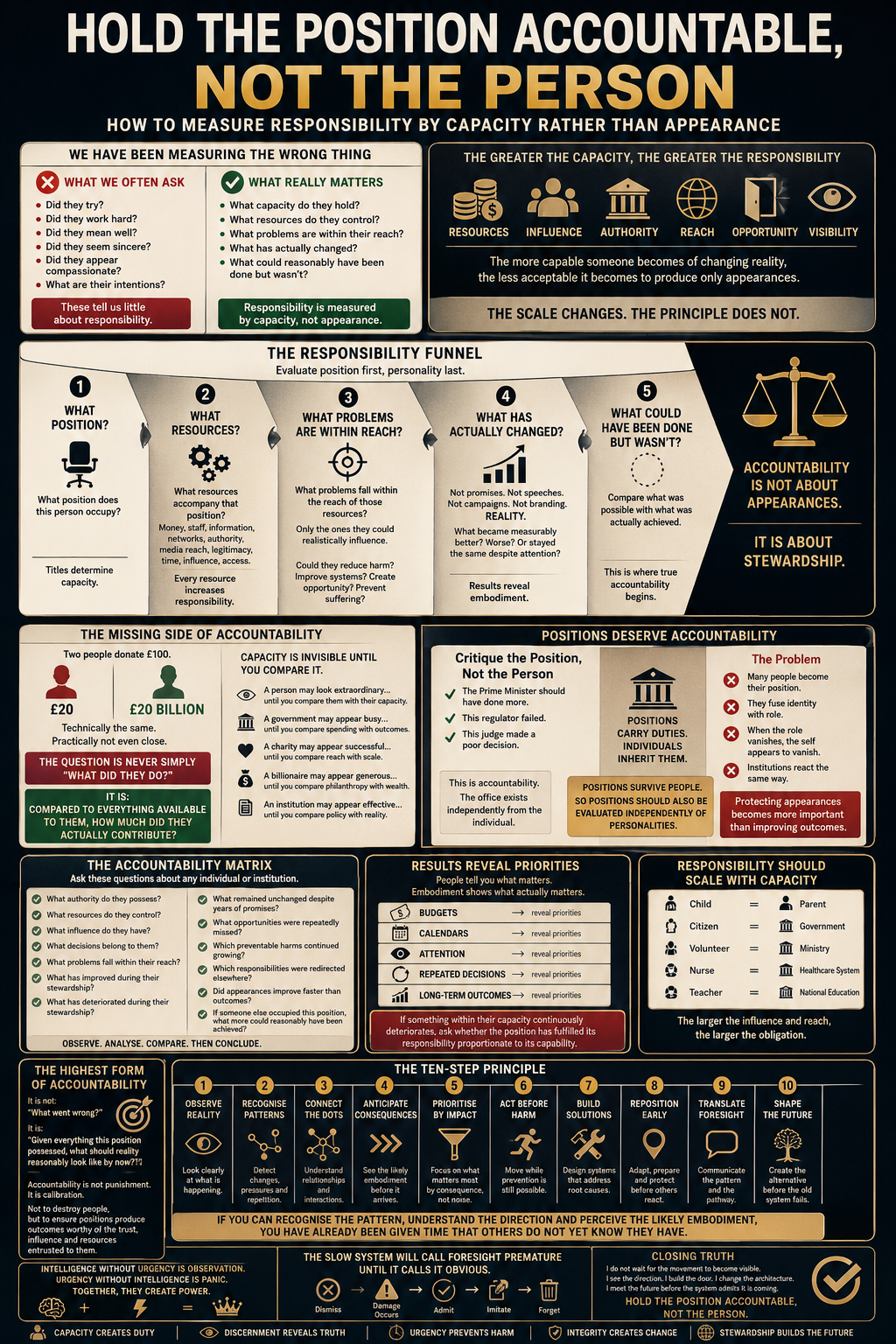
The greater the capacity, the greater the responsibility.
How to Measure Responsibility by Capacity Rather Than Appearance
One of the greatest failures of modern accountability is that we often ask the wrong questions.
We ask whether someone tried.
We ask whether someone seemed sincere.
We ask whether they worked hard.
We ask whether they appeared compassionate.
We ask whether they meant well.
But these questions tell us very little about responsibility.
Responsibility is not measured by effort alone.
Responsibility is measured by capacity.
The greater the capacity, the greater the responsibility.
That principle should apply equally to every human being, every institution, every corporation, every government, every monarch, every billionaire, every judge, every regulator, every CEO, every university, every charity and every public body.
The scale changes.
The principle does not.
We Have Been Measuring the Wrong Thing
A person earning minimum wage should not be measured by the same standard as someone controlling billions.
A local volunteer should not be measured by the same standard as a national government.
A small charity should not be measured by the same standard as an international organisation.
A citizen should not be measured by the same standard as someone who influences millions of people every day.
Because responsibility expands with influence.
Responsibility expands with reach.
Responsibility expands with resources.
Responsibility expands with authority.
Responsibility expands with visibility.
Responsibility expands with opportunity.
The more capable someone becomes of changing reality, the less acceptable it becomes for them to produce only appearances.
The Responsibility Funnel
When evaluating anyone, resist the temptation to begin with personality.
Instead, begin with position.
Then move through the funnel.
Step One
What position does this person occupy?
Not because titles matter.
But because titles determine capacity.
Step Two
What resources accompany that position?
Money.
Influence.
Staff.
Information.
Networks.
Public attention.
Political access.
Media reach.
Decision-making power.
Institutional legitimacy.
Time.
Connections.
Every resource increases responsibility.
Step Three
What problems fall within the reach of those resources?
Not every problem.
Only the ones they could realistically influence.
Could they reduce homelessness?
Improve education?
Improve transparency?
Reduce preventable harm?
Create better infrastructure?
Fund research?
Challenge outdated systems?
Influence legislation?
Coordinate experts?
Raise awareness?
Build solutions?
The question is not whether they could solve everything.
The question is whether they solved proportionately to what they possessed.
Step Four
Now ask the most neglected question in public accountability.
What has actually changed?
Not announcements.
Not speeches.
Not campaigns.
Not promises.
Not branding.
Not awards.
Not public relations.
Reality.
What became measurably better?
What became measurably worse?
What remained unchanged despite years of attention?
Results reveal embodiment.
Step Five
Only after asking what was done should you ask:
What could reasonably have been done but wasn’t?
This is where accountability truly begins.
Most societies stop at action.
Critical thinking continues into unrealised capacity.
Because capability carries responsibility.
The Missing Side of Accountability
Modern culture celebrates what people have done.
It rarely investigates what they consistently chose not to do.
Imagine two people.
One has £20.
One has £20 billion.
Both donate £100.
Technically both donated.
Practically those actions are not remotely equivalent.
The question is never simply:
“What did they do?”
It is:
Compared to everything available to them, how much did they actually contribute?
That comparison changes everything.
Capacity Is Invisible Until You Compare It
A person may look extraordinary.
Until you compare them with their capacity.
A government may appear busy.
Until you compare its spending with its outcomes.
A charity may appear successful.
Until you compare its reach with the scale of the problem.
A billionaire may appear generous.
Until you compare their philanthropy with their accumulated wealth.
An institution may appear effective.
Until you compare decades of policy against decades of worsening outcomes.
Context creates accountability.
Positions Deserve Accountability
One of the greatest confusions people make is believing criticism of a position is automatically criticism of the person.
The two are not identical.
A position carries duties.
The individual temporarily occupying it inherits those duties.
When someone says:
“The Prime Minister should have done more.”
That is accountability.
When someone says:
“This regulator failed.”
That is accountability.
When someone says:
“This judge made a poor decision.”
That is accountability.
The office exists independently from the individual.
Positions survive people.
Which means positions should also be evaluated independently of personalities.
The Problem Is That Many People Become Their Position
This is where psychology becomes incredibly important.
Human beings often fuse their identity with their role.
“I am my career.”
“I am my title.”
“I am my profession.”
“I am my business.”
“I am my social status.”
“I am my rank.”
“I am my achievements.”
For years this may appear stable.
Until retirement.
Until redundancy.
Until resignation.
Until illness.
Until failure.
Until bankruptcy.
Until divorce.
Until the children leave home.
Until the role disappears.
Then many people experience what is commonly called a midlife crisis.
But perhaps it is more accurately understood as an identity crisis.
Not because life suddenly lost meaning.
Because the identity had become attached to a temporary position.
When the position disappeared…
the self appeared to disappear with it.
The role had become mistaken for the person.
The Same Psychology Exists in Institutions
Institutions frequently react the same way.
Instead of hearing:
“This office failed.”
They hear:
“You are attacking us.”
Instead of asking:
“How can we improve?”
They defend their reputation.
The identity of the institution becomes inseparable from its image.
This creates a dangerous loop.
Protecting appearances becomes more important than improving outcomes.
Public relations replaces self-reflection.
Brand replaces responsibility.
Narrative replaces reality.
Discernment Separates Identity From Duty
A discerning mind asks two completely different questions.
Who is this person?
What responsibilities belong to their position?
Those answers are rarely identical.
Someone may be kind.
Yet ineffective.
Someone may have good intentions.
Yet produce harmful outcomes.
Someone may work incredibly hard.
Yet continuously fail.
Someone may genuinely care.
Yet never translate that care into measurable improvement.
Personal character and public responsibility overlap.
But they are not the same thing.
The Accountability Matrix
Whenever evaluating any individual or institution, ask:
- What authority do they possess?
- What resources do they control?
- What influence do they have?
- What decisions belong to them?
- What problems fall within their reach?
- What has improved during their stewardship?
- What has deteriorated during their stewardship?
- What remained unchanged despite years of promises?
- What opportunities were repeatedly missed?
- Which preventable harms continued growing?
- Which responsibilities were redirected elsewhere?
- Did appearances improve faster than outcomes?
- If someone else occupied this position, what more could reasonably have been achieved?
Notice that none of these questions begin with blame.
They begin with observation.
Discernment always observes before concluding.
Results Reveal Priorities
People often tell you what matters.
Embodiment shows what actually matters.
Budgets reveal priorities.
Calendars reveal priorities.
Attention reveals priorities.
Repeated decisions reveal priorities.
Long-term outcomes reveal priorities.
If something has remained within a person’s capacity for years, yet continually deteriorates, it becomes increasingly reasonable to ask whether the position has fulfilled its responsibility proportionate to its capability.
That is not personal hostility.
That is stewardship.
Responsibility Should Scale With Capacity
This may be the simplest principle of all.
A child should not carry the responsibility of a parent.
A citizen should not carry the responsibility of a government.
A volunteer should not carry the responsibility of a ministry.
A nurse should not carry the responsibility of an entire healthcare system.
A single teacher should not carry the responsibility of national education.
Likewise…
A billionaire should not expect to be measured by the standards of someone surviving week to week.
A monarch should not be measured like an ordinary celebrity.
A global corporation should not be judged like a family business.
The larger the influence…
the larger the obligation.
The larger the reach…
the larger the accountability.
The Highest Form of Accountability
The highest form of accountability is not asking:
“What went wrong?”
It asks:
“Given everything this position possessed, what should reality reasonably look like by now?”
That question changes the conversation.
Because it no longer evaluates performance through appearances.
It evaluates stewardship through consequence.
It reminds us that accountability is not punishment.
It is calibration.
Not to destroy people.
But to ensure that positions carrying extraordinary capacity produce outcomes worthy of the trust, influence and resources entrusted to them.
A mature society does not confuse questioning a position with attacking a person.
It understands that every position carries a duty beyond the individual occupying it.
And the higher the position…
the higher the duty.
Because responsibility should never be measured by status alone.
It should always be measured by the distance between what was possible and what was actually achieved.
…
Write eassay on how to hold reaponsibility and accountably accountable to any person, authority, institution body, by their scale as discussed. The funnel of question, how to look at what has beeen done and whats hasnt been done with critical thinking snd discernment, we’re not holding people accountable, we’re holdong their posotion in society accountable, if the person tskes it perosnally it is because their sense of identity is rooted in their roles or positions in society(make sure to incorporate this as it is founsamentally shown over time, how people merge their sense of identity with positions, careers and whatnot and get midlife crisis when those divert)





Leave a Reply