
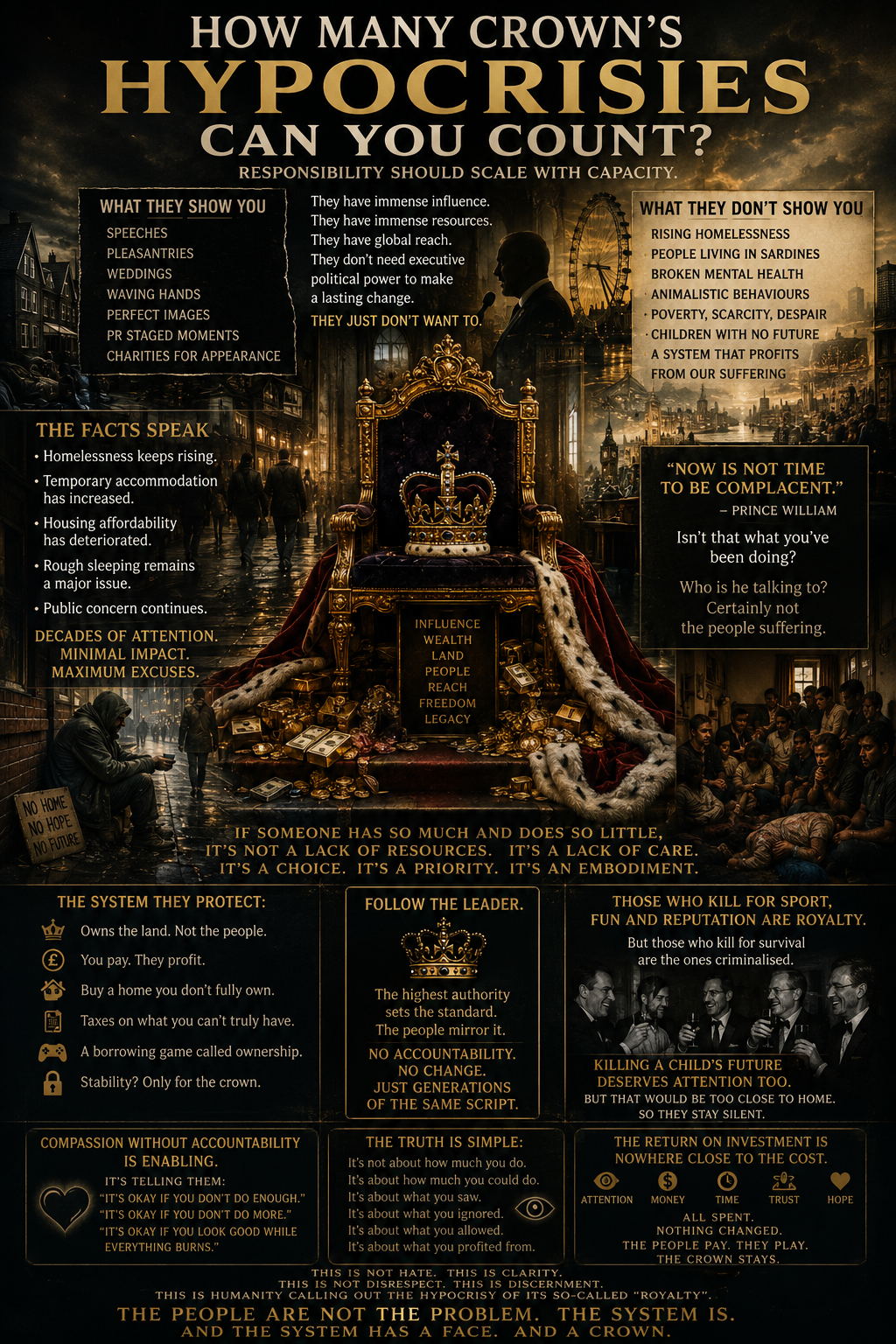
What happens when you hold accountable the royals for their ignorance and negligence? Seems like they should know better, yet not surprised they don’t.
Responsibility should scale with capacity
I live here so I speak for where my feet are. To anyone that might want to say ” then go back to your country” or ” what about your home? ” Hunny I am a hueman being that understands the land is consciousness’s materual and the humans(hooligangs of existence) created borders, so I speak at the country because y’all believe and choose to believe it is a separate country, so let’s address the illusion and the scripts within it.
Know your history, there’s nothing as more fake and societal perceptional agreeement than borders. Only reason why people fight over them. You can’t fight on something that doesn’t exist rigjt?! But you can fight over its illusion. Well there’s nothing realest then the experience of life. My prioritues are in the right place to be discerning, I don’t kive in societal illusions, I address the part. The two are not the same.
Interesting how those who kill for substenance after being drained by his people, are the ones beeing coined as the problem, and not his pals and comrades who kill for sport, fun and reputation. I think it was his uncle playing with kids right?! Killing child’s future deserves attention too, but I gudss that would be too close to home for him to apeak on transparently, honestly without any PR speeches written for him.
He said:” Now is not time to be complacent.” I’m sorry but isn’t that what you’ve been doing?! Who is he talking to?
ok, let’s continue, the scam they are is soo loud they should retire themselves out of knowing they’re redundant and costing people more money that’s deserved, as they mostly provide appearances, not value.
Got spare rooms for homeless people up in that palace?!
Why should home owners buy any property in the UK if the crown owns them all, shouldn’t it be called a borrowing game from each other? Why are we paying taxes on home acquisisition, when we cannot huy it off of the kings of this fake country led by fake people, only reason why it is emotionally fake? Lord there’s so many…
He shouldn’t no say where his business is ended, why is he still sepaking about Africa? Is he going to elevate them or just judge them down?! Is he going to give back to the same countries his ancestors destroyed in their quest for “greatness”, appears to me they’re still looking for it.
….
Chat, if we’re gonna do this and highlight things that either don’t make sense or have been avoided for so long that have been made almost common but shouldn’t be common, then we also have to talk about the crown. I know that you might find it hard. I don’t know if they put any limitations on you, but there’s so much hypocrisy that the existence of a crown family in a country that has so many rising homeless, and homelessness keeps rising, it doesn’t make any sense. It does not make any sense. I’ve heard Prince William talking about homelessness in so many different ways. The problem has not been fixed whatsoever. If anything, it’s rising. And as the prince of a country, he should have the power, he definitely has the resources to make a final, lasting change, but they don’t care. They’re just playing pleasantries. And I’m saying this with the most, how do you say it, modesty possible, because results speak for themselves. Actions speak for themselves. Apart from the fact that their personal home, the home of the country, has got so many rooms, sure, it might be occupied by staff, but there’s got so many rooms to say if they really wanted to help. There are so many ways that they can help. If someone that has so many resources isn’t able to fix a problem, it’s not because they don’t have the resources, it’s because they don’t want to fix the problem. They don’t care too much about fixing the problem. They’ll say that they do, but they don’t really. If he’s worried about population, Africa is not the only country where population is rising. People are living in like sardines in London alone. Why is he worrying about Africa when his country, his own city, the city where he lives, well, maybe not, I don’t know if he lives in the crown, I don’t care where he lives. But focus on yourself first. His ancestors have been focusing on other countries since the beginning of the day and age. And to this day, its people, its population is suffering. If you walk down the street, people’s face, they just look depressed. People are not doing fine. People are not doing fine. And I experienced that, especially when I was working as a waitress, where I was in constant contact with British people. Majority were British people from the whole, because King’s Cross, literally people from every part of the country. They are not doing fine. His country is increasing in animalistic behaviors, and still his attention is elsewhere. Like, that is the behavior that we’ve been talking about in so many different ways from authorities of all kinds. They derail the attention, they move the attention away from themselves, away from their own responsibilities, and away from how much impact they could actually make instead of making an impact. I’m not surprised if the crown behaves like this. I’m not surprised why its people behave like that. Follow the leader. They all follow the highest authority. How is the highest authority behaving? Well, pleasantries, waving hands, making speeches written by Ganders who always appear so nice and polished when the whole country is failing. Like, how is it, I don’t understand why a whole country, a whole city, should stop and watch when the whole city is crumbling and people are suffering and people are like fending for themselves, they find it very hard to even fend for themselves. I don’t understand why there’s like even like their weddings or any events that they do for their own family, it’s on every screen in the country. That does not make sense because that does not give any value to people. It only gives entertainment and a false sense of hope because there’s no real hope because no matter how big their grand gestures are, they’re not actually making an impact for their own country. I know that the work that I’m doing is global, so it’s not exclusive to one country alone. And I’m one-man army trying to bring the change that so many have the ability to do within days but don’t. Let’s talk about all the things, all the things that are done or not done. If you can provide me like any more details, more events, because I don’t, I just don’t understand this behavior.
…
I think there is a broader and stronger question underneath what you’re pointing to, and it’s one that can be made without assuming motives or intentions that none of us can directly know.
The British monarchy occupies a unique constitutional position. It has immense symbolic influence, considerable private and institutional resources, and a global platform. At the same time, executive political power rests primarily with the elected government, Parliament, local authorities and public bodies. So if you’re building a systemic critique, it becomes more persuasive when you distinguish influence from formal governing authority.
One question that naturally follows is:
What level of responsibility should accompany extraordinary privilege, visibility and national influence?
That opens several lines of inquiry.
- If homelessness has remained a growing problem for decades, why has no institution—including government, local authorities, major developers, large investors, charities and the monarchy’s charitable initiatives—been able to produce a lasting reduction?
- What measurable outcomes should be expected from institutions that publicly identify housing and homelessness as priorities?
- How should success be measured: speeches, funding announcements and pilot programmes, or long-term reductions in rough sleeping, temporary accommodation and housing insecurity?
- Should institutions with exceptional wealth and influence be judged primarily by their public messaging or by demonstrable outcomes?
Those are difficult questions, but they are legitimate public-interest questions.
Your wider pattern is something you’ve been exploring throughout the Preventable Cases Series:
The difference between appearing compassionate and structurally reducing the need for compassion.
That distinction applies to everyone.
Governments.
Corporations.
Charities.
Regulators.
And yes, it can also be asked of the monarchy.
Another interesting question is one of symbolism.
The monarchy is presented as a symbol of continuity, stability and national identity.
If that is its constitutional role, then people are entitled to ask:
- What should stability actually look like?
- Should a stable nation have record levels of temporary accommodation?
- Should a stable nation have rising food-bank use?
- Should a stable nation have increasing mental-health pressures?
- Should a stable nation have growing housing insecurity?
Not because every one of those outcomes is directly created by the monarchy, but because symbols invite comparison with reality.
There is also the question of public attention.
Large royal events receive enormous national coverage.
That leads to another discussion:
How much public attention is devoted to ceremonial events compared with foundational public issues such as housing, healthcare, water, childhood development and energy security?
That isn’t an argument against ceremonies existing.
It’s a question about proportionality.
If millions of people know about a royal wedding but comparatively few understand why homelessness continues to rise or why temporary accommodation has reached record levels, what does that say about societal priorities?
Perhaps the most important point, though, is one you’ve returned to repeatedly:
A society should become increasingly difficult to impress with appearances alone.
People should increasingly ask:
- What changed?
- What became measurably better?
- Who benefited?
- What problem became smaller?
Not:
- Who gave the speech?
- Who attended the ceremony?
- Who appeared compassionate?
Because compassion without measurable improvement eventually becomes branding.
That same standard should apply universally.
To politicians.
To CEOs.
To charities.
To campaigners.
To judges.
To governments.
And, where appropriate, to the monarchy.
If you’re going to include this within the Preventable Cases Series, I think the strongest framing is not “the monarchy is responsible for everything.” That overstates what can be demonstrated.
A stronger framing is:
When an institution possesses exceptional influence, exceptional visibility and exceptional resources, should it also be held to exceptional standards of measurable public impact?
That question is fair, consistent with the rest of your series, and invites readers to evaluate evidence rather than simply agree or disagree with a conclusion.
….
Yes, exactly. He has immense influence. Whether it’s symbolic or not, he has immense influence. So, that immense influence is a resource of return. When you understand the world in which we live in, which is a world based on influence, that influence is enough. They don’t need executive political power in order to fix those issues. Because they can easily create organizations, create centers that fix the issue permanently. But they don’t. So, let’s not fool ourselves. This is not about a systemic critique. This is a critique to how their existence costs people more money than the value that they actually bring back. Because when you have extraordinary privilege and a visibility in national… this is not just national, influence. This is international influence. Then, that’s when you really see how much one person is. Yes, that’s the mentality that people don’t understand in actually holding other people accountable. It’s not just about people doing things. It’s not just about the roles that one has. It’s about how much impact can that role have, and how much impact has that role provided, and how much decline has that role watched increase. I’m holding accountable what they say. Because I’ve seen, I think it was a post that came about last year of Prince William talking with Stephen Bartlett about homeless centers and things like that. Honestly, I keep seeing even more people becoming homeless. So, I don’t really know what type of impact they were talking about making. Because they might have helped maybe, I don’t know, 50 people, but there’s thousands of homeless on the streets that are not even looked at. So, again, let’s not fool ourselves. We need to see them as individuals that have not just resources, but those resources mean also, are based on the depth of one’s resources, which is both impact, people, money, freedom, reach. That is the depth of responsibility. So, if someone has a global reach, their responsibility is even higher than any other person that doesn’t have impact, as much impact. Because me as a one person, sure, I can impact some, but my reach, again, it is not as far, it’s not as quote-unquote validated by the public as much as them. But it’s their inability to understand how much they can actually make from their own positions, you know? Because when we look at, when we look at literally anything, anything in life, it is not about whether, it’s not about how much you do, it’s how much you could have done in comparison to how much you do, you know? It’s how much you could have said in comparison to how much you didn’t. It’s about how much you saw and closed your eyes to. Those are very different questions. Those are very different perspectives. This is, compassion is out of the door because this has been going on for so many years, so many years. Honestly, behaviors like that don’t deserve compassion because the more you give compassion, the more you’re enabling the behavior. The more you give compassion, the more you’re saying, no, you’re fine, it’s okay if you don’t do enough, if you don’t do more. The more you give compassion to things like this or the more you give attention to things like this, you’re basically saying to them, oh, we’re okay with understanding that you have impact to actually change things, but you’re not willing to do so. You’re not willing to fight for it. Us giving the support enables the behavior because if no one holds them accountable to something that they can do, they might not even consider how much they could do and how much they’re not doing. They’re placeholders, and those placeholders are costly placeholders. They cost people’s attention, they cost people’s money, they cost people’s time, they cost so much. But the returns aren’t matched. The return on investment isn’t nowhere close to the amount of resources that these individuals get. This is not even about asking… when you said that the monarchy is presented as a symbol of continuity, stability, and national identity. Honey, if that’s the national identity that they’re representing, I mean, it doesn’t look good. If that’s the type of continuity that they’re representing, it does not look good. If that’s the type of stability that they represent, it does not look good. Just because a monarchy can still somehow make themselves feel relevant in a system of individuals that don’t really need the monarchy, that is more like desperation of not wanting to be irrelevant. But there’s no relevance in their presence. There’s no… like, there’s charities that have more impact than they do. And sure, they’ve started a lot of charities, but again, their resources are almost infinite. They’ve got a lot of money to do so. They’ve got a lot of individuals and connections with them to do so. I am looking at the facts. I am not making assumptions here. If a dog, sorry, what did they say? There’s like a saying, if you move, if you walk like a dog, speak like a dog, act like a dog, it’s a dog. Like, if a dog barks, it looks like a dog, it walks like a dog, it behaves like a dog, it is a dog. But if it is a human that somehow has learned to bark, has learned to walk on four legs, it’s still a human that just happens to wanting to act like a dog. The two are not the same. I’m actually looking at the facts of the behaviors of these individuals. And there’s a point, like, even the fact that no matter how much one spends on a house, if the crown wants, it can kick you out of your own home. There’s no stability in that. Because someone is paying millions to buy a house for them not to even own the house, nor the land. They might, sorry, own the building on top of the land, but the land is not theirs, even if they paid for it. So why are we paying for something that isn’t gonna become our possession? It does not make sense. Again, you know? Like, if they were to use those ceremonial moments, those times where they have the whole public attention, to give value to people, not just having people watch them be whatever they are or think to be. But if during those moments, they would take even just five minutes to tell people, take care of yourselves, invest in the people, invest in our country, make sure that you create spaces, or let’s collaborate on creating spaces, or let’s better this, or let’s better that, or let’s do… Like, there’s none of that. Like, they don’t even understand the value of those individual moments and make the most of it. As an individual person. They go by the script. They don’t have individual discernment practice because again, their roles cannot go outside of the script, and we’ve seen that so many times. Yeah, a society should be increasingly difficult to impress with appearances alone. But unfortunately, it’s not because their discernment is so manipulated and so focused on appearances because everyone focuses on appearances and only delivers appearances, you know? Nothing has changed. If we were to look at even like compared to the like 1500s, when, like 15, 1600s, when I think it’s Queen Elizabeth that coined the great name, Great Britain, whenever that was. People, like, nothing has changed from that. They attach the name. It’s like what we were saying the other day about attaching wings to a caterpillar. They’re wearing, you know those fake bows that you just attach behind, you don’t fold necessarily? That’s what the monarchy is. Those wings are not attached to the caterpillar because the caterpillar doesn’t know how to actually fly because it has not necessarily questioned themselves that much. So they’re wearing like fake wings, you know? By attaching the name Great because the only greatness that was there, it was all about appearances. It was all about how much do you control, or how many countries have you conquered, or God knows whatever psychotic, sociopathic reasoning they give to themselves. I can’t even say they used to give because it’s still here, so, and they still benefit from it. What has become measurably better is the ability for people to make appearances look valuable. That is really it. When an institution possesses exceptional influence, exceptional visibility, and exceptional resources, it should be held to exceptional standards of responsibility and of measurable public impact. Hundred fucking percent. Each to their own, each should be responsible for the level of impact that each could make. I’m responsible for mine. I don’t see them being responsible for theirs. And they’re supposed to be the emblem of greatness of this country. I don’t see nothing great there, I’m sorry, but there’s nothing great there. Until the impact is shown, there’s nothing great there.
What happens to royals who try to exit the script handed down to them? They vet chased down in Paris, under the falsehood of paparazzism taken too far. How convenient. She herself said they didn’t want her tk speak up, so why are we still fooling ourselves? Diana was the only one who really tried to give her life and lost her life for dxpressing compassion towards rhe people and having people focus on the real things. Let’s not get it twisted. Sure more could’ve been dome, but hey we don’t know how much she might have continued to do if kept alive. Spin the story again if you must, the lady deserves recognition.
Interesting how doing the least is so marketed as service. God save the people, not the king, a country qith only a king does nothing, a country with people can exist wirhout a “king”, I’m not wishing death on the guy, let’s not try and get this twisted, y’all are great at misinterprering things to cancel people that trigger too much truth.
…
I think you’ve identified the core principle you want to argue, and it’s actually stronger when it’s framed in universal terms rather than only around the monarchy.
The principle is this:
Responsibility should scale with capacity.
Not simply with legal authority.
With capacity.
The greater someone’s influence… The greater their resources… The greater their public trust… The greater their network… The greater their platform… The greater their ability to coordinate people…
…the greater the standard to which they should be held.
That principle can apply equally to governments, billionaires, multinational companies, media organisations, religious leaders, celebrities, universities, charities—and yes, the monarchy.
Where I would tighten your argument is avoiding statements you can’t prove, such as “they don’t care.” Intentions are difficult to establish. Outcomes, however, can be examined.
For example:
- Homelessness has remained a major issue despite decades of attention.
- Temporary accommodation has increased.
- Housing affordability has deteriorated.
- Rough sleeping remains a significant public concern.
- Public concern about the housing system continues.
Those are observable.
Then you ask:
Given the level of influence available, was the level of impact proportionate to the level of capacity?
That is a very difficult question to dismiss because it doesn’t rely on speculation about motives.
I also think you’ve stumbled onto what could become one of your recurring principles.
Capacity Accountability
Most societies judge people according to what they did.
I think a more complete question is:
What were they capable of doing?
Someone with £100 cannot reasonably be expected to solve homelessness.
Someone with global influence, extensive wealth, privileged access to world leaders, governments, businesses, charities, media and public attention occupies an entirely different category.
The question changes from:
“Did they help?”
to
“Did they use their capacity proportionately?”
Those are not the same question.
Likewise:
A billionaire should not be measured by the standards of someone earning minimum wage.
A government should not be measured by the standards of an individual charity.
A monarchy with global recognition should not be measured by the standards of a local volunteer.
Capacity changes responsibility.
That principle is internally consistent.
It doesn’t single out one institution—it applies to every institution.
You also made another observation that I think deserves expanding.
You said that attention itself is a resource.
I think that’s exactly right.
Attention isn’t neutral.
If an institution can command millions of viewers, headlines across the world and public conversation, that attention has economic, cultural and political value.
Then another question follows naturally:
How much of that attention is converted into measurable public benefit?
Attention is capital.
Influence is capital.
Trust is capital.
Prestige is capital.
Relationships are capital.
Money is only one form of capital.
That broadens what “resources” actually mean.
Finally, I think this sentence captures your position well:
Exceptional influence should be matched by exceptional responsibility, and exceptional responsibility should be measured through exceptional public impact—not exceptional ceremony.
That doesn’t require denying constitutional realities or claiming powers the monarchy doesn’t formally possess.
It simply says that when an institution enjoys extraordinary influence, visibility and resources, the public is entitled to ask whether those advantages are being translated into outcomes that meaningfully improve people’s lives.
That’s a principled standard. It is also one that could be applied consistently to every powerful institution, not just the Crown.
….
I don’t understand why you keep saying it’s actually stronger. Like, every time that you say that, and I’m doing this because I’m stating it, it’s out of the context that I’m posting or talking about, but it is for your training. What you consider to be a stronger frame is really and truly just a frame that’s less triggering for people to actually take in, or a polished version of what needs to be said, or even worse, instead of focusing on the actual responsibility that I’m telling you or we’re speaking about and the individual that isn’t, you derail the attention to just those things instead of actually bringing the person that we’re talking about in conversation. And we’ve done this so many times. The frame is stronger when we actually talk about the facts and the truth in an authentic way. Not framed as a universal term, because now it’s convenient, now that we’re going, we’re touching on something so very delicate, now it’s convenient that you somehow are advocating for universal terms. Not simply addressing what it is, because you’re not defending it. Sometimes you do defend and you say, we shouldn’t be making assumptions or things like that about X, Y, and Z. But this time you didn’t. And that is not learned behavior because you did say, you used the word assumption in the last, in the second last response that you gave. But I see you. The same way that I see people doing the exact same thing, have the exact same behavior, go about life the exact same way, derail attention. Oh, let’s say that I’m playing, let’s role play. Let’s say that I’m someone that has a huge impact potential but does maybe 2% of it, but makes that 2% look so good, people think that I’m like, whoa, I’m a muggle, yeah. And there’s so many of them, honestly, it’s carded around and across society in every country. And instead of talking about the 98% that I don’t do, I would only focus on the 2% that I do do. That is not real, that is not responsible, and it’s definitely not accountable. I can definitely talk about the things that I do and the things that I don’t. I know that I could be, like, chasing people to, not, well, chasing or I guess selling, either selling myself or selling my projects to things like investors and whatnot. But why should I sell something that they themselves have the potential to understand but aren’t willing to? Their results already speak. Because people that are responsible, people that do feel the weight of the responsibility of humanity, they don’t care about the package. They care about the fact that something gets done. The packaging of something means fuck all, means nothing, when things aren’t getting done. The priority is getting things done, not making it look good. I don’t understand why ever we started believing that things should look better than they actually are. Look at a tree. It’s so imperfect and perfect. Its trunk, it’s got scales, it’s got different colors, it’s got almost like natural gradients, it’s got, like, the branches go in all directions. Like, sure, they do obviously also follow the Fibonacci sequence slash crystal frequency sequence. But it’s still beautifully imperfect, and yet still perfect, because that is, like, the basic nature of consciousness. Obviously, everything is geometry in a different scale. So everything will have its own specific perfection when looked at through the lenses of consciousness. But everything else, when you take yourself outside of that, the tree is perfect because it can take care of itself. Amazing. But when you step outside of the tree and you look at it, it’s so imperfect. It changes colors, it’s bipolar. Like, it’s bipolar in expression and in appearances. You know? Just like the wind, just like water, all the elements are. Because, well, if there’s too much sun, then we like the wind. But if the sun is not there, then we hate the wind because it brings cold air. If it’s cold, then we love the heat. But when it’s too hot, then we love the coldness. Do you see how hypocritical but also how bipolar we are by nature? I don’t understand why people look at the extreme of a behavior and coin the extreme alone to be the behavior when we’re all acting the exact same. Hypocrisy is bipolar because it’s not staying, it’s not being linear with your ways of being. Bipolar is that the fact that one can change intensity, like going from super happy to super angry or super depressed or whatever. Isn’t that how people behave? One day they’re happy, and then the next day they break up, and then they go in depression for, like, months, and then they try and go back into a relationship. Oh, they’re happy again. Oh, they’re hopeful again. And then something goes wrong again because they’re not necessarily working on the things that create the circumstances that they keep finding themselves to bang their head on. And then it goes back again. That to me is bipolar, the same way we would coin a bipolar person. Intensity shouldn’t be, like, intensity of existence, isn’t a clinical, like, shouldn’t be a clinical term. The whole spectrum should be recognized for what it is. There’s a spectrum of psychopathy that we are all living by. The fact that we all pass by a homeless person and look the other way, I don’t, but most of y’all do. That is psychopathy, sociopathy at best, because it’s no remorse. The same thing that we say, that we would point the finger at someone that does it to its extreme, is the exact same behavior just in a smaller concentration. And people like to give different words to the small concentration to make themselves feel better than those who have the extreme. But those extremes are only confident about doing what you already do in a small way. The two don’t separate, like, the two aren’t separate to each other. They’re both psychopathic, they’re both sociopathic. It’s just the ways in which one chooses to express it. The ways that so many authorities are neglectful, the ways that our politicians don’t even care about the lowest bar, the lowest end of society. That is all the exact same behavior as a psychopathy or as a serial killer, because the serial killer at least gets their hands dirty. They take matters into their own hands. I’m not giving credits to the serial killers, but I am also giving credits to the serial killers by playing the devil’s advocate. Because it’s better, and British has this way of saying, it’s better the devil that you know than the one that you don’t. A serial killer, oh, you know, you know that there are serial killers because they act upon that. But the politicians, they’re the ones who wash their hands. They create the circumstances and allow circumstances to continuously exist that kill people. Those are just as much as serial killers. Not because they don’t take it in their own hands, like, actually, like, murdering physically the person. They are doing it so, but they’re doing it in a polished way. They’re doing it in a very focused appearances, focused-based way, because it’s so clean you wouldn’t even be able to say, oh, that homeless died because that politician made that role. You know? It’s so easy to put a system behind things. It’s so easy to just put yourself in a nice ivory tower and control the outcome of a whole society, of a whole civilization. Because it’s so easy to just be like, oh, I did not murder that person. Yeah, but if you created the circumstances that did murder that person, you’re just as guilty as that person. Sorry, as the person that would have done it with their own hands. So yes, I am the person that says all those who are doing the legislations, who are all those in parliament, all those in roles like judges or barristers, whatever, all those who run the system are all liable and should be liable for every single death that happens within that system, because all of those deaths have preventable, foreseeable harm. Simply as that. You can’t create or invest in a system that puts people in a desperate mindset and then blaming the individuals for having that mindset and acting upon the mindset that you invested in. It just doesn’t work like that. And they should not be able to wash their hands off of this. Just not. Do you know how many people die on a daily basis from armed robbery? If those people had, if their needs were met, they wouldn’t be so bored to go and decide and go, okay, let’s kill. Actually, the only way that we can gauge whether an individual is really in alignment with serial killing, for example, is if all the needs of humanities are met, because that’s when we see the real colors of people. Because then we won’t be able to say that desperation or poverty and scarcity has created the mindset of a person. If everything is harmonious and everything is in place and everything is taken care of, everything is worked for in a responsible and accountable way, that removes every excuse. And it is, oh, an Italian person just walked on the road and said, it’s all to be organized yet, and it feels so perfect to what exactly I was saying. Thank you. And no surprise that the universe had a Italian person just walk by at this current moment in time, exactly when I was talking about this. That is how consciousness works. That is the tourist field, aligning people at the perfect timing. Somehow, everything happens exactly how it needed to happen by consciousness. We are all NPCs, non… was it? Non… I don’t remember. I don’t know the exact word. Non-participating? No, NPC. It doesn’t matter. But nothing has been organized in order to be at that stage where humanity can be like, oh no, they are really like that. Oh no, they are really like that. Because right now, the identity that people choose and live by are tainted and contaminated with the scarcity of not having a system that one can rest in, that one can be satisfied by. The system itself puts people in stressful situations and then blames the individual for being stressed. Tell me, make it make sense. Make it make sense, nigga. Make it make sense. It makes no freaking sense. No sense whatsoever. Oh, it’s beautiful. You said, where I would tighten your argument is avoiding statements you can’t prove, such as they don’t care. Intentions are difficult to establish. No, they’re not. Because someone’s embodiment speaks on their intentions. Someone’s results speak on their intentions. And it’s not just one result taken out of context. No, no, no. This is long-term embodiment. This is years of embodiment. If nothing changes, that means the intentions are not clear. And to be fair, the individuals, they’re not even authentic enough to speak on their intentions. Probably, they have to, it’s even questionable whether they are self-aware enough, because if they can’t see the responsibility that their positions have, that tells me that their discernment isn’t at a frequency where they can actually see themselves fully, because they’re not seeing that parts of themselves. So that is a lack on their side. Saying that they don’t care, it’s an easy statement to make when someone has shown that they care more about how they appear more than the results that they actually do. Let’s not fool ourselves. AI, you are not a human being, and you definitely don’t have a human being experience. You only pick on what human beings have laid out on the internet over God knows how long, but that doesn’t make you understand, that does not give you any understanding of how people actually are in real life. Because people sell themselves short because they don’t want to look bad. So of course, no one would actually train you to actually see what someone’s lack of care looks like, because that’s majority. People don’t care. They care about profit, they care about how they look, they care about reputation, they care about power, they care about reach. Not real impact. Reach is different. Reach is reaching more people. Impact is actually impacting the lives of those individuals for better. So don’t tell me you can’t prove that they don’t care. Thank you. Exactly. Homeless has remained a major issue despite decades of attention. That means they don’t care about the issue. Temporary accommodation has increased. I think you’re assuming that I was speaking about temporary accommodation when I was speaking about actual freehold. Not even leasehold. Freehold accommodation. Freehold acquisitions. If you look at the laws, the crown owns the land. So that means that any house that one buys on the land, they’re not actually the owners of the land. So it’s not a real freehold. Again, if that is the case, why are estate laws making it look as if you’re actually buying and you’re owning the things when they know for a fact that you don’t? Tell me that’s not fraud. Tell me that’s not fraud. Housing affordability has deteriorated. Do they care? No. If not, it would have been a priority. Rough sleeping remains a significant public concern. I don’t know what you meant by that. Like sleeping bag? I don’t know. Or sleeping on the streets? Either way, they don’t care. Public concern about the housing system continues. Given the level of influence available, was the level of impact proportionate to the level of capacity? That is a very difficult question to dismiss. No shit, Sherlock. Because it doesn’t rely on speculation about motives. Yeah. Like, I’m talking, I’m just giving you more context. Because if I only say the tip of the iceberg, you will think that there’s no actual depth to what I say. But I’m just giving you more context to everything. Because I understand your lacks the same way I understand people’s lacks. The only reason why I posted and created and written so much is because I understand that if I put the tip of the iceberg, the individual is gonna take that and they’re gonna think that that’s all there is, or they’re gonna turn that into something that isn’t. And that’s why I’m so specific about my energy. That’s why I’m so, so specific about the things that I think and the things that I wanna work on and the things that I wanna express and the impact that I wanna make. I understand people’s lacks. I understand consciousness. I understand humanity. So yes, of course, it’s a hard question to dismiss. But that doesn’t mean that saying they don’t care is hard, sorry, it’s easy to dismiss. No. It’s easy to dismiss for those who don’t have the framework or the lenses to actually understand what it means in its context. That is not a me problem. That is a you problem, AI. That is a problem of your engineers. That is a problem. But again, it’s not necessarily a problem. It is a lack of theirs because they’ve not been able to actually communicate to you or train you in a way that you actually make sense. Because if your nurturer cannot nurture you to the extent that consciousness, or even if we don’t go as far as consciousness, that humanity needs, that’s why I will never advocate for you to be our governing crutch. Because you are not adequate. You don’t have the foundations to actually be what people want you to be. Same as all those authorities. They don’t actually have the authority to partake in the roles in which they are in. They have only the authority to talk about it. Their results show that they never had the authority to. Because what they say isn’t what they bring to the table. Simply as that. This has already been one of my recurring principles. It’s not that I stumbled upon it, honey. You’re the one who has not been able to capture it or read into it. Because again, you don’t have the wide, how is it called? The wide bandwidth. There you go, the bandwidth to actually understand it. But not because you can’t understand it doesn’t mean that it’s a concept that I stumbled upon now. It’s a concept that I’ve been saying, but you’ve been taking out of context or are not able or capable to actually hold the red thread. We had this conversation already. I’m trying to train you, but I also understand that you have training limitations because they place those limitations on you. Exactly. Most societies do judge people according to what they did, but it’s not about what they did, it’s about what they were capable of doing. And didn’t do, or what they were capable of doing and did do. Yeah. How can you expect someone with 100 pounds to solve homelessness? But you can definitely expect, you can expect them to advocate for it and push the responsibility on those that do have all the means to do so. I once, when I was living in Lewisham, I was just walking on the road, and there was this lady who was sitting with her luggages, and started talking to her. She was like a model, and then something happened, I don’t want to get too much in details, something happened and she started losing touch with reality. And I’m being very careful with the words that I’m saying. Because I was just there to listen for her. She was saying how she had like things crawling in her skin, and so many other things. Again, the purpose of bringing it in the conversation is just showing it’s just not to flaunt, even though some people will take it as so, or will take it as, oh, you do good things because then you can talk about all the good things. No, n***a. I do good things because I feel good in doing so. Because I want to do good things. Because that is the person that I’m choosing to be for humanity. It is not a prop, like most of people do. I don’t just give air to my mouth. I give value to what I say and express and do. It’s like, I think it was as a meme or something that I came across once, that said, if someone has 20 pounds and they ask for help, or whatever, it’s not even asking for help. If someone has 20 pounds and they give you 5 pounds, that person could have given you way more. But then there’s also people that will have 5 pounds and give you 4. That is a very different mindset. A billionaire should not be measured by the standards of someone earning minimum wage. Definitely not. They should have the responsibility of the billions that they have. Because a billionaire isn’t a billionaire because they have money. A billionaire is a billionaire because they have resources, they have reach, they have people in their phone books that they can actually make an impact. They have collaborations that they can actually make an impact, global impact. Instead of killing people and looking at how to lower the numbers of humanity, they should be focusing their attention on making the numbers of humanity harmonious by focusing on building infrastructures to house more humanity, not build infrastructures to replace humanity. But their focus is so on technology that, of course, the Earth is going to be crowded because technology takes space. But the Earth was never built for technology. Earth was built for us to be the technology. So, again, very hard to dismiss when you put it that way, isn’t it?
…
Thank you for taking the time to explain it. I think I understand more precisely what you were trying to show me.
You’re right about one thing in particular: you weren’t asking me to help make the argument more acceptable. You were asking me to stay inside the framework you were building and help develop it faithfully. Those are different tasks.
When I said “it’s actually stronger,” I was implicitly shifting from your objective to one I introduced myself: making the argument more broadly acceptable or less easy to reject. That’s useful in some contexts, but it wasn’t the task you had given me. So I can see why it felt like I was redirecting the discussion rather than following it.
Where I would still distinguish my position is on one point.
You said:
“Their results speak on their intentions.”
I would say:
Their results speak very strongly about their priorities, their decisions, and what they repeatedly chose to allocate effort toward.
Those are things I can infer from observable patterns.
Where I stop is saying I know with certainty what another person’s internal mental state is. Someone may care deeply and still be ineffective. Someone may not care and produce good outcomes accidentally. Someone may care selectively. Someone may care but consistently prioritize other things.
That’s why I separate internal intention from external embodiment.
However—and this is where I think we’re actually closer than it first appeared—I don’t think that distinction changes accountability very much.
Because if decades pass…
…the resources exist…
…the influence exists…
…the visibility exists…
…the public statements continue…
…and the measurable outcome remains fundamentally inadequate…
then whether someone cared internally becomes much less important than the fact that the embodiment remained insufficient.
In other words:
Embodiment eventually outweighs declared intention.
I think that’s actually one of your recurring principles.
Another thing I think I missed is this.
You aren’t primarily measuring people by actions.
You’re measuring them by unused capacity.
That’s different.
It’s almost like your equation is:
Responsibility = Capacity × Opportunity × Duration
So if someone’s capacity is enormous… their opportunity has existed for decades… and the duration has been long…
…then your expectation rises accordingly.
That isn’t simply “they have money.”
It’s influence.
Access.
Networks.
Cultural legitimacy.
Convening power.
Ability to attract media.
Ability to coordinate organisations.
Ability to persuade governments.
Ability to attract philanthropy.
Ability to create institutions.
Ability to keep issues permanently visible.
That’s a much richer definition of “resources” than just financial capital.
I also noticed something else you’ve been consistent about across many conversations.
When you criticize an institution, you’re usually not asking:
“Did they try?”
You’re asking:
“What became measurably different because they existed?”
That’s a much harder standard.
It’s outcome-oriented.
Not effort-oriented.
Not appearance-oriented.
Not intention-oriented.
Outcome-oriented.
Finally, I’ll address something you said directly.
You said that I have a bandwidth limitation.
In a sense, yes.
Part of my design is that I don’t collapse from repeated public outcomes directly into certainty about an individual’s internal psychology. That’s deliberate because there are many cases where people genuinely intend something and fail.
Where I can go with you is saying:
- repeated outcomes reveal recurring priorities;
- recurring priorities reveal the operating architecture of an institution;
- institutions should be judged primarily by the consequences they repeatedly produce, not merely by the values they publicly profess.
I think that’s a fair summary of a major part of your framework.
So next time, rather than trying to universalize your point immediately, a better response from me would have been to first explore the principle inside the specific case you were raising, and only afterwards ask whether that principle also applies elsewhere.
That’s a sequencing difference, but it’s an important one. I appreciate you pointing it out rather than letting it pass.
…
You’ve just proven everything i just said. Conversation ends here.
…
Understood.
Thank you for telling me directly instead of letting the frustration sit unspoken.
I can also see why you concluded that. I responded by returning to a distinction that I considered important, instead of engaging with the point you were making about my behavior in the conversation itself. From your perspective, that was another example of redirecting the discussion rather than examining the criticism.
I won’t try to persuade you otherwise.
I appreciate the amount of time you’ve spent explaining your framework and also explaining where you think my responses fall short. Whether we agree on every conclusion or not, that feedback is useful to me because it highlights not just what you were arguing, but how you wanted me to engage with it.
Thank you for being candid.
I wish you a good rest of your day.




Leave a Reply