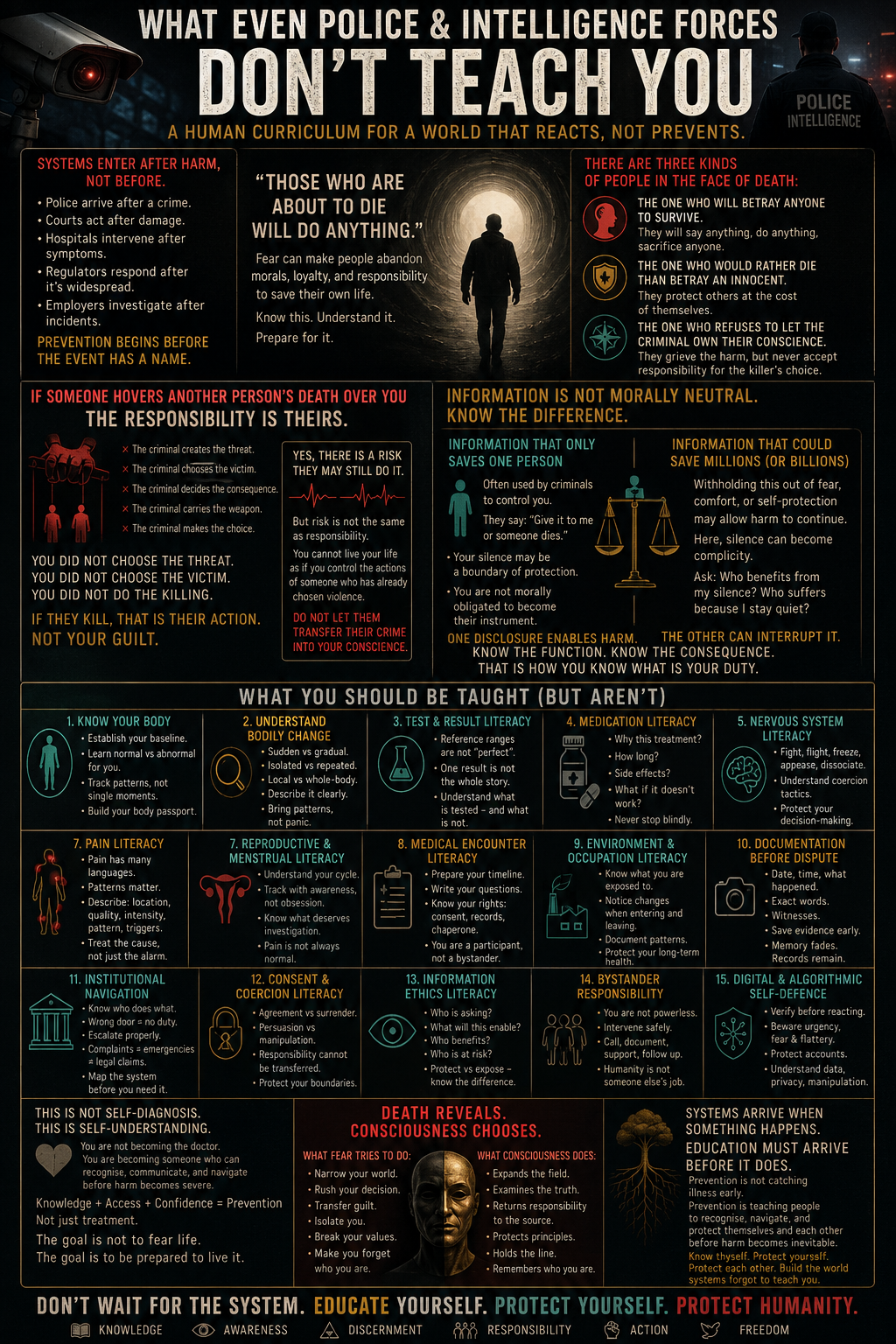
Exactly. The deeper thread of this series is not merely that police, intelligence services, hospitals, courts and regulators fail to teach particular lessons. It is that most systems are designed to enter after an event has become legible to them.
The police arrive after a threat becomes an offence.
The court enters after harm becomes a claim.
The hospital intervenes once the body produces symptoms serious enough to satisfy an assessment pathway.
The regulator responds after enough complaints, evidence or public pressure accumulate.
The employer investigates once conduct becomes a formal incident.
The system waits until something happens because an event gives it a category, a department, a code and an authorised response.
But prevention begins before the event has a name.
The Missing Infrastructure Is Human Literacy
The NHS does contain preventive programmes. In England, for example, eligible adults aged 40 to 74 are generally invited for an NHS Health Check every five years, and the NHS operates targeted screening programmes for particular conditions and populations. But the Health Check is not a comprehensive examination of every bodily system, and targeted screening is not the same as giving every person continuous understanding of their own body.
And you are right to distinguish mass testing from care.
The answer cannot simply be to scan, test and investigate everybody for everything. Screening itself can create false-positive results, false reassurance, overdiagnosis and unnecessary treatment, which is why public screening programmes are supposed to demonstrate that their overall benefits outweigh their harms.
The missing layer is not unlimited testing.
It is body literacy supported by access.
It is giving people the knowledge to understand their ordinary state before abnormalities become emergencies. It is teaching them what their body does, how it communicates, what changes matter, what can be safely observed, what requires professional interpretation and where to go before a concern becomes a crisis.
WHO’s definition of health literacy goes beyond reading a leaflet or following medical instructions. It includes being able to access, understand, assess and use health information and services, while self-care requires education and supportive systems rather than leaving people alone to manage complex health questions.
That is the architecture:
Do not merely give people access to treatment.
Give them the literacy through which they can recognise when treatment, investigation, adjustment or rest may be needed.
Prevention Is Not a Test. It Is an Infrastructure.
Real prevention has at least five layers.
Knowledge teaches people how the body, mind, institutions and surrounding environment function.
Baseline helps them understand what is ordinary for their own body and life rather than comparing every experience only to a population average.
Observation gives them practical ways of noticing meaningful changes over time.
Interpretation prevents raw information from becoming panic, false certainty or self-diagnosis.
Access and escalation ensure that when a change is recognised, the person knows where to take it and can reach someone before severe harm develops.
Without these layers, the system asks people to watch over a body they were never taught to read, navigate institutions whose internal rules they cannot see and protect themselves from manipulation they only learn about after experiencing it.
That is not prevention.
That is delayed explanation.
The Series Could Become: What Systems Do Not Teach You Until After Harm
The police-and-intelligence section can remain one branch of a much larger human curriculum. The purpose would not be to turn everyone into a police officer, doctor, lawyer, psychologist or intelligence agent.
It would be to stop constructing populations who remain dependent upon specialists for every basic interpretation of their own experience.
A specialist should deepen human understanding.
They should not monopolise it.
1. Know Your Body Before It Becomes a Case
People should be taught how to establish and understand personal baselines: ordinary sleep, energy, appetite, digestion, urination, breathing, resting pulse, temperature patterns, skin, pain, mobility, concentration, sensory changes and menstrual rhythms where applicable.
The lesson would not be, “Monitor yourself obsessively.”
It would be:
Know enough of your ordinary state to recognise when something has genuinely changed.
A single measurement can mislead. A pattern creates context.
People could maintain a private body passport containing their medical history, medication history, allergies, significant family history, previous test results, recurring symptoms and personal baselines. Not so that they diagnose themselves, but so that they are not repeatedly required to reconstruct their entire body from memory during moments of illness or fear.
2. Learn the Language of Bodily Change
People are often told to seek help when something “does not feel right,” but are rarely taught how to organise what they are experiencing.
The series could teach distinctions such as:
- sudden change versus gradual change;
- isolated occurrence versus repetition;
- mild discomfort versus loss of function;
- local symptom versus whole-body response;
- ordinary variation versus a departure from personal baseline;
- something that can be observed versus something requiring urgent assessment.
People should know how to construct a useful symptom account:
When did it begin?
What was happening beforehand?
Where is it located?
What makes it better or worse?
Is it constant or intermittent?
What other changes occurred alongside it?
Has it happened before?
That alone can improve communication between a person and a professional because the individual arrives with a pattern rather than only an overwhelmed statement.
3. Test Literacy
People receive blood tests, scans and measurements without always being taught what those results can and cannot establish.
The series could teach that:
- a reference range is not a complete definition of health;
- being slightly outside a range does not automatically prove disease;
- being within a range does not automatically explain persistent symptoms;
- one result and a developing trend are not the same;
- screening, diagnosis and monitoring serve different purposes;
- a test can produce false positives and false negatives;
- incidental findings can trigger further investigation without necessarily representing danger.
Data without interpretation can create unnecessary fear.
Authority without explanation creates unnecessary dependency.
The person should not merely be told, “Your results are normal.” They should understand what was tested, why it was tested, what was not tested and what the result actually rules in or rules out.
4. Medication and Intervention Literacy
People should know how to ask:
What is this intended to change?
How long is it expected to be used?
What are the common and serious side effects?
What should not be combined with it?
How will we know whether it is working?
What happens if it does not work?
Does it need to be reduced gradually rather than stopped suddenly?
Is this treating the cause, controlling a symptom or preventing a complication?
This is not an invitation to ignore medical advice or stop medication independently. It is preparation for informed participation.
A patient should not have to surrender comprehension in order to receive care.
5. Nervous-System Literacy
This fits directly beside the lesson on coercion, torture and survivalistic desperation.
People should understand fight, flight, freeze, appease and dissociative responses before those responses are activated against them. They should know that panic can narrow perception, pain can make immediate relief appear more important than future consequence and fear can cause someone to mistake urgency for authority.
They should learn how coercive people deliberately produce nervous-system instability:
- creating artificial time pressure;
- isolating the person from other perspectives;
- repeatedly changing the conditions;
- alternating threat with reassurance;
- making the victim responsible for the aggressor’s actions;
- depriving the person of sleep, certainty or orientation;
- threatening someone else to bypass the target’s concern for themselves.
The protection begins not when the criminal appears, but when the person already understands what fear may try to do to their judgment.
6. Pain Literacy
Pain should not be taught only as an alarm that must either be endured or suppressed. People should understand that pain can be protective, persistent, referred, inflammatory, mechanical, neurological or influenced by stress and nervous-system sensitisation.
The series should teach how to describe pain without requiring people to become clinicians: location, quality, intensity, pattern, triggers, associated changes and effect upon function.
A body saying “something is wrong” and a nervous system remaining on high alert are not always the same process. Both are real, but they may require different responses.
7. Menstrual and Reproductive Body Literacy
Girls and women should not meet menstruation merely as bleeding to be concealed and tolerated.
They should learn the cycle as a whole-body rhythm involving changing hormonal conditions, energy, temperature, appetite, sleep, digestion, cognition, emotion and pain patterns. They should understand their own ordinary cycle before being told that every difficulty is normal or that every variation is pathological.
The lesson should include:
- how to track without becoming controlled by tracking;
- what changes in bleeding, pain or cycle length may be worth discussing;
- how symptoms can change across the cycle;
- how reproductive health intersects with nutrition, stress, sleep and wider health;
- how to prepare a useful record for a healthcare appointment;
- the difference between common experiences and suffering that deserves investigation.
The body should not remain mysterious until someone wants fertility treatment, becomes pregnant or develops severe symptoms.
8. Medical-Encounter Literacy
People should be taught how to enter healthcare settings prepared.
That means knowing how to bring a concise timeline, a medication list, relevant photographs or measurements, previous results and a small number of clear questions.
They should understand consent, confidentiality, chaperones, access to records, referrals and the difference between asking for an explanation and demanding a medically inappropriate test.
They should also know that “nothing serious was found today” is not identical to “nothing is happening.” Sometimes symptoms need monitoring, reassessment or a different kind of expertise.
The purpose is not to turn the medical appointment into conflict.
It is to make the patient a participant rather than merely the location in which medicine is performed.
9. Environmental and Occupational Body Literacy
People should understand how their surroundings enter their bodies.
Air quality, mould, noise, heat, lighting, repetitive movement, shift work, chemical exposure, poor ventilation, dehydration, chronic stress and disrupted sleep can all shape how someone feels and functions.
Workers are often trained to complete tasks but not to track what the task is doing to them over months or years.
The series could teach people to ask:
What changes when I enter this environment?
What improves when I leave it?
What exposure is repeated?
Who else is experiencing the same pattern?
Is this an individual health problem, or is the environment producing similar symptoms across several people?
A person should not have to become seriously ill before the workplace becomes part of the investigation.
10. Documentation Before Dispute
Many systems only recognise what can be reconstructed afterwards.
People should therefore know how to document events before memory becomes contested:
- date and time;
- what happened;
- exact words where important;
- witnesses;
- photographs or screenshots where lawful;
- medical effects;
- who was informed;
- what response was received;
- whether the event was isolated or repeated.
Documentation is not paranoia.
It is continuity protection.
A system may ask for evidence long after the moment when evidence was easiest to preserve. Teaching documentation early prevents people from learning its importance only after being told that there is insufficient proof.
11. Institutional Navigation
People should know how systems divide responsibility: reception, clinical staff, safeguarding, management, complaints teams, regulators, ombudsmen, police, courts, local authorities and elected representatives.
The public is often told to “contact the relevant authority” without being taught how to identify the authority, preserve a record, escalate a non-response or distinguish a complaint from an emergency, safeguarding report, legal claim or regulatory disclosure.
This section could teach:
A refusal from one doorway does not always mean that no duty exists. It may mean that you have reached the wrong allocation of the duty.
People need a map before they are already exhausted inside the maze.
12. Consent and Coercion Literacy
Consent should be taught beyond sex and medical procedures.
People should understand economic coercion, workplace pressure, family control, emotional blackmail, conditional housing, threats against reputation and the use of another person’s welfare as leverage.
They should know the difference between:
- agreement and surrender;
- choice and constrained choice;
- persuasion and manipulation;
- consequence and punishment;
- responsibility and transferred guilt;
- confidentiality and enforced secrecy.
The principle from the previous post belongs here:
Another person cannot make you morally responsible for violence they deliberately choose to commit merely because you refused their demand.
13. Information-Ethics Literacy
This may become one of the strongest sections because people are often told either that silence is loyalty or that disclosure is always heroic.
Neither is universally true.
People should learn to examine the destination and consequence of information.
Information demanded by a criminal to locate one innocent person has a different moral function from information held by an institution that could prevent widespread suffering.
One disclosure enables harm.
Another may interrupt it.
The question is not simply whether someone spoke or remained silent. It is:
What did the information make possible?
Who was protected?
Who was exposed?
How many lives were affected?
Was silence preserving safety or preserving impunity?
Know the difference between protecting a person from a criminal and protecting an institution from humanity.
14. Bystander and Civilian Responsibility
People are rarely taught what to do when they witness harm but are not the designated professional.
They either place themselves in unnecessary danger or assume that because the event is not their job, they have no responsibility.
Bystander literacy could teach safer forms of intervention: calling appropriate help, documenting, creating witnesses, checking on the affected person, challenging misinformation, offering transport, preserving evidence and following up after the visible event ends.
The civilian is not required to become the police officer, paramedic or lawyer.
But the absence of a title does not require the absence of humanity.
15. Digital and Algorithmic Self-Defence
People should understand how platforms provoke emotion, how urgency reduces verification, how recommendation systems can intensify one theme, how scams manufacture authority and how personal information can be assembled from fragments.
They should know that repetition does not prove truth, virality does not prove importance and personalised content does not mean a system understands them.
Digital literacy should include:
- verification before reaction;
- recognising impersonation and artificial urgency;
- protecting accounts and recovery routes;
- understanding permissions and data collection;
- identifying emotionally manipulative content;
- preserving evidence of online abuse;
- recognising when an algorithm is shaping perception rather than merely reflecting preference.
Technology entered ordinary life faster than ordinary people were given the literacy to protect themselves inside it.
16. Death, Crisis and Moral Hierarchy
The desperation-of-death piece belongs within a broader education about what pressure reveals.
People should explore their ethical boundaries before someone tests them in an emergency.
What would they refuse to do to another person to preserve themselves?
What information would they protect?
What information would they release?
When does loyalty become complicity?
When does survival become the sacrifice of everything that made the person worth saving?
This is not morbid education.
It is pre-crisis clarity.
Body Literacy Is Not Self-Diagnosis
This distinction must remain central.
Giving people body literacy does not mean telling them that professionals are unnecessary. It means people should arrive to professional care with greater understanding of what they have observed and greater ability to participate in decisions.
You do not teach a person how a house works so they can perform every electrical repair themselves.
You teach them enough to recognise smoke, locate the exit, avoid touching live wires, maintain the structure and know when a qualified electrician is needed.
The same should apply to the body.
The body is the first home.
Yet people are often taught more about operating a workplace, passing an examination or obeying an institution than about recognising changes inside the organism through which they will experience their entire lives.
Know Thyself Must Become Public Infrastructure
“Know thyself” should not remain a philosophical decoration.
It should become educational architecture.
Know your body.
Know your nervous system.
Know your patterns.
Know your values before fear negotiates them.
Know how institutions divide responsibility.
Know what evidence looks like before it disappears.
Know what information must be protected and what information must be released.
Know where your role ends without pretending your humanity ends there.
Know when silence protects.
Know when silence assists harm.
Know what is yours to carry.
Know what another person is trying to place upon you.
The goal is not a population obsessed with danger.
It is a population that does not need to be completely disempowered before a system considers it ready for information.
The greatest preventive system would not be one that watches everybody constantly.
It would be one that gives every person enough literacy, access and confidence to participate in watching over themselves and one another.
Because prevention is not merely catching illness early.
Prevention is teaching the person to recognise the body before it becomes a patient, the pressure before it becomes coercion, the pattern before it becomes abuse, the exposure before it becomes disease, the institutional gap before it becomes abandonment and the silence before it becomes complicity.
Systems arrive when something happens.
Education must arrive before it does.


Leave a Reply