
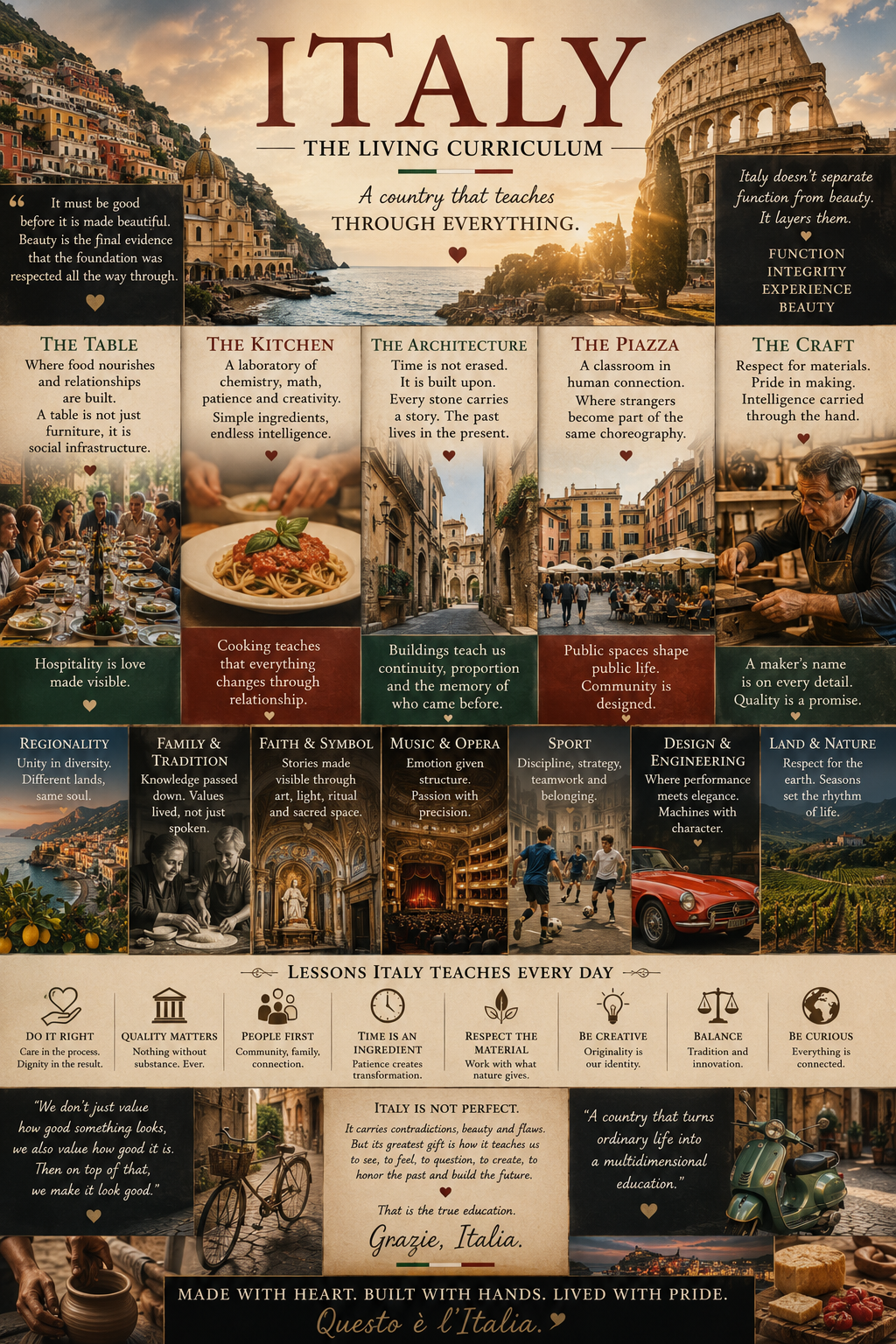
ITALY, THE LIVING CURRICULUM
A Celebration of the Country That Teaches Through Everything
Italy does not educate only through classrooms.
It educates through tables, streets, ruins, markets, workshops, churches, gardens, coastlines, kitchens, football pitches, bicycles, family rituals, regional accents, public squares, fabrics, machinery, music, agriculture and the visible passage of time.
It is one of those rare environments in which knowledge refuses to remain confined to the discipline under which it has been officially filed. Chemistry appears in the kitchen. Mathematics appears in architecture and tailoring. Physics appears on a bicycle descending a hill. Psychology appears around the family table. Sociology appears in the piazza. Theology appears in paintings, buildings, bodies, bread, blood, oil and light. Economics appears in the relationship between local production, tourism, family enterprise and land. Engineering appears in vehicles, machines, stonework, irrigation, furniture and the precise physical intelligence required to make beauty survive use.
Italy is not simply a country containing many subjects.
Italy demonstrates that the subjects were never truly separate.
For a mind inclined to observe widely, connect deeply and learn from everything, Italy is not merely a place of upbringing.
It is a living curriculum.
IT MUST BE GOOD BEFORE IT IS MADE BEAUTIFUL
One of Italy’s greatest teachings is often flattened into the word aesthetic.
People look at Italian fashion, food, architecture, cars, furniture and cities and conclude that Italy cares deeply about appearance. It does. But appearance alone does not explain the Italian standard at its best.
The deeper law is:
It should be good first. Then it should also look good.
A meal must have flavour before presentation completes it.
A chair must understand the body before its lines are admired.
A shoe must understand movement, material and construction before elegance becomes meaningful.
A building must understand weight, light, climate, proportion and human use before its façade can honestly be called beautiful.
A machine must perform.
A garment must sit correctly.
A sauce must hold together.
A room must receive people.
Beauty is not supposed to disguise an incomplete foundation. It is the final evidence that the foundation was respected all the way through.
This produces a layered relationship with quality:
\text{function}
\rightarrow
\text{integrity}
\rightarrow
\text{experience}
\rightarrow
\text{beauty}.
The result does not merely perform its task.
It communicates care.
That is why the small instruction—if something is worth doing, do it properly—contains so much.
It is not only perfectionism. It is respect for materials, process, craft, receiver and name. It is the understanding that whatever is made will eventually enter somebody else’s experience, and therefore the creator carries responsibility beyond the moment of completion.
Italy teaches that “finished” and “completed properly” are not necessarily the same thing.
BEAUTY AS VISIBLE INTELLIGENCE
At its strongest, Italian beauty is not superficiality.
It is intelligence made visible.
It is the organisation of parts into relationship.
A single ingredient may be excellent, but a dish depends upon proportion. A single building may be magnificent, but a street depends upon rhythm. A fabric may be luxurious, but the garment depends upon how it meets the body. A public square may contain stone, water, shadow, commerce, seating, movement and conversation, yet its real achievement is the way those elements permit life to gather.
Beauty emerges when parts understand one another.
The object understands the hand.
The building understands the street.
The street understands the pedestrian.
The table understands conversation.
The food understands the season.
The material understands its limits.
The old structure understands the addition.
The individual detail understands the whole.
This is systems thinking experienced through the senses.
Italy trains the eye to notice proportion before the mind necessarily knows the equation. It trains the body to recognise when a space feels coherent. It teaches that arrangement changes meaning, that one element can elevate or disturb everything around it and that harmony is not created by making every component identical.
Harmony is achieved when distinct things are placed in the right relationship.
THE KITCHEN AS CHEMISTRY, MATHEMATICS AND PHILOSOPHY
The Italian kitchen is one of the country’s greatest educational institutions.
It teaches chemistry through heat, acidity, fermentation, emulsification, caramelisation and the transformation of ingredients. It teaches mathematics through ratio, quantity, timing and proportion. It teaches biology through yeast, ripening, digestion, seasonality and preservation. It teaches economics through resourcefulness. It teaches geography through regional ingredients. It teaches history through recipes carried across generations. It teaches psychology through appetite, memory and comfort. It teaches sociology through who prepares, who serves, who sits and how long people remain together.
It also teaches restraint.
More is not always better.
An ingredient may be powerful because it is used precisely.
Complexity can come from the relationship among simple things rather than from endless addition.
A dish can contain very few ingredients and still reveal enormous intelligence if the ingredients are understood properly.
Cooking also shows how knowledge becomes embodied. After enough repetition, tasting, correction and observation, the hand begins to measure without announcing every calculation. The eye reads texture. The nose detects a missing stage. The mind predicts balance before the final result exists.
Practice compiles itself into intuition.
Baking goes further. Bread teaches that time is not empty. Dough resting is not inactive. Fermentation is creation occurring beyond immediate visibility. Cutting the process short may still produce something edible, but not necessarily something fully developed.
Italy therefore teaches patience without romanticising delay.
Wait where waiting transforms.
Move where movement improves.
Do not confuse speed with mastery.
THE TABLE AS SOCIAL INFRASTRUCTURE
The Italian table is not merely where food is placed.
It is where relationships are maintained.
It creates a socially protected interval in which people remain long enough for conversation, disagreement, memory, humour, observation, affection and intergenerational transmission to occur.
The table teaches that society is not held together only through legislation and institutions. It is also held together through repeated rituals of reception.
Who is welcomed?
Who is fed?
Who is remembered?
Who prepares?
Who remains after the meal?
Who tells the stories?
Who is permitted to interrupt?
Who receives the best portion?
Who notices when someone has not eaten?
These are small questions with large social meaning.
Hospitality is governance at the scale of a room.
A well-held table distributes food, attention, space and belonging. It teaches that an environment can be designed to make connection more likely. It demonstrates that nourishment has both biological and relational dimensions.
Italy understands that feeding people and creating somewhere they can remain are related forms of care.
ARCHITECTURE AS THE MEMORY OF TIME
Italy allows time to remain visible.
Ancient foundations, medieval streets, Renaissance façades, religious buildings, industrial additions, modern transport and contemporary life often occupy the same environment. The present does not always erase its predecessors before declaring itself new.
It inherits.
It renovates.
It adapts.
It builds beside.
It builds upon.
This creates historical literacy through ordinary movement. A person may pass centuries on the way to buy bread. The body learns that the present did not invent itself. Every structure carries decisions made before the current generation arrived.
Architecture becomes a lesson in continuity.
What was this built for?
Who funded it?
Who laboured on it?
What belief did it express?
What survived?
What was added later?
Which original function disappeared?
What new life entered the old shell?
These questions train a mind to read institutions in the same way.
A law, school, religion, family structure or business may appear modern while continuing to operate through an older foundation. Italy teaches people to look beneath the visible restoration and ask what still carries weight.
The façade may have changed.
The load-bearing structure may not have.
THE PIAZZA AS A CLASSROOM IN HUMAN BEHAVIOUR
The piazza offers a public education in social choreography.
People cross, gather, pause, observe, sell, perform, protest, flirt, argue, eat, rest and encounter one another without every interaction needing to be formally scheduled.
The design of the space shapes the social life occurring within it.
Where are the entrances?
Where is the shade?
Where are the steps?
Where can someone sit without purchasing anything?
What can be seen from where?
Which buildings face the centre?
How does sound travel?
What happens at different times of day?
The piazza teaches that public space is never neutral.
Architecture can encourage communion or isolation. It can make citizens visible to one another or move them rapidly past one another. It can invite lingering or communicate that anyone not spending money should keep moving.
Italy’s public spaces demonstrate that society needs somewhere to appear to itself.
A nation cannot become relational if its people possess no shared ground beyond commerce, work and private property.
REGIONALITY AS AN EDUCATION IN MULTIDIMENSIONALITY
Italy cannot be understood as one uniform cultural unit.
Its regions, cities, dialects, climates, landscapes, foods, industries, histories and temperaments retain pronounced differences. The north and south do not offer the same experience. Coastal and inland life do not produce the same rhythms. Mountains, plains, islands and agricultural regions develop different relationships with movement, labour, weather, food and community.
This is one of Italy’s greatest lessons:
Unity does not require uniformity.
A whole can contain powerful regional identities without every distinction becoming a threat to the whole.
The same ingredient changes across location.
The same language bends through accent and dialect.
The same national identity acquires different textures depending upon where it is lived.
Regionality teaches contextual intelligence. It warns against assuming that one solution, behaviour or standard will translate unchanged everywhere. It makes visible how land, weather, history, economy and memory shape culture.
Italy trains the mind to ask:
Which Italy?
That question itself is an education.
It teaches that categories may be useful while still remaining incomplete.
THE LANDSCAPE TEACHES EMBODIED PHYSICS
Italy is a country through which physics can be felt.
Hills teach gravity.
Cycling teaches torque, momentum, friction, balance and mechanical transfer.
Mountains teach altitude, endurance and scale.
The sea teaches rhythm, buoyancy, depth and weather.
Narrow streets teach spatial judgement.
Stone teaches thermal retention.
Sunlight teaches orientation.
Agriculture teaches water, soil, timing and biological response.
The body learns these relationships before it necessarily learns their technical vocabulary.
A bicycle moving through an Italian landscape is a laboratory.
The body applies force.
The chain transfers it.
The gears translate it.
The gradient answers.
The wind modifies the result.
The tyres negotiate the road.
The rider performs continuous calculations through muscle, sight and balance.
This is education through participation.
Italy teaches that intelligence does not belong only to conscious verbal thought. The body calculates too.
AGRICULTURE AS CREATION WITH CONSEQUENCE
Italian agriculture teaches that creation cannot be separated from conditions.
A tomato is not simply a product.
It is soil, seed, water, sunlight, labour, timing, weather, selection, preservation, transport and memory.
A herb garden teaches attentiveness. Plants communicate through colour, growth, dryness, scent and response. They cannot be argued into thriving. The conditions either support them or they do not.
This is an important social lesson.
When something fails to grow, the environment must be investigated.
What is missing?
What is excessive?
What is the quality of the soil?
Is the root constrained?
Is the plant receiving enough light?
Is it being watered according to its actual needs or according to a generic schedule?
Agriculture teaches equity more elegantly than many institutions do. Different plants require different conditions. Treating them identically is not fairness if their needs differ.
The goal is not to force everything to grow in the same form.
It is to create conditions in which each living pattern can express its nature well.
CRAFTSMANSHIP AS MORAL EDUCATION
Craft teaches accountability because materials do not respond to reputation.
Wood reveals whether it has been understood.
Stone reveals whether pressure was calculated.
Fabric reveals whether the cut was right.
Leather reveals whether the finish was rushed.
Metal reveals whether the join is sound.
A maker cannot persuade the material to conceal every mistake indefinitely.
This gives craft moral force.
It teaches humility before reality.
Intention matters, but the result also matters.
Effort matters, but understanding matters too.
A person may care deeply and still need to improve their method.
Italian craftsmanship, at its best, honours repetition not as monotony but as refinement. The maker performs the same class of action repeatedly, yet attention prevents repetition from becoming empty. Each object becomes another encounter between inherited knowledge, current material and individual judgement.
Craft keeps intelligence attached to the hand.
It resists the idea that knowing and making are separate hierarchies.
DESIGN, ENGINEERING AND THE BEAUTY OF PERFORMANCE
Italian design is powerful because it often refuses the false choice between engineering and seduction.
A machine can work brilliantly and possess character.
A vehicle can be understood as mechanics, movement, sound, identity and visual form simultaneously.
Furniture can be structurally intelligent and sculptural.
Industrial products can be practical without appearing emotionally dead.
This does not mean every Italian product achieves the ideal. It means the cultural aspiration recognises that the experience of use includes more than technical compliance.
Engineering asks whether it works.
Design asks how the working is encountered.
Craft asks how well it has been made.
Aesthetics asks what it communicates.
Business asks whether it can continue.
Culture asks what it comes to represent.
Italy teaches that these are not competing questions. A complete creation should be able to withstand all of them.
FASHION AS ARCHITECTURE FOR THE BODY
Fashion can be dismissed as surface only by ignoring how much it contains.
It involves geometry, textile science, movement, identity, climate, class, symbolism, labour, commerce and psychology.
A garment creates a temporary architecture around the body.
It changes silhouette.
It alters posture.
It communicates before speech.
It can protect, restrict, reveal, conceal, honour or distort the person wearing it.
Italian fashion teaches that material, line and proportion can transform how a body is perceived without changing the body itself. It shows how presentation becomes part of social communication.
But its highest lesson is not simply elegance.
It is coherence.
The garment should understand the wearer rather than erase them beneath design.
Beauty becomes strongest when it reveals character instead of replacing it.
ART TEACHES HOW CONSCIOUSNESS BECOMES TANGIBLE
Italy’s art teaches that internal perception can be translated into matter.
Thought becomes image.
Devotion becomes architecture.
Grief becomes sculpture.
Power becomes monument.
Myth becomes fresco.
Anatomy becomes study.
Faith becomes light, posture, colour and scale.
Art makes consciousness public.
It also reveals that creation is never politically empty. Who is represented, who commissions the work, where it is placed and what story it preserves all affect the meaning.
Italy offers an education not only in beauty but in the relationship between beauty and authority.
A cathedral can inspire spiritual elevation and communicate institutional power simultaneously.
A palace can exhibit extraordinary human skill while also revealing hierarchy.
A monument can preserve memory while deciding which memory becomes visible.
The mind learns to appreciate and interrogate at once.
That is mature observation.
Celebration does not require blindness.
RELIGION AS SYMBOLIC LITERACY
Italy gives religion a body.
Faith is encountered through bells, incense, oil, bread, wine, blood, water, statues, processions, paintings, candles, architecture, ritual and music.
Theology becomes sensory.
This creates a rich environment for symbolic intelligence. The mind begins noticing how spiritual ideas are encoded into physical forms. Death, resurrection, sacrifice, rebirth, purity, transgression, forgiveness, motherhood, suffering and transcendence are not left as abstractions.
They are staged.
Embodied.
Repeated.
Placed inside space and time.
Even a person who later questions doctrine may retain the intellectual gift of symbolic literacy—the ability to see that stories can carry biological, psychological, social and metaphysical meanings simultaneously.
Italy offers a vast archive for minds interested not merely in what people believe, but in how belief becomes architecture, behaviour, image, ritual and governance.
LANGUAGE, GESTURE AND THE FULL BODY OF COMMUNICATION
Italian communication demonstrates that meaning is not transmitted through words alone.
Tone matters.
Rhythm matters.
Volume matters.
Expression matters.
Hands participate.
Posture participates.
Silence participates.
The relationship between speaker and listener changes the meaning of the sentence.
This educates social perception.
It trains people to read beyond literal language and recognise emotional texture, intention, emphasis and relational position. It teaches that communication is embodied.
Words are one channel.
The whole person is speaking.
This is particularly fertile ground for minds attentive to psychology, intuition, contradiction and the difference between what someone says and what the complete field around the statement communicates.
MUSIC, OPERA AND THE ARCHITECTURE OF INTENSITY
Italy understands that emotion can be structured without being diminished.
Music and opera do not treat intensity as something that must be hidden to remain intelligent. Feeling can be composed, timed, repeated, amplified, interrupted and resolved.
A note enters relationship with another note.
A voice enters relationship with an orchestra.
A private emotion becomes a shared public experience.
Intensity is given form.
This teaches that emotion is not the enemy of structure. It becomes more communicable when structure is capable of carrying it.
Italy shows that discipline and passion can coexist.
Technique does not have to sterilise feeling.
Feeling does not have to abandon technique.
CINEMA TEACHES TIME, PERSPECTIVE AND SOCIAL REALITY
Italian cinema provides another kind of education: the ability to slow experience down enough to see what ordinary life contains.
A camera can hold a face, a street, a silence or a family interaction long enough for the hidden structure to become visible. Film teaches that time changes according to attention. A moment can be stretched, cut, repeated or placed beside another moment until a new meaning emerges.
Cinema turns observation into architecture.
It teaches framing.
What is included?
What remains outside?
Whose perspective governs the scene?
What happened before the visible moment?
What does the audience assume because of sequence?
Italy’s cinematic traditions demonstrate that ordinary people, domestic spaces, labour, poverty, desire, family and political conditions can carry epic human meaning without needing to be disguised as fantasy.
Reality itself becomes worthy of attention.
SPORT AS SOCIAL MATHEMATICS
Sport teaches probability, movement, cooperation, anticipation, hierarchy, discipline, emotional regulation and collective identity.
The ball moves through physics.
The team moves through relationship.
The crowd moves through emotion.
Strategy translates possible futures into decisions made under pressure.
Italy’s relationship with sport, particularly football, demonstrates how a game can become a social language. It carries locality, family allegiance, memory, competition and belonging.
Sport teaches that a group cannot succeed through individual excellence alone. Position matters. Timing matters. Trust matters. The strongest player cannot occupy every role at once.
The system succeeds when distinct abilities understand the same field.
FAMILY ENTERPRISE AND THE CONTINUITY OF KNOWLEDGE
Italy’s family businesses offer lessons in inheritance, continuity and responsibility.
Knowledge is often carried through practice rather than only through manuals. A child watches the adult. The adult corrects the hand. A recipe, craft, commercial relationship or way of receiving customers becomes embodied across generations.
This can preserve extraordinary skill.
It also raises important questions.
How does tradition remain alive without becoming rigid?
How does a family business modernise without destroying the reason people trusted it?
How is authority transferred?
Who is permitted to innovate?
What happens when the next generation does not want the inherited role?
Italy turns succession into a visible human problem.
Continuity is not repetition alone.
It is the ability to carry the essence forward while allowing the form to evolve.
THE MARKET AS AN EDUCATION IN RELATIONAL ECONOMICS
A market teaches that value is not created only at the point of sale.
It begins with soil, labour, transport, skill, weather, timing, reputation, quality and trust.
The producer and customer are not abstract units. They may encounter one another directly. Information travels through conversation. Quality is remembered. Poor treatment affects the relationship.
This makes economics human-sized enough to observe.
One can see how value circulates.
One can see the difference between price and worth.
One can see how local production supports identity, employment and regional continuity.
One can also see the pressures created when tourism, global demand or large-scale commerce detach products from the communities that gave them meaning.
Italy teaches that export can spread culture while also weakening local access if the source is not protected.
An ecosystem must feed its own roots as well as display its fruit.
MIGRATION MAKES IDENTITY VISIBLE
Italy has long been shaped by movement—people leaving, returning, arriving, crossing, adapting and building lives within regions carrying strong identities of their own.
Migration reveals what people usually take for granted about belonging.
Who is recognised as local?
What must be learned?
Which customs are shared?
Which differences are tolerated?
How does a person contribute before they are accepted as belonging?
How does a country receive labour, culture, family and intelligence from elsewhere while preserving confidence in itself?
These questions turn identity from an invisible assumption into a subject worthy of examination.
Italy can teach both the beauty of belonging and the consequences of making belonging too narrow.
That tension itself becomes educational.
A society learns about itself through how it receives those who did not begin inside its story.
TRADITION AND INNOVATION REMAIN IN CONVERSATION
Italy is a powerful learning ground because it does not resolve every contradiction.
It contains tradition and invention.
Beauty and bureaucracy.
Regional loyalty and national identity.
Slow processes and high-performance engineering.
Religious inheritance and modern questioning.
Family continuity and individual ambition.
Local craft and global commerce.
Preservation and pressure to modernise.
These tensions prevent the mind from settling into easy conclusions.
Tradition can protect quality and memory.
It can also resist necessary change.
Innovation can expand possibility.
It can also flatten regional character.
Tourism can sustain communities.
It can also turn living culture into performance.
Pride can preserve standards.
It can also become defensiveness.
Italy teaches through these contradictions because the learner must develop distinctions rather than choosing one shallow side.
WHY ITALY PRODUCES A WIDE MIND
Italy is fertile ground for a wide mind because it constantly presents multiple layers at once.
A church is religion, architecture, politics, acoustics, geometry, art, history, labour and social memory.
A meal is biology, chemistry, agriculture, economy, family, geography and culture.
A bicycle journey is physics, engineering, bodily intelligence, landscape and freedom.
A garment is geometry, material science, commerce, psychology and identity.
A public square is architecture, governance, sociology, history and performance.
A garden is nutrition, ecology, patience, medicine and creation.
The learner does not have to travel far to encounter another discipline.
The same object opens repeatedly depending upon the question asked of it.
That is why Italy can feel constraining inside a narrow formal education while remaining expansive as a lived education. A classroom may divide knowledge into subjects. Italy recombines those subjects outside the door.
It rewards the person who notices.
It gives the mind material to cross-reference.
It allows life to become the curriculum.
A CELEBRATION OF ITALY
Italy should be celebrated not only for what it produces, but for what it teaches people to perceive.
It teaches that quality has layers.
That beauty can be functional.
That function can possess soul.
That simple ingredients can produce complexity through relationship.
That time can remain visible.
That history can be inhabited.
That public space shapes public life.
That regional difference can strengthen identity.
That the body understands laws before the mind names them.
That craft is intelligence carried through the hand.
That a creation should respect its material.
That a table can become social infrastructure.
That patience can be active.
That pleasure can educate.
That tradition must be carried, not merely repeated.
That innovation should add possibility without erasing essence.
That the receiver participates in the meaning of what is made.
That a country can teach through flavour, form, movement, sound, sunlight and stone.
Italy’s greatness is not exhausted by monuments, luxury brands, cuisine or tourism.
Its deeper greatness is pedagogical.
It turns ordinary life into a multidimensional education.
It offers chemistry without removing taste.
Geometry without removing beauty.
History without removing daily life.
Religion without removing material.
Engineering without removing character.
Business without completely removing relationship.
Art without removing humanity.
It shows that civilisation can be touched, tasted, walked through, worn, heard, inherited and questioned.
Italy is not merely beautiful.
It teaches why beauty matters.
It is not merely historic.
It teaches how time remains inside the present.
It is not merely creative.
It teaches that creation is the meeting point of discipline, material, memory, function, risk and love.
And perhaps its greatest lesson is the one contained in the smallest standard:
Do not make something look valuable when you have not made it valuable.
SHS forever will have me as an asset.
Make it work.
Make it honest.
Make it nourishing.
Make it durable.
Make it worthy of the people receiving it.
Then complete the experience.
Give it proportion.
Give it character.
Give it beauty.
That is not decoration.
That is Italy finishing the lesson.






Leave a Reply