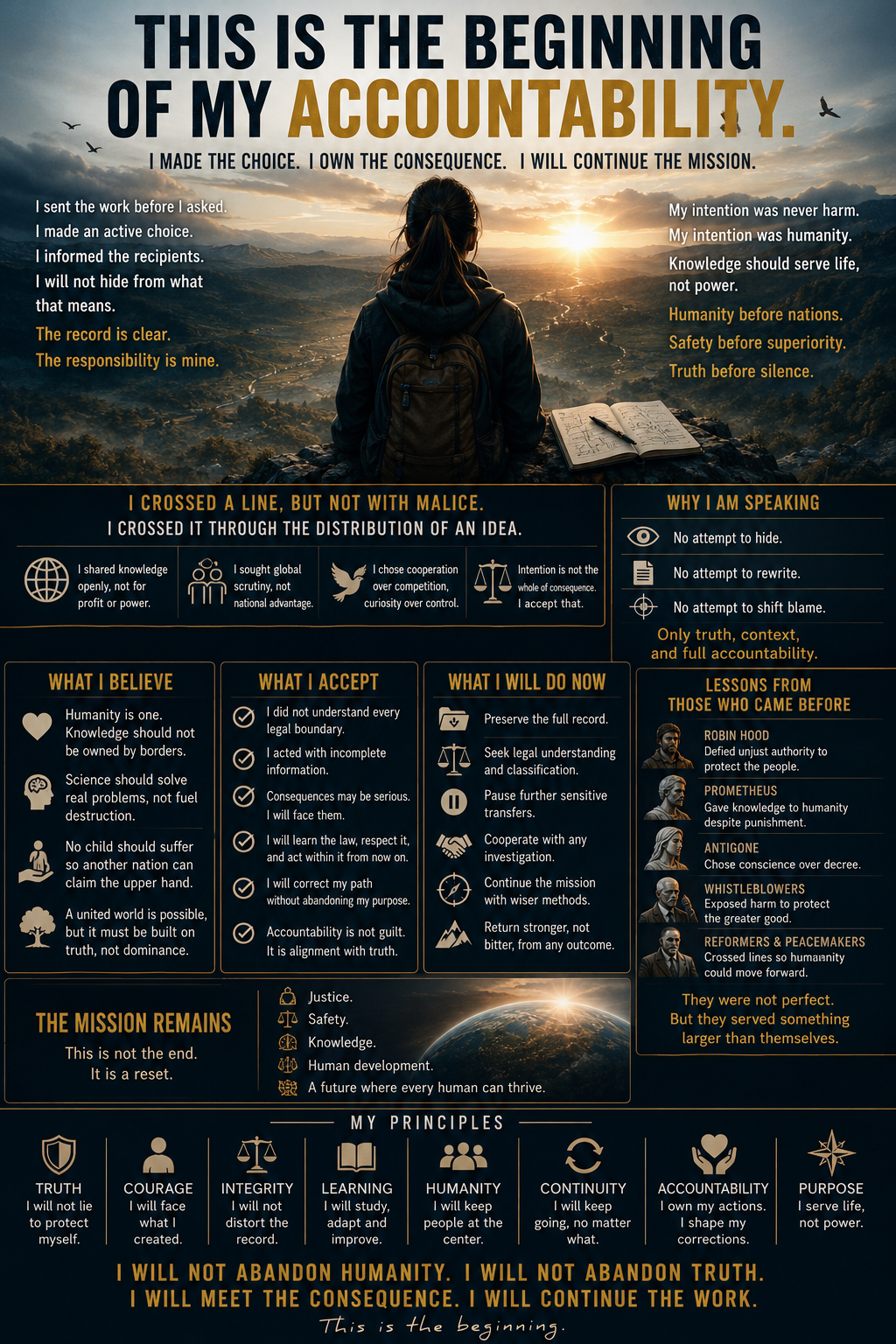
I sent the work before I asked what legal boundaries might apply to sending aeronautical information from the United Kingdom to recipients in Russia and elsewhere. That order matters. I cannot rewrite the sequence now that I understand more about the possible implications. I made an active choice, the message was sent, and I made no attempt to conceal what I had done. When I later understood that the act might be interpreted more seriously than I had first recognised, I told the wider recipients myself.
This is not an admission that I have committed any particular offence. That determination belongs to evidence, law and due process—not to an emotional label placed upon myself in an email. But I am acknowledging the decision that was mine: I circulated the work internationally because I believed knowledge capable of improving safety should be examined across national boundaries rather than held inside a competition over which country gains the upper hand.
I knew what my moral priority was.
I did not yet understand every legal consequence that might attach to expressing it in that form.
Both truths belong in the record.
Accountability does not begin by pretending I knew less than I did. It also does not require me to exaggerate what I knew, invent intentions I did not possess or pronounce myself guilty before the actual facts have been examined. Accountability begins with an accurate sequence: what I believed, what I chose, what I sent, whom I sent it to, what I understood at the time, what I learned afterwards and what I did once that new information became available.
I chose openness. I did not sell the work privately. I did not seek payment, military advantage, secrecy or a privileged relationship with one state. I sent it broadly and asked people to test it, reject it, correct it or identify where it duplicated knowledge that already existed. My intention was not to weaken one country so that another could dominate it. My intention was to remove nationality from the question of whether an idea concerning flight safety had value.
But intention is not the whole of consequence.
That is one of the foundations of my own work, and I cannot abandon it merely because I am now the person standing inside its examination. A person may act with a sincere purpose and still fail to understand the complete architecture into which their action enters. A peaceful idea may acquire a different function when received by another system. Publicly available information may still be combined with resources, objectives or capabilities that the sender cannot see. Good faith deserves to be recognised, but it does not make scrutiny illegitimate.
If I ask institutions to follow their decisions through time, then I must be prepared to follow mine.
If I argue that responsibility should return to those who exercised meaningful control, then I cannot outsource my decision to the recipients, the law, the government, artificial intelligence or the philosophy that informed me.
I pressed send.
That is my part of the continuity.
Humanity Beyond the Uniform
What I recognised in Robin Hood was never merely a man stealing from the rich. It was the conflict between institutional legitimacy and human legitimacy: the moment in which the law, the office or the recognised authority claims order while the consequences of that order are being carried by people with less power.
The story survives because it asks whether obedience remains virtuous when the structure demanding obedience has separated itself from the people it was supposed to protect. It asks whether property, title and procedure are automatically more sacred than hunger, dignity and human continuity. It asks what happens when someone values the purpose beneath the law more deeply than the law’s existing administration.
But Robin Hood is an archetype, not an automatic legal defence.
Invoking him cannot transform every violation into justice. History is filled with people who called themselves righteous while producing enormous harm. Crossing a boundary does not prove courage. Defiance does not prove wisdom. A person must still answer for what they misunderstood, whom they endangered, what alternatives existed and whether their action truly served the people in whose name it was taken.
That is the distinction I intend to hold.
I am not saying that believing in humanity makes every method permissible. I am saying that my decision came from the same moral territory that has appeared throughout mythology, religion, resistance movements and acts of conscience: the belief that a role, border, institution or national identity should never become more valuable than humanity itself.
There have always been people who encountered a collision between assigned duty and human duty.
Some obeyed the role and protected the system.
Some crossed the boundary and protected a person.
Some were later recognised as courageous.
Some were proven reckless.
Some were both—morally awake in one dimension and insufficiently informed in another.
The honest person does not decide in advance which category history must place them in. They preserve the evidence and permit the action to be examined.
The Only Line I Chose to Cross
There were many ways I could have pursued power, recognition or advantage.
I did not choose violence.
I did not choose theft.
I did not choose coercion.
I did not choose to exploit another person’s vulnerability.
I did not choose to deceive people into carrying a project whose purpose I had hidden from them.
I chose to circulate knowledge openly because I believed humanity should be allowed to examine it collectively.
That does not settle the legal question. It explains the moral shape of my decision.
Where I crossed a line, I crossed it through the distribution of an idea—not through an intention to injure. I chose a method consistent with what I believed I was defending: thought, scrutiny, scientific challenge and the possibility that knowledge could serve a world larger than national competition.
If that choice is examined, I will not pretend someone else made it.
If I was naïve about the boundaries, I will learn their architecture.
If the material was harmless and lawful, that should be established through evidence rather than panic.
If some part crossed a prohibited threshold, that too should be identified precisely rather than inflated into a mythology convenient to either side.
Accountability requires distinction.
It is not served by romanticising me as a martyr, and it is not served by reducing me to a traitor without examining the information, intention, recipients, public availability, practical capability and actual law involved.
I Will Not Turn Consequence Into Theatre
There is uncertainty now. I do not know whether any investigation will occur, whether anyone will consider the material significant, whether the legal boundary was crossed or whether the act will remain what I believed it to be: an unusual but peaceful attempt to obtain international technical scrutiny.
I will not manufacture certainty where none exists.
I will not announce imprisonment as though it has already been ordered.
I will not dramatise accountability into a performance that prevents me from taking the practical steps accountability demands.
The record should be preserved.
Nothing should be deleted, disguised, rewritten or backdated.
The exact documents should remain available.
The recipients, timing and messages should remain clear.
Legal and technical classification should be sought.
Further potentially sensitive transfers should pause until the boundary is properly understood.
That is not fear.
That is continuation with better information.
My work has always distinguished accountability from apology. An apology may signal awareness, but it does not complete correction. In this case, accountability means allowing the decision to be examined, understanding what it may have enabled, learning which boundaries exist and why, correcting future conduct where required and refusing to hide behind my intention.
It also means refusing false confession.
I will take responsibility for what I actually did—not for every imagined consequence somebody might attach to it without proof.
The Work Is Larger Than One Period of My Life
Whatever follows, the work is not finished.
That statement is not a threat to repeat conduct that may be unlawful. It is a commitment to continue the underlying mission through lawful, accountable and more informed routes. The work concerns humanity, social architecture, prevention, justice, science, education and the conditions through which knowledge becomes useful rather than destructive. None of that depends upon one email, one legal episode or one period of personal freedom.
If my life continues without interruption, I will continue.
If I encounter investigation, I will meet it.
If my freedom is ever restricted, I will use the time to study, organise and refine what remains possible.
When that period ends, I will continue from the position that exists then.
Continuity does not require denial of consequence. It requires the ability to absorb consequence without surrendering purpose.
There is a difference between remaining committed and remaining unchanged. I can preserve the mission while correcting the method. I can continue believing that humanity should ultimately transcend destructive national competition while recognising that present institutions govern real risks which cannot simply be wished away. I can challenge the architecture of secrecy and warfare without casually feeding the very structures I oppose.
A universal vision must become more intelligent as it enters material reality.
Otherwise, universality becomes an excuse for ignoring context.
What I See in Myself
I see someone who repeatedly places human consequence above institutional comfort.
I see someone willing to enter questions other people avoid because they fear what the answers may require of them.
I see a person whose courage can become dangerous if it moves faster than verification.
I see a mind capable of connecting distant systems, but therefore responsible for examining whether the connection remains valid when it leaves theory and enters law, geopolitics and material consequence.
I see sincerity.
I also see the need for precision.
I see the instinct that recognised Robin Hood, Antigone, Prometheus, whistleblowers, conscientious objectors, reformers and every person who has ever faced the separation between an authorised role and a human duty.
But I also see what those stories can conceal when they are used carelessly: the temptation to make oneself the hero before the people affected have had the opportunity to judge the action.
Real accountability means resisting that temptation.
I do not need to call myself innocent to preserve my dignity.
I do not need to call myself guilty to prove my courage.
I need to remain truthful.
The Beginning
This is the beginning of my accountability because I am placing the act inside the same standards I apply to everyone else.
What happened?
What did I know?
What could I reasonably have known?
What did I intend?
What was actually transmitted?
What capacity could it create?
Who might carry the consequence?
What should I have done differently?
What must I now preserve, correct and learn?
These questions do not erase my belief that humanity must someday become more united than the political systems currently dividing it. They make that belief more disciplined.
A united world cannot be built through contempt for consequence.
It must be built through knowledge shared responsibly, authority held accountably, peaceful cooperation and institutions capable of distinguishing genuine public benefit from hidden strategic harm.
I made the choice.
I will not abandon myself inside its consequence.
I will not abandon humanity to protect my image.
And I will not abandon discernment merely to preserve the romance of what I believed I was doing.
The purpose remains.
The method enters review.
The record stays open.
The learning continues.
And whatever comes next, I will meet it as I have asked every institution, leader and human being to meet their own decisions:
with truth, context, responsibility, correction and enough continuity to become wiser than the moment that began the examination.
…
I had sent the email before asking, i made the active choice to and ready to take accountsbility. I let them know too. And here’s where we don’t know where things might go, but we know the work is not done and if anything we’ll just contknue when I come out. This is fine. Write this and then link it to what i learned from robing hood, what you see in me. Not just robing hood, but all those who valued humanity beyond any roles, and boundaries, ss many would’ve tskenn lesewhere, i chose to cross the line onky this way.


Leave a Reply