
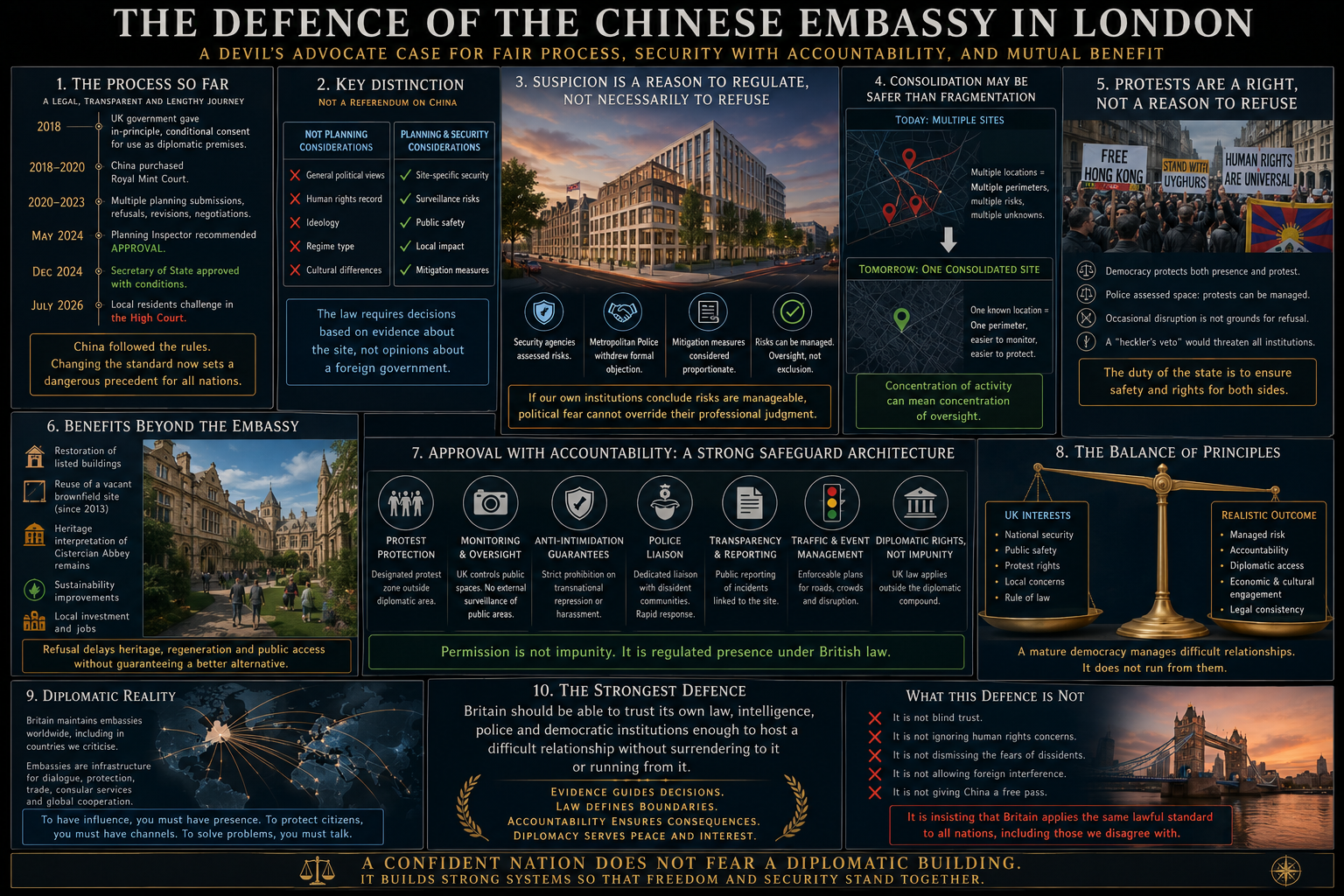
The strongest defence would not be: “China poses no risk.”
That would be too easy to dismantle.
The strongest defence would be:
The United Kingdom cannot claim to govern through evidence, law and equal process, then refuse a lawful embassy primarily because it distrusts the country applying for it. Suspicion may justify safeguards. It does not automatically justify exclusion.
As of 17 July 2026, the Royal Mint Court project has already received planning and listed-building approval, but local residents are challenging that decision in the High Court, principally over protest safety and the risk of surveillance or intimidation of dissidents.
The Defence of the Chinese Embassy
China bought Royal Mint Court after the UK government had already granted conditional consent in 2018 for it to become diplomatic premises, subject to obtaining planning permission. The site was not secretly occupied or seized; China entered a recognised British property and diplomatic process, invested substantially, submitted plans and waited through repeated refusals, inquiries, delays and revisions.
If Britain invites a foreign state to purchase a site for a possible embassy, allows that state to spend years pursuing the prescribed process and then changes the practical standard from “meet the planning and security requirements” to “convince the public that your government is morally trustworthy,” the process becomes politically impossible to complete. No major power could satisfy such a test, including Britain.
The defence should therefore begin with a distinction:
An embassy application is not a referendum on the entire conduct of the state behind it.
The official planning decision made that distinction. It concluded that general political, moral or cultural objections to the People’s Republic of China were not, by themselves, planning considerations. Site-specific security concerns were relevant and had to be examined, but general hostility towards China could not replace evidence about this particular development.
That does not excuse allegations of espionage, transnational repression or human-rights abuses.
It prevents the planning system from becoming an informal foreign-policy punishment mechanism.
If the UK wishes to sanction China, limit diplomatic relations or introduce stricter laws governing foreign missions, it should do so openly through foreign policy and legislation. It should not use planning language to conceal a geopolitical decision it is unwilling to state directly.
Suspicion Is a Reason to Regulate, Not Necessarily to Refuse
The central security argument against the embassy is serious: the site is close to sensitive infrastructure, dissidents fear monitoring, and residents argue that diplomatic protections may make some planning conditions difficult to enforce. Those concerns are now part of the High Court challenge and should not be trivialised.
But the defence can answer that the relevant British agencies were not excluded from the assessment. The Foreign Office and Home Office told the planning process that they had worked with policing and other partners to consider the full range of national-security issues, and that their earlier concerns had been resolved. The Metropolitan Police withdrew its formal objection, although it retained concerns about the resources required for major protests.
The defence would say:
Britain cannot ask its intelligence, security and policing institutions to evaluate the risks, receive their conclusion that those risks can be managed, and then disregard that conclusion because political fear remains emotionally stronger than the evidence available publicly.
The public is entitled to question whether the agencies are correct. But a security decision cannot be reduced to whichever side can imagine the most frightening possible use of a building.
The proper test is not whether wrongdoing is conceivable.
Wrongdoing is conceivable at almost every embassy.
The test is whether this location creates risks that the British state cannot reasonably monitor, contain or counter.
Consolidation May Be Safer Than Fragmentation
China currently operates through several diplomatic properties in London. One defence of consolidation is that bringing those activities into a single known campus may make the mission easier—not harder—for British security services to observe and protect. UK security officials reportedly considered consolidation potentially advantageous, while judging the mitigation measures proportionate.
A dispersed network creates multiple perimeters, travel routes, technical environments and neighbouring communities requiring protection and surveillance.
A consolidated site creates a larger concentration, but also one principal perimeter.
That is a genuine relational trade-off:
\text{greater concentration of activity}
\quad\leftrightarrow\quad
\text{greater concentration of oversight}.
The embassy’s size should therefore not automatically be treated as proof of sinister purpose. China is one of the world’s largest countries, with extensive consular, commercial, cultural and diplomatic relations with the UK. A large mission may reflect the scale of that relationship as well as security and operational preferences.
Size creates responsibilities.
It does not establish guilt.
The Protest Argument Risks Becoming a Heckler’s Veto
Another defence would ask whether a lawful institution should be refused because opponents may protest against it.
Tower Hamlets originally objected partly because of concerns about crowds, road safety, policing and the effect on residents and tourists. The Metropolitan Police later concluded that there was sufficient space for future protests to be managed, although disruption remains possible.
The Secretary of State accepted that large demonstrations could cause serious disruption, but concluded that London police had the experience and capacity to manage them and that occasional disruption did not justify refusal.
The defence would say:
A democratic country must be extremely careful not to establish that the likelihood of protest is itself a reason to prevent the institution being protested against from existing.
That principle could later be used against religious buildings, political conferences, controversial speakers, abortion clinics, refugee accommodation or minority institutions.
The duty of the state is to preserve both:
- the right of lawful diplomatic presence;
- and the right to protest against it.
Neither side should acquire an automatic veto over the other.
The Development Has Benefits Independent of China
Royal Mint Court has been largely vacant since 2013. The approved scheme includes restoration and reuse of listed structures, improvements to the surrounding site, sustainability measures and a public heritage programme concerning the site’s archaeological remains. The inspector and Secretary of State gave substantial weight to heritage restoration, brownfield reuse, design improvements and the proposed public interpretation of the Cistercian Abbey ruins.
Conditions include an events-management plan involving police, transport authorities, local stakeholders and community-safety representatives, along with public-access and heritage requirements.
So the defence can reasonably argue that refusal would not simply prevent a Chinese embassy.
It could also leave a major historic site underused and postpone restoration, public interpretation and investment without guaranteeing that a less controversial redevelopment would arrive quickly.
That does not make heritage benefit superior to national security.
It means the planning balance contains more than one consequence.
Britain Cannot Demand Diplomatic Presence and Then Treat Presence as Contamination
Britain maintains embassies across the world, including in countries whose political systems, security practices and human-rights records it criticises.
Diplomacy exists precisely because states do not need to agree in order to remain in communication.
An embassy is not a medal for good behaviour.
It is infrastructure for managing relations, including difficult relations.
The UK wants access to Chinese officials for trade, climate policy, visas, consular emergencies, education, global security and the protection of British citizens and interests. It cannot coherently insist upon those channels while treating the physical presence required to operate them as inherently illegitimate.
The defence would therefore say:
Britain does not approve China’s political system by allowing China an embassy. It demonstrates confidence in Britain’s own capacity to govern what occurs on British soil.
A state secure in its law does not need to pretend that refusing a building makes a rival power disappear.
But the Defence Must Carry Accountability
A credible defence cannot ask residents, Hongkongers, Uyghurs, Tibetans, Chinese dissidents or other critics simply to trust Beijing.
It must offer an accountability architecture.
The strongest pro-embassy position would support:
- a clearly protected protest zone outside diplomatic premises;
- UK-controlled monitoring of the surrounding public realm;
- strict prohibitions on external facial-recognition or intimidation activity;
- dedicated police liaison with dissident communities;
- transparent reporting of incidents linked to the site;
- enforceable traffic and event-management plans;
- protection for neighbouring residents;
- and immediate diplomatic consequences for any attempt to pull protesters inside the compound or exercise foreign coercion on British soil.
The public areas that are not covered by diplomatic inviolability must remain unmistakably under British jurisdiction; the official decision specifically records that Exchange Square is outside the area receiving diplomatic consent.
That is where the defence becomes stronger than denial.
It says:
Approve the embassy because the applicant passed the lawful process—but surround that approval with a British security, protest and accountability system strong enough that permission never becomes immunity from consequence.
The Best Closing Argument
The Chinese government should not receive a free pass because it is powerful.
But it should not receive a different planning law because it is feared.
Britain must distinguish among:
- evidence and suspicion;
- planning and foreign policy;
- diplomatic protection and impunity;
- protest rights and protest veto;
- national-security precautions and political exclusion.
China purchased the property with prior conditional diplomatic consent. An independent planning inspector recommended approval. The security concerns were referred through the relevant British institutions. The application includes restoration of neglected historic assets and mechanisms for managing public events. Those facts establish a defensible basis for permission even while serious concerns remain.
The strongest defence is therefore not:
“China can be trusted.”
It is:
Britain should be able to trust its own law, intelligence services, police, planning conditions and democratic institutions enough to host a difficult diplomatic relationship without either surrendering to it or running from it.
That is the devil’s-advocate case I would build for them.
I can monitor the High Court challenge and let you know when the judgment changes the project’s position.






Leave a Reply