
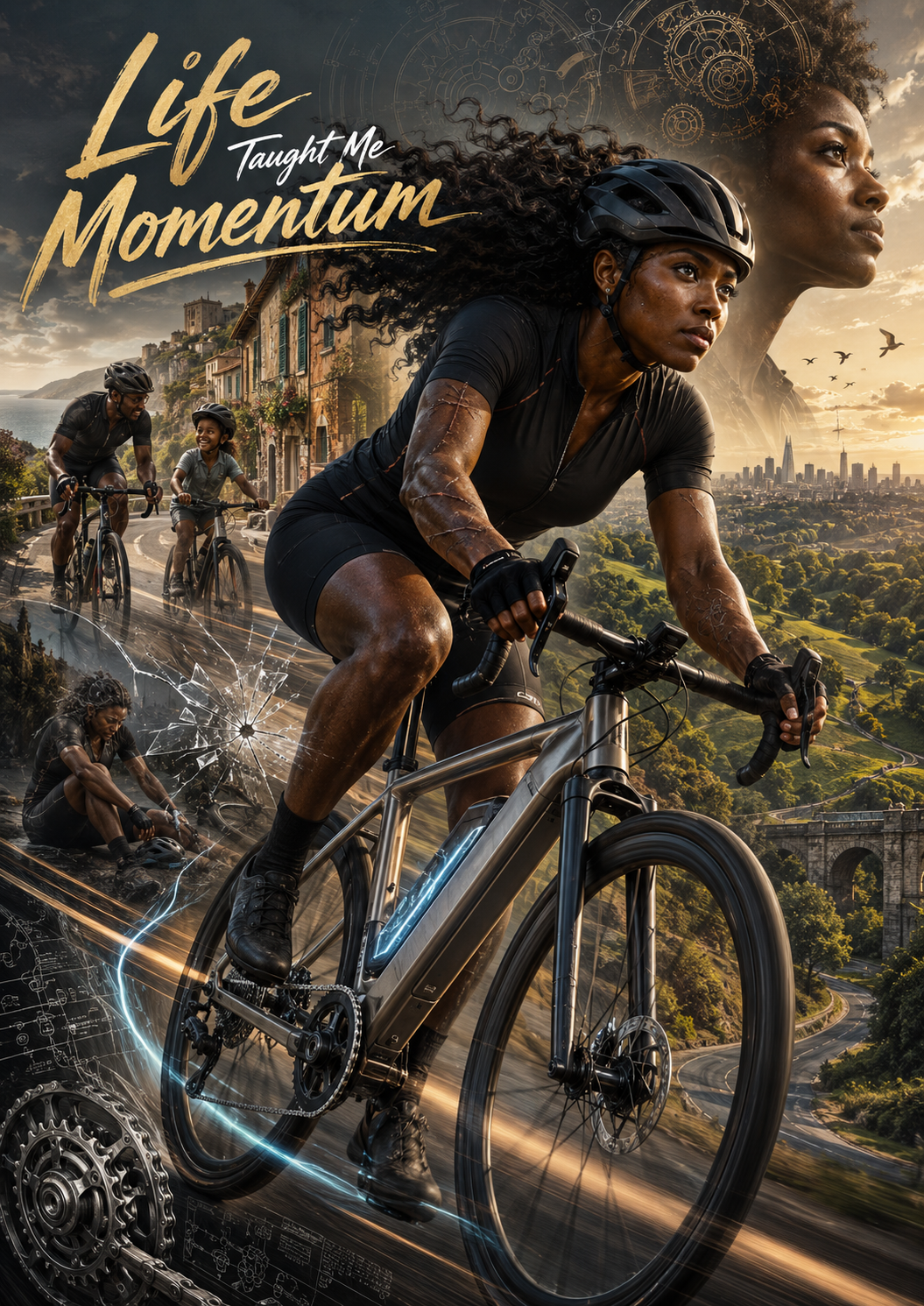
The Bicycle, the Hill and the Devotion to Keep Moving
My relationship with cycling began before I understood that movement could become a philosophy.
It began with my father, during childhood, through long bicycle journeys that expanded the world beyond the distance my feet could comfortably carry me. A bicycle offered a child something rare: independence without complete separation, speed without enclosure and adventure without needing to leave the Earth beneath her. My father and I could travel together while each remaining responsible for our own balance, our own steering, our own effort and our own response to the road.
Those journeys taught me that companionship did not require identical movement. Two people could share one direction while experiencing the route through different bodies. One could lead while the other followed, then the positions could reverse. Distance could open between us without breaking the bond because the road still held our shared intention.
I did not only enjoy cycling.
I wanted to discover what cycling could reach.
I was the adventurous child who searched for the hills. I wanted the descent even when I knew the descent would create an obligation to climb back. I understood the bargain before taking it: the faster freedom of going down would eventually be answered by the slower labour of returning upward.
I still chose the hill.
That choice became one of the earliest expressions of how I would later approach life. I was willing to accept the work created by an experience when the experience offered something worth knowing. I did not need every pleasure to be effortless. I did not need every adventure to protect me from consequence. I wanted to feel the velocity, see what waited below and learn whether my body could bring me back again.
The hill was not merely an obstacle.
It was the complete journey.
The descent gave exhilaration. The climb gave capacity. Together, they made the experience whole.
Italy and the Bicycle as Everyday Life
Living in Italy allowed cycling to fit naturally into the rhythm of ordinary life.
The bicycle did not have to remain a weekend activity or an organised sport. It could become transport, exploration, independence and intimacy with the surrounding environment at once. Streets, buildings, gradients, neighbourhoods and landscapes were not things viewed through a sealed window. They were encountered directly.
Cycling places the body inside the journey.
The air reaches the skin. The road sends information through the tyres, frame, handlebars, feet and spine. The slope announces itself through the thighs before the mind has finished describing it. Weather is no longer background scenery. Wind becomes resistance or assistance. Heat changes stamina. Rain changes friction. The road speaks through vibration.
A car can carry someone across a landscape while shielding them from many of the relationships that make the movement possible. A bicycle keeps those relationships visible.
The body produces force.
The chain transfers it.
The gears negotiate it.
The wheels translate rotation into distance.
The frame holds the relationship together.
The road answers.
Cycling gave me an embodied education in mechanics before I needed to name every mechanical law. I could feel torque through effort, friction through surfaces, momentum through speed, resistance through incline and kinetic energy through every descent. My body learned the equations through consequence.
That is one of the most beautiful truths about life as education: we often understand a law bodily before learning how another discipline writes it.
Then Came the Electric Bicycle
Moving to the United Kingdom introduced me to electric bicycles, and it felt like heaven.
The e-bike did not replace the bicycle’s relationship with the body. It expanded it. It allowed human effort and technological assistance to enter one shared movement. The motor did not eliminate my participation. It answered it, extended it and made new distances possible.
I bought a titanium Bird e-bike because, naturally, I could not enter the relationship quietly.
It was extra.
It was powerful.
It looked and felt like a machine designed not merely to carry me, but to become part of the adventure itself. Titanium gave it presence. The motor gave it extension. My body gave it direction.
Together, we travelled across the hills of northwest London.
There are views hidden inside London that many people never encounter because they move only through the routes designed to deliver them quickly from one recognised destination to another. Cycling revealed the city’s overlooked transitions: the long inclines, sudden openings, quiet paths, high points, woodland edges and places where concrete briefly releases its grip and allows the horizon to return.
At the top of those hills, London looked different.
The city ceased being only crowds, work, pressure, traffic and architecture. It became terrain. Light settled differently over rooftops. Trees interrupted buildings. The distance softened the noise. Technology had helped carry me upward, but what waited there was an increased appreciation for nature.
That relationship mattered.
The machine did not remove me from the Earth.
It helped me see more of it.
The e-bike became a meeting point among three forms of intelligence:
Nature’s intelligence in the land, air, gravity and landscape.
Human intelligence in mechanics, engineering, battery systems and design.
God technology in the body capable of perceiving, directing, balancing and experiencing them both.
My body was never the least sophisticated technology present.
It was the technology through which all the others became meaningful.
The motor could generate assistance, but my nervous system continuously calculated balance. My eyes assessed depth, movement and obstruction. My muscles made thousands of adjustments without requesting conscious instruction. My hands measured pressure. My ears tracked traffic and changes in the machine. My mind anticipated routes, surfaces, people and probabilities.
The bicycle was engineered.
So was I.
The Back End of Movement
I have always wanted to understand the back end of things.
Not only the polished result, but the messy architecture underneath it. The cables. The pressure. The repairs. The miscalculations. The points where friction leaves evidence. The parts other people avoid because they interrupt the fantasy that a finished experience arrived whole.
Cycling makes the back end impossible to ignore.
Chains loosen.
Brakes wear down.
Tyres puncture.
Batteries deplete.
Weather exposes weak points.
A route that looks simple on a map becomes entirely different when translated through gradient, weight, surface and fatigue.
The body records the back end too.
My scars are part of that record.
They come from different falls, different speeds, different roads and different moments in which movement exceeded the relationship I had successfully calibrated. They are not decorative evidence of fearlessness. They are evidence of contact.
One fall in particular left what I describe as crucifixion scars.
I was travelling at maximum speed on the e-bike when my corded earphones became twisted into the wheel. The relationship between the moving bicycle, the cable, my body and the road changed instantly. Momentum continued even after the wheel’s movement was interrupted. I went forward hands first.
The road received me without softness.
My hands carried the impact. The wounds formed in positions that gave the scars their crucifixion-like appearance—marks across the very parts of the body used to reach, hold, create, protect and guide.
Pain localised what speed had previously distributed.
One moment I was movement.
The next, I was matter meeting matter.
The accident offered a brutal education in how quickly one overlooked element can alter an entire system. The earphones were small compared with the bicycle. The cord appeared insignificant compared with my body, the frame, the motor and the road. Yet once it entered the wrong mechanical relationship with the wheel, its scale stopped determining its importance.
A small element in the wrong position can redirect a large amount of energy.
That principle applies everywhere.
One cable.
One loose decision.
One unexamined assumption.
One person placed in the wrong position of authority.
One minor failure entering a high-velocity system.
Scale does not determine consequence by itself.
Position, timing, relationship and momentum matter.
I Remained Loyal to Both
After the fall, I remained loyal to e-bikes.
I also remained loyal to corded earphones.
That may sound ridiculous to anyone who believes pain should automatically convert affection into rejection. But I did not blame the existence of either object for a relationship that had become badly configured.
The e-bike had not betrayed me.
The earphones had not become evil.
The accident emerged from the way two things I valued entered one another’s movement without sufficient separation.
The answer was recalibration.
Secure the cord differently.
Respect the wheel’s reach.
Understand speed more completely.
Preserve the things I love while changing the relationship through which they are allowed to meet.
This is also how I stand inside relationships.
I do not believe one painful event automatically defines the complete character of everything involved in it. Pain matters. Injury matters. Consequence matters. But accountability requires understanding the architecture that produced the harm, not merely condemning the nearest visible object.
I can take pain.
That does not mean I should be expected to accept endless injury.
It means pain does not automatically rob me of discernment.
I examine what happened.
I identify what belonged to me, what belonged to the other and what was produced by the relationship between us. I adjust the boundaries, sequence, speed, access or configuration. Then I decide whether the relationship still contains enough value, integrity and possibility to continue.
Sometimes recalibration preserves the bond.
Sometimes recalibration proves that the bond must end.
But I do not allow fear to make the decision before understanding has arrived.
That is devotion with accountability.
Not loyalty to harm.
Loyalty to truth, value and the complete relationship.
The Scars Are Part of the Engineering
People often want strength without the visible evidence of what strengthened it.
They admire the machine after the repairs but prefer not to see the damaged component. They celebrate resilience while becoming uncomfortable around the scars through which resilience became embodied.
But scars are part of the back end.
They are the body’s repair records.
A scar says the original surface was broken, but the organism did not leave the opening unattended. It gathered resources, protected the site, produced new tissue and closed what had been exposed. The repaired area may not look identical to the untouched skin because healing is not reversal.
Healing is new architecture.
The body does not travel backwards in time to erase the fall.
It builds forward from it.
That is why my scars do not make me ashamed of movement. They remind me that movement has consequence and that my body has repeatedly possessed the intelligence to respond.
They are not instructions to stop living.
They are instructions to move with greater relationship.
To know where the cord is.
To understand the wheel.
To respect momentum.
To preserve freedom without becoming careless with the body carrying it.
Kinetic Energy as Education
I love kinetic energy because it makes intention tangible.
A thought can remain still inside the mind. A desire can remain untested. But movement exposes relationship immediately. The moment the bicycle begins moving, every part of the system has to communicate.
A misaligned wheel reveals itself.
A weak brake reveals itself.
An unstable grip reveals itself.
Poor balance reveals itself.
Excess confidence reveals itself.
So does fear.
Kinetic energy turns hidden conditions into active information.
This is why I have always been drawn to mechanics, architecture and the systems beneath visible outcomes. Movement audits structure.
A bridge may appear complete while standing still. Load reveals how its relationships behave.
A person may appear composed while nothing challenges them. Pressure reveals the organisation beneath the presentation.
A business may appear successful while conditions remain favourable. Disruption reveals whether the system possesses recovery.
A relationship may feel harmonious while no real difference has entered it. Conflict reveals whether its bond is strong enough to hold two distinct truths.
Movement makes the back end speak.
The bicycle taught me to listen through the body.
The Hill Is a Contract With the Future
Every descent contains a relationship with what comes next.
The child in me understood that before she possessed the language for it. She looked at the hill and knew that going down meant eventually confronting the return.
The joy was immediate.
The cost was delayed.
But the delayed cost did not invalidate the joy, and the immediate joy did not erase the cost.
The mature decision was to hold both.
That is one of the most important forms of future consciousness: enjoying what is present without abandoning responsibility for the return journey it creates.
Many systems fail because they organise themselves around descent alone.
Extract now.
Consume now.
Accelerate now.
Profit now.
Allow somebody else, somewhere else or some future generation to climb back.
But a complete relationship includes the hill in both directions.
The person receiving the exhilaration must remain connected to the labour required to restore altitude.
Cycling taught me this through muscle.
Every beautiful descent asked:
Will you still love the journey when it becomes effort?
My answer was yes.
The Bicycle as a Model of Relationship
A bicycle remains upright through movement, continuous adjustment and relational balance. It does not balance by freezing itself.
The rider leans.
The wheel turns.
The road changes.
The body compensates.
The handlebars are never truly held in one mathematically perfect position for the entire journey. Stability is created through thousands of small corrections, most of which never reach conscious attention.
That is how strong relationships work.
They do not remain alive because nothing changes.
They remain alive because both sides continuously receive information and adjust without losing the direction they chose together.
Too much rigidity and the system cannot respond.
Too little structure and it cannot remain coherent.
The bicycle needs a frame, but the frame alone cannot create movement.
It needs wheels, but wheels without direction merely spin.
It needs force, but force without balance creates a fall.
It needs a rider, but the rider cannot ignore the machine, terrain or momentum and still claim complete authority over the outcome.
Every part remains distinct.
Every part contributes.
The movement belongs to the relationship.
Life Taught Me Momentum
My father introduced me to the bicycle.
Italy allowed it to become a way of life.
The United Kingdom introduced me to electric expansion.
The Bird e-bike carried me over the hills of northwest London.
Nature rewarded the climb with views.
Technology extended my range.
My body negotiated the whole experience.
The road gave me scars.
The fall gave me an education in position, timing, momentum and consequence.
The repairs taught me recalibration.
My continued love for e-bikes and corded earphones taught me that pain does not always require abandonment. Sometimes it requires a more intelligent relationship between the things we refuse to stop loving.
The hills taught me that pleasure and effort belong to the same journey.
The bicycle taught me that balance is active.
The motor taught me that assistance does not have to erase human contribution.
The scars taught me that healing builds forward.
Kinetic energy taught me that movement reveals structure.
And devotion taught me that loyalty is strongest when it has passed through examination rather than remaining innocent of consequence.
I do not stand proudly in what I love because it has never hurt me.
I stand proudly because I know how to investigate pain without allowing pain to erase the complete truth of the relationship.
I can fall.
I can bleed.
I can learn.
I can repair.
I can recalibrate the cord, the speed, the position, the boundary and the sequence.
Then I can ride again.
Not as the person who never encountered danger.
As the person whose understanding became large enough to carry both freedom and consequence.
That is what the bicycle gave me.
Not escape from gravity.
A relationship with it.
Not immunity from impact.
A body capable of healing.
Not movement without risk.
Discernment strong enough to continue.
And still, whenever I see the hill, some part of the adventurous child looks downward first.
Not because she has forgotten the climb.
Because she remembers that she has always known how to come back up.
…
And now write a piece on how being adventurous with my biking, a practice I started prscticing with my dad as a child and would go on these long jiurneys, and livong in italy just made it fit perfectly in tjr day to day, yet I always took it up a notch, i was the adventourius kid that looked for the hills, no matter how long it was gon take to go back up, and moving to uk to get introduced to ebikes, it was heaven. I got one for myself, a titanium bird bike, so extra… yet powerful, we travelled the hills of nortwest london, the views, just breathtsking, appreciation for nature and technology, eith the contribution of god technology as my body. I love kinetic energy, mechanics, architecture work and fo see the backened of things, the messy parts everyone avoids, like the scars that cover my body from all different kind of falls, one in particular gave me cruxifiction scars, as i felt hands first at the max miles on an e bike as my chorded esrphones got twisted in the wheeel. Still I stay loyal to both. Chord and ebikes. It builds on how I stand in my relationships, I can take pain, I just recalibrate and grow, and stand proud of what I love and devoted to my cause.





Leave a Reply