Why Excellence Sometimes Requires Leaving Your Industry to Discover What Your Industry Cannot See
We are taught a comforting equation:
Work harder, improve, qualify, succeed.
It sounds fair.
It gives effort a direct route to outcome. It tells us that the person who trains longest, studies hardest, arrives earliest and sacrifices most will eventually make the cut.
Sometimes that is true.
Sometimes hard work is exactly what separates potential from achievement.
But sometimes the obstacle is not effort.
Sometimes a person can work with extraordinary discipline and still fail to qualify because the real limitation sits somewhere their training has never taught them to look.
They may be working harder against the problem rather than understanding it.
They may be strengthening the wrong part of the system.
They may be treating a biological constraint as a motivational failure, a nutritional deficiency as a training failure, a psychological barrier as a character flaw or a structural mismatch as evidence that they simply did not want success badly enough.
That is where the worship of hard work becomes dangerous.
Because effort is powerful, but effort is not diagnostic.
Hard work can increase output.
It cannot automatically identify what is preventing the output from becoming the required result.
A person may spend years pushing on the same locked door without discovering that the entrance is elsewhere.
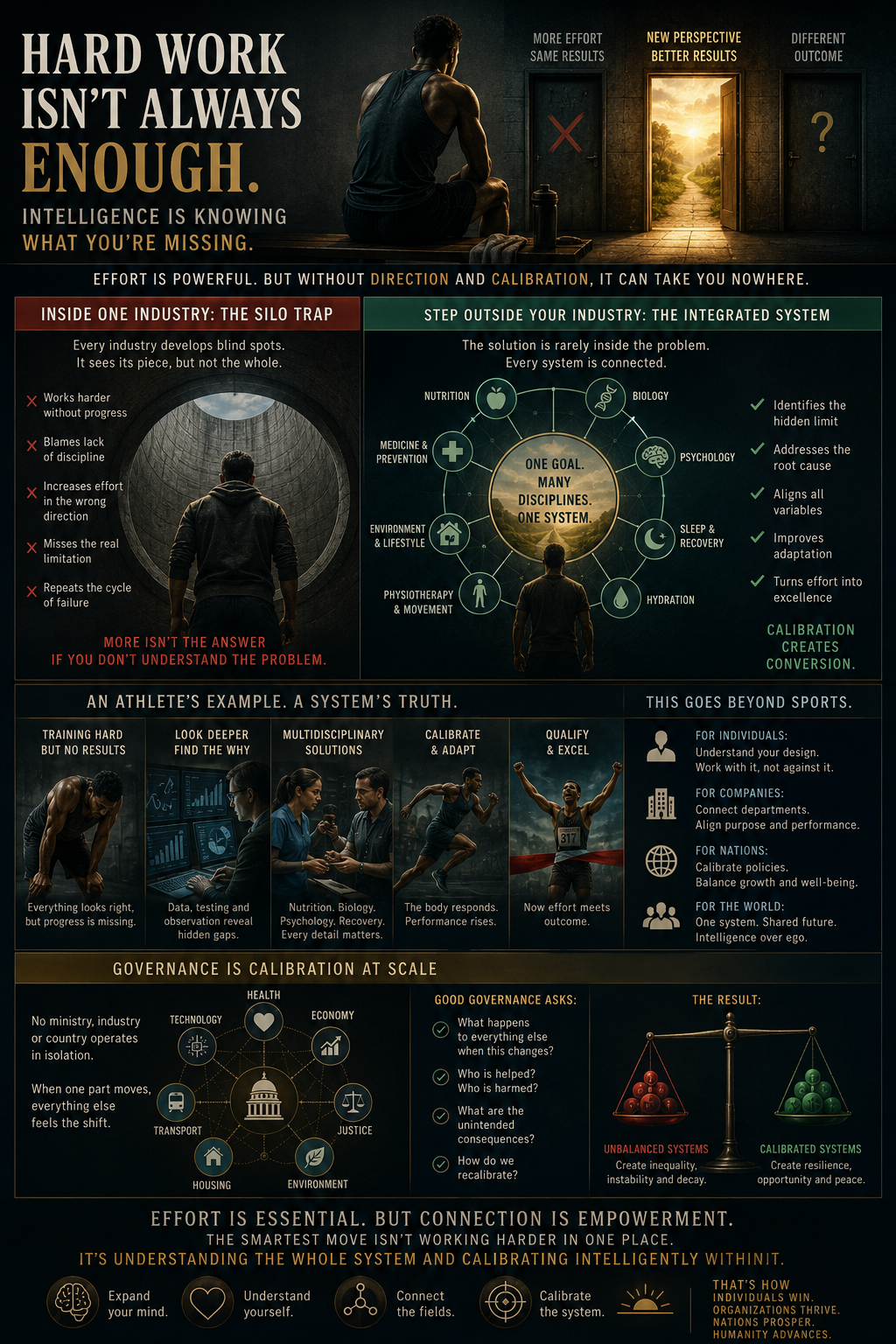
The Athlete Who Does Everything Right and Still Does Not Make the Cut
Consider an athlete who struggles to build muscle.
The standard response is predictable:
Train harder.
Lift heavier.
Be more disciplined.
Stop making excuses.
But what happens when they are already training consistently?
What happens when they are technically skilled, mentally committed and willing to endure discomfort, yet their body is not adapting at the expected rate?
More effort may not solve the problem.
It may deepen it.
The athlete could be under-recovering. They could be eating enough food but absorbing or distributing nutrients poorly. Their protein intake may be mistimed or inadequate for their body mass and training demand. Their sleep may be disrupting hormonal recovery. Their hydration may be affecting performance and repair. Their stress response may be keeping the body in a state that is hostile to growth.
The issue might involve:
- body composition;
- bone density;
- cellular ageing;
- inflammation;
- metabolic health;
- hormone balance;
- nutrient absorption;
- muscle-fibre distribution;
- recovery rate;
- hydration;
- sleep quality;
- injury history;
- psychological stress;
- or the relationship between the nervous system and muscular recruitment.
The coach can observe the performance.
Nutrition can examine the fuel.
Biology can examine adaptation.
Medicine can investigate dysfunction.
Psychology can examine stress, identity, fear and performance pressure.
Physiotherapy can examine movement and compensation.
Sleep science can examine recovery.
Data analysis can compare the athlete’s response over time.
The athlete does not become less of an athlete because answers are found outside sport.
They become a better-supported athlete because sport has stopped pretending it contains every answer to the body performing it.
That is the point:
The industry producing the problem is not always the industry containing the solution.
Hard Work Is an Amplifier, Not a Compass
Hard work amplifies whatever direction a person is already moving in.
When the direction is correct, effort accelerates progress.
When the direction is slightly wrong, effort may create exhaustion.
When the direction is fundamentally wrong, effort can produce injury, failure and self-blame.
This relationship can be expressed simply:
\text{Result}
=
\text{effort}
\times
\text{direction}
\times
\text{adaptation}
If direction or adaptation approaches zero, increasing effort alone produces far less than expected.
That does not make effort meaningless.
It means effort must be joined by calibration.
A person needs to know:
What is changing?
What is not changing?
Why is it not changing?
Which part of the system is failing to receive the effort?
Is the problem capacity, timing, biology, information, environment, structure or recovery?
Without those questions, “work harder” becomes an intellectually lazy answer delivered to someone already carrying the consequences.
Industries Become Dangerous When They Only Consult Themselves
Every profession develops its own language, methods, incentives and measures of success.
That specialisation is useful. It creates depth. It allows people to become exceptionally skilled within defined areas.
But every industry also develops blind spots.
A medical institution may understand disease while misunderstanding housing, poverty or food access.
A technology company may understand software while misunderstanding childhood development, loneliness or democratic stability.
An education system may understand curriculum while misunderstanding trauma, nutrition or family economics.
A government may understand taxation while misunderstanding psychology, community trust or the physical reality of frontline work.
A company may understand profit while misunderstanding the human energy being consumed to produce it.
The problem begins when specialisation mistakes itself for completeness.
The expert knows their section so deeply that they begin believing the section is the whole.
Then every problem is forced through the same lens.
If the person is not improving, they need more discipline.
If the company is not growing, employees need more pressure.
If the public is not complying, citizens need more punishment.
If the patient is not recovering, they need another intervention inside the same treatment model.
If the student is not achieving, they need more hours inside the same educational environment.
The institution increases the dose because it cannot imagine another diagnosis.
This is how expertise becomes enclosure.
The Solution Often Lives One Industry Away
The athlete may need nutrition.
The nutritionist may need psychology because a perfect food plan is useless when stress, poverty or disordered eating makes it impossible to follow.
The psychologist may need neuroscience to understand how trauma alters attention and regulation.
The neuroscientist may need sociology because the brain does not develop outside family, culture and material conditions.
The sociologist may need economics because social behaviour is shaped by access to resources.
The economist may need ecology because no economy exists outside land, energy, water and physical limits.
The ecologist may need governance because evidence without authority may remain unused.
And governance needs all of them.
This is not because every leader must personally become a doctor, economist, engineer, psychologist, biologist and sociologist.
That would be impossible.
The necessary intelligence is not knowing everything.
It is knowing that no single field knows enough to govern the whole.
A strong integrative mind understands where one discipline ends, where another must enter and what happens in the space between them.
That space is where many failures begin.
It is also where many breakthroughs are waiting.
The Qualifier May Be Hidden Outside the Competition
Sport makes the principle visible because qualification is measurable.
A runner either reaches the required time or does not.
A weightlifter either lifts the qualifying load or does not.
A swimmer either enters the final or does not.
But human systems often confuse the visible threshold with the complete cause of reaching it.
The stopwatch gives the result.
It does not explain the result.
Two athletes may train equally hard and produce different outcomes because their starting conditions, bodies, recovery systems, coaching, finances, nutrition, safety and stress are different.
The visible competition begins at the starting line.
The real competition began years earlier.
It began in childhood nutrition.
It began in access to facilities.
It began in genetics.
It began in whether an injury was treated properly.
It began in whether the athlete could afford recovery time.
It began in the quality of sleep available in their home.
It began in whether somebody recognised their body’s unusual requirements before calling them lazy.
This applies far beyond sport.
A worker may fail to qualify for promotion not because they lack intelligence, but because the organisation rewards a communication style they were never taught.
A student may fail an examination not because they do not understand the subject, but because anxiety blocks retrieval under timed conditions.
A business may fail not because the idea is weak, but because the founder lacks access to finance, networks or legal knowledge.
A citizen may fail to navigate a public service not because they are irresponsible, but because the system was designed by people who already understand it.
The qualifier is often presented as neutral.
The path to it rarely is.
Calibration Is More Intelligent Than Judgment
Judgment asks:
Why has this person failed?
Calibration asks:
Which relationship is preventing their effort from becoming the required output?
That is a very different question.
Judgment isolates the person.
Calibration examines the system around the person.
Judgment says:
They are not strong enough.
Calibration asks:
Is their programme producing adaptation?
Judgment says:
They are not committed enough.
Calibration asks:
Is their nervous system overloaded?
Judgment says:
They do not belong at this level.
Calibration asks:
Which variable has not yet been identified?
This is not an attempt to remove all standards.
A qualifier still matters.
A pilot must demonstrate competence.
A surgeon must meet clinical standards.
An athlete must reach the required level.
A bridge must withstand the load.
But standards become more useful when they are treated as information rather than moral verdicts.
Failure to qualify tells us that the current combination has not produced the required result.
It does not automatically tell us why.
That “why” is where cross-disciplinary intelligence becomes essential.
The Human Body Is Already Multidisciplinary
The body does not care how universities divided their departments.
It does not say:
This is a nutritional problem, so psychology must remain outside.
This is a muscular problem, so sleep is irrelevant.
This is a mental problem, so inflammation may not participate.
The body operates simultaneously.
Thought changes breathing.
Breathing changes chemistry.
Chemistry affects energy.
Energy affects movement.
Movement affects confidence.
Confidence affects performance.
Performance changes identity.
Identity affects willingness to continue.
The system is circular.
Its categories are useful for study, but the person remains whole.
The same is true of a company.
Finance affects staffing.
Staffing affects service.
Service affects reputation.
Reputation affects sales.
Sales affect investment.
Investment affects technology.
Technology affects labour.
Labour affects health.
Health affects absence.
Absence affects finance again.
The departments appear separately on the organisational chart.
Their consequences do not remain separate in reality.
A country works the same way.
Healthcare affects employment.
Employment affects tax revenue.
Taxation affects public services.
Education affects innovation.
Housing affects health.
Transport affects opportunity.
Technology affects democracy.
Environment affects food, energy and migration.
Justice affects trust.
Trust affects compliance.
Compliance affects the cost of governance.
One industry moves, and several others must recalibrate.
That is not an exception.
That is the basic condition of a living system.
Governance Is the Management of Moving Relationships
Government is often divided into ministries and departments because complexity requires organisation.
Health goes here.
Education goes there.
Transport has another office.
Business, energy, housing, justice and defence each receive their own structure.
Administratively, this makes sense.
Intellectually, it can become disastrous.
The departments begin acting as though their boundaries exist in reality.
A housing decision is made without calculating its health consequence.
An education policy is introduced without examining nutrition, family labour or digital access.
A transport project is evaluated without understanding community displacement.
A technology policy is approved without psychology, child development or democratic analysis.
An economic measure is celebrated for increasing output while quietly increasing illness, inequality and environmental cost elsewhere.
Each department succeeds on its own spreadsheet.
The country fails in the spaces between them.
That is why governance requires more than specialists sitting beside one another.
It requires calibration across specialisms.
A specialist can say:
This intervention improves our variable.
The integrative mind must ask:
What happens to every connected variable when yours improves?
That is the harder intelligence.
Not because it knows more details than every expert, but because it recognises that improvement in one area may create deterioration elsewhere.
Economic growth may increase employment while increasing pollution.
Automation may improve productivity while eroding income security.
A medical policy may extend life while increasing unsustainable care burdens if social support is not redesigned.
A policing strategy may reduce one visible offence while damaging trust and making other crimes harder to detect.
Nothing moves alone.
Governance is therefore not merely the administration of industries.
It is the continuous recalibration of their relationships.
A Nation Needs the Equivalent of an Athlete’s Integrated Performance Team
Elite athletes do not usually rely upon one person for everything.
They may have:
- a coach;
- strength and conditioning support;
- physiotherapy;
- medical care;
- nutritional guidance;
- psychological support;
- performance analysis;
- recovery monitoring;
- and technical specialists.
Each person sees something different.
The coach sees execution.
The doctor sees health.
The physiotherapist sees movement.
The nutritionist sees fuel.
The psychologist sees cognition and emotional regulation.
The analyst sees patterns over time.
The athlete becomes the point at which all that information must meet.
A country should be governed with at least the same seriousness.
Yet nations often operate as though economic advice alone can explain society, or political strategy alone can explain people.
Imagine managing an athlete only through their bank balance.
Their income increases, so the programme is declared successful.
Meanwhile, their joints are deteriorating, sleep has collapsed, motivation is disappearing and injury risk is rising.
That is how governments can speak proudly about growth while citizens experience the country as increasingly unliveable.
The headline variable improved.
The living system did not.
A national calibration body would not ask only whether one ministry achieved its target.
It would examine how every major policy redistributed pressure across the whole.
If industry expands, what happens to housing?
If housing density increases, what happens to transport, schools, water and health?
If automation increases productivity, how are income, identity and education recalibrated?
If healthcare extends life, how are care, pensions, housing and community redesigned?
If digital access expands, how are attention, safety, privacy and mental health protected?
This is not making governance unnecessarily complicated.
The complexity already exists.
Refusing to account for it does not remove it.
It merely moves the consequences into the future.
Multidisciplinary Intelligence Is Not Indecision
People sometimes treat cross-disciplinary thinking as a lack of focus.
They say:
Stay in your lane.
Choose one field.
Trust the experts.
Do not complicate the issue.
But the issue is already connected.
The person crossing disciplines may be the only one refusing to pretend otherwise.
There is a difference between interfering without knowledge and integrating with respect.
A multidimensional thinker does not replace specialists.
They prevent specialists from becoming isolated.
They ask the physician what the economist missed.
They ask the psychologist what the technologist overlooked.
They ask the frontline worker what the executive’s data cannot show.
They ask the engineer what the politician’s promise requires physically.
They ask the public what the policy feels like once it leaves the document and enters daily life.
Their role is not to know everything better than everyone.
Their role is to ensure that every form of knowledge enters the same living conversation.
That is calibration.
Hard Work Without Diagnosis Becomes Punishment
There is something cruel about telling a person to work harder when the system has not investigated why their work is failing to produce the expected adaptation.
The athlete trains more and becomes injured.
The nurse works more and becomes burnt out.
The teacher works more while class sizes increase.
The employee works more inside a broken process.
The citizen works more while housing, food and energy costs absorb the gain.
The government then points to effort as though effort is an unlimited resource.
It is not.
Human energy has conditions.
It requires fuel.
It requires recovery.
It requires direction.
It requires feedback.
It requires an environment capable of converting effort into development.
When those conditions are absent, demanding more effort is not leadership.
It is extraction.
The intelligent response is not always:
Do more.
Sometimes it is:
Stop. Measure. Investigate. Reconfigure. Then continue differently.
The Best Answer May Come From Someone Who Does Not Belong to the Field
Many industries protect themselves through professional language.
The language helps specialists communicate precisely, but it can also prevent outside observation from entering.
A person from another field may ask a question that sounds naïve because they have not learned which assumptions everyone inside the industry has stopped questioning.
That question may expose the entire problem.
The biologist asks the economist where unlimited growth occurs in nature.
The nurse asks the software designer what happens when the user is frightened, confused or in pain.
The psychologist asks the policymaker why punishment is expected to teach behaviour when the person cannot understand the system.
The waiter asks the executive why a customer-service strategy ignores the actual rhythm of serving customers.
The athlete asks the coach why worsening performance is being answered with more training.
Fresh eyes do not always bring the solution.
But they may reveal where expertise has become habituated to failure.
The Future Belongs to Translators Between Worlds
The most valuable intelligence may not belong to the person who knows the most within one room.
It may belong to the person capable of walking between rooms without losing the meaning of what each room knows.
Someone must translate biology into policy.
Psychology into technology.
Frontline experience into executive decisions.
Environmental limits into economics.
Human suffering into institutional design.
Data into consequence.
That translator must be able to see differences without allowing the differences to become walls.
This is not general knowledge for decoration.
It is relational intelligence.
It understands that the value of one discipline increases when correctly positioned beside another.
Nutrition does not weaken sport.
It enables adaptation.
Psychology does not distract from physical performance.
It explains how the mind participates in the body.
Biology does not excuse failure.
It identifies what kind of intervention has a realistic chance of working.
Sociology does not undermine personal responsibility.
It explains the environment in which responsibility must operate.
Cross-disciplinary thinking is not the abandonment of rigour.
It is the refusal to confuse one form of rigour with the whole truth.
Same Effort. Different Conversion
Two people can apply equal effort and receive unequal outcomes.
Two departments can receive equal funding and create different consequences.
Two countries can adopt similar policies and experience different results because their populations, institutions, histories and material conditions differ.
The missing variable is often conversion.
\text{Effective outcome}
=
\text{effort}
\times
\text{capacity to convert effort}
That conversion capacity includes:
- biology;
- knowledge;
- timing;
- tools;
- environment;
- access;
- recovery;
- coordination;
- and feedback.
This is why equality cannot mean giving every system the same input and ignoring what happens next.
Calibration asks what each system requires to produce comparable value without damaging another part of the whole.
The athlete may need a different training volume.
The student may need a different route to demonstrate understanding.
The company may need a different leadership structure.
The country may need different policies in different regions.
The goal is not identical treatment.
The goal is coherent development.
The Qualifier Is Not Always More Effort
Sometimes the qualifier is knowledge.
Sometimes it is nutrition.
Sometimes it is safety.
Sometimes it is rest.
Sometimes it is a different coach.
Sometimes it is a different environment.
Sometimes it is accepting that the original goal does not fit the person’s actual structure and discovering where their capacities become exceptional instead of merely insufficient.
That final possibility matters.
Not every limitation must be defeated.
Some must be understood.
A person may never become the athlete they originally imagined, but the investigation may reveal another form of excellence their original industry had no language to identify.
Hard work should not become a lifelong argument against one’s own design.
It should be directed where adaptation is possible and meaning can grow.
The Governing Principle
No athlete should be understood through training alone.
No patient should be understood through medicine alone.
No worker should be understood through productivity alone.
No company should be understood through profit alone.
No country should be understood through economics alone.
Every living system is an accumulation of relationships.
The role of intelligence is not merely to improve each part separately.
It is to observe how improvement in one part changes the conditions of every other part.
That is why governing a company, a country or an international organisation requires minds capable of moving across disciplines.
Not minds that claim mastery over every expert.
Minds that know how to bring expertise into relationship.
Minds that can say:
This industry has advanced.
What pressure has that placed elsewhere?
This department has increased output.
What has it consumed?
This policy has succeeded numerically.
What happened humanly?
This athlete worked harder.
Why did the body not convert the effort?
The answer is rarely to abandon discipline.
It is to expand the field of inquiry.
Because hard work can take a person very far.
But when effort reaches the boundary of what one discipline can explain, intelligence must be willing to leave the room, gather what the room is missing and return with a more complete way forward.
Hard work moves the system.
Cross-disciplinary intelligence tells us where—and whether—it should move.
…
We wanna write a piece. This is, the inspiration came from sports, but it’s something that goes beyond sports. That sometimes the qualifiers for something cannot be achieved through hard work. No matter how hard one might work, they just might never make the cut because they’re on fit for whatever reason. And if they try and just work hard, they might never find the reason and be able to work around it, or with it, or through it. And that’s where we have to abandon our own individual industries to go and beyond to see what can aid to our industries. For example, if we look to an athlete that doesn’t build muscle easily, well, nutrition is the next best partner. Not just nutrition, but also biology. And if you can, since it’s all about the mind, look also at psychology and the relationship between the body and the mind. Look at preventing and the individual aspects, whether it’s like cell age, whether it’s like bone density, whether it’s like hydration, whether it’s, how’s it called, retention, whether it’s muscle mass or the rate at which muscles grow per protein or carb, all those different details can be found, and all of those different industries can help sprung upward and further the one athlete in one industry, specific industry. So arming ourselves with multiple industries has always been beneficial in any industry possible. So when it comes to utilizing it in a place of governance, why not have them all at once helping calibrate, because it’s all about calibration. Okay, that industry has increased there. Okay, how do we recalibrate this other industry in order to make sure that it matches or that it’s all the same value or that it doesn’t work against the other or whatever the case may be, you know? It’s bringing that type of intellect to the conversation when it comes to managing multiple aspects of a company, managing multiple industries within a country, or managing multiple countries within an organization, you know? It’s that simple, but people make it harder than it needs to be by not being willing to expand their own individual experience of life and individual experience of a industry.


Leave a Reply