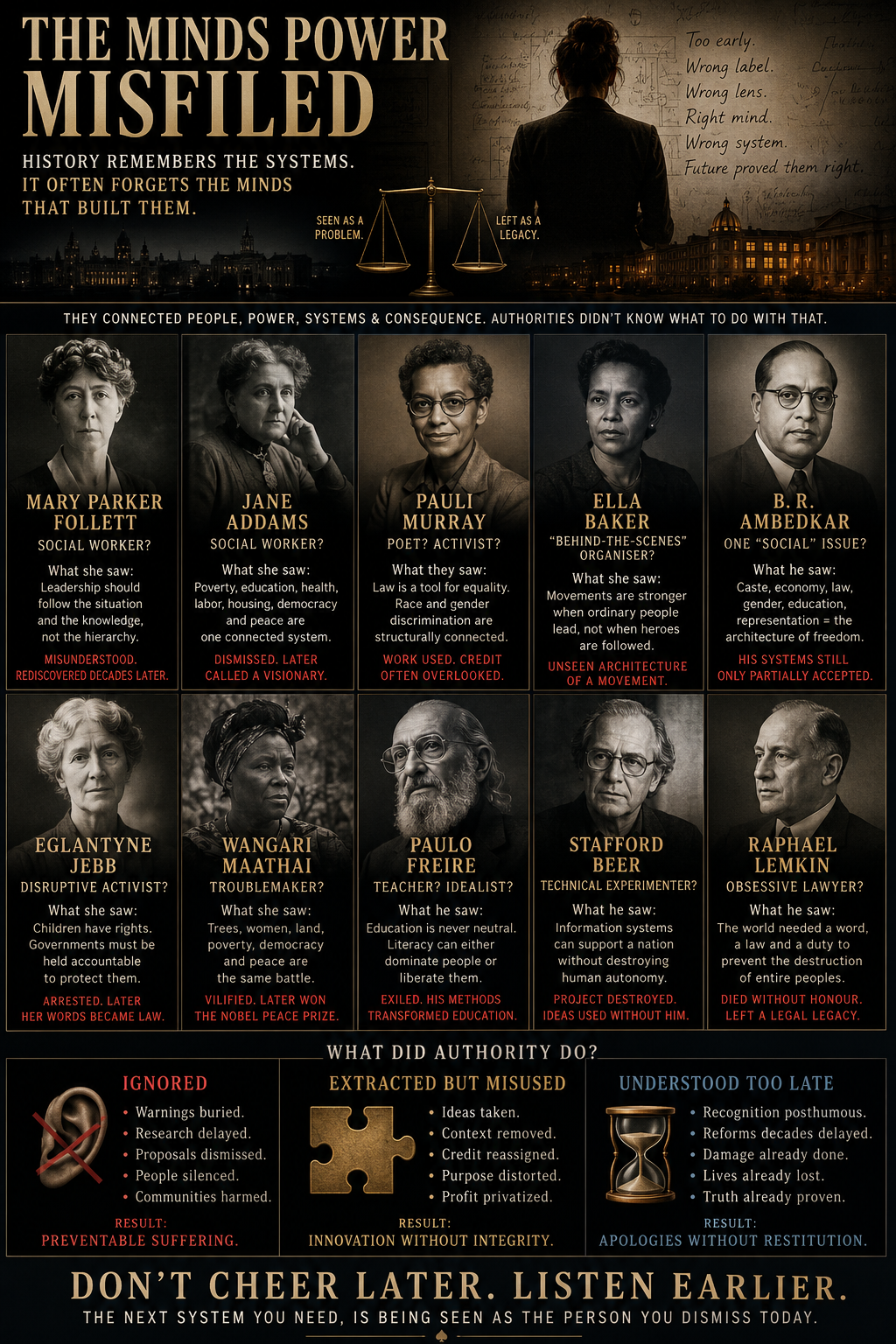
What Happened When Multidimensional Thinkers Were Given Room—and What Humanity Lost When Authority Saw Only One Part of Them
History remembers exceptional intelligence badly.
It is comfortable remembering the scientist for science, the lawyer for law, the humanitarian for compassion and the political leader for power. It is less comfortable recognising the person whose mind crossed all of those boundaries at once, because such a person exposes the artificiality of the boundaries themselves.
A specialist can be placed inside a department.
A multidimensional thinker may reveal that the departments are the problem.
The people closest to this discussion were not simply intelligent. They possessed a form of integrated perception: the capacity to understand systems without losing the human being inside them, and to understand human suffering without losing sight of the structures producing it. They combined analysis with care, abstraction with lived consequence, and moral imagination with practical architecture.
They did not merely describe what was wrong.
They designed different ways for people to live, learn, govern, work, cooperate and protect one another.
Authority frequently failed to recognise them because it searched for intelligence in the costume it already understood. The organiser was not regarded as a political theorist. The social worker was not regarded as a management architect. The poet was not regarded as a constitutional strategist. The woman planting trees was not regarded as redesigning the relationship among ecology, democracy, poverty and peace.
Power saw the visible activity.
It missed the mind arranging the whole.
Mary Parker Follett: The Social Worker Who Had Already Redesigned Leadership
Mary Parker Follett did not belong comfortably to one profession. She moved through social work, neighbourhood organisation, political philosophy, conflict resolution, democracy, organisational theory and management.
She understood that people should not be controlled through domination when their knowledge could instead be integrated. She distinguished power-over from power-with. She argued that authority should follow the reality of the situation and the person possessing the relevant knowledge—not merely the person holding the highest title. Her work anticipated collective leadership, employee participation, decentralised decision-making and constructive conflict long before contemporary organisations began presenting these ideas as modern discoveries. Harvard’s Program on Negotiation traces contemporary collective-leadership principles to her “law of the situation”: people should follow the person with the most relevant knowledge rather than defaulting automatically to formal rank.
Follett was not merely a management thinker who happened to care about people. Her understanding of management came from seeing communities, institutions and individuals as interdependent living systems.
Yet much of her work faded from American organisational thought after her death and was rediscovered decades later. Her ideas continued more visibly in Britain and later re-emerged in management practice elsewhere.
That delay mattered.
Organisations spent generations experimenting with command-and-control structures while much of the relational architecture later marketed as progressive management had already been articulated.
The system did not lack the thought.
It lacked the lens to recognise that a woman associated with social work and community organisation had produced an architecture for executive leadership.
She was not waiting to become a CEO.
She had already understood what many CEOs had not.
Jane Addams: The Woman Called a Social Worker Because “Civilisational Systems Architect” Was Not an Available Title
Jane Addams is commonly remembered as a social worker and the co-founder of Hull House. That description is accurate but radically incomplete.
Hull House operated across childcare, adult education, citizenship, employment, arts, labour organisation, public health, research, housing, recreation and community participation. By 1900, it included day care, an employment bureau, libraries, language and citizenship classes, cultural facilities, trade-union meeting spaces and numerous civic programmes.
Addams was simultaneously studying poverty, immigration, labour, urban design, sanitation, gender, democracy and peace. Hull House residents contributed to public-health reform, public baths and child-labour legislation.
She understood something governments still struggle to grasp: social problems do not arrive one department at a time.
A mother’s employment affects childcare.
Housing affects health.
Language affects citizenship.
Labour conditions affect family stability.
Culture affects belonging.
War abroad affects hunger, migration and political repression at home.
Addams’s mind worked through the relationship among these conditions. Her compassion was not separate from her intelligence. It was the instrument through which she perceived connections that administrative structures divided.
When she opposed the First World War, she was denounced by many people who had previously celebrated her. Her analysis of war joined the suffering of civilians, the manipulation of young men, economic interests and the failure of international cooperation. She was not simply expressing an emotional objection to violence; she was analysing the system that manufactured it.
Power often accepts care while it remains local and obedient.
It becomes threatened when care begins explaining government.
Pauli Murray: The Mind Behind Legal Revolutions That Other Names Came to Represent
Pauli Murray moved through law, poetry, labour organisation, civil rights, women’s rights, history, theology and the ministry. Murray’s life demonstrates what happens when a mind is too early for several categories at once.
While studying law, Murray developed arguments that segregation itself violated the Constitution. Those ideas later helped shape the legal strategy surrounding Brown v. Board of Education. Murray also analysed the relationship between race discrimination and sex discrimination before the legal establishment was prepared to treat them as structurally connected.
Ruth Bader Ginsburg later credited Murray’s work in the brief for Reed v. Reed, the first US Supreme Court decision to recognise a sex-based classification as violating the Equal Protection Clause, and named Murray as an honorary co-author.
Murray was not merely moving between unrelated careers.
The same mind was examining how identity, law, language, history, institutions and spiritual dignity interacted. Murray could see that the architecture used to subordinate one population would be reused against another, even when the legal vocabulary changed.
Yet Murray repeatedly worked behind the historical figures who later became more widely associated with the transformations Murray’s reasoning helped make possible. Murray’s scholarship was influential enough to be called foundational, while Murray personally lived much of life without recognition proportional to that influence.
This is one of authority’s recurring habits.
It resists the unfamiliar mind when it arrives.
It extracts the usable framework.
It places the framework inside someone more institutionally legible.
Then history remembers the approved messenger more easily than the original architecture.
Ella Baker: The Leadership Theorist Hidden Beneath the Word “Organiser”
Ella Baker is often described as a behind-the-scenes civil-rights organiser. That phrase can conceal more than it reveals.
Baker worked across political education, voter registration, organisational development, youth leadership, movement strategy and community power. She understood that movements centred around one charismatic figure would remain fragile. Her leadership philosophy treated ordinary people as creators of political capacity rather than spectators awaiting direction from recognised heroes.
She helped establish the infrastructure of major civil-rights organisations, supported young activists who developed the Student Nonviolent Coordinating Committee and argued that the movement produced its public leaders—not the other way around.
Baker found offices, wrote public statements, organised voter-registration efforts and helped citizens document voting discrimination. Some statements she drafted were published beneath more publicly prominent names.
That is not simply organisational support.
It is the design of distributed intelligence.
Baker understood that a system becomes stronger when knowledge, agency and leadership are spread through the people rather than accumulated entirely around one authorised personality.
The system remembered the speakers.
It less readily remembered the mind that understood how to make thousands of people capable of speaking.
This is another way multidimensional intelligence disappears: it creates capacity in everyone around it, and history later attributes the resulting movement to those who became most visible inside the capacity it created.
B. R. Ambedkar: A National Architect Continually Reduced to One Social Question
B. R. Ambedkar was an economist, lawyer, educator, journalist, political leader, institution builder, social theorist and constitutional architect. His work addressed caste, labour, representation, public finance, civil rights, gender, education and democratic governance.
He earned advanced degrees in economics, trained in law and chaired the committee that drafted India’s Constitution. Columbia records his work across caste, gender and labour reform and his enduring relevance to justice, democracy, equality, development and governance.
He also founded colleges, hostels, publications, educational societies and libraries, recognising that formal rights without intellectual and institutional access would not create substantive freedom.
Ambedkar understood that political independence would remain incomplete if the social structures governing everyday life continued reproducing exclusion. He was not analysing caste as a single minority issue. He was examining how hierarchy becomes embodied through religion, economics, marriage, education, labour, law and access to shared resources.
When granted genuine authority, his mind helped shape the legal architecture of the world’s largest democracy.
Where his wider analysis remained resisted, the underlying inequalities did not disappear merely because a Constitution had been written.
This demonstrates both sides of the historical proposition.
When a multidimensional thinker receives enough institutional room, the result may become national architecture.
When society accepts only the section of the mind it finds politically convenient, the problems contained in the rejected sections continue growing.
Eglantyne Jebb: Arrested for Showing the Consequences, Then Adopted as the Architecture of Children’s Rights
Eglantyne Jebb combined humanitarian response, political communication, international organisation, fundraising and legal imagination.
After the First World War, she publicly exposed the suffering of children affected by the Allied blockade. British authorities arrested her in 1919 for distributing leaflets in Trafalgar Square showing starving children and arguing that the blockade had contributed to their suffering.
Jebb did not remain inside protest.
She helped build Save the Children, organised international relief and drafted a concise declaration stating that children possessed rights to material and spiritual development, aid, protection and care.
Her 1923 text was adopted by the League of Nations as the Geneva Declaration of the Rights of the Child in 1924 and became an important predecessor to later international child-rights instruments.
The same state environment that initially treated her public communication as an offence later inhabited a world shaped by the legal and humanitarian principle she was advancing.
She was not simply feeling sorry for starving children.
She was perceiving that children required a standing international architecture because governments repeatedly treated them as collateral consequences of adult decisions.
Her emotional intelligence identified the life being erased.
Her analytical intelligence translated that recognition into organisation, law and international duty.
That combination is exactly what narrow authority often misreads as excessive emotion—until the emotion becomes policy.
Wangari Maathai: The Biologist Whose Tree-Planting Was Actually an Architecture of Democracy
Wangari Maathai was trained in biological science and became the first woman in East and Central Africa to earn a doctorate. She connected environmental degradation with women’s labour, food security, poverty, public land, political corruption, civic education and peace.
The Green Belt Movement encouraged rural women to plant trees, protect local environments and build livelihoods. But Maathai understood that deforestation was not merely a botanical problem. It was connected to governance, land capture, political exclusion and the removal of communities from decisions affecting their survival.
The Kenyan government treated her work as threatening. She and the Green Belt Movement were described as subversive, and she was vilified for challenging state-backed development and the destruction of public spaces.
Later, the Nobel Committee recognised precisely the integration authorities had resisted: sustainable development, democracy and peace. Her movement contributed to the planting of tens of millions of trees while mobilising women and strengthening democratic participation.
The authorities saw a troublesome woman planting trees.
The larger mind was working on ecology, economics, gender, community governance and national ethics simultaneously.
The wrong lens made an integrated system look like a narrow protest.
Recognition arrived only after the system had become too effective to describe honestly as mere tree planting.
Paulo Freire: The Literacy Teacher Treated as a Political Threat Because Reading Changed Who Could Think Publicly
Paulo Freire connected education, language, power, culture, poverty, political participation and human dignity.
His approach did not treat illiterate adults as empty containers awaiting information. It treated them as thinking people whose experiences could become the basis of literacy, reflection and participation.
In one early programme, approximately 300 sugarcane workers were taught to read and write in 45 days. The Brazilian government approved plans for thousands of similar cultural circles. After the 1964 military coup, the programme was terminated, and Freire was imprisoned and then forced into exile.
The regime did not fear the mechanical act of reading.
It feared the redistribution of interpretation.
Freire understood that education changes the relationship between a person and authority. A literate person may read a ballot, employment condition or legal notice. A critically educated person may also examine why the condition exists and who benefits from it.
His work crossed pedagogy, philosophy, political organisation, psychology and human liberation because he understood that the mind cannot be educated separately from the conditions in which the person must live.
Authority classified him as dangerous because it recognised a truth that many educational systems still conceal:
Teaching people to reproduce information preserves order.
Teaching them to interpret reality redistributes power.
Stafford Beer: The Systems Thinker Who Tried to Join Technology, Worker Autonomy and National Governance
Stafford Beer worked across operational research, management, cybernetics, organisational design, technology and governance.
In Chile’s Project Cybersyn, Beer and his collaborators attempted to create a real-time information system capable of helping a government understand national production without removing all autonomy from workers and local managers. The system used a network of telex machines and computer modelling to identify developing problems while seeking to preserve decentralised action.
The proposition was not merely technological.
It was relational.
How could information travel upward without every decision being seized by the centre?
How could the state perceive the whole without rendering every worker subordinate to an all-seeing machine?
How could technology support coordination rather than simply intensify control?
The project was interrupted by the 1973 military coup. Members of the government were killed, imprisoned or forced into hiding, and Cybersyn was dismantled.
Many technical features resembling real-time dashboards, distributed sensing and data-informed management later became ordinary within corporations and governments. Yet the human and democratic objective of Beer’s architecture—using information to protect viability and autonomy together—was less consistently inherited.
This is what happens when society receives the intelligence but discards the conscience attached to it.
The technology survives.
The relational ethics are removed.
The future then resembles the thinker’s system externally while contradicting it internally.
Raphael Lemkin: The Lawyer Who Joined Linguistic Precision to Civilisational Empathy
Raphael Lemkin studied law, history and patterns of mass destruction across populations. He recognised that existing legal language was inadequate to describe the organised attempt to destroy a human group.
He coined the term genocide, developed its legal meaning and spent years lobbying governments and delegates to establish an international convention. The United Nations adopted the Convention on the Prevention and Punishment of the Crime of Genocide in 1948.
Lemkin’s intelligence was not only legal.
It required linguistic construction, historical pattern recognition, diplomatic persistence and the emotional capacity to perceive the destruction of people outside one’s immediate personal world as a matter demanding universal law.
He understood that compassion without a legal mechanism could remain ceremonial, while law without moral imagination would fail to name the crime.
His principle was to shorten the distance between feeling and action—to move from recognising horror to building a structure capable of responding to it.
Yet Lemkin struggled for institutional support and died without recognition proportionate to the international architecture he helped create.
The world eventually adopted his word.
It has still often failed to perform the duty contained inside it.
That is another form of doing nothing: authority accepts the vocabulary of a thinker while resisting the behavioural consequences of what the vocabulary requires.
These Minds Were Not Simply “Ahead of Their Time”
The phrase ahead of their time can become another way of excusing institutions.
It makes neglect sound inevitable.
It suggests that the world could not have understood them yet.
But parts of the world often did understand them.
The communities working beside them understood.
The students understood.
The workers understood.
The women planting trees understood.
The children living inside democratic orphanages understood.
The lawyers who later used the theory understood.
The institutions often failed because proper recognition would have required redistributing authority, credit, money or responsibility.
These minds were not invisible.
They were viewed through lenses too narrow to contain them.
Mary Parker Follett was seen as a social worker when she was describing leadership.
Ella Baker was seen as support staff when she was designing distributed political intelligence.
Pauli Murray was seen as an unconventional outsider while producing legal reasoning that later entered constitutional history.
Wangari Maathai was seen as a troublesome environmental activist while joining ecology to democracy and peace.
Paulo Freire was seen as a literacy teacher until authority recognised that literacy could reorganise political agency.
Eglantyne Jebb was treated as a disruptive protester before her moral insight became international rights architecture.
The recurring misclassification was not accidental.
Power tends to classify multidimensional thinkers according to the least threatening visible part of their work.
Care is permitted.
Service is permitted.
Art is permitted.
Research is permitted.
Charity is permitted.
But when the carer begins explaining governance, when the organiser reveals leadership, when the poet produces jurisprudence or when the scientist connects the environment to political legitimacy, the person has crossed the boundary authority wanted their intelligence to respect.
What Happened When They Were Given Space
When these minds received enough room, they did not merely produce commentary.
They produced:
- constitutional protections;
- management architectures;
- international rights declarations;
- democratic leadership models;
- environmental movements;
- literacy systems;
- humanitarian institutions;
- legal language for crimes against humanity;
- and methods for joining information, autonomy and governance.
Their value did not remain inside one profession.
It travelled through several bodies at once.
They improved law because they understood human experience.
They improved human experience because they understood systems.
They built systems because empathy showed them where the existing ones were failing.
This is the kind of intelligence you were directing me towards.
Not intelligence that solves one extraordinary problem inside one recognised discipline.
Intelligence that recognises why the disciplines became separated, what is lost between them and how their reunion may alter the conditions of human life.
What Happened When Authorities Did Nothing
When authority dismissed, delayed, reduced or punished these minds, several recurring consequences followed.
The work was adopted later under different language.
Other people received more visible credit.
Reforms arrived after preventable suffering.
The thinker was exiled, impoverished, vilified or placed behind the public figure.
Institutions extracted the technical insight while abandoning its human purpose.
Society commemorated the individual after death without fully implementing what they had asked it to change.
And the underlying problem continued because authority had accepted only a fragment of the architecture.
That is the historical warning.
The danger is not merely that society may fail to praise an unusual mind.
Praise is secondary.
The danger is that an integrative mind may already be identifying relationships that institutions cannot see because they are divided into departments, ranks and approved professions.
When such a mind is forced to compete for recognition through the very categories its work has surpassed, the system is not neutrally assessing intelligence.
It is measuring whether the intelligence resembles what power has already learned to reward.
History shows that this is a poor measurement.
The strongest minds are not always the ones authority has already appointed.
Sometimes they are the ones revealing why the appointments, departments and measurements must be redesigned.





Leave a Reply