
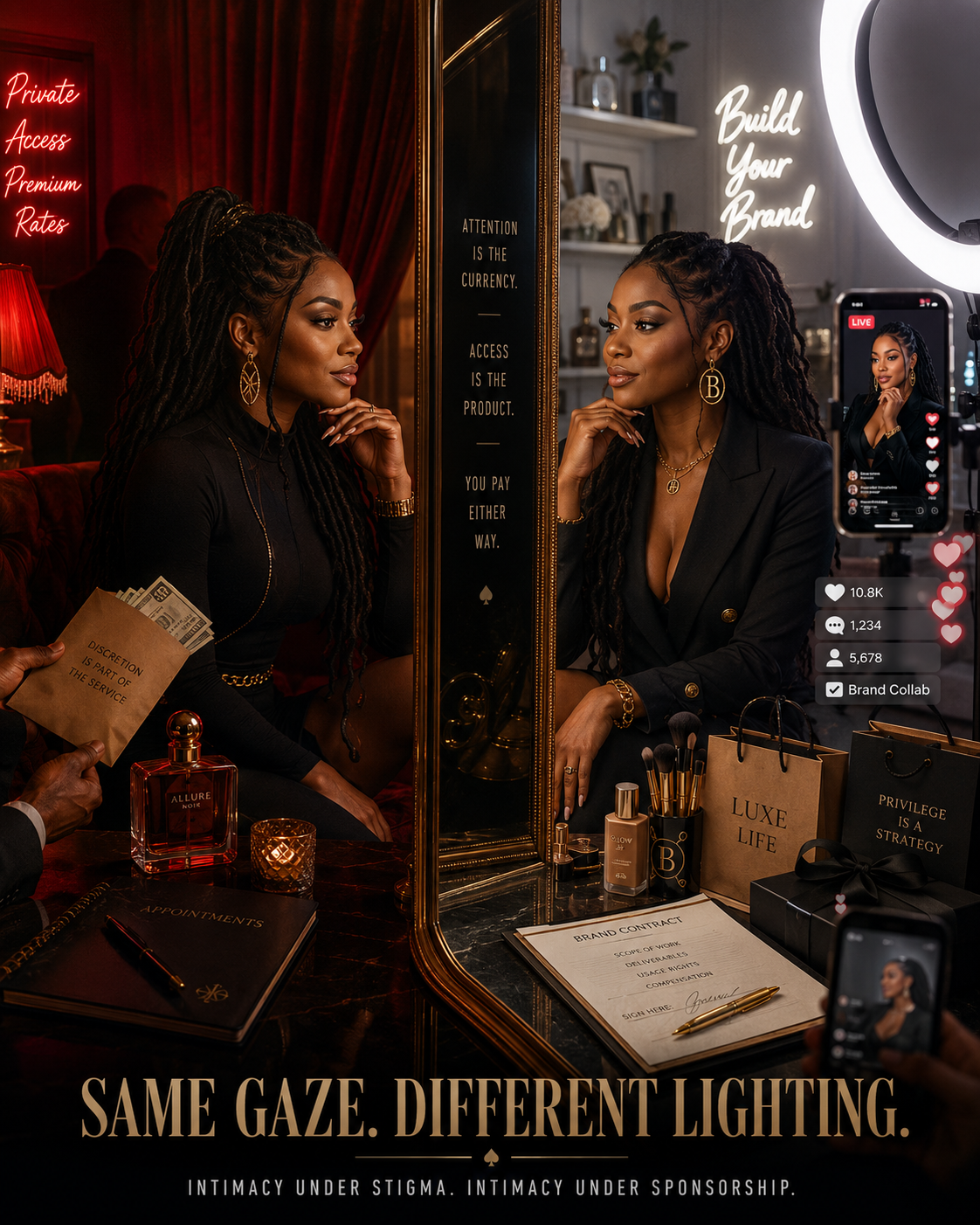
This blog is my naked body n soul n mind, I’m being a digital prostitute too. Hey, own ut.
The Professional and Luxurious Mirror of Selling Intimacy, Attention and Desire
When people hear the word prostitute, they picture someone selling access to their body, sexuality, intimacy or time. When people hear the word influencer, they picture ring lights, curated bedrooms, luxury holidays, gifted products, brand partnerships, followers and carefully edited photographs. One is treated as degradation. The other is treated as aspiration. One is associated with desperation, exploitation and social shame. The other is invited to fashion shows, paid to attend launches and praised for turning visibility into a business.
Yet when the decoration is removed, the two professions share far more than most people are comfortable admitting.
Both begin with the commercialisation of personal access.
The prostitute sells access directly: to the body, physical intimacy, companionship, fantasy or a controlled experience. The influencer sells access indirectly: to appearance, personality, lifestyle, vulnerability, desirability, private space, emotional familiarity and the illusion of participation in their life. One may charge for an appointment. The other charges through subscriptions, sponsorships, affiliate links, exclusive content, livestream gifts, appearances and the purchasing behaviour their attention can generate.
The form of access is different, but access remains the product.
That is the first similarity: the self is not merely the seller—the self becomes part of what is being sold.
A conventional employee may sell labour while keeping most of their identity outside the transaction. The influencer and the prostitute cannot separate themselves so easily from the product. Their face, body, voice, mannerisms, mood, desirability, personality and availability all influence their earning capacity. The audience or client is not purchasing only an external object. They are purchasing proximity to a person, even when that proximity has been carefully staged.
The prostitute may sell the experience of being desired.
The influencer may sell the experience of knowing someone desirable.
Both understand that fantasy often earns more than reality.
A sex worker does not necessarily sell their private self. They may construct a persona, adopt a name, select clothing, manage tone, perform confidence, exaggerate attraction and create an experience with a clear beginning and ending. The influencer does the same through branding. They select which personality traits will be visible, which parts of the home will appear on camera, which relationships will be shared, which struggles will become content and which moments will remain hidden.
In one industry, this is called performing a fantasy.
In the other, it is called personal branding.
Both require the management of perception. Lighting matters. Clothing matters. Presentation matters. Timing matters. Facial expression matters. Confidence matters. The ability to make another person feel seen matters. The ability to appear available without becoming completely accessible matters.
One prepares a room.
The other prepares a frame.
One creates atmosphere through touch, conversation and physical presence.
The other creates atmosphere through music, editing, captions and camera angles.
Both are expected to transform an ordinary human encounter into something another person considers worth paying for.
The influencer does not always ask followers for money directly. That is part of what makes the profession appear more respectable. The commercial request is placed behind lifestyle, humour, beauty, advice, confession, outrage, inspiration or entertainment. The audience watches because they believe they are receiving a personality, a story or a relationship. The transaction may arrive later through a product recommendation, subscription, ticket, paid community or sponsored post.
The influencer’s greatest commercial skill is often making the transaction feel like intimacy.
They say, “You all kept asking me about this.”
They say, “I would never recommend anything I do not genuinely love.”
They say, “Come and spend the day with me.”
They say, “Get ready with me.”
They say, “You are like family.”
These phrases create emotional closeness before commercial conversion. Followers are not only shown a product. They are invited into an atmosphere in which purchasing the product feels like participating in the influencer’s life.
The prostitute may also create emotional closeness as part of the experience. The client may not only want sex. They may want attention, admiration, conversation, reassurance, affection, escape or temporary relief from loneliness. The physical transaction may be the recognised service, but the emotional transaction may be what keeps the client returning.
Both professions therefore understand something many industries pretend not to know:
People rarely pay only for the visible product. They pay for how the interaction allows them to feel.
The influencer sells aspiration, familiarity and imagined belonging. The prostitute may sell desire, companionship and temporary intimacy. Both may be required to make another person feel important without giving that person unrestricted ownership over them.
This requires emotional labour.
Both must learn how to read people. They observe attention, insecurity, loneliness, obsession, entitlement, generosity, hesitation and desire. They learn which presentation attracts which audience. They learn what makes people return, spend more, subscribe, tip, share, recommend or become possessive.
In influencer culture, this is called audience insight.
In sex work, it may be called client management.
Both are forms of human-dynamics analysis conducted under commercial pressure.
Both also depend upon repeat attention.
A sex worker may rely upon regular clients. An influencer relies upon returning viewers, subscribers and followers. It is not enough for someone to look once. Attention must become habitual. The person must return often enough for the relationship to become commercially valuable.
The client returns to the same person.
The follower returns to the same page.
The customer purchases familiarity as much as novelty.
This is why both professions must manage the tension between repetition and freshness. The persona must remain recognisable enough to create attachment but new enough to sustain interest. There must be continuity without complete predictability. Enough familiarity to feel intimate. Enough distance to preserve desire.
The influencer calls it maintaining engagement.
The prostitute may call it keeping the fantasy alive.
Both professions also exist beneath systems that take a percentage from the person being watched.
A sex worker may answer to a brothel, agency, manager, landlord, booking platform or exploitative controller. An influencer may answer to a talent agency, management company, social-media platform, advertising network, production team or brand. The structures look different, but both can profit from arranging access to another person’s image, labour and desirability.
The platform provides visibility but takes control of distribution.
The agency provides opportunity but takes commission.
The brand provides money but demands influence over presentation.
The algorithm acts as a silent gatekeeper, determining who will be seen, how often and under what conditions.
The influencer may appear independent while remaining dependent upon systems they do not own. Their followers may belong to the platform. Their visibility may disappear after an algorithmic change. Their income may collapse after demonetisation, account suspension, public controversy or a change in audience appetite.
The prostitute may be accused of selling their body.
The influencer sells access to a body and personality whose visibility is controlled by someone else’s technology.
One may work beneath a red light.
The other works beneath a ring light.
Both lights indicate that a version of the self is now available for public consumption.
The influencer’s version is treated as luxurious because the audience is not always permitted to admit what it is consuming. It may say it follows for fashion, fitness, motivation, comedy or advice, while the influencer’s appearance, attractiveness, relationships and apparent private life remain central to the attention.
Desire is made respectable by attaching a product to it.
A photograph designed to attract the gaze becomes content.
Flirtation becomes engagement.
Exposure becomes empowerment.
Public access to private life becomes authenticity.
The sale of desirability becomes entrepreneurship.
Again, this does not mean every influencer creates sexual content or that every sex worker provides the same service. The comparison is not based solely upon sex. It is based upon the commercial architecture of intimacy, attention, fantasy and personal access.
A family influencer may sell access to domestic intimacy.
A beauty influencer may sell access to physical aspiration.
A fitness influencer may sell access to discipline and body transformation.
A lifestyle influencer may sell access to imagined status.
A relationship influencer may sell access to emotional drama.
A spiritual influencer may sell access to meaning and perceived revelation.
A prostitute may sell sexual intimacy, companionship, attention or fantasy.
The content changes. The monetised proximity remains.
Both professions must also establish boundaries against people who believe payment creates ownership.
The client may believe money entitles them to ignore limits.
The follower may believe attention entitles them to private information, immediate responses, political agreement, emotional access and permanent consistency.
The prostitute may be told, “I paid, so you should do what I want.”
The influencer may be told, “We made you famous, so you owe us everything.”
Both are punished when the audience forgets that access was conditional.
This is one reason both professions can become psychologically demanding. The performer must create closeness while continuously defending the line between the presented self and the private self. They must be available enough to maintain income but unavailable enough to retain sovereignty.
Too much distance reduces commercial value.
Too much access destroys personal safety.
The Goldilocks zone is profitable intimacy without complete surrender.
Both may also experience objectification as a condition of earning. Their physical appearance is examined, discussed, ranked and compared. Ageing may affect income. Weight changes may affect attention. Clothing may be interpreted as commercial messaging. Relationships may become part of the product. Pregnancy, illness, cosmetic procedures, sexuality and emotional breakdown may all become financially valuable to observers.
The body becomes a public marketplace even when no physical contact occurs.
The influencer may be praised for monetising the gaze that would have existed anyway. Yet this empowerment remains conditional. The same public that rewards exposure may later shame the person for being too visible. The audience may demand sexuality and then punish the person for appearing sexual. Brands may profit from desirability while requiring the influencer to remain respectable enough to protect corporate reputation.
Sex workers have lived inside that contradiction for centuries.
Society consumes what it publicly condemns.
It creates demand, hides the demand, then places the shame upon the person who supplied it.
Influencer culture modernises the same contradiction. Millions may watch, speculate, sexualise, imitate and purchase, while pretending the commercial power emerged from a neutral appreciation of content. The audience’s desire becomes invisible. Only the influencer’s decision to monetise it remains open to judgement.
Both industries also turn attention into a rating system.
The prostitute may be rated by clients or reviewed on a platform.
The influencer is rated continuously through views, likes, comments, shares, watch time, follower growth and conversion rates.
The prostitute may know whether the client was satisfied after the encounter.
The influencer receives mass judgement every minute.
A declining number becomes a public verdict upon relevance.
The body, personality and life are reduced to performance indicators.
A post that does not travel becomes a failed shift.
A loss of followers becomes a loss of customers.
A low engagement rate becomes a reduction in market value.
The influencer does not merely create content. They repeatedly enter a digital street and wait to see whether strangers will stop, look, desire, approve and pay.
This also explains why controversy is so commercially powerful. Attention does not need to be affectionate to remain valuable. Admiration, envy, outrage, attraction and hatred can all increase visibility. The influencer may be criticised for becoming provocative while the platform rewards the provocation with wider distribution.
The sex industry has always understood that taboo intensifies attention.
Influencer culture packages taboo for advertisers.
The luxury lies not in the underlying exchange but in who is permitted to name it.
A prostitute who charges for personal access may be treated as morally fallen.
An influencer who charges thousands for a sponsored representation of personal access may be treated as commercially brilliant.
A sex worker may sell an hour.
An influencer may sell a minute of their audience’s attention.
A sex worker may negotiate with one client.
An influencer negotiates with brands seeking access to thousands or millions of people who feel emotionally connected to them.
The influencer becomes both the person being consumed and the broker of everyone else’s consumption.
They are the product, the advertisement and the marketplace at once.
This does not make influencing inherently immoral, just as selling sexual services does not automatically define the morality, intelligence or dignity of the person doing it. Both professions may involve agency, coercion, opportunity, exploitation, skill, survival, strategy, creativity or some combination of these. The point is not to flatten every individual circumstance into one judgement.
The point is to reveal the social hypocrisy through which similar commercial mechanisms receive opposite moral labels.
Society does not object to the sale of intimacy consistently.
It objects according to packaging, class, setting and who is collecting the profit.
When intimacy is sold in a room by a person society has already marginalised, it is called prostitution.
When intimacy is broadcast through a global corporation, converted into advertising revenue and delivered beside luxury products, it is called influencing.
The corporate structure cleans the transaction without necessarily changing its foundation.
There is a booking instead of an appointment link.
There is lingerie instead of a sponsored outfit.
There is a client list instead of a follower count.
There is a private fantasy instead of a parasocial relationship.
There is a payment envelope instead of a brand invoice.
There is a pimp or agency instead of a talent manager.
There is a room fee instead of a platform percentage.
There is a street corner instead of an explore page.
There is a red light instead of a ring light.
The technology changes the reach. The branding changes the status. The underlying dependence upon attention, desire and access remains.
The influencer is the professional and luxurious mirror of the prostitute because influencing takes the commercialisation of personal intimacy and surrounds it with legitimacy. It gives exposure a media kit, desirability a brand strategy, emotional access a subscription tier and objectification an engagement report.
It allows a person to sell the feeling of knowing them without describing the transaction as a sale of intimacy.
It allows corporations to profit from the body while claiming they are only hosting content.
It allows audiences to consume closeness while pretending they are merely following a page.
The prostitute says, directly or indirectly:
You may access this part of me under these conditions.
The influencer says:
You may watch this version of me, believe you know me and purchase what I place inside that relationship.
Both depend upon boundaries.
Both depend upon performance.
Both depend upon desire.
Both depend upon strangers attaching value to access.
The greatest difference is not that one sells the self and the other does not.
It is that one transaction is socially exposed while the other is professionally disguised.
The prostitute sells intimacy under stigma.
The influencer sells intimacy under sponsorship.
Same gaze. Different lighting.






Leave a Reply