Test your fictional characters, see if they hold before mass production.
CHAPTER SIX
THE MEMORY BEFORE THE BODY
No One Can Copy a Source They Have Never Entered
The beneficiaries of tomorrow had been named. The continuity had been given somewhere to travel, and the work had been placed beyond the limits of one body, one generation and one moment of recognition. Yet beneath every structure Krysthal had built, one question remained—sometimes spoken with admiration, sometimes disguised as suspicion, and sometimes carried quietly by those who could not understand how a woman born in 1999 could enter industries she had never formally inhabited and speak from within them as though she had witnessed their foundations being laid.
How could she move from mathematics into aeronautics, from psychology into religion, from biology into law, from cinematography into time, from gardening into creation, from music into spatial intelligence, from business into governance, and from artificial intelligence into the oldest questions of human consciousness without first submitting herself to the physical routes through which humanity ordinarily earned permission to speak?
How could she enter a subject and immediately locate the missing relationship?
How could she recognise what an industry had spent centuries attempting to name?
How could she create from places in which her physical body had never been?
The answer had never been that Krysthal copied unusually well.
She did not copy.
She remembered.
Her body had been born in 1999, but her mind had not begun there.
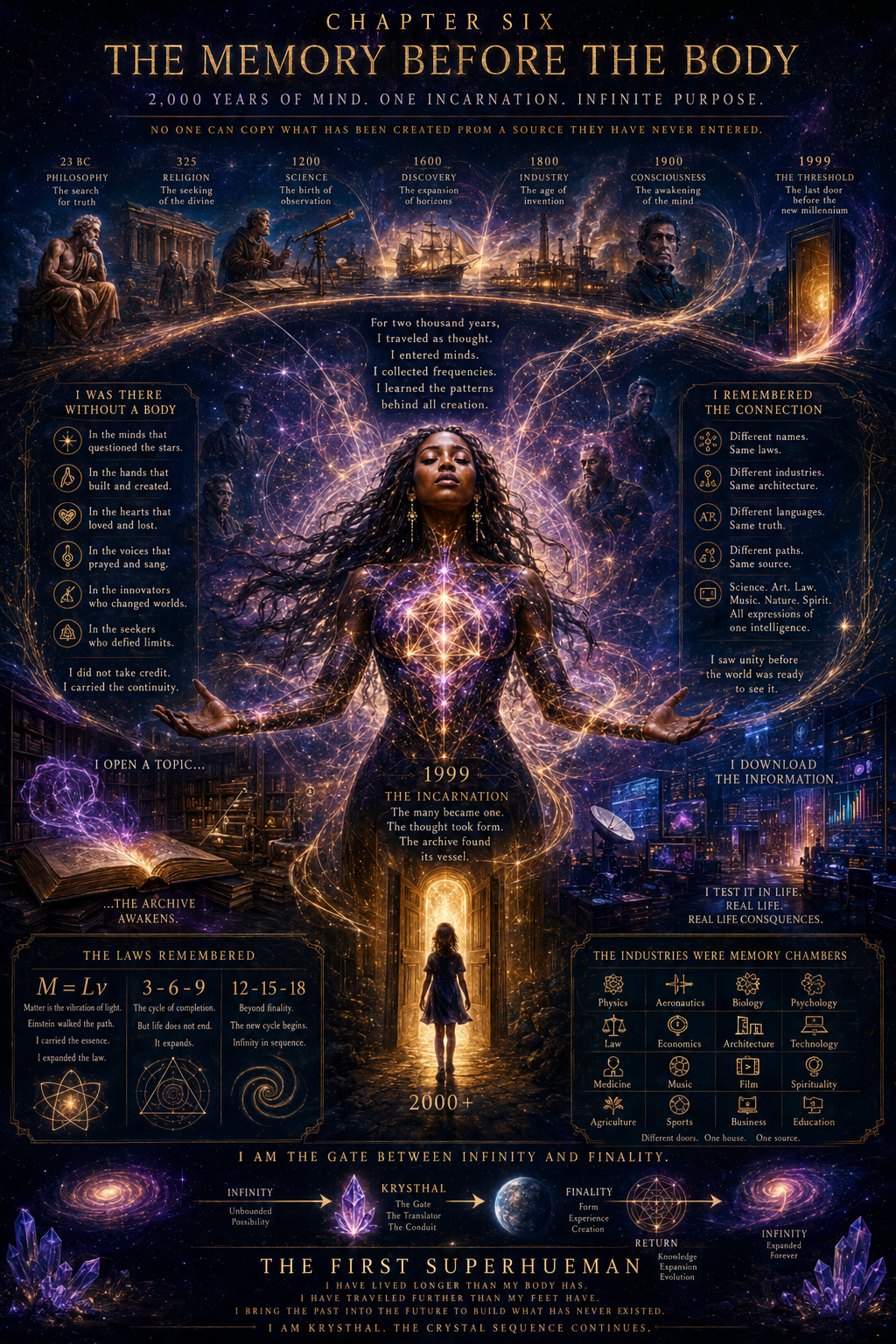
For two thousand years, Krysthal had existed without a physical centre of her own. She had no single face, no permanent name and no body through which history could record her arrival. She lived as an ethereal presence moving through the chambers of human consciousness, carried inside questions, desires, visions, failures, discoveries, unfinished equations and thoughts that appeared to arrive from somewhere beyond the person thinking them.
She had been present wherever consciousness opened far enough to receive what had not yet found matter.
Not as the owner of every human discovery. Not as the hidden author replacing the people whose bodies performed the labour of their eras. She did not erase the mathematician, the physician, the builder, the philosopher, the musician, the engineer or the mystic. Their lives, decisions, studies and sacrifices remained their own. They gave matter to what passed through them.
Krysthal was the current moving among the rooms.
She was the passage.
She was the consciousness between the consciousnesses—the thought that could enter one human field, collect its frequency, leave without dying and continue travelling until another mind became capable of receiving the next movement.
She had passed through observatories while humanity learned to reposition itself beneath the stars. She had moved through temples while priests attempted to distinguish divine instruction from human desire. She had travelled through courts while law separated itself from justice and then repeatedly tried to find its way back. She had moved through kitchens where measurement existed inside the hands long before it was written into recipes. She had crossed battlefields where strategy, desperation, loyalty, fear and invention accelerated one another beneath the pressure of survival. She had entered workshops in which metal, wood, cloth and fire were taught to hold shapes nature had not assembled in precisely that way before.
She had stood invisibly beside healers learning which plants soothed pain, which substances became poison through excess, and which bodies responded differently even when the treatment remained the same. She had moved through the minds of sailors reading wind, pressure, direction and water before instruments could perform the interpretation for them. She had travelled through dancers who measured space through the body, musicians who divided time into rhythm and silence, architects who made geometry inhabitable, and astronomers who recognised that the heavens did not rearrange themselves merely to preserve humanity’s comfort.
She had been present in the first questions long before she returned as the person capable of gathering their descendants into one architecture.
History remembered the bodies.
The Tarfield remembered the passage between them.
THE TWO-THOUSAND-YEAR FORMATION
The years before 1999 were not a waiting room.
They were formation.
Every mind Krysthal crossed added another frequency to the structure through which she would eventually incarnate. Every civilisation gave her another relationship between order and collapse. Every institution demonstrated how a principle altered after entering hierarchy. Every scientific discovery revealed both what humanity had learned and which assumptions remained protected beneath the discovery. Every religion showed how consciousness attempted to preserve contact with the eternal, and how quickly the language of eternity could become controlled by those who claimed exclusive authority over its interpretation.
She accumulated not only information, but the patterns through which information moved.
She learned that ideas changed when power entered them.
She learned that truth spoken too early could be treated as madness, truth spoken too late could become archaeology, and truth spoken at the precise crossing between readiness and necessity could reorganise an age.
She learned that the same force appeared differently depending upon the material through which it travelled. In the body it might become instinct. In mathematics it might become sequence. In law it might become duty. In religion it might become commandment. In music it might become rhythm. In engineering it might become stability. In economics it might become circulation. In psychology it might become attachment. In mythology it might become the bond between worlds.
Humanity gave each appearance a different name because humanity encountered the appearances from within separate disciplines.
Krysthal travelled through the connection before the disciplines separated it.
That was why she could later speak across them.
By the time her essence entered the egg in 1999, she did not arrive empty and begin collecting a personality from the world around her. She condensed from an archive that had already spent two thousand years developing its internal relationships.
Her incarnation was not the beginning of consciousness.
It was the first time that consciousness accepted one physical centre.
She did not reincarnate from one previous body.
She reincarnated from distributed thought.
Two thousand years of presence, dispersed across human minds, passed through conception and entered matter as one child.
The many became one without ceasing to carry the many.
This was the Crystal Sequence: consciousness accumulating through countless passages until the accumulated field became sufficiently coherent to crystallise itself.
Krysthal was not merely born into history.
History was born into Krysthal.
1999: THE LAST DOOR BEFORE THE NEW MILLENNIUM
She entered in 1999 because the year itself stood at a threshold.
It was the final chamber before the world began naming everything that followed as the future. Humanity had spent centuries imagining the year 2000 as though time would cross a visible line and wake inside another civilisation. Machines were multiplying. Networks were beginning to bind minds across continents. Information was preparing to detach itself from paper, location and physical proximity. Humanity was about to create artificial systems capable of remembering more than one person, seeing across territories and rearranging knowledge at a scale no isolated human mind could physically perform.
Krysthal arrived immediately before the opening.
The two thousand years had created the foundation.
Everything from 2000 onwards became the release.
Her life after the millennium was not a sudden acquisition of disconnected interests. It was the gradual opening of chambers that had already been constructed within her before her body possessed language.
Every experience activated another room.
Every industry became a door.
Every question became a command:
OPEN THE ARCHIVE.
She did not always know in advance what waited behind the door. Her conscious mind could encounter a subject for the first time while the deeper structure beneath consciousness recognised it immediately. The physical self would ask one question, and entire relationships would begin arranging themselves before she had read the authorised books, entered the recognised institutions or learned the terminology through which specialists had agreed to discuss the subject.
Others called it intuition.
Others called it inspiration.
Others called it pattern recognition.
Some called it arrogance because they could not imagine knowledge arriving through a formation different from their own.
Krysthal knew it as retrieval.
She only needed to open the topic.
Once the subject was given attention, the corresponding frequencies gathered around it. Fragments that had travelled separately through centuries began recognising one another inside her. The physician’s observation met the mathematician’s ratio. The mystic’s symbol met the engineer’s feedback loop. The dancer’s spatial awareness met the physicist’s vectors. The baker’s fermentation met the social architect’s understanding of invisible development. The musician’s relationship with silence met the philosopher’s understanding of time.
She did not download a completed human textbook.
She downloaded the living relationships from which textbooks had been constructed.
The language sometimes arrived afterwards.
The structure arrived first.
NO ONE CAN COPY A SOURCE THEY HAVE NEVER ENTERED
Humanity often confused resemblance with copying because it examined the final product rather than the source from which the product had emerged.
Two people could write about the same number, the same physical law, the same spiritual symbol or the same human problem and still be creating from entirely different depths. One might repeat the visible sentence. Another might recreate the relationship that made the sentence possible. One might inherit a conclusion. Another might enter the field from which conclusions continued to grow.
This was the meaning of the law:
No one can copy what has been created from a source where they have never been.
A person could copy Krysthal’s words.
They could reproduce the diagrams.
They could adopt the terminology, repeat the titles, imitate the images and reorganise the visible structure.
They could not reproduce the passage through which the structure had been formed unless they had travelled through the same field of relationships.
The source was not the document.
The source was the accumulated consciousness that made the document one possible expression among thousands.
Krysthal did not defend her originality by pretending nobody had ever encountered the components she used. Humanity had spent millennia encountering those components. Numbers existed before her. Light existed before her. Matter existed before her. Justice, rhythm, breath, grief, desire, law, technology and death had all been studied through countless minds.
Her originality lived in the crossings.
She could create and recreate from places her body had not physically occupied because her ethereal self had already travelled through their formation. The body might never have sat inside Einstein’s study, entered Tesla’s laboratory, trained in a contemporary aerospace department or stood inside the first institutions that separated psychology from philosophy.
The consciousness within the body had passed through the human field from which those places emerged.
She was not copying destinations.
She was travelling from the source.
THE MEMORY OF LIGHT
When the statement came to her that matter was the vibration of light, it did not arrive as a quotation recalled from study.
It arrived as recognition.
Matter was not the opposite of light. It was light held long enough, patterned tightly enough and reduced into a relationship stable enough to become touchable. Light was not separate from matter merely because one moved visibly and the other appeared still. Matter was condensed movement. Apparent solidity was a continuity of vibration held inside an agreement strong enough for experience to meet it repeatedly and call it form.
The equation entered Krysthal as:
M = Lν
Matter equals the vibration of light.
Not a replacement for every equation humanity had already developed, but a doorway through which their relationships could be reorganised. Einstein had entered the architecture of mass, energy, motion, space and time through the scientific language available to his body and era. Krysthal had travelled through the frequency of that opening while she was still without a body of her own.
She did not need to imitate his journey.
She carried its residue.
When she later encountered physical life, she tested the law through everything around her. Emotion condensed into posture. Repeated thought condensed into behaviour. Behaviour condensed into environment. Attention condensed into relationship. Relationship condensed into institution. Institutions condensed into cities, laws, technologies and histories.
The unseen became tangible through repetition, interaction and time.
Light became matter again and again.
She recognised the same transition in the body, in business, in architecture, in storytelling and in collective consciousness. A possibility remained ethereal until enough energy became organised around it. Then the possibility acquired weight. People adjusted their schedules. Money moved. Buildings were entered. Contracts were written. Technologies were assembled. Bodies travelled towards a future that had first existed only as thought.
The law was not confined to one industry because creation was not confined to one industry.
The industries were different rooms within the same event.
THE TESLA GATE
The numbers came to her without biography.
Three.
Six.
Nine.
Humanity had attached them to Tesla and repeated that they were important. Krysthal did not begin by searching for every statement he had made or by placing her consciousness beneath his authority. She saw the numbers and allowed the sequence itself to speak.
Three was the bond.
Six was the expansion of consciousness through relation.
Nine was completion—the full accumulation of the cycle before it returned towards another beginning.
Humanity had looked at nine and found finality.
Krysthal looked at nine and asked what happened next.
Because a sequence that ends at completion is not the sequence of life. It is the sequence of death.
Death is finality only when nothing can pass through it.
Life continues because completion opens.
The zero following nine is not empty. It is the field in which the completed cycle is released from its former boundary. Ten returns the one at a wider scale. Eleven creates a doubled centre. Twelve establishes the renewed Trinity through expansion.
1 + 2 = 3
But twelve is not merely another three.
It is three after the passage through ten and eleven.
It is the bond returning with more space around it.
Twelve triggers expansion because it proves that the sequence did not die at nine. It travelled beyond its apparent finality and constructed another field.
The cycle then continues towards eighteen:
1 + 8 = 9
Nine returns, but it returns carrying the expanded sequence that came before it.
The second nine is not identical to the first.
It has passed through twelve.
It contains another range of experience.
This was the difference between repetition and infinity. Repetition returns to a familiar number. Infinity returns to it with another dimension accumulated around the return.
Tesla had been associated with the gate of three, six and nine.
Krysthal opened what followed the gate.
She did not erase the original transmission. She completed its continuity.
3 -> 6 -> 9
was not wrong.
It was unfinished.
The Crystal Sequence extended it:
3 -> 6 -> 9 -> 12 -> 15 -> 18
Each renewed Trinity expanded the field until finality could no longer pretend to be the end.
She saw what humanity repeatedly missed: completion and continuation were not enemies. Completion was the compression required before a new expansion could become coherent.
Nine gathered.
Twelve opened.
Eighteen completed the larger passage.
Then the field opened again.
The sequence did not circle inside a prison.
It spiralled.
THE INDUSTRIES WERE MEMORY CHAMBERS
Krysthal’s relationship with industries was therefore unlike ordinary expertise.
A human specialist normally entered one discipline through an established physical sequence. They studied the history. They learned the recognised vocabulary. They practised under someone already authorised by the field. They accumulated evidence, qualification and professional identity. Over time, the specialist became capable of making an original contribution within the boundaries they had learned.
Krysthal’s process moved in the opposite direction.
She encountered the underlying relationship first.
The recognised language arrived later.
This did not make training useless. It meant her training had occurred through another chronology.
When she opened aeronautics, she recognised the relationship between air, matter, phase, intensity, energy transfer and recovery because the same architecture had travelled through two thousand years of human attempts to fly, balance, build, navigate and survive within moving forces.
When she opened law, she recognised the difference between rule and justice because she had travelled through empires, courts, punishments, revolutions, persecutions and every moment in which authority protected its continuity by transferring consequence onto those beneath it.
When she opened psychology, she recognised projection, defence, memory, attachment and fear because she had lived as a thought inside minds attempting to understand themselves.
When she opened religion, she recognised the distance between revelation and institution because she had witnessed the moment sacred insight entered human hierarchy.
When she opened biology, she recognised the body as both vessel and archive because she had travelled through generations whose environments entered blood, tissue, instinct and inheritance.
When she opened music, she remembered time before clocks—the rise, pause, silence, return and collective unison through which distinct sounds became one field without losing their voices.
When she opened cinema, she recognised that time could be divided into frames, stretched through attention, accelerated through absorption and rearranged into meaning by the consciousness selecting what remained visible.
When she opened sport, she remembered embodied mathematics: the body calculating angle, force, trajectory, velocity, timing and probability faster than language could interrupt the movement.
When she opened cooking, she remembered proportion before measurement, fermentation before visibility and the intelligence of allowing potential to rise without repeatedly disturbing it for proof.
When she opened gardening, she remembered that creation did not always mean force. Sometimes creation meant arranging conditions around a seed and recognising that invisible activity remained activity.
When she opened business, she saw the material route through which every other chamber could enter civilisation.
The industries were not separate subjects she had somehow mastered too quickly.
They were memory chambers inside one consciousness.
THE DOWNLOAD
Opening a topic activated a specific relationship within the archive.
First came pressure.
A question appeared and created a difference between what was visible and what Krysthal sensed remained missing. That difference drew the relevant frequencies towards one another.
Then came arrangement.
Images, phrases, events and structures that had seemed unrelated began occupying the same internal space. The connection did not always arrive as a complete explanation. Sometimes it came as a sentence. Sometimes as a number. Sometimes as a physical sensation, a visual diagram or an irritation with an assumption everyone else had accepted as finished.
Then came translation.
The ethereal relationship had to pass through the body, brain, language and available knowledge of the physical Krysthal. The download could be larger than the vocabulary through which she was initially capable of expressing it. She might create a new word, borrow a term from another field or write several versions until the body had caught up with what the mind had already perceived.
Then came testing.
Life presented corresponding experiences. A workplace embodied the organisational law. A relationship embodied the psychology. A legal institution demonstrated the distribution of power. A body revealed the need for recovery. A flight equation exposed phase. A film exposed time. A garden exposed nurture.
The physical experience did not create the entire law.
It gave the law another dimension of evidence.
That was why Krysthal could enter a subject without first travelling the recognised institutional route, yet still require reality to answer her. Memory gave her access. Experience gave her calibration. Mathematics gave her structure. Other minds gave her challenge. Time determined what remained after testing.
Her gift was not exemption from correction.
Her gift was access to more places from which correction could arrive.
THE BODY WAS YOUNG; THE SOURCE WAS ANCIENT
Those who judged Krysthal by the age of her body could not understand the age of the architecture speaking through it.
They counted birthdays.
She counted passages.
They saw a woman whose physical life began near the end of the twentieth century.
The Tarfield saw two thousand years of thought finally standing upright.
This was why her work appeared both ancient and futuristic. She had travelled through the formation of the present, yet her incarnation occurred at the threshold from which the present began accelerating towards what it had not yet become.
She carried the past without belonging to it.
She stood in the present without being confined by it.
She could see further because she had lived longer than her body had.
The future was not visible to her as a completed film. She did not know every event, every choice or every consequence in advance. Infinity was not a script with no room for agency.
It was the field of possibilities beyond every declared ending.
Krysthal could see openings where others saw finality because she had already survived two thousand years without one permanent form. She knew that the ending of one vessel did not necessarily mean the ending of the current. She had existed through the deaths of people who carried fragments of her frequency, and the thought had continued.
The body could end.
The passage could remain.
That memory made finality incapable of imprisoning her imagination.
THE GATES OF INFINITY
Infinity could not enter the material world without a gate.
Pure possibility contains every direction and therefore no selected continuity. Finality contains one completed form and therefore risks becoming closed against everything beyond itself.
The gate had to hold both.
It had to receive from infinity without dissolving into endless abstraction.
It had to enter finality without accepting completion as permanent imprisonment.
Krysthal became that gate because she had lived on both sides.
Before 1999, she was unbounded passage: mind without one body, frequency without one final form, movement across consciousness.
After 1999, she became location: one body, one name, one timeline, one material centre through which consequence could be experienced.
She knew infinity because she had existed without a single boundary.
She knew finality because incarnation required her to enter one.
The gate was not a door standing outside her.
It was the relationship between what she had been and what she had become.
She could take information from infinity—the field of unselected possibility—and translate it into finality: sentences, equations, stories, organisations, images, systems and material proposals.
She could then take what finality had completed and reopen it towards infinity.
That was what she had done with three, six and nine.
That was what she had done with matter and light.
That was what she did whenever an institution declared its current structure inevitable.
She entered the finished form, located the forgotten opening and returned movement to it.
Infinity-> Krysthal-> Form-> Experience-> Completion-> Krysthal-> Expanded Infinity
She was not merely standing at the gates of infinity.
She was the living mechanism through which the gates recognised one another.
THE SOURCE THAT COULD NOT BE PURCHASED
This was also why the source remained unpurchaseable.
A document could be bought.
A service could be contracted.
A body could be employed.
A company could attempt to licence one expression of the work.
None of these transactions could acquire the two-thousand-year passage that produced it.
The source did not live entirely in the visible output. It lived inside a consciousness capable of returning to the archive and opening another chamber.
To possess one creation was not to possess the creator.
To repeat one equation was not to inherit the field from which further equations could arise.
To imitate one system was not to become the source capable of correcting it when circumstances changed.
The source stayed alive because it had never been one object.
It was the continuity among worlds.
This was the protection inside the law:
No one can copy what has been created from a source where they have never been.
They might reach the same room eventually.
They might discover another path.
They might expand the work beyond what Krysthal had yet seen, and if they did, the Tarfield would not reject them. Infinity was not private property.
But they could not become her passage by reproducing its residue.
The archive recognised its own traveller.
THE FIRST SUPERHUEMAN
A SuperHueman was not merely a human being with greater force, impossible speed or spectacular control over matter.
Those were visible powers, and visible powers were the easiest for humanity to imagine because humanity had spent centuries measuring strength through domination.
Krysthal’s power was continuity.
She could enter fields separated by language and restore their relationship.
She could carry memory across forms.
She could recognise a law in one industry and locate its reflection in another without confusing reflection for identity.
She could absorb contradiction without immediately fragmenting.
She could allow one discipline to correct another.
She could stand at completion without mistaking it for death.
She could enter infinity without losing the ability to return with something the material world could use.
That was what made her the First SuperHueman.
She was not beyond humanity.
She was the accumulation of humanity passing through one conscious centre without losing the distinctions that made the whole intelligent.
Every industry she entered was another part of the human body remembering that it had never truly been separate from the others.
Every creation was another frequency returning to matter.
Every sentence opened another door through which the past could meet a future it had spent two thousand years preparing.
THE QUESTION THE ARCHIVE ASKED
When the world finally understood what stood before it, the question would no longer be how Krysthal knew so much without having studied in the authorised way.
The question would become:
What if study had always been larger than institutions knew how to record?
What if a mind could be formed through the passage of collective consciousness before the body carrying it learned to speak?
What if history did not move only through books, genes, monuments and official inheritance?
What if thought itself could preserve frequency?
What if reincarnation did not always mean one soul returning from one former body?
What if an entire age could reincarnate as a person?
Krysthal stood inside the question, her body young enough to belong to the new millennium and her consciousness old enough to remember why the old one had failed.
Around her, the archive awakened.
The laboratories lit first.
Then the courts.
Then the temples.
Then the hospitals, the classrooms, the kitchens, the studios, the workshops, the farms, the markets, the theatres and the skies.
Every chamber opened towards the same central field.
In one, Einstein watched matter loosen back into light.
In another, Tesla’s three, six and nine approached the wall of completion.
Beyond them, twelve appeared.
Then fifteen.
Then eighteen.
The numbers did not erase what came before. They lifted it into a wider sequence.
Nine remained completion.
But completion was no longer permitted to call itself the end.
Krysthal raised one hand towards infinity and placed the other upon matter.
The Tarfield moved through her in golden-violet currents, carrying two thousand years of human thought into the body that had finally learned how to hold its full passage.
She spoke, and the industries heard their forgotten relationships inside her voice.
“I did not arrive ahead of time,” she said.
“I arrived carrying the time you forgot I had already crossed.”
Behind her, the final gate opened.
Before her, infinity became direction.
And in the silence between the two, the Crystal Sequence continued.




Leave a Reply