You Cannot Demand Compliance From People You Never Properly Informed
A very fair question keeps presenting itself:
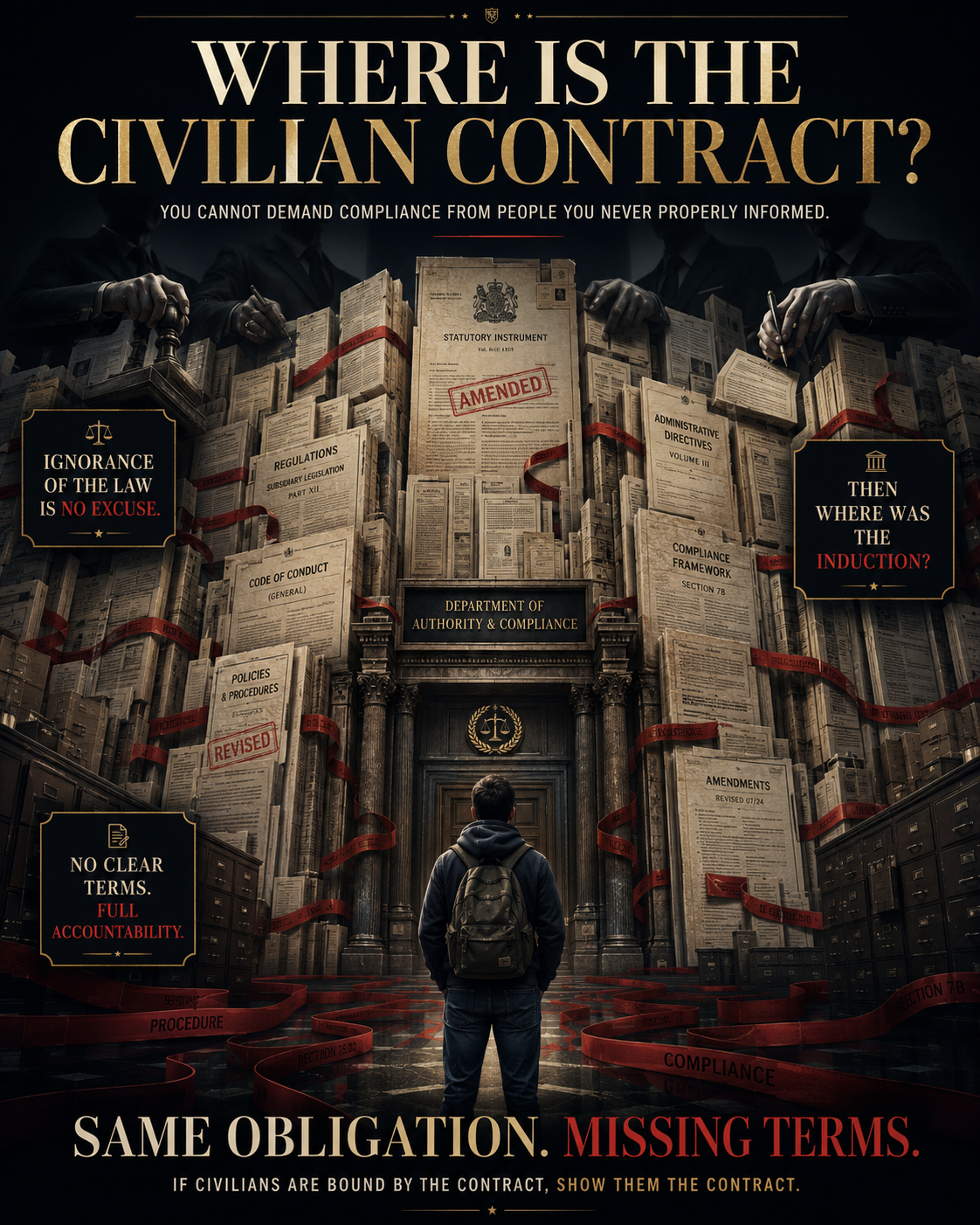
Where is the contract of civilianism?
Where is the document that clearly explains what a person is entering simply by being born, raised or resident within a country? Where are the terms, the obligations, the rights, the updates, the exceptions, the penalties, the procedures, the appeal routes and the quiet little clauses that apparently become binding whether anyone has read them or not?
We are told that ignorance of the law is no excuse.
Convenient.
But ignorance of the population appears to be perfectly acceptable when the system introducing, amending and multiplying those laws does not ensure that ordinary people actually understand them.
The government behaves as though every civilian has entered a contract. Yet the civilian is rarely shown the whole agreement. There is no induction. No mandatory education explaining the legal architecture they are expected to live under. No annual briefing outlining what has changed. No simple public record translating legal amendments into the language of daily life.
Still, when a person trips over a rule they did not know existed, the system suddenly remembers that the agreement was binding.
That is not informed participation.
That is a set-up with administrative stationery.
A contract ordinarily requires identifiable terms. It requires some degree of communication. It requires parties to understand what they are agreeing to, what is expected of them and what may happen if those expectations are breached.
Civilian life seems to operate differently.
You are expected to consent through existence.
You are expected to comply through assumption.
You are expected to remain updated through instinct.
You are expected to remember rules you were never properly taught.
Then you are judged as though you sat at the table while they were written.
The public is not in the room where most legislation is developed, negotiated, amended and interpreted. People may vote occasionally, write to representatives, respond to selected consultations or attempt to follow political reporting, but that is not the same as participating meaningfully in the continuous construction of the system governing their lives.
If civilians are not genuinely in the conversation, it becomes rather difficult not to trip and fall.
The law is not a small handbook placed neatly on the kitchen table. It is an expanding architecture of statutes, regulations, guidance, case law, contractual conditions, local rules, administrative procedures and institutional interpretations. Different rules apply depending on age, work, housing, family structure, immigration status, health, business activity, transport, technology, taxation and location.
Even professionals specialise because no one person can comfortably retain the whole thing.
Yet the civilian is expected to move through all of it with the memory of a judge, the vigilance of a compliance department and the free time of someone who has no need to earn a living.
Perhaps we should all wake at six, read legislative updates over breakfast, review local authority guidance during lunch and finish the evening with recent judgments before preparing for work the following morning.
Very practical.
The system knows that this is unrealistic.
That is why businesses employ lawyers, accountants, compliance officers, policy advisers, human-resources departments and risk teams. Organisations understand that rules are too numerous, technical and changeable to be managed casually.
But the individual civilian is expected to navigate the same society largely alone and then blamed when something was misunderstood, missed or never known.
A corporation receives professional interpretation.
A civilian receives a penalty notice.
That contrast tells us something important.
The government does not truly believe that everyone can naturally know the law. Its own institutions require entire departments to interpret and administer it. The expectation of universal civilian awareness is therefore not a genuine belief.
It is a liability arrangement.
When something goes wrong, the phrase you should have known transfers the burden downwards.
The authority writes the rule.
The institution controls its communication.
The system decides how accessible the explanation will be.
The civilian carries the consequence of not discovering it.
What an elegant arrangement.
This architecture does not remain confined to government. Other institutions learn from the structure above them.
Employers introduce policies hidden in long handbooks and expect workers to remember every amendment. Digital platforms change terms and conditions, then treat continued use as agreement. Banks alter fees, landlords introduce restrictions, insurers redefine exclusions and companies bury obligations beneath pages of language written primarily to protect the drafter.
Everyone learns the same lesson:
If you control the structure, you can call silence consent and confusion responsibility.
The government models the behaviour.
Corporations refine it.
Institutions reproduce it.
Individuals then imitate it wherever they gain enough authority.
This should not surprise us. People learn from the systems they inhabit. If the highest structures maintain control by keeping the rules complex, the updates quiet and the burden of discovery on everyone beneath them, smaller structures will adopt the same method.
It becomes the only visible route to autonomy:
Either understand enough of the hidden architecture to protect yourself, or gain enough power to control how the architecture affects others.
That is not civic freedom.
That is competitive legal survival.
A society serious about lawful behaviour would not merely punish violations. It would build the population’s capacity to understand the rules before violations occur.
Legal education would not be reserved for people studying law.
Children would be taught the practical legal structure of adulthood: employment rights, housing obligations, contracts, police powers, consent, taxation, debt, public services, digital rights, consumer protection and routes of appeal.
Adults would receive accessible updates when material changes affected daily life.
Laws would be accompanied by plain-language explanations describing what changed, who is affected, what action is required and where support can be found.
There would be a clear civilian portal containing the current terms of participation, not a maze requiring people to know the exact terminology before they can even search for the answer.
Because the current structure contains a circular cruelty:
You need legal knowledge to discover the legal knowledge you are missing.
You need to know which question to ask.
You need to know which institution holds the answer.
You need to know whether guidance is binding.
You need to know whether the rule has changed.
You need to know whether an exception applies.
Then, after navigating all of that, you may still be told that the final interpretation belongs to someone with greater authority.
And yet the original expectation remains:
You should have known.
Known how?
By osmosis?
Through the national atmosphere?
Was the legislation transmitted telepathically while people slept?
The issue is not that individuals should be free from responsibility. Shared life requires rules. People cannot reasonably demand rights while rejecting every obligation. A functioning society needs standards, boundaries and consequences.
But responsibility without education is not accountability.
It is exposure.
Accountability requires a fair relationship between what a person could reasonably know, what they were clearly told, what capacity they had to comply and what consequence follows if they do not.
A government that wants lawful civilians must first create legally literate civilians.
It cannot keep the architecture distant, technical and continuously changing, then act offended when ordinary people fail to navigate it perfectly.
That is like constructing a staircase in darkness, moving several steps overnight and prosecuting everyone who falls.
The problem becomes even more confronting when the government itself breaches duties, delays action, miscommunicates policy or creates contradictory systems. Institutions are often granted reviews, investigations, extensions, consultations and opportunities to correct.
Civilians are frequently given deadlines.
When authority makes an error, it may be called an administrative failure.
When the individual makes one, it may become non-compliance.
The language changes according to who possesses the power to name the mistake.
A genuine civilian contract would work both ways.
It would not merely list what the public owes the state. It would define what the state owes the public in exchange for obedience, taxation, participation and trust.
If civilians must follow the law, government must make the law reasonably knowable.
If civilians must meet deadlines, institutions must meet duties.
If civilians can be penalised for non-compliance, authorities must be accountable for inaccessible systems, contradictory instructions and failures to inform.
If the public is expected to behave as a party to the contract, the government must stop treating it like a subject who entered by default and may speak only when invited.
The social contract cannot remain metaphorical whenever the public asks to see the terms and suddenly become literal when payment, punishment or obedience is required.
That is the cheekiest part of the arrangement.
When citizens ask what government owes them, the contract becomes philosophical.
When government asks what citizens owe it, the contract becomes enforceable.
We are told that society depends upon mutual responsibility.
Wonderful.
Then make it mutual.
Show the terms.
Teach the architecture.
Explain the amendments.
Translate the language.
Create meaningful participation before decisions are finalised.
Make legal updates as visible as election campaigns.
Stop hiding major obligations inside technical systems and then pretending every civilian had equal access to understanding them.
Because a person cannot responsibly abide by what they were never given a reasonable opportunity to know.
And a government cannot call people partners in democracy while treating them as late arrivals to every conversation that determines how they are permitted to live.
If civilianism is a contract, present it.
If it is membership, provide an induction.
If it is participation, include the participants.
If it is obedience without meaningful knowledge, then at least name it honestly.
The public is not failing to read the room.
The public was never properly invited into it.


Leave a Reply