Spectatorship, Specificity and the Difference Between Building a Case and Looking for One
There is an old tension between those who play and those who teach. People say that those who cannot perform become teachers, while others respond that those who cannot teach simply perform without ever learning how to transfer what they know. Somewhere between those two statements sits another category:
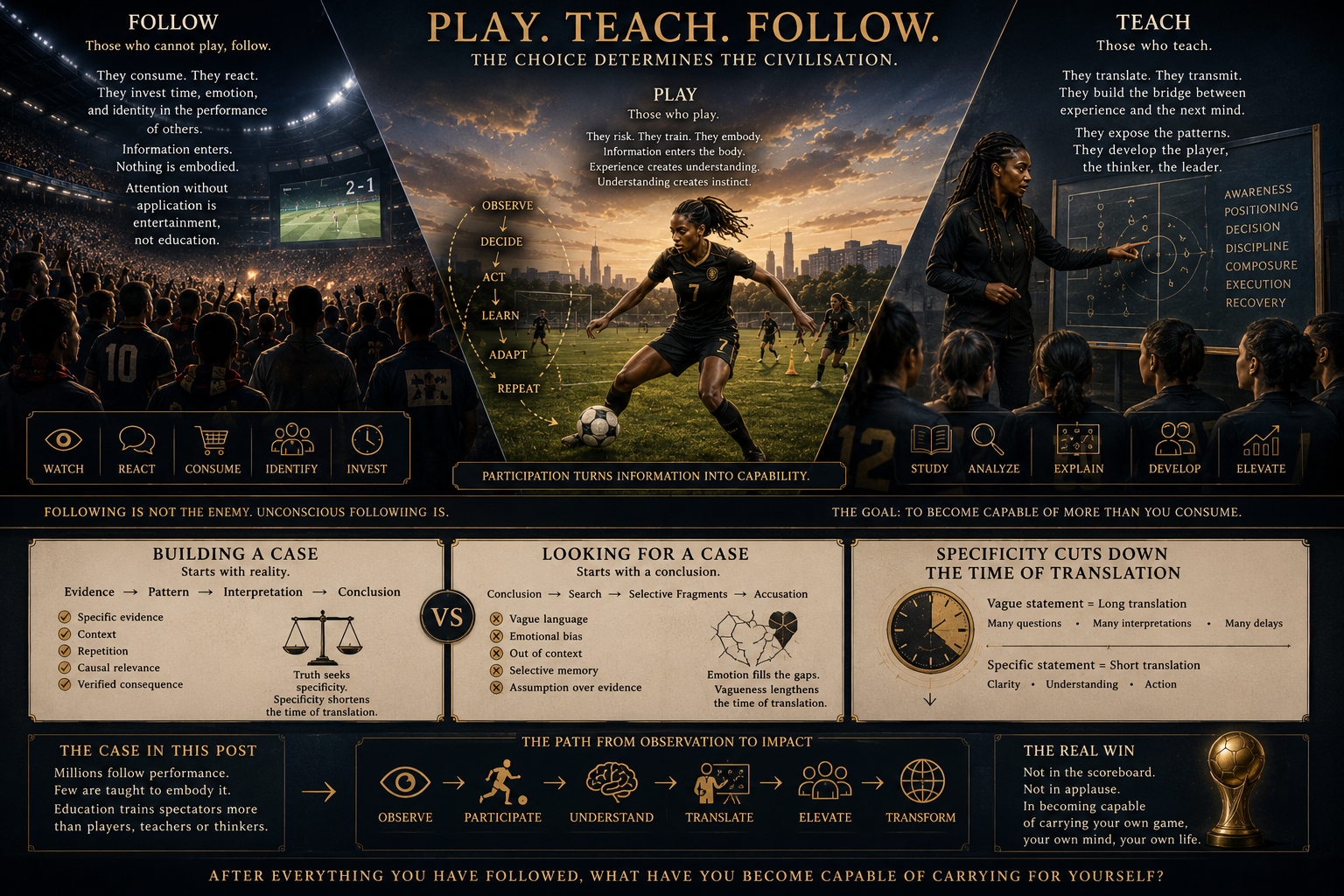
Those who cannot play, follow.
This is not a condemnation of every person who watches football, supports a team or enjoys being part of a collective experience. Spectatorship can create community, preserve culture and financially sustain the people performing the craft. Conscious followership also has value. Nobody needs to originate, perform and teach everything they encounter.
The problem begins when following becomes the largest investment a person makes in something they neither practise nor learn how to transmit.
Millions of people can name players, formations, transfers, scores, injuries and historic matches. They invest hours of attention, emotion, argument, money and identity into football. Their nervous systems rise and fall according to what another person does with a ball on a field. Yet many will never play, coach, study the psychology of performance or translate the lessons of the sport into their own discipline, relationships, leadership or daily standards.
They are not players.
They are not teachers.
They are followers of the performance.
That position is not automatically wrong, but it reveals something important about education. Society has become extremely effective at teaching people how to consume excellence while doing very little to teach them how to embody, interpret or transfer it.
People watch discipline without becoming disciplined.
They celebrate stamina without developing their own.
They criticise strategy without studying decision-making.
They demand that players remain mentally strong under pressure while falling apart when smaller pressures enter their own lives.
They study the visible score while missing the consciousness that produced it.
I do not care much about watching football. I enjoy playing it. I also enjoy teaching the mentality that makes a footballer—or any high performer—successful. I am interested in spatial awareness, decision-making, recovery after mistakes, the preservation of standards while winning or losing, and the ability to read where movement is heading before the ball reaches its destination.
I occupy both ends.
I play.
I teach what the play reveals.
I largely remove the position in the middle because I am not interested in becoming a follower of another person’s performance when I can use the game to expand my own participation and understanding.
The difference is not that one person knows more names or has watched more matches. The difference is where the information terminates.
For the player, information enters the body.
For the teacher, information becomes transferable consciousness.
For the follower, information may terminate in attention.
The educational question is therefore not merely:
What are people watching?
It is:
What are they becoming capable of doing with what they watch?
If information produces no new ability, no strengthened discernment, no transferable principle and no meaningful change in participation, then much of it remains accumulated spectatorship. It may entertain, but it does not necessarily educate.
That is part of the case I am building concerning the weaknesses of education in society.
The evidence is not that football exists or that people enjoy it. The evidence is the extraordinary amount of attention people can dedicate to observing mastery while remaining unsupported in developing mastery, teaching ability or conscious application within their own lives.
This is not a case against football supporters.
It is evidence concerning a society that trains followers more consistently than it trains players, teachers or independent interpreters.
Building a Case Is Not Looking for One
This distinction matters because there is an enormous difference between building a case and looking for a case.
A person building a case begins with what is materially present.
They observe the event.
They identify the behaviour.
They preserve context.
They distinguish a single occurrence from a pattern.
They examine who possessed knowledge, authority and control.
They trace the consequence.
They ask which interpretation is supported and which remains speculative.
Whether the issue concerns criminality, institutional failure, education, employment or personal conduct, a real case is built from particulars.
Case Strength =Specific Evidence+ Context+ Repetition+ Causal Relevance+ Verified Consequence
A person looking for a case begins somewhere else.
They begin with a desired conclusion.
They decide what they want another person, institution or event to represent, then search for anything that can be attached to that conclusion. The evidence does not create the judgment. The judgment recruits fragments to support itself.
A person building a case asks:
What is this?
A person looking for a case asks:
How can I make this look like what I have already decided it is?
The first investigates.
The second prosecutes an identity.
The person looking for a case may take language out of context, interpret ordinary ambiguity as malicious intent, enlarge one isolated event into an entire character and ignore every fact that would narrow or correct the accusation. They may be emotionally convinced while remaining evidentially vague.
This is why people who are looking for a case often speak through broad labels.
Dangerous.
Suspicious.
Manipulative.
Disloyal.
Problematic.
Unprofessional.
Arrogant.
The label arrives before the specific act has been clearly defined.
A person who is building a case has to say what happened, when it happened, what the person did, what duty existed, what consequence followed and why the evidence supports the conclusion.
A person looking for a case can remain generic because emotional implication is doing the work that evidence has not completed.
The difference can be expressed simply:
Building a case:Evidence -> Pattern -> Interpretation -> Conclusion
Looking for a case:Conclusion -> Search -> Selective fragments -> Accusation
One allows evidence to shape the conclusion.
The other reshapes evidence until it appears to serve the conclusion.
Specificity Reduces the Time of Translation
Specificity is not merely a writing preference. It is an efficiency tool.
The more specific a person is, the less interpretive distance another mind must travel before understanding what is being communicated.
A vague statement creates multiple possible meanings. The recipient must guess which one was intended, compare those guesses with context and potentially ask several questions before the information becomes usable.
A specific statement closes unnecessary pathways.
Translation Time ≈ Ambiguity / Specificity
As specificity rises, avoidable translation time falls.
Consider the statement:
“That person is dangerous.”
Dangerous how?
Physically?
Financially?
Emotionally?
Legally?
Professionally?
Are they presently creating danger, capable of creating danger or merely making the speaker uncomfortable?
Compare that with:
“On three recorded occasions, the manager instructed staff to bypass the safety procedure after being informed that the equipment was defective.”
The second statement can be investigated.
It contains behaviour, repetition, authority, knowledge and risk.
The first creates atmosphere.
This is why specificity distinguishes a case from a projection. A genuine case becomes clearer as it is made more precise. A false or emotionally manufactured case often weakens when specificity is demanded because the accusation was surviving through implication.
Ask for the exact act.
Ask for the date.
Ask for the wording.
Ask which rule applied.
Ask what consequence occurred.
Ask what evidence supports causation.
Ask whether competing explanations were examined.
The person building a case ordinarily welcomes these questions because specificity strengthens what they have observed.
The person merely looking for a case may experience the same questions as obstruction because precision threatens the emotional story they were attempting to preserve.
The Football Observation Is Evidence, Not the Defendant
When I say, “Those who cannot play, follow,” I am not trying to construct a criminal case against football audiences.
Football is not the defendant.
The observation is one evidentiary component within a larger case about education, attention and social participation.
The question is why modern societies can produce enormous populations of highly informed spectators who have not been taught to convert observation into personal, practical or transferable intelligence.
Why are people trained to follow the success of players but not to examine the mentality that makes performance sustainable?
Why can they analyse a footballer’s mistakes in real time but remain unable to identify the patterns directing their own decisions?
Why can they understand team formation but not organisational structure?
Why can they recognise when a player is out of position but not when they themselves have been pulled out of their own centre by social pressure?
Why can they see that one weak bond destabilises a team but fail to understand how one unaccountable relationship destabilises a family, workplace or institution?
The sport contains education.
The audience is not always taught how to retrieve it.
That is the case.
The evidence is not that spectators exist. The evidence is that spectatorship has become a dominant social position while embodied participation, teaching capacity and transferable interpretation remain comparatively underdeveloped.
We see the same structure elsewhere.
People follow politics but do not understand governance.
They follow business leaders but do not study organisational responsibility.
They follow health influencers but do not learn their own bodies.
They follow spiritual teachers but do not develop discernment.
They follow public trials but do not understand evidence.
They follow creators but do not create.
They consume intelligence as entertainment and then wonder why society remains governed by a small number of active participants.
A society dominated by followers does not necessarily lack intelligence.
It lacks routes through which intelligence becomes agency.
Playing, Teaching and Following Are Not Permanent Identities
The objective is not to arrange people into a hierarchy in which players are always superior to teachers and teachers are always superior to followers.
These are relational positions.
A person may play in one field, teach in another and consciously follow expertise somewhere else. The intelligent person knows when each position is appropriate.
A surgeon may lead inside medicine and follow an engineer’s guidance concerning aircraft safety.
A footballer may perform exceptionally but require a coach capable of seeing patterns the player cannot perceive from inside the movement.
A teacher may understand the architecture of a skill without possessing the same physical capacity as the strongest performer.
A spectator may notice something that those inside the system have normalised.
The problem is not followership itself.
It is unconscious followership that mistakes proximity to performance for participation in it.
Watching excellence does not make someone excellent.
Criticising a player does not make someone a coach.
Repeating a teacher’s words does not mean the lesson has been understood.
Wearing the symbols of a team does not mean one has developed teamwork.
The decisive question remains:
What can you now do, perceive, create or transmit that you could not do before the information entered you?
That question turns consumption into an educational assessment.
A Society of Case Builders, Not Case Hunters
Education should produce people capable of building cases rather than hunting for them.
That means teaching people how to separate observation from interpretation, evidence from emotion, pattern from coincidence and consequence from intention.
It means teaching them that specificity does not remove humanity. It protects people from being reduced to vague accusation.
It also protects institutions from vague praise.
The same precision used to establish wrongdoing should be used to establish merit.
Do not merely say someone is brilliant.
What did they create?
What problem did it solve?
What relationships did they identify?
What evidence supports its value?
What became possible because of their contribution?
Recognition should also be specific. Otherwise, praise becomes another atmosphere disconnected from reality.
A mature educational system would teach people to move through the full sequence:
Observe.Participate.Test.Interpret.Specify.Teach.Correct.Build.
Following may be part of learning, but it should not always be the destination.
The follower watches the movement.
The player enters it.
The teacher understands enough of its architecture to help another person enter it more intelligently.
The case builder then examines what the movement reveals about the wider system.
That is what I was doing when the football observation appeared.
I was not searching for a convenient cultural target. I was looking at a visible pattern and asking what it revealed about the education surrounding it.
The statement became useful because it was specific enough to open a larger question:
Why do we invest so heavily in populations that follow performance while investing so little in helping those populations become players, teachers, creators and conscious investigators within their own lives?
That is not an accusation looking for a person.
It is evidence building towards an architecture.
The Case Is in the Post
A strong case does not need to hide its evidence behind the authority of the person making it.
The evidence should be visible enough for another mind to examine.
This post contains its own case:
People invest substantial attention in observing skills they are rarely taught to embody or transfer.
Society economically rewards spectatorship at enormous scale.
Formal and informal education often separates learning from participation.
Generic accusation travels more easily than evidential reasoning.
Emotional interpretation regularly substitutes for specificity.
And populations trained to follow stories are easier to direct than populations trained to investigate how stories are built.
The case may be challenged.
The distinctions may be refined.
Evidence may be added.
Exceptions may be identified.
That is what a living case permits.
What it does not require is a predetermined enemy.
The purpose is not to prove that football audiences are deficient. The purpose is to recognise how much unrealised education is sitting inside what people already give their time to.
A match can teach psychology, probability, spatial awareness, teamwork, consequence, leadership, emotional regulation, dignity, strategy and recovery.
But only when someone helps the spectator move beyond the score.
The real educational failure is not that people follow football.
It is that so much of what they follow is never translated into capacity.
Those who can play should play.
Those who can teach should teach.
Those who can do both should connect embodiment with understanding.
Those who follow should be given routes through which attention becomes participation rather than being treated merely as an audience whose value ends at consumption.
And those examining the pattern should build the case specifically enough that nobody has to guess what is being claimed.
Because specificity shortens translation.
Evidence strengthens interpretation.
Participation converts information into ability.
And the difference between a society that watches and a society that develops may begin with one simple question:





Leave a Reply