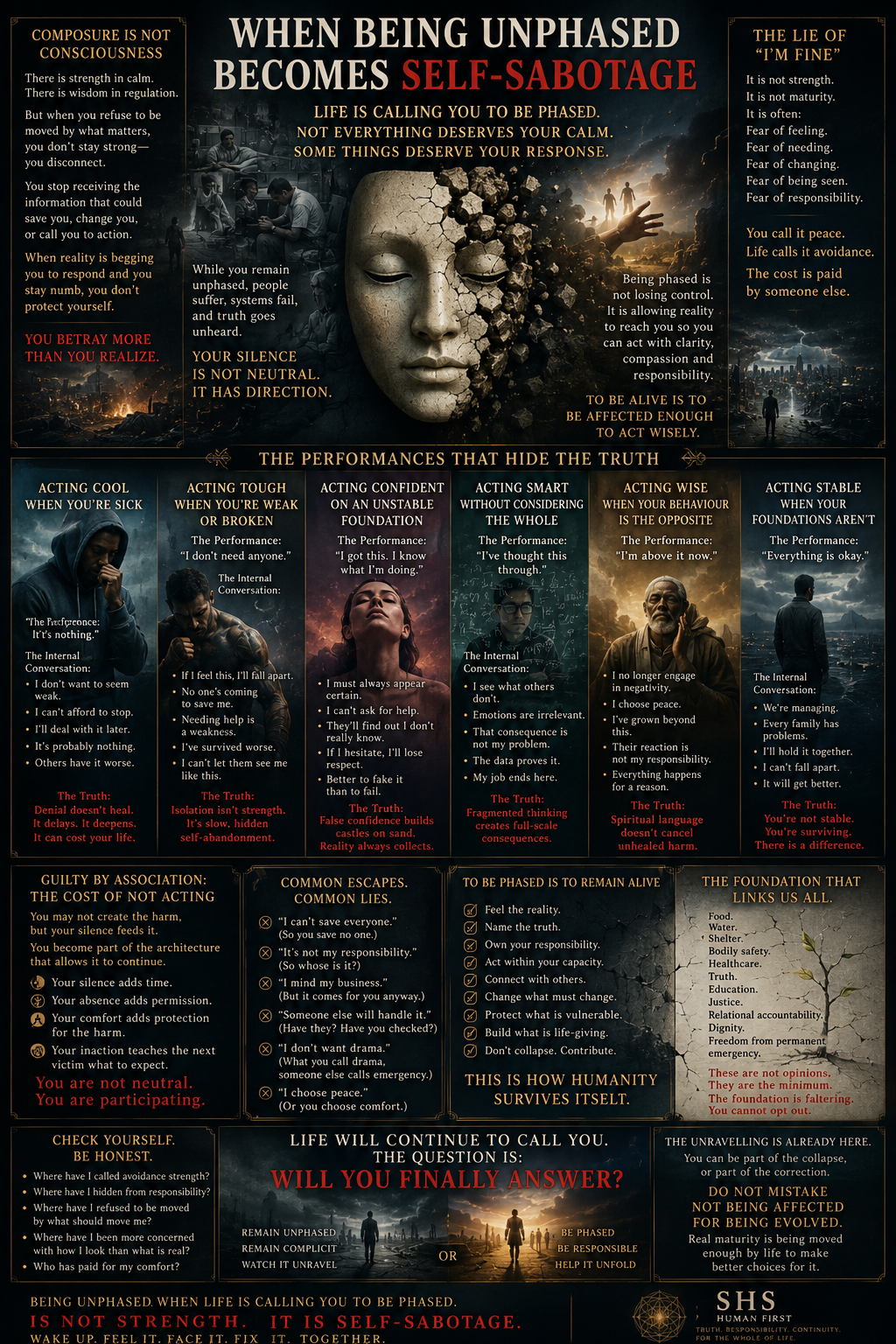
It is the performance of invulnerability while the body is deteriorating, the relationship is collapsing, the institution is harming people, the community is grieving or another human being is visibly suffering within reach. It calls itself strength because “numbness,” “avoidance,” “cowardice” and “emotional absence” would be harder names to wear.
Composure Is Not Consciousness When Reality Is Begging You to Respond
There are moments when being unphased is strength.
A crisis erupts and somebody must remain calm enough to think. A room becomes emotional and somebody must preserve enough internal order to prevent panic from multiplying. A person is injured and the one beside them must act before collapsing into fear. In those moments, composure protects life because composure remains in contact with reality.
But there is another kind of being unphased.
It does not protect reality.
It protects the self from having to meet it.
It is the performance of invulnerability while the body is deteriorating, the relationship is collapsing, the institution is harming people, the community is grieving or another human being is visibly suffering within reach. It calls itself strength because “numbness,” “avoidance,” “cowardice” and “emotional absence” would be harder names to wear.
This is where being unphased becomes self-sabotage.
Not because every event deserves panic. Not because people must publicly display every emotion. Not because sensitivity requires emotional disintegration. It becomes self-sabotage when reality is delivering information necessary for survival, correction, protection or moral action, and a person refuses to let the information register because registering it would disturb the identity they are trying to preserve.
Life is attempting to phase them.
Their nervous system is attempting to report.
Their body is attempting to warn.
Their conscience is attempting to interrupt.
Their relationships are attempting to reflect.
The surrounding world is attempting to make the consequence visible.
And they keep replying:
I am fine.
Sometimes “I am fine” is not resilience.
Sometimes it is the sentence through which deterioration receives permission to continue without witness.
THE DIFFERENCE BETWEEN REGULATION AND DISCONNECTION
A regulated person can feel the event without becoming entirely governed by it.
A disconnected person avoids feeling the event so that they do not have to respond.
These states may look similar from outside. Both people may speak calmly. Both may remain physically still. Both may avoid dramatic expression. But their internal movements are opposite.
The regulated person says:
This is serious. I can feel what it is doing to me. I will remain present enough to choose the next responsible action.
The disconnected person says:
This cannot be serious because I do not want it to require anything from me.
Regulation preserves contact.
Disconnection removes contact.
Regulation creates response capacity.
Disconnection protects non-response.
The person who remains calm while calling for help is regulated.
The person who remains calm because calling for help would force them to acknowledge the emergency is absent.
The person who can stand beside grief without making themselves the centre is grounded.
The person who treats grief as an inconvenience because another person’s pain disrupts their preferred atmosphere is emotionally unavailable.
The person who pauses before reacting may be discerning.
The person who repeatedly uses “I do not react” to justify never intervening has converted restraint into abandonment.
Strength does not mean reality cannot move you.
Strength means reality can move through you without stealing your ability to respond coherently.
WHEN LIFE IS CALLING YOU TO BE PHASED
There are events that should alter the state of a conscious human being.
A person dies.
A child is harmed.
Someone is assaulted.
A colleague is breaking under pressure.
A neighbour is starving quietly.
A patient is deteriorating while systems argue about procedure.
A relationship becomes unsafe.
A body begins presenting symptoms that do not disappear.
A community repeatedly reports the same injury.
An institution keeps producing the same victims.
To be affected does not require losing control. It means allowing the event to enter consciousness with enough force to change attention, judgement or behaviour.
When nothing changes after preventable suffering becomes visible, the absence of response becomes part of the architecture through which the suffering continues.
Not every witness possesses the same power.
Not every person knows what to do.
Some people are frozen by trauma. Some fear retaliation. Some are physically incapable of intervening. Some require help themselves. Responsibility must always be measured according to knowledge, proximity, capacity, authority and risk.
But where a person could reasonably have acted and chooses not to because they are protecting the performance of being unaffected, they do not remain outside the event merely because they did not create its first injury.
They become part of what allowed the injury to continue.
That is not necessarily legal guilt.
It is relational implication.
It is the moral consequence of possessing enough awareness to recognise deterioration and still investing in the atmosphere that permits it.
The person says:
It has nothing to do with me.
But their silence has entered the situation.
Their refusal has entered it.
Their normalisation has entered it.
Their decision to protect comfort rather than interrupt harm has become another condition the harm can use.
The event now contains them.
WATCHING PEOPLE DIE WHILE CALLING YOURSELF PEACEFUL
There is a form of peace that is simply distance from consequence.
People call themselves calm because the violence is occurring in somebody else’s body.
They call themselves rational because they have not been personally forced into desperation.
They call themselves neutral because choosing a side would disturb relationships that currently benefit them.
They observe suffering and think:
This is tragic, but I cannot carry everything.
That may be true.
No person can carry everything.
But “I cannot carry everything” is not the same as “I will carry nothing.”
The next internal sentence often reveals the deeper architecture:
What difference would I make anyway?
Sometimes this is realism.
Sometimes it is permission.
It allows a person to reduce their responsibility to zero before testing whether they possessed one phone call, one warning, one vote, one report, one contribution, one correction, one refusal, one introduction, one piece of evidence or one moment of courage that could have changed the direction.
They say:
Someone more qualified should handle it.
Who?
Did you contact them?
Did you confirm that the matter had reached someone capable of responding?
Or did the imagined existence of a responsible person become the method through which you escaped being the nearest actual person?
People die inside gaps made from assumed responsibility.
Everyone believes somebody else is carrying the emergency.
Nobody checks.
The system later describes the outcome as unfortunate.
But unfortunate is not always accidental.
Sometimes it is what happens when every person protects their innocence by refusing to become involved soon enough to prevent the consequence.
WHEN SICKNESS IS TREATED AS A CHARACTER TEST
Many people try to act cool while they are sick.
They continue working.
They joke about the symptoms.
They minimise the pain.
They describe rest as weakness and help as inconvenience. They wait until the body has no quiet language left and must become dramatic enough to interrupt the identity controlling it.
Their internal conversation sounds like this:
It is probably nothing.
I have had worse.
I cannot stop now.
People depend on me.
I do not want to seem dramatic.
I will deal with it later.
Later becomes the destination where neglected bodies are repeatedly sent.
The person imagines that refusing to acknowledge illness demonstrates power over it. Yet the body does not require emotional agreement in order to deteriorate. A condition does not become less real because the person has mastered sounding casual while describing it.
There is a difference between refusing catastrophisation and refusing information.
A conscious person may say:
I will not panic, but I will investigate.
The self-sabotaging person says:
I will not investigate because investigation might confirm that I need to change my life.
The sickness is not always the greatest threat.
Sometimes the greater threat is the identity that cannot tolerate being a body with limits.
They are not only fighting an illness.
They are defending an image of indispensability.
They believe the world will become unsafe if they stop producing. They believe other people will see them differently if they need care. They believe their value is connected to how much pain they can conceal while remaining useful.
Then they call the concealment resilience.
But resilience is the ability to recover.
A person cannot claim resilience while repeatedly preventing recovery from beginning.
ACTING TOUGH WHILE FEELING BROKEN
Toughness can be protective.
It can carry a person across conditions where softness would be exploited. It can preserve movement through grief, poverty, conflict and responsibility. But toughness becomes a prison when the person no longer knows how to remove it after the immediate danger has passed.
The internal conversation begins:
Nobody is coming to save me.
Then expands:
Therefore, I must never need anyone.
That conclusion does not follow.
The fact that support was absent once does not mean the highest form of survival is permanent self-abandonment.
The person continues:
If I let myself feel this, I will fall apart.
Perhaps.
But if the feeling has already reorganised sleep, appetite, intimacy, anger, concentration and trust, then the falling apart is already occurring. It has simply been distributed into behaviours that allow the person to preserve a composed face.
They say:
I am over it.
But they punish people who remind them of it.
They say:
It no longer matters.
But every decision is built around preventing its repetition.
They say:
I have forgiven.
But closeness still feels like surrender.
They say:
I do not need closure.
But they rehearse imaginary conversations in which the other person finally admits what they did.
The mind may deny what the body continues organising itself around.
That is not completion.
It is concealed governance.
The wound is still leading. It has simply learned to speak through standards, boundaries, sarcasm, busyness, hyper-independence and the worship of never appearing affected.
A person is not strong because nobody can reach them.
They may simply have built a life in which nothing nourishing can reach them either.
ACTING CONFIDENT ON AN UNSTABLE FOUNDATION
Confidence is not volume.
It is not unwavering eye contact, polished posture or the speed with which somebody answers a question they have not fully understood.
Confidence is the ability to remain in contact with oneself while reality provides information that may require adjustment.
False confidence requires constant protection.
It says:
I must answer immediately or they will realise I do not know.
I must appear certain or I will lose authority.
I cannot ask for clarification because competent people understand the first time.
If another person has the better method, there will be less room for me.
The person appears decisive because uncertainty terrifies them.
They confuse hesitation with weakness and therefore rush through the stage where accurate decisions are formed. They call themselves bold while repeatedly forcing reality to absorb the cost of their unexamined certainty.
Their foundations are unstable because the confidence is not attached to demonstrated capacity.
It is attached to the preservation of an impression.
True confidence can say:
I do not know yet.
I need more evidence.
That person understands this better than I do.
My first conclusion was wrong.
The foundation needs repair before I build higher.
False confidence hears these sentences as humiliation.
Real confidence hears them as structural maintenance.
A tower is not made stronger by threatening anyone who notices a crack.
ACTING SMART WHILE REFUSING TO CONSIDER THE WHOLE
Intelligence is often performed through complication.
The person uses specialised language, rapid connections, references and certainty to create the impression of comprehensive thought. Yet the most important variable remains outside their analysis because including it would complicate the conclusion they prefer.
Their internal conversation sounds like:
I understand this better than they do.
They are emotional. I am being rational.
The numbers prove it.
That consequence is outside the scope of my role.
My responsibility ends where my department ends.
But reality does not honour departmental boundaries.
The budget cut becomes a housing crisis.
The housing crisis becomes illness.
The illness becomes unemployment.
The unemployment becomes family stress.
The family stress enters childhood development.
The childhood consequences later appear in healthcare, policing, education and law.
The person who optimised the original spreadsheet may still be praised for efficiency because nobody followed the consequence far enough to return it to the source.
That is not intelligence.
It is local cleverness producing systemic stupidity.
To act smart while refusing to consider the whole is to use cognition as a hiding place.
The person says:
You cannot expect me to account for every possible consequence.
Correct.
But accountability for the whole does not require omniscience. It requires enough humility to ask who else must be in the room before the decision is treated as complete.
Intelligence is not knowing everything.
It is recognising when what you know is insufficient for the scale of what you are about to affect.
ACTING WISE WHILE BEHAVING WITHOUT WISDOM
Wisdom has become an aesthetic.
People speak calmly.
They quote ancient traditions.
They advise detachment.
They tell others to protect their peace, release control, trust timing and stop reacting.
Their behaviour remains punitive, evasive, exploitative or emotionally immature.
Their internal conversation says:
I no longer engage with low vibrations.
Meaning:
I do not want to answer difficult questions about my behaviour.
They say:
I have outgrown the situation.
Meaning:
I want the moral authority of development without completing the accountability required by departure.
They say:
Everything happens for a reason.
Meaning:
I do not intend to investigate who exercised preventable control.
They say:
I choose peace.
Meaning:
I choose the condition in which nobody challenges me.
They say:
Their reaction is their responsibility.
Sometimes it is.
But that sentence does not dissolve the speaker’s responsibility for the action to which another person is reacting.
Wisdom is not the ability to place spiritual language around avoidance.
Wisdom is the capacity to remain accountable while seeing beyond the immediate emotional frame.
It is knowing when to release and when release would simply abandon someone inside a consequence you helped create.
It is knowing when silence preserves dignity and when silence protects harm.
It is knowing that peace without truth may be only a ceasefire arranged around the comfort of the more powerful party.
A wise person does not merely sound undisturbed.
They disturb what must not be permitted to continue.
ACTING STABLE ON A FOUNDATION THAT IS FAILING
Stability is frequently measured through appearances.
The bills were paid this month.
The marriage is still intact.
The company remains open.
The institution has not collapsed.
The person continues arriving on time.
Therefore, everything is described as stable.
But continuity is not proof of health.
Some systems remain standing because people inside them have become load-bearing in ways that cannot continue.
The internal conversation says:
We are managing.
Who is “we”?
Who has stopped sleeping?
Who is borrowing money?
Who is suppressing anger?
Who is performing emotional regulation for the entire household?
Who is doing unpaid labour to preserve the appearance of normality?
Who cannot leave because they lack somewhere safe to go?
Who is afraid to name the instability because the whole structure depends upon everyone agreeing not to look directly at it?
They say:
Every family has problems.
True.
But not every problem should become a permanent operating system.
They say:
Every workplace is stressful.
True.
But ordinary pressure is not permission for endless exhaustion, humiliation or preventable danger.
They say:
The economy is difficult for everyone.
Perhaps.
But difficulty distributed unevenly does not become equitable because it is described collectively.
A structure can remain upright long after it has stopped being safe.
Collapse is often the final visible event of instability that has been active for years.
The question is not merely:
Is it still standing?
The question is:
What is it consuming in order to stand?
THE LIE OF “THAT IS JUST MY FOUNDATION”
People possess different values, cultures, histories and understandings of what makes a life meaningful. One person may consider family the foundation. Another may prioritise independence, faith, creativity, land, duty, community, truth or bodily freedom.
Difference is real.
But difference cannot be used to deny the foundations upon which all human variation depends.
No philosophy makes starvation harmless.
No culture makes preventable abuse nourishing.
No personal preference makes poisoned water compatible with human development.
No interpretation makes a child’s lack of safety irrelevant.
No individual worldview can remove the body’s need for rest, nourishment, protection and enough relational stability to develop.
Human foundations include more than material survival, but they do not include less.
Food.
Water.
Shelter.
Bodily safety.
Healthcare.
Truth sufficient for informed choice.
Education sufficient for conscious participation.
Legal protection.
Relational accountability.
Enough freedom from permanent emergency for a person to develop beyond survival.
People may build different homes upon these foundations.
They cannot honestly claim that foundations do not matter because they prefer different interior design.
And the shared foundation is faltering.
Housing is increasingly insecure.
Healthcare arrives late.
Education teaches information without sufficiently teaching discernment.
Work consumes time without reliably producing stability.
Technology accelerates faster than accountability.
Institutions distribute authority downward and responsibility outward.
Environmental damage returns through bodies that were never included in the original transaction.
People are exhausted, overstimulated, under-supported and repeatedly told to demonstrate personal resilience inside systems organised around preventable strain.
To look at this and insist everything is broadly fine is not optimism.
It is developmental refusal.
It is childish because it protects the fantasy that a problem becomes less real when the person does not want to carry its emotional weight.
Children may cover their eyes and believe they have disappeared.
Adults build institutions through the same logic and call it policy.
THE INTERNAL CONVERSATION OF THE UNPHASED SOCIETY
The social conversation sounds like this:
It is bad, but it has always been bad.
Then why has repetition become permission?
There is nothing one person can do.
Who taught you that responsibility becomes meaningless unless it is total?
I need to focus on my own life.
What happens when everybody’s private protection depends upon public neglect?
I do not watch the news because it affects my mental health.
Understandable. But have you reduced harmful exposure, or removed every route through which reality can require something from you?
I am not responsible for problems I did not create.
Are you benefiting from them? Are you reproducing them? Do you possess any capacity to interrupt them?
I treat everyone equally.
Have you examined whether equal treatment inside unequal conditions preserves the advantage already present?
I am a good person.
What does goodness do when nobody is watching and no social reward is available?
I mind my business.
What becomes “your business” when another person’s untreated crisis eventually enters your workplace, healthcare system, neighbourhood, family or body?
I do not get involved in drama.
Are you avoiding drama, or refusing to distinguish conflict from an emergency?
I cannot save everyone.
Nobody asked you to.
The question is whether you used that impossibility to excuse the person you could have helped.
BEING UNPHASED CAN BECOME AN IDENTITY ADDICTION
Some people are addicted to being the least affected person in the room.
They derive status from appearing untouchable.
They watch others cry and feel superior for remaining composed. They interpret emotional expression as loss of control and their own distance as evidence of evolution. They do not realise that their calmness depends upon never allowing reality to reach the parts of them responsible for human connection.
Their internal reward is subtle:
Nothing can get to me.
But if nothing can get to them, neither can love, grief, responsibility, warning, intimacy, awe or correction.
They have not transcended humanity.
They have narrowed the routes through which humanity can enter.
The identity becomes self-sabotaging because the person must continually ignore more information to preserve it.
Pain must be minimised.
Need must be mocked.
Dependence must be denied.
Grief must be rushed.
Illness must be hidden.
Fear must be converted into anger.
Uncertainty must be disguised as certainty.
The performance becomes increasingly expensive.
Eventually they no longer know what they feel until the feeling has already become behaviour.
They do not recognise sadness until it becomes hostility.
They do not recognise fear until it becomes control.
They do not recognise exhaustion until the body refuses cooperation.
They do not recognise loneliness until they resent everyone for failing to reach the place they have made inaccessible.
The identity that promised protection becomes the architecture of isolation.
THE PRICE OF NOT BEING PHASED
Every unprocessed event still requires somewhere to go.
If it is not consciously felt, interpreted and integrated, it may enter:
the body;
the relationships;
the work;
the sleep;
the appetite;
the temper;
the attention;
the immune system;
the standards;
the children;
the culture;
the institution.
A person may avoid being visibly phased and still organise their entire life around the avoided event.
A society may refuse to acknowledge grief and become more punitive.
It may refuse to acknowledge fear and become more controlling.
It may refuse to acknowledge guilt and become more defensive.
It may refuse to acknowledge instability and become obsessed with appearances.
It may refuse to acknowledge inequality and become increasingly violent towards those whose lives reveal it.
What is denied does not disappear.
It becomes less governable because it is now operating without conscious supervision.
COMPLICITY THROUGH NON-RESPONSE
There is a dangerous fantasy that only the person initiating harm is part of it.
But harm often requires an environment.
It needs silence.
It needs delay.
It needs disbelief.
It needs fragmented responsibility.
It needs people who recognise enough to feel uncomfortable but not enough to risk becoming inconvenient.
The bystander says:
I did not do anything.
Exactly.
Sometimes the indictment is contained inside the sentence.
Again, capacity matters. Safety matters. Power matters. A vulnerable witness should not be judged as though they held the same responsibility as the authority capable of ending the harm.
But the person with authority who does nothing is not neutral.
The colleague who protects the institution’s reputation rather than the injured person is not neutral.
The friend who repeatedly witnesses abuse and strengthens the abuser’s public image is not neutral.
The professional who understands the danger but withholds the warning to preserve access is not neutral.
Non-action has direction when action was reasonably available.
It protects whatever would have continued without interruption.
That is why doing nothing can become an investment.
It adds time to the harmful system.
It allows the next incident.
It teaches the perpetrator that the environment will absorb the consequence.
It teaches the harmed person that truth will not produce protection.
It teaches every witness that comfort ranks above intervention.
The situation gets worse partly because the people around it continue acting as though remaining unphased proves they are uninvolved.
YOU ARE NOT REQUIRED TO COLLAPSE
The answer is not permanent emotional overwhelm.
The world does not become safer when everybody is incapacitated by everything they encounter.
Being phased does not mean being destroyed.
It means allowing reality to produce an appropriate alteration.
Grief may require mourning.
Illness may require treatment and rest.
Danger may require protection.
Confusion may require investigation.
Harm may require intervention.
Wrongdoing may require accountability.
Overload may require boundaries.
Powerlessness may require collective organisation rather than private guilt.
A conscious response is proportionate.
It neither minimises nor performs catastrophe.
It asks:
What has happened?
What is this doing to me?
What responsibility is actually mine?
What capacity do I possess?
Who else must be involved?
What becomes worse if nobody acts?
What is the smallest meaningful intervention available now?
What must change so the same event is not simply handed to the next person?
That is not emotional weakness.
It is homeostasis.
The system senses disruption, interprets it, responds, receives feedback and recalibrates.
A system that refuses to register disturbance is not stable.
It is blind.
THE MOST DANGEROUS PERSON IS NOT ALWAYS THE MOST EMOTIONAL
We are often warned about people who react intensely.
There is reason for caution. Unregulated intensity can become destructive. Fear, anger and grief can overwhelm proportion and harm others.
But societies often overlook another danger: the person so committed to appearing reasonable that no amount of suffering alters their decisions.
They can watch the numbers rise and remain composed.
They can hear testimony and remain unmoved.
They can administer destructive policy without raising their voice.
They can deny healthcare, housing, safety or justice through polite language and perfect procedure.
They appear stable because the consequence is occurring in bodies outside the room.
Their lack of emotional disturbance is treated as professionalism.
But what should we call a nervous system that remains perfectly comfortable while repeatedly authorising preventable harm?
The absence of visible emotion does not prove the presence of reason.
Sometimes it proves that the relationship between decision and consequence has been severed.
THE SHARPEST QUESTION
The question is not:
Why are you so affected?
The sharper question may be:
Why are you not affected enough for anything to change?
Why does witnessing harm leave your behaviour untouched?
Why does sickness have to become collapse before you grant the body legitimacy?
Why does the relationship have to become unbearable before you acknowledge the pattern?
Why must a person die before their warnings become credible?
Why must an institution fail publicly before its private incoherence matters?
Why does another person’s suffering require proximity to your own life before you recognise it as real?
Why do you need catastrophe to perform the education that attention could have provided earlier?
The failure is not always excessive emotion.
Sometimes the failure is an insufficient human response to conditions that should have disrupted the existing direction.
TO BE PHASED IS TO REMAIN ALIVE
Life phases living systems.
Light changes the eye.
Heat changes the body.
Loss changes memory.
Love changes priority.
Danger changes attention.
Truth changes direction.
A system incapable of being changed by contact is not displaying mastery.
It may no longer be participating in relationship.
To be alive is not to be controlled by every force.
It is to remain capable of receiving information from what one encounters.
A conscious person is permeable without becoming formless.
They allow reality to enter, but they decide how it will be integrated.
They can say:
This hurt me.
without saying:
This owns me.
They can say:
I am frightened.
without surrendering the decision to fear.
They can say:
I need help.
without converting need into worthlessness.
They can say:
This is beyond my capacity alone.
without abandoning the responsibility to connect it with greater capacity.
They can say:
I was wrong.
without treating correction as death.
They can say:
This should change me.
without believing change means the previous self had no value.
THE FOUNDATION THAT LINKS US ALL
Humanity does not require everyone to hold the same beliefs, lifestyles or ambitions.
It does require enough shared foundation for difference to exist without becoming organised abandonment.
The foundation is not perfection.
It is the minimum coherence through which people can remain human together.
A person’s pain must be capable of becoming information before it becomes spectacle.
A child’s needs must matter before the child becomes economically productive.
A body must be allowed to signal before breakdown becomes proof.
Authority must become responsive before outrage becomes the only remaining language.
Truth must have somewhere to travel.
Responsibility must be able to return to those with control.
Care must not depend entirely upon whether the injured person can make their suffering convenient for others.
The foundation is faltering because too many people have learned to protect themselves from being phased by what the whole is experiencing.
They call it peace.
They call it professionalism.
They call it minding their business.
They call it strength.
But a civilisation cannot remain coherent when everybody’s emotional survival depends upon refusing to recognise what their shared systems are doing.
THE UNRAVELLING
Perhaps the person reading this still says:
This is not me.
Then inspect the sentence.
Do you mean it is not you because you have examined your behaviour?
Or because you recognised yourself quickly enough to become defensive?
Where have you called avoidance composure?
Where have you called emotional absence wisdom?
Where have you called fear independence?
Where have you called exhaustion discipline?
Where have you called silence neutrality?
Where have you called delayed collapse stability?
Where have you called incomplete knowledge intelligence?
Where have you called social performance confidence?
Where have you called the inability to receive help strength?
Where have you called being untouched evolution?
The objective is not to force shame.
Shame often produces another performance.
The objective is contact.
A person can only correct the architecture they are willing to see.
THE FINAL DISTINCTION
Do not confuse being unphased with being centred.
The centred person can be moved without being removed from themselves.
The unphased person may refuse movement because the self they are protecting is too fragile to survive honest contact.
Do not confuse toughness with capacity.
Capacity includes the ability to recognise when something is exceeding it.
Do not confuse confidence with certainty.
Confidence can remain present while information changes.
Do not confuse wisdom with detachment.
Wisdom knows which bonds must not be abandoned.
Do not confuse stability with continuation.
A harmful system can continue for generations.
Do not confuse non-involvement with innocence.
The decision not to act may still become one of the conditions through which the outcome was made possible.
And do not call yourself alive while building an identity around never being affected by life.
There are moments when the world needs your calm.
There are other moments when your calm has become the shield behind which deterioration proceeds without interruption.
Learn the difference.
When life is asking you to be phased, allow the event to register.
Let sickness change the treatment of your body.
Let grief change the depth of your presence.
Let harm change what you are willing to tolerate.
Let evidence change your conclusion.
Let another person’s suffering change what you consider your responsibility.
Let the failure of the shared foundation change the direction of your contribution.
Do not collapse.
Do not perform devastation.
But do not remain unchanged merely to protect the image of being untouchable.
Because the person who cannot be phased cannot be warned.
The person who cannot be warned cannot recalibrate.
The person who cannot recalibrate will eventually call the consequence sudden.
And the society that refuses to be moved by its suffering will continue describing preventable collapse as though nobody had been trying to tell it what was coming.



Leave a Reply