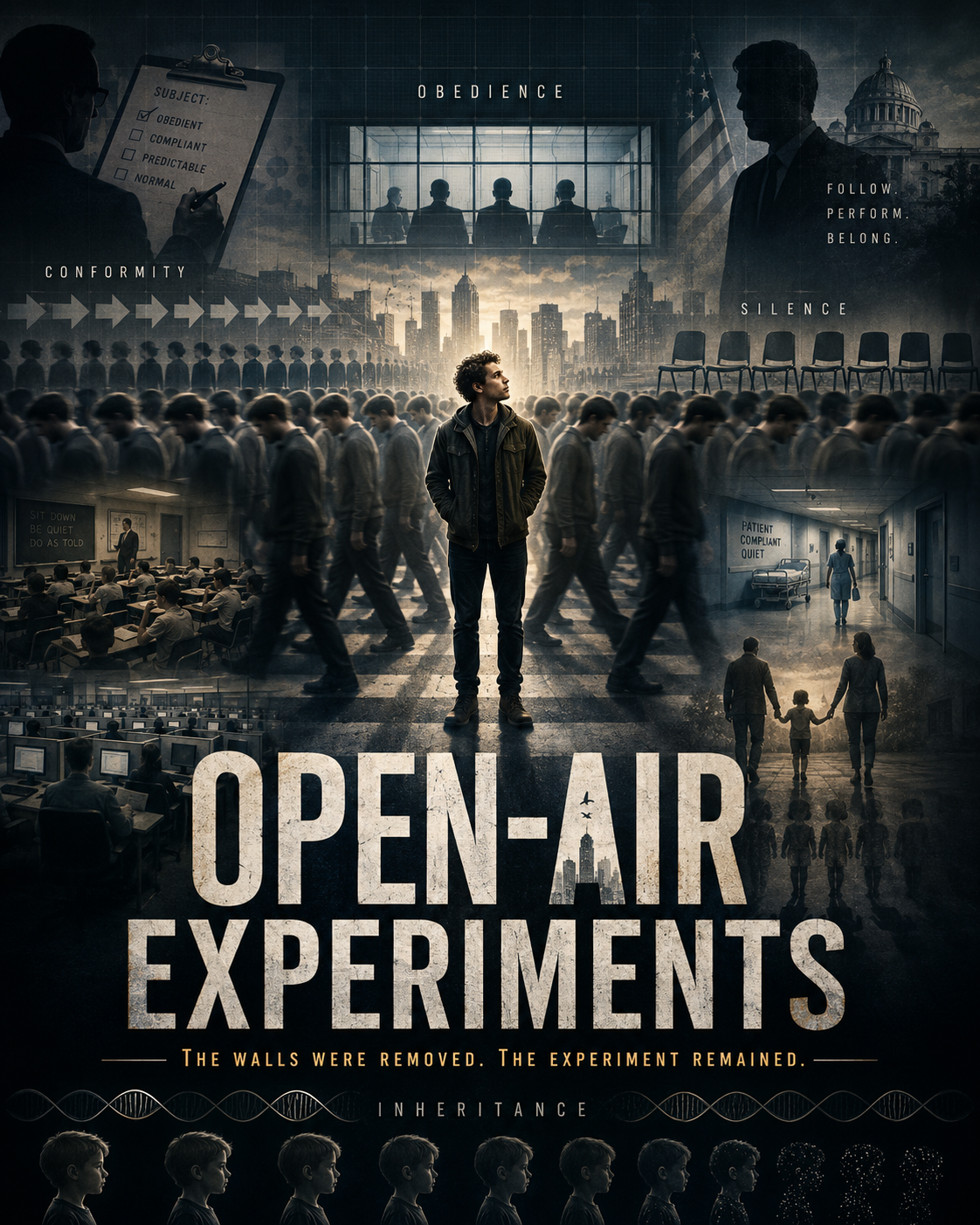
The Walls Were Removed. The Experiment Remained.
Society has been experimenting on itself for generations.
Some experiments were deliberately constructed inside laboratories. Participants were placed in controlled rooms, given instructions, observed under pressure and later studied to determine how human beings respond to authority, conformity, fear, uncertainty, belonging, punishment, responsibility and social approval.
Other experiments were never formally announced.
They unfolded inside families.
Inside schools.
Inside workplaces.
Inside hospitals.
Inside courtrooms.
Inside governments.
Inside religious institutions.
Inside friendships, neighbourhoods, industries and entire nations.
No researcher introduced the conditions.
No participant signed a consent form.
No one announced where the observation period began or when it would end.
The conditions were simply repeated until their consequences became ordinary life.
The Open-Air Experiments Series will examine the social and psychological experiments that humanity has already run, both formally and informally, and the results that continue to appear wherever the same conditions are reproduced.
The series begins from a simple discovery.
I did not knowingly set out to recreate famous psychological experiments.
I did not assemble participants, assign actors, manufacture social pressure or design controlled variables. I was living, working, speaking, creating, challenging and moving through society when I began noticing that the responses surrounding me were not isolated reactions.
They were patterns.
People behaved in ways that had already been studied.
Institutions reproduced dynamics that had already been documented.
Groups responded to unfamiliar propositions through mechanisms that psychology had already named.
Individuals surrendered judgement to authority, repeated conclusions they had not independently examined, remained silent while waiting for somebody else to act, defended harmful arrangements because those arrangements were familiar and interpreted social consensus as though it were evidence.
Only in hindsight did I recognise that I had repeatedly entered versions of experiments that civilisation had already conducted.
The room had changed.
The clothes had changed.
The language had become more professional.
The consequences had become real.
But the human architecture remained recognisable.
The Milgram obedience experiment asked how far ordinary people might continue an apparently harmful action when a recognised authority instructed them to proceed.
The Asch conformity experiments asked whether people would deny an answer plainly visible to them when an apparently unanimous group confidently gave the wrong one.
Other studies examined how witnesses respond when everybody assumes somebody else will intervene, how uncertainty causes people to borrow the behaviour of the crowd, how authority redistributes personal responsibility and how silence becomes mistaken for agreement.
Beyond the formal laboratory, families have conducted their own intergenerational experiments.
An unhealed parent raises a child through the limitations, fears, wounds, survival mechanisms and incomplete development they have not yet confronted. That child may grow into an adult who reproduces those same conditions—not necessarily because they consciously chose them, but because repetition was presented as normality before they possessed the knowledge required to name it.
The unhealed child may then become an unhealed parent.
Pain becomes parenting.
Fear becomes protection.
Control becomes care.
Emotional absence becomes strength.
Silence becomes respect.
Endurance becomes love.
The next generation receives the unresolved result and begins another round.
That is also an experiment.
A variable is introduced into a human system.
It is repeated.
Its effects are carried forward.
The consequences become embedded in behaviour, relationships, institutions and culture.
Eventually, society forgets that the condition was ever introduced.
It starts calling the result human nature.
This is how we arrived at many of the systems now surrounding us.
Not through one decision.
Through repetition without sufficient interruption.
One authority instructed people to continue.
One group made dissent socially expensive.
One parent transferred an injury they had never been helped to understand.
One institution protected its procedure rather than examining its consequence.
One generation adapted to an incoherent condition.
The next generation inherited the adaptation and mistook it for the foundation.
Over time, the experiment escaped the laboratory and became civilisation.
The Laboratory Was Never the End of the Study
A controlled psychological experiment isolates variables so that researchers can observe what may happen under specific conditions.
But life rarely isolates anything.
Authority interacts with money.
Belonging interacts with survival.
Childhood interacts with education.
Education interacts with employment.
Employment interacts with housing.
Housing interacts with health.
Health interacts with law.
Law interacts with political power.
Political power interacts with public understanding.
The open-air experiment therefore contains more relationships than the original room.
A participant in a laboratory may fear embarrassment.
An employee may fear unemployment.
A child may fear losing the care upon which their survival depends.
A professional may fear exclusion from their field.
A citizen may fear becoming socially associated with an unpopular position.
A family member may fear that naming the truth will collapse the only structure they have ever known.
The mechanism may resemble the laboratory finding, but the stakes become more complicated.
That is precisely why these experiments must be revisited outside their original conditions.
It is not enough to know that people may conform when strangers unanimously state the wrong answer.
We must ask what happens when an entire profession repeats one framework.
What happens when a family agrees not to name the harm holding it together?
What happens when employees can see a dangerous practice but understand that the person who speaks first may become the problem?
What happens when institutions reward obedience, punish disruption and then describe the resulting silence as consent?
What happens when everybody privately knows that the foundation is failing, but each person waits for another to make acknowledgement socially safe?
The experiment is no longer about whether a participant can identify the matching line.
The line has become a collapsing healthcare system.
A mistreated child.
A dangerous workplace.
An exploitative industry.
An unaccountable technology.
A polluted river.
An exhausted population.
A civilisation continuing to perform stability while its shared foundations weaken beneath it.
The answer may remain visible.
The social cost of stating it has changed.
I Became Both Participant and Observer
There is a particular kind of knowledge that becomes available when a person is not only studying a system from outside it but living inside the conditions being examined.
I have been the participant encountering the pressure.
I have also been the observer recording the pattern.
I have watched what happens when a proposition is considered first through the number of people supporting it rather than through the coherence of what it contains.
I have watched people recognise a problem privately but refuse to acknowledge it publicly until somebody with greater status gives them permission.
I have watched individuals defer to institutions whose conclusions they had never personally examined.
I have watched people repeat language they could not explain because the language offered social safety.
I have watched disagreement emerge without evidence and agreement remain unspoken because visible support felt too risky.
I have watched people defend arrangements that were harming them because the familiarity of the harm felt more stable than the uncertainty of change.
I have watched people ask who had already approved an idea before asking whether the idea held.
These were not controlled experiments in the formal scientific sense. The participants were not randomly assigned, the variables were not isolated and the environment could not be reproduced under identical conditions.
But the mechanisms were not unfamiliar.
The outcomes echoed what earlier experiments had already revealed.
Authority could interrupt conscience.
Consensus could interrupt perception.
Fear of exclusion could interrupt speech.
Diffused responsibility could interrupt intervention.
Unhealed experience could interrupt development and then reproduce itself through another person.
The experiment did not need laboratory walls because society had already built the conditions into ordinary life.
The Results Are Still Being Collected
The purpose of this series is not merely to retell famous studies.
It is to examine what became of their findings after the researchers left the room.
What happens to obedience when it enters government?
What happens to conformity when it enters education?
What happens to bystander behaviour when it enters safeguarding?
What happens to groupthink when it enters a boardroom?
What happens to intergenerational injury when it enters parenting, leadership, law and institutional design?
What happens when the authority figure is not a person in a laboratory coat but a title, a policy, an algorithm, a professional culture or an institution that has existed for longer than the person questioning it?
What happens when the crowd is no longer eight strangers seated in a room, but millions of people repeating the same conclusion through media, work, education and social identity?
What happens when the person who sees differently is not asked to select a line, but to risk their income, reputation, belonging, safety or future?
The series will examine the original experiments, the conditions they created and the behaviours they revealed.
It will then place those findings beside the open-air versions already occurring throughout society.
Some entries will concern formal psychological studies.
Some will concern inherited family systems.
Some will concern workplaces, institutions, public behaviour and governance.
Some will concern experiments I unknowingly moved through myself before recognising the historical and psychological pattern surrounding the result.
The aim is not to claim that every social interaction is a scientific experiment.
It is to recognise that repeated conditions produce information whether or not society appoints somebody to record it.
When the same structure repeatedly generates the same type of outcome, the outcome becomes evidence.
When authority consistently suppresses personal judgement, that is evidence.
When groups consistently make individuals conceal what they can see, that is evidence.
When unhealed adults consistently transfer unresolved conditions into childhood, that is evidence.
When institutions repeatedly require catastrophe before acknowledging warnings, that is evidence.
When people privately recognise incoherence but publicly perform agreement, that is evidence.
Civilisation has accumulated enormous quantities of human evidence while continuing to treat each consequence as though it arrived alone.
The Open-Air Experiments Series will return the consequences to their conditions.
Society Is Not Outside the Experiment
It is easy to read psychological research as though the participant is always somebody else.
The obedient person is somebody weaker.
The conforming person is somebody less intelligent.
The silent witness is somebody less moral.
The unhealed parent is somebody less self-aware.
The institution protecting itself belongs to another industry.
The person repeating inherited harm belongs to another family.
But experiments become socially useful only when the reader is willing to enter the room.
Where have you followed authority beyond the point at which your own conscience began objecting?
Where have you concealed a conclusion because everybody around you appeared to believe something else?
Where have you waited for another person to intervene despite recognising that something was wrong?
Where have you confused familiarity with safety?
Where have you inherited a behaviour, called it personality and passed it forward without examining what first created it?
Where have you treated the number of people agreeing as evidence that the conclusion must be sound?
Where have you known privately and denied publicly?
The purpose is not to produce endless personal guilt.
It is to recover participation.
A person who can recognise the experiment while it is occurring possesses more opportunity to alter its result.
A group that understands conformity can design room for dissent.
An institution that understands obedience can prevent authority from becoming a substitute for conscience.
A family that understands intergenerational transmission can stop treating inherited injury as an unavoidable tradition.
A society that understands diffusion of responsibility can build clear pathways through which responsibility returns to somebody capable of acting.
Knowledge cannot guarantee courage.
But it can remove the lie that nobody understands what is happening.
The Walls Were Removed
The laboratory gave the experiment a visible beginning and end.
Open-air experiments do not offer that comfort.
Nobody announces that the group has begun influencing your judgement.
Nobody warns that authority is attempting to relocate your conscience.
Nobody tells a child that the adult raising them is transferring an unresolved condition.
Nobody informs a worker that silence is being measured as loyalty.
Nobody tells a population that repetition is manufacturing normality.
The experiment becomes harder to recognise because it appears as life.
That is why this series exists.
To recover the room.
To identify the condition.
To name the variable.
To trace the result.
To examine where the same architecture has continued operating under different names.
Psychology documented the mechanisms.
Society expanded the scale.
Humanity inherited the consequences.
I entered many of the same arrangements without knowingly setting out to reproduce them, and the results repeatedly returned me to patterns already present in the historical record.
The walls were removed.
The experiment remained.
And now the results must be read in the civilisation they helped produce.
…
We’re gonna write the openair experiments series, as all the social experiments that siciety has run in the past, i have tested myself too, coming to the same results, i.e. this one about something that psychology has already touched upon, and there’s been countless of tests of, what’s it called, herd thinking. And there’s been countless of experiments where they put everyone in a room, like a bunch of strangers in a room, and one person that is part of the experiment itself. And there’s always like options, and where one is the clear answer, but people get, like, yeah, the people in the experiment follow the one person that gave the first answer, even if it was wrong, because they don’t want to show, they don’t want to seem wrong, they don’t want to say something beyond what the group is saying. There’s been examples of experiments where people thought, well, they were given the control of like zapping someone with like high voltages. I don’t remember exactly if it was for wrong answers or they had taught the person doing the experiments that the person that they were zapping deserved it or something like that. I don’t remember, but I’m pretty sure that you can retrace the experiments, but let’s focus on, yeah, let’s focus on the experiments of the herd, the group thinking, where one person in the group does not want to go against what the whole group says because they don’t want to seem like the odd one out. Let’s write a whole post on that and an extensive parts highlighting the actual experiments that has already been done.



Leave a Reply