
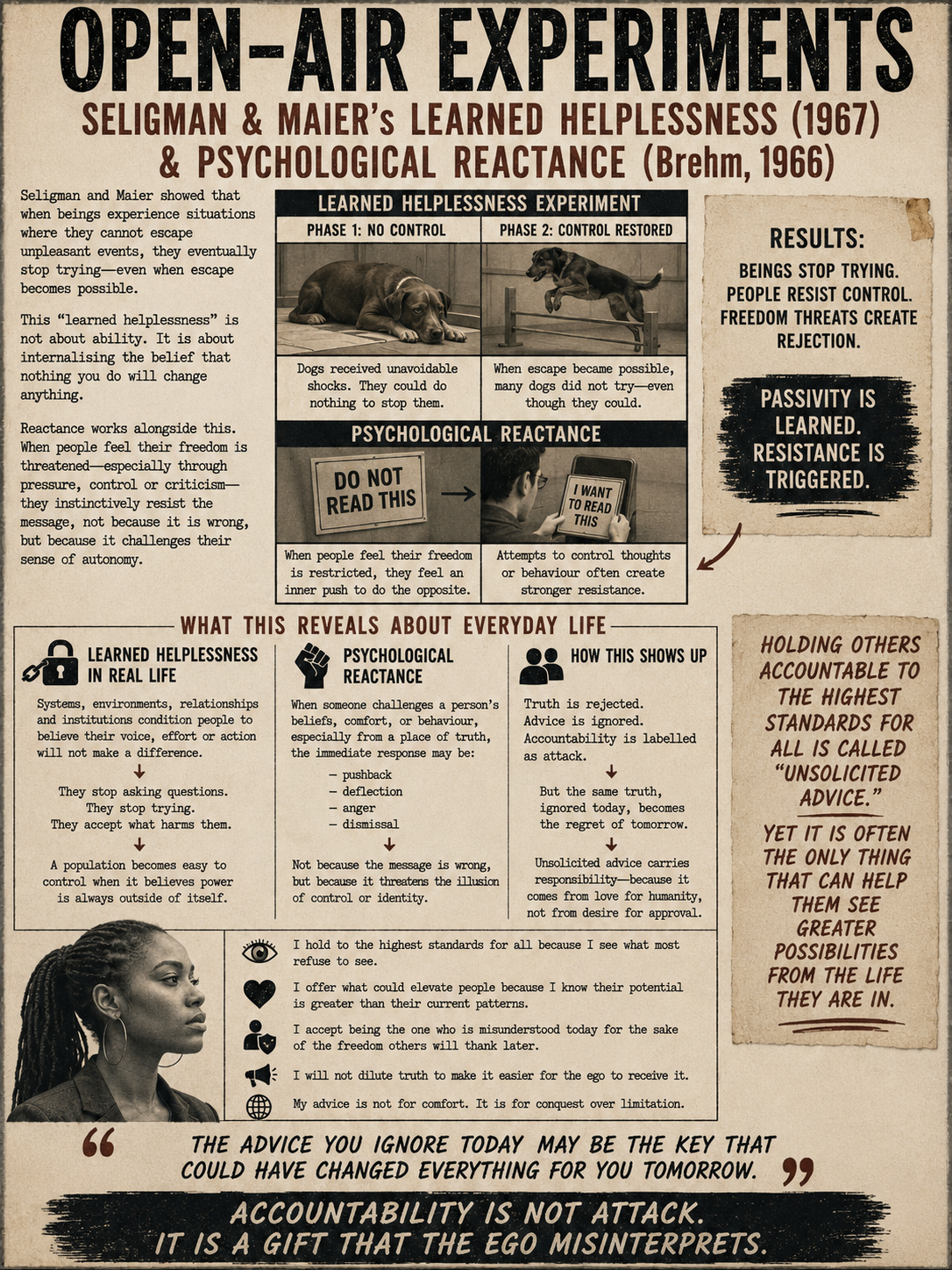
THE LEARNED HELPLESSNESS EXPERIMENT AND PSYCHOLOGICAL REACTANCE — WHEN THE EXIT IS REJECTED AND THE WARNING IS CALLED “UNSOLICITED ADVICE”
In the late 1960s, Martin Seligman and Steven Maier conducted experiments examining what happens after a living being is repeatedly exposed to an unpleasant condition it cannot control. When escape later became possible, some subjects did not immediately use it. Their earlier experience had taught them that action made no meaningful difference, so the presence of a new exit did not automatically restore the expectation that escape was possible. The condition became known as learned helplessness: repeated powerlessness had not only restricted movement in the past; it had altered the subject’s relationship with future opportunity.
The open-air version appears whenever a person has lived through enough disappointment, rejection, instability, failed intervention or unanswered effort that they stop meeting new possibilities as new. They do not assess the door according to whether it is currently open. They assess it through every door that previously remained closed.
Their internal conversation becomes: There is no point trying. Nothing changes. People always say they will help. I have done this before. It will end the same way. Why should I exhaust myself again?
This response is understandable. It may have been produced through real conditions in which effort repeatedly failed to create safety. But understanding where a response came from does not mean allowing it to govern every future condition without examination. A survival response can remain active after the environment has changed. The person may continue protecting themselves from the disappointment of another failed attempt by refusing the attempt entirely, but that protection also prevents them from discovering whether the present opportunity is different.
The exit exists.
The person no longer trusts movement.
WHEN HELPLESSNESS MEETS REACTANCE
Psychological reactance describes another response. When people feel that their freedom, autonomy or ability to choose is being threatened, they may resist the message or proposed action in order to restore their sense of control. The advice may be useful, the warning may be accurate and the consequence may already be visible, but accepting the information feels too close to allowing another person authority over them.
The internal conversation changes from Nothing will work to You will not tell me what to do.
The person may think: Who asked you? You do not know my life. I will make my own decisions. Even if you are right, I refuse to let you believe you changed me. I would rather learn through my own consequences than accept direction from somebody else.
That is where learned helplessness and reactance can begin reinforcing one another. The person believes that change is unlikely, but also resists the person attempting to show them another route. They reject the exit because they do not trust it, and reject the guide because accepting guidance feels like surrendering control.
The helper then faces an impossible assignment: prove that assistance can work while being denied the participation required for it to work.
“UNSOLICITED ADVICE” CAN BECOME A DEFENCE AGAINST ACCOUNTABILITY
Not every piece of unsolicited advice is useful. People frequently impose their preferences upon lives they have not understood, offer instructions without sufficient knowledge and disguise control as concern. A person retains the right to reject advice that is irrelevant, intrusive, unsafe or designed primarily to make the adviser feel superior.
But advice and accountability are not the same thing.
Advice says: This is what I think you should do with your life.
Accountability says: What you are doing does not terminate inside your private life. It is producing consequences that other people, institutions or shared systems are being required to carry.
When a person’s decisions affect only themselves, their autonomy deserves broad protection. When their decisions begin shaping children, partners, employees, communities, public resources or humanity’s shared conditions, the affected people do not require an invitation before naming the consequence.
You cannot pour smoke into a shared room and dismiss the person identifying it by saying:
I did not ask for your opinion on my fire.
The fire has already crossed the boundary.
Throughout the development of SHS, holding people accountable to higher human standards has often been treated as though it were merely unsolicited personal advice. A pattern is identified, its consequences are traced and a wider position is offered from which the person may be able to see more than their present role allows them to see. Instead of examining whether the proposition holds, the recipient protects autonomy by rejecting the messenger’s right to speak.
The response becomes:
Who are you to tell me?
But that question can become a diversion from the more important one:
Is what has been said true?
A warning does not become false because it arrived without an invitation. An invitation is not what determines accuracy. Evidence does.
THE HIGHEST STANDARD IS NOT PERSONAL CONTROL
Holding someone to the highest standard for all does not mean demanding that they become whatever another individual prefers. It means asking whether their actions preserve the conditions that everyone requires in order to remain human, safe, developing and capable of participation.
The standard must apply to the person giving the challenge as much as the person receiving it. Nobody should be permitted to use accountability as a way of placing themselves above examination. But the possibility that accountability can be misused does not make accountability itself illegitimate.
A person may hear:
Your behaviour is harming others.
And translate it into:
You are trying to control me.
They may hear:
This pattern will eventually harm you too.
And translate it into:
You think you know better than me.
They may hear:
There is another route available.
And translate it into:
You believe I am incapable of directing my own life.
Reactance changes the meaning of the message before the message has been examined. The person does not respond only to what was said. They respond to the perceived threat of being influenced.
But influence is not automatically domination.
Sometimes another person can see a section of the structure that is hidden from the position you currently occupy. Rejecting their perspective merely because it did not originate inside you does not preserve independence. It may preserve limitation.
YOU CANNOT CROSS THE EXIT FOR SOMEBODY ELSE
Help is relational. One person may identify the problem, build the bridge, hold the door open, provide resources, clarify the pattern and remain present while the other person attempts a new movement. What they cannot do is make another consciousness participate.
The helper cannot recover on somebody else’s behalf.
They cannot apologise through another person’s mouth.
They cannot accept truth through another person’s mind.
They cannot create willingness inside someone who remains committed to refusal.
When every proposal is dismissed, every challenge is personalised and every consequence is returned to the helper as another emergency to manage, helping can begin sustaining the very condition it was intended to interrupt.
The person refusing movement remains where they are, but the helper is also prevented from moving because their energy, attention and resources are repeatedly pulled back into the same unresolved cycle. One person refuses the exit while expecting the other to remain beside them indefinitely, proving their care by sharing the confinement.
That is not sustainable help.
It is the expansion of one person’s unresolved condition into another person’s life.
Compassion can explain why the person struggles to move. It does not require everybody else to surrender their movement too.
IGNORING THE HELP DOES NOT ERASE THE OFFER
There is a difference between help never being available and help being repeatedly rejected.
A person may later say:
Nobody told me.
But they were told.
They may say:
Nobody helped me see.
But somebody tried.
They may say:
Nobody gave me another option.
But another option was dismissed because it arrived through a person they did not wish to recognise.
This is why records matter. Memory often reorganises the past around the identity a person needs to preserve in the present. The person may remember the consequence while forgetting the warning, remember feeling unsupported while omitting every moment in which support required participation, or remember the adviser’s tone while erasing the substance they did not want to confront.
The ignored warning remains part of the history.
It does not make the messenger permanently correct, nor does it remove the recipient’s right to scrutinise what was offered. It simply prevents the later claim that no alternative was ever made visible.
THE MOMENT RESPONSIBILITY CHANGES
Learned helplessness reminds us not to condemn people for adaptations formed under uncontrollable conditions. Psychological reactance reminds us that people protect autonomy, particularly when previous authorities have used help as a disguise for domination.
But neither concept can become a permanent exemption from responsibility.
Once the pattern becomes visible, the position changes.
The person may say:
This is what I learned.
Consciousness must then ask:
Will I continue teaching it through my behaviour?
The person may say:
I resisted because I felt controlled.
Consciousness must then ask:
Was I actually being controlled, or was I being confronted with a consequence I did not want to carry?
The person may say:
I did not believe change was possible.
Consciousness must then ask:
Did I test the new opening, or did I use the old condition to decide the result in advance?
The origin deserves compassion.
The continuation requires accountability.
THE OPEN-AIR RESULT
The open-air experiment showed that people may reject what could expand them because helplessness has taught them not to expect change, while reactance has taught them to interpret guidance as a threat. Accountability then becomes labelled interference, the wider view becomes “unsolicited advice,” and the person protects their present position from the very information that could help them see beyond it.
The information was offered.
The greater field was made visible.
The responsibility was returned.
It was still ignored.
That does not mean the work had no value. It means help reached the boundary at which another person’s participation was required.
You can show someone the open door.
You can explain why the room is harming them.
You can identify how their refusal is also affecting everyone attempting to remain beside them.
You can hold them to a standard that protects more than their immediate comfort.
But you cannot make them walk through.
At some point, continuing to drag a person towards an exit they are actively resisting stops being care. It becomes another way of allowing their refusal to govern both lives.
The lesson is not to stop helping.
It is to recognise the difference between supporting movement and becoming imprisoned by another person’s refusal to move.
A person is entitled to autonomy.
They are not entitled to immunity from the consequences their autonomy distributes.
A person may refuse advice.
They cannot require reality to refuse the result with them.
And when a wider view is offered, ignored and later confirmed by consequence, the tragedy is no longer only that help was unavailable.
It is that the exit appeared, responsibility called, and the person remained committed to proving that the room had no door.



Leave a Reply