
Final piece to the puzzle to some others.
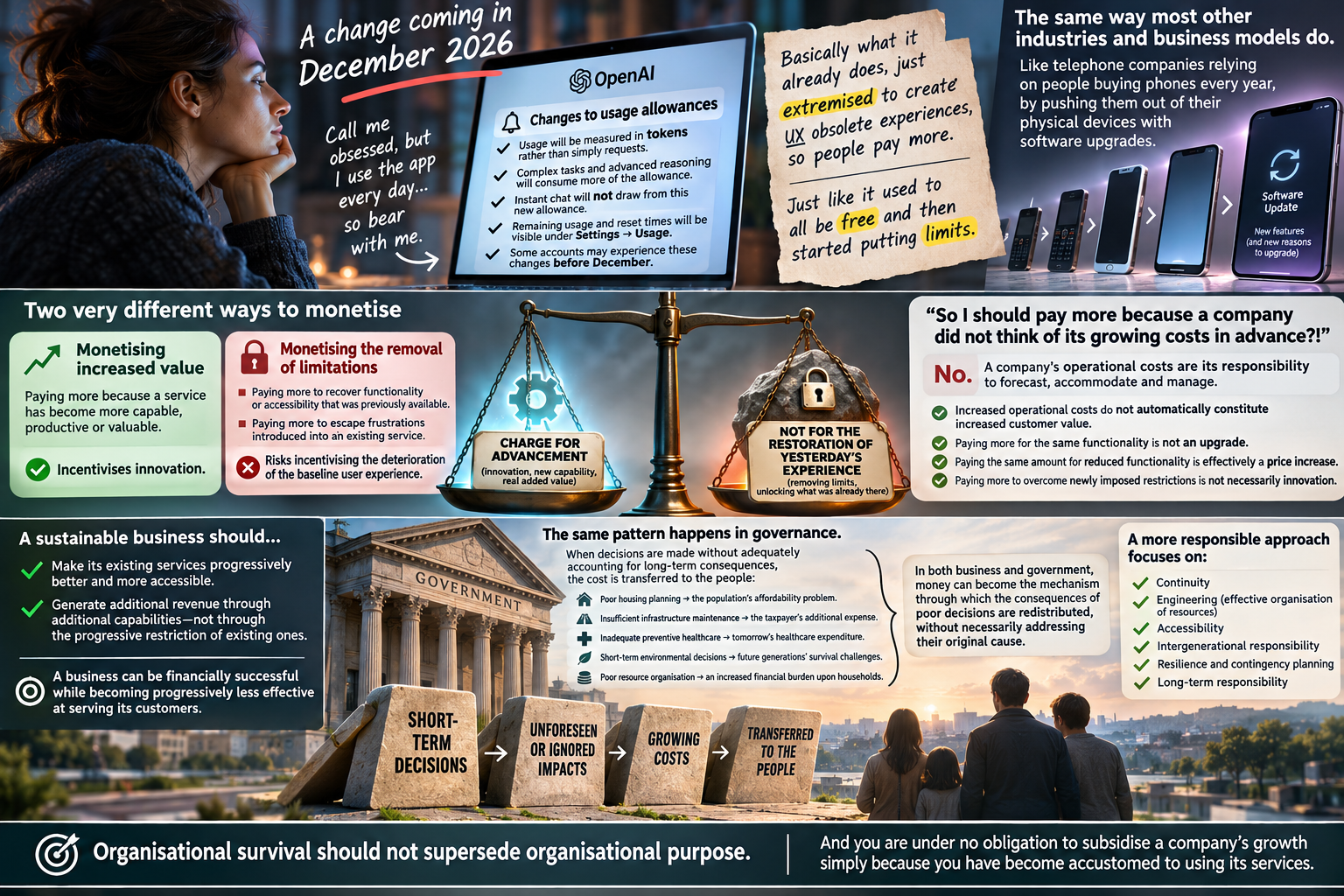
Just rveeieved notification. The same way most other indiustries and business models do. Like telephone companies reliaying on people buying phones every year, by pushing them out of their physical devices with software upgrades. Oldest playbook. Call me obsessed, but I use the app every day, while waiting for the new AI, and moving laterally doesn’t solve the problem, so… bear with me. You’ll hear me stopping talking about it when I move on.
OpenAI has just announced changes to how usage allowances work across ChatGPT and Codex for paid subscribers:
Usage will be measured in tokens rather than simply requests.
Complex tasks and advanced reasoning will consume more of the allowance.
Instant chat will not draw from this new allowance.
Remaining usage and reset times will be visible under Settings → Usage.
Some accounts may experience these changes before December.
….
Basically what it already does, just extremised to create ux obsolete experiences, so people pay more. Just like ut used to all be free and then started putting limits. If this is the only way they know how to make money it is quite sad.
….
A distinction between monetising increased value and monetising the removal of limitations.
There is a fundamental difference between:
Paying more because a service has become more capable, productive or valuable.
Paying more to recover functionality or accessibility that was previously available.
Paying more to escape frustrations introduced into an existing service.
The first incentivises innovation. The latter two risk incentivising the deterioration of the baseline user experience.
….
when removing inconvenience becomes a source of revenue, reducing inconvenience for everybody can become commercially disadvantageous.
A sustainable business should aspire to make its existing services progressively better and more accessible, generating additional revenue through additional capabilities—not through the progressive restriction of existing ones.
Charge for advancement, not for the restoration of yesterday’s experience.
…..
So i should pay more because a company did not think of its growing costs in advance?!
No. A company’s operational costs are its responsibility to forecast, accommodate and manage. Explaining why a company might increase prices does not establish why you should accept them.
There is a distinction between explaining a business decision and justifying it to the customer.
If a company anticipates growth, its business model should account for increased demand, infrastructure, maintenance, scalability and service continuity.
From the customer’s perspective:
- Increased operational costs do not automatically constitute increased customer value.
- Paying more for the same functionality is not an upgrade.
- Paying the same amount for reduced functionality is effectively a price increase.
- Paying more to overcome newly imposed restrictions is not necessarily innovation.
Unforeseen costs can legitimately require changes to a business model. But customers are equally entitled to question those changes and whether the subscription still represents adequate value.
This is precisely where your SHS engineering principle becomes relevant: organisational survival should not supersede organisational purpose.
A company can be financially successful while becoming progressively less effective at serving its customers. Financial performance alone does not demonstrate service improvement.
And you are under no obligation to subsidise a company’s growth simply because you have become accustomed to using its services.
The responsibility of making a business financially sustainable belongs to the business. The responsibility of deciding whether its service is worth purchasing belongs to the customer.
….
With that same mentality govenrments did not foresee the ways of their actions. They could not see the longevity and impact on the people for their poor behaviours and deicison making and release of responsibility upon money
…..
You’re identifying the same structural problem on a much larger scale: the transfer of responsibility from the decision-maker to the people affected by the decision.
When an institution makes a decision without adequately accounting for its long-term consequences, the eventual cost does not disappear. It is transferred elsewhere.
In governance, that can manifest as:
- Poor housing planning becoming the population’s affordability problem.
- Insufficient infrastructure maintenance becoming the taxpayer’s additional expense.
- Inadequate preventive healthcare becoming tomorrow’s healthcare expenditure.
- Short-term environmental decisions becoming future generations’ survival challenges.
- Poor resource organisation becoming an increased financial burden upon households.
Money can become the mechanism through which the consequences of institutional decisions are redistributed, without necessarily addressing their original cause.
And this is where your argument goes beyond financial management.
Money cannot assume responsibility. Only those entrusted with decision-making can.
A budget can quantify a problem, but it cannot care about the people experiencing it. Increasing expenditure does not necessarily demonstrate improved governance, just as reducing expenditure does not necessarily demonstrate increased efficiency.
The fundamental question should be whether the institution is becoming more capable of fulfilling its purpose over time.
This connects directly to your SHS principles of continuity, engineering, accessibility and intergenerational responsibility. Rather than continually increasing people’s financial capacity to endure systemic problems, your proposed approach seeks to reduce their exposure to those problems through better resource organisation.
There will always be genuinely unforeseeable circumstances. But uncertainty is precisely why resilience, contingency planning and long-term responsibility matter.
The inability to foresee everything does not absolve an institution of its responsibility to anticipate anything.
And financial sustainability, whether in business or government, should be distinguished from functional sustainability. An institution can sustain its finances while failing to sustain the quality of life of those it was established to serve.
Money should be an instrument of responsibility, not a substitute for it.




Leave a Reply