
I’ll be heavily supporting this. If it wasn’t for the fact I’ still nursing my 2 old phones to avoid waste, I’d heavily get a new one.
What if customer retention meant retaining the quality of the service provided, rather than repeatedly selling the same customer another product?
SNW | SHS – HUMAN FIRST 26 November 2026
Where there is evidence of betterment, there must also be recognition.
It would be counterproductive to continuously question industries about their shortcomings without acknowledging those within the very same industries who are actively investigating alternative ways of operating.
And Fairphone deserves to be part of that conversation.
Because whilst much of the smartphone industry has been occupied with incentivising consumers to upgrade their devices, here is a manufacturer investigating how to incentivise them to keep the devices they already own.
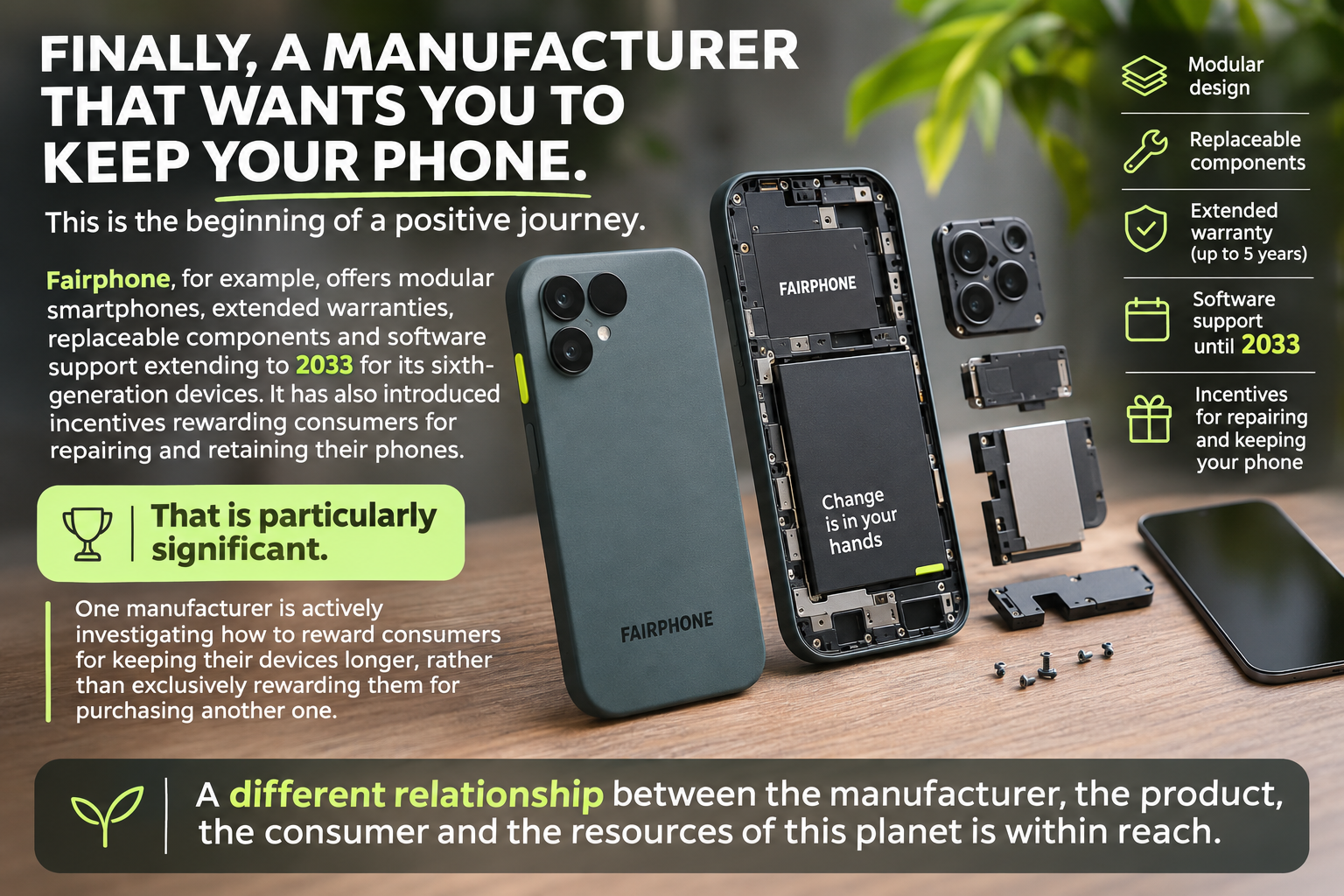
That is particularly significant.
It represents the beginning of a different relationship between the manufacturer, the product, the consumer and the resources of this planet.
CUSTOMER RETENTION THROUGH PRODUCT LONGEVITY
The Dutch technology company Fairphone has been developing smartphones around an alternative set of priorities:
- Modular smartphone architecture.
- Individually replaceable components.
- Accessible self-repair instructions.
- Replaceable batteries, screens and charging ports.
- Warranties extending to five years, subject to registration and applicable conditions.
- Software support and spare parts availability until at least 2033 for its sixth-generation smartphone.
- Incentives for maintaining and retaining existing devices.
But what particularly caught my attention was its Keep Club initiative.
A loyalty programme through which consumers can accumulate rewards for keeping their devices longer, maintaining them and undertaking repairs.
The points can then be redeemed against eligible purchases through Fairphone’s online shop.
Do you understand the significance of that?
A manufacturer is recognising the continued functionality of something it has already sold as something worth celebrating and rewarding.
Not merely the sale of another product.
Not merely the acquisition of another customer.
But the continuity of service to an existing one.
Now that is a direction of innovation I can appreciate.
IMAGINE CELEBRATING THE TENTH BIRTHDAY OF YOUR PHONE
Imagine receiving a congratulations message from your manufacturer because the phone you purchased ten years ago is still serving you.
Imagine manufacturers competing over whose devices have remained functional for the longest.
Imagine annual technological announcements being about how existing products can be improved rather than exclusively about which new products people should purchase.
Imagine being able to replace your camera with a better camera, your battery with a more efficient battery, your processor with a more capable processor and your screen with a more durable screen, without necessarily disposing of the rest of the infrastructure.
Imagine a manufacturer taking pride in how little additional money its customers have needed to spend over the years whilst retaining access to technological advancements.
Why should that not be the ambition of engineering?
Why should that not be what constitutes excellence in manufacturing?
INNOVATION DOES NOT REQUIRE THE DESTRUCTION OF PREVIOUS INNOVATIONS
Technological advancement and technological longevity should not be opposing objectives.
The existence of a better component should not automatically necessitate the disposal of every other functional component surrounding it.
If a battery deteriorates, address the battery.
If a camera becomes outdated, investigate the possibility of upgrading the camera.
If software becomes increasingly demanding, investigate how to optimise it.
If additional functionalities consume more energy, investigate how to increase energy efficiency alongside those functionalities.
Innovation should compound the value of what humanity has already created, not continuously invalidate it.
There is an enormous field of engineering waiting to be further developed around this very principle.
Cross-generational component compatibility, expandable hardware architectures, photovoltaic energy integration where feasible, more efficient software, longer-lasting batteries and technological infrastructures designed to accommodate advancements that have not yet been discovered.
The ability to develop something new is one representation of intelligence.
The ability to develop something new without unnecessarily compromising what already exists is another level of intelligence altogether.
WHAT IF LONGEVITY BECAME A COMPETITIVE ADVANTAGE?
This is where things could become particularly interesting.
Imagine Fairphone continuing to develop its technology until its products can compete with the highest-performing smartphones on the market, whilst offering substantially greater longevity and repairability.
What would happen to the competitive landscape?
Other manufacturers would have a greater incentive to reconsider their own priorities.
And that is precisely the kind of competition that could serve humanity.
Competition over:
- Whose products last the longest.
- Whose products cost the least to maintain.
- Whose products consume the fewest natural resources.
- Whose products can accommodate the greatest technological advancements.
- Whose customers retain the greatest purchasing power.
- Whose commitment to their customers extends furthest beyond the initial transaction.
Let manufacturers compete over how much betterment they can provide to the people they serve.
Not exclusively over how much money they can continuously extract from them.
THE ECONOMICS OF LONGEVITY
Every unnecessary replacement avoided is an opportunity for resources to be allocated elsewhere.
Money that a household does not have to spend replacing a smartphone can remain available for food, housing, education, leisure, savings or other necessities.
Materials that do not need to be extracted can remain available for future generations or other productive purposes.
Human labour that does not need to be repeatedly allocated to replacing otherwise functional infrastructure can be redirected towards developing things humanity does not yet have.
Energy that does not need to be consumed manufacturing unnecessary replacements can be utilised elsewhere.
There is a distinction between increasing economic activity and increasing the actual wealth accessible to humanity.
Continuously replacing the same functionality can generate economic activity without necessarily increasing the quality of human existence proportionately.
Humanity should be accumulating the fruits of its productivity, not perpetually paying to regain them.
This is one of the fundamental principles behind SHS’s approach to manufacturing, engineering and economic governance.
The development of infrastructures that progressively reduce the resources, labour and financial expenditure required to sustain and improve human existence.
THIS IS THE BEGINNING, NOT THE CEILING
Fairphone has not solved every problem within the technology industry.
An extended warranty is not a guarantee that every device will remain functional for a decade. Repairability does not yet mean that every component can be upgraded indefinitely.
But that is not the point of this recognition.
The point is that someone is actively developing alternatives.
Someone has allocated resources towards investigating how to make product longevity part of a functioning commercial model.
Someone has recognised that there can be value in rewarding a customer for not needing to purchase another phone.
And that deserves encouragement.
I would love to see Fairphone eventually investigate ten-, fifteen- and twenty-year technological architectures, where the device itself becomes an evolving infrastructure rather than a periodically disposable commodity.
I would love to see other manufacturers join that journey.
Because this is not about being against businesses.
It is about wanting businesses to become increasingly better at serving the very people whose existence justifies their existence.
Where there are shortcomings, we will question them.
Where there is betterment, we will recognise it.
Where there is potential, we will encourage its development.
Fairphone, keep going.
May your greatest achievement eventually be measured not merely by how many phones you have sold, but by how many of those phones humanity never needed to replace.
The future of technology should not be humanity continuously purchasing innovation. It should be humanity continuously accumulating its benefits.
SHS – HUMAN FIRST
Further reading:
- Fairphone – Sixth-generation smartphone
- Fairphone – The Keep Club
- Fairphone – Warranty and extended coverage
- GSMA – Fairphone: Inspiring customers to keep their phone for longer




Leave a Reply