
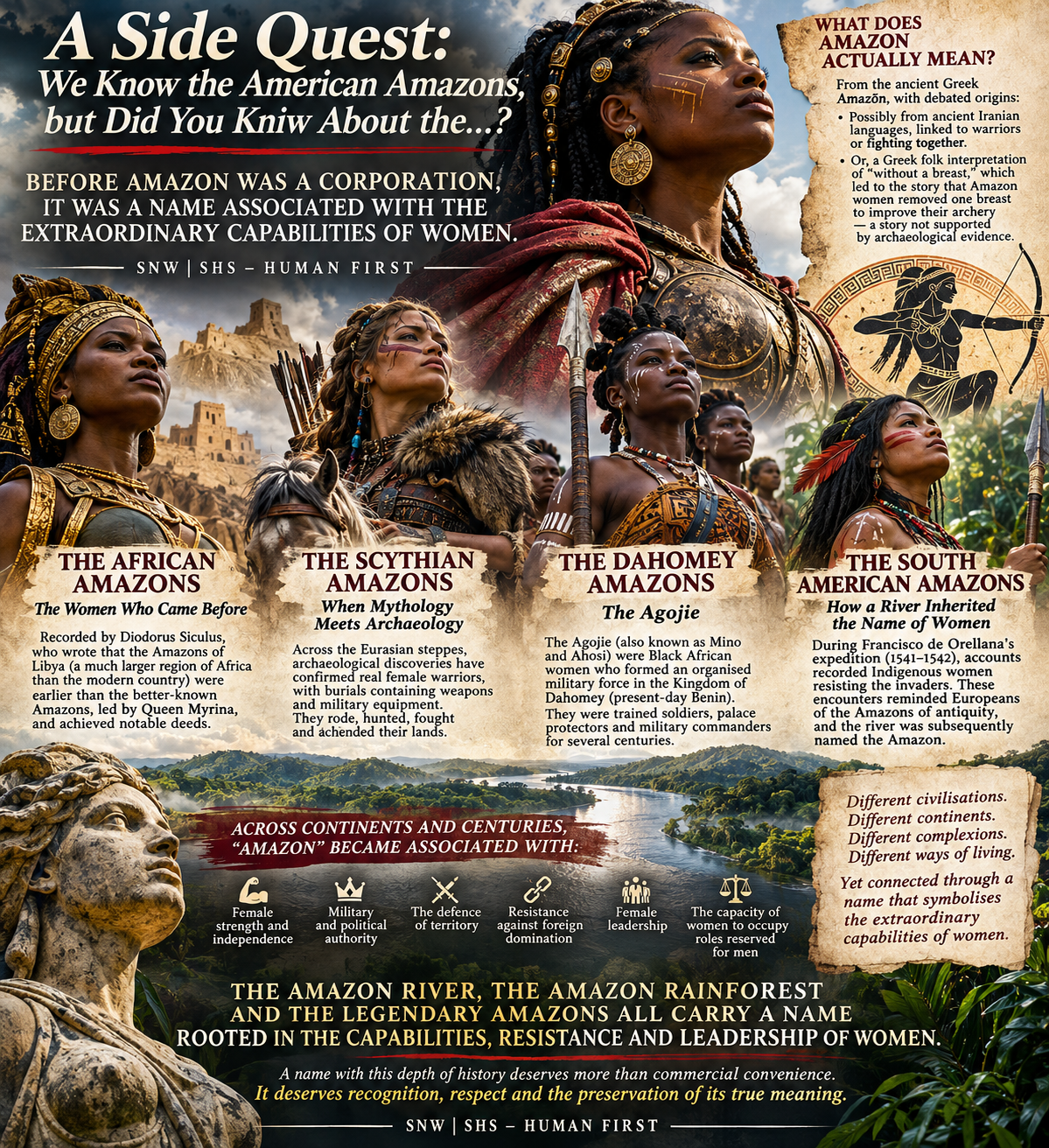
BEFORE AMAZON WAS A CORPORATION, IT WAS A NAME ASSOCIATED WITH THE EXTRAORDINARY CAPABILITIES OF WOMEN.
SNW | SHS – HUMAN FIRST
It is fascinating how extensively we can use a word without ever being introduced to the knowledge it carries.
Say Amazon today, and most people will think of an American corporation, online shopping, deliveries, subscriptions or, at best, the South American rainforest.
But how many will think of women? Of African civilisations? Of female governance? Of women who defended their lands, commanded armies and participated in shaping the geopolitical landscape of the ancient world?
And how did a name carrying such an extensive historical and cultural inheritance become primarily associated with a commercial enterprise?
THE AFRICAN AMAZONS — THE WOMEN WHO CAME BEFORE
The Greek historian Diodorus Siculus, writing in the first century BCE, dedicated part of his Bibliotheca Historica to the African Amazons.
He wrote:
The Amazons of Libya were much earlier in point of time and accomplished notable deeds.
Now, before we geographically confine these women to modern-day Libya, we must understand that the ancient Greeks used the name Libya to describe a much larger portion of the African continent.
Diodorus situated these women in western Libya, describing a civilisation in which women exercised political and military authority.
Among them was Queen Myrina, who, according to his account, led military expeditions across parts of Africa and into Asia Minor.
He described a society in which women participated in governance, military organisation and territorial expansion, whilst men occupied roles traditionally attributed to women in other civilisations.
Whether every element of his account can be historically verified is another question. Archaeological evidence has yet to establish the existence of Myrina’s civilisation as described, nor can we establish the precise complexion of its inhabitants.
Nevertheless, the existence of this ancient African tradition is itself significant.
Especially when the historian explicitly placed these African Amazons before the better-known Amazons associated with the Black Sea.
How many of us were introduced to this account before being introduced to the European representation of the Amazon woman?
THE SCYTHIAN AMAZONS — WHEN MYTHOLOGY MEETS ARCHAEOLOGY
Across the Eurasian steppes, including territories now belonging to Ukraine, Russia, Kazakhstan and surrounding regions, lived populations commonly associated with the Scythians and Sarmatians.
For centuries, the Greek stories of female warriors were predominantly treated as mythology.
However, archaeological discoveries have identified numerous female burials containing weapons, military equipment and skeletal evidence consistent with participation in combat.
These were real women.
Women who rode horses, hunted, fought, defended themselves and developed capabilities that many subsequent societies would attempt to present as exclusively masculine.
Their populations were diverse, and they cannot all be confined to one complexion or ethnic identity.
What is particularly interesting is that the Amazons were not necessarily Greek themselves.
The Greeks documented, interpreted and mythologised them, but documenting another people’s existence does not make their existence yours.
THE DAHOMEY AMAZONS — THE AGOJIE
Then we have the historically documented female military regiments of the Kingdom of Dahomey, in present-day Benin, West Africa.
The Agojie, also known by names including Mino and Ahosi, were Black African women who formed an organised military force within the kingdom.
Their history extended across several centuries, ending with the French colonial conquest of Dahomey in the late nineteenth century.
They were trained soldiers, palace protectors, military commanders and participants in the kingdom’s political and military history.
European visitors called them the Dahomey Amazons because they reminded them of the female warriors described in Greek antiquity.
But even here, we encounter something interesting about linguistic appropriation.
These women already had names.
They already had an identity.
They already had their own history, languages, traditions and social structures.
They did not require a European reference to establish the legitimacy of their capabilities.
And whilst we should not romanticise their entire history, particularly Dahomey’s participation in warfare and the slave trade, we should equally not allow those historical complexities to erase the recognition of women’s capabilities.
Humanity’s history is rarely uncomplicated.
THE SOUTH AMERICAN AMAZONS — HOW A RIVER INHERITED THE NAME OF WOMEN
Now we move to South America.
During the expedition of Spanish conquistador Francisco de Orellana between 1541 and 1542, accounts emerged of Indigenous women participating in armed resistance against the expedition.
Gaspar de Carvajal, a friar accompanying Orellana, documented encounters involving female warriors.
These accounts reminded Europeans of the Amazons described in classical antiquity.
The river consequently inherited the name Amazon.
Whether the women belonged to an independently organised female warrior society remains historically uncertain.
But the naming connection remains.
The largest river on Earth by volume carries a name associated with women who were reported to have resisted European intruders.
And from the river, the name became geographically associated with the surrounding rainforest.
So even when we speak about the Amazon rainforest, we are indirectly carrying forward a historical reference to the capabilities of women.
BUT WHAT DOES AMAZON ACTUALLY MEAN?
The word reached the English language through Latin and French, originating in the ancient Greek designation Amazōn.
Its ultimate linguistic origin, however, remains disputed.
One proposed origin connects the word to ancient Iranian languages and a term associated with warriors or fighting together.
Another, traditionally Greek interpretation associated it with being without a breast, giving rise to the story that Amazon women removed one breast to improve their archery.
This latter interpretation is generally regarded as folk etymology rather than established linguistic fact.
How interesting that even in the interpretation of their name, there emerged a story suggesting that women needed to physically alter their femininity to accommodate their military capabilities.
As though the female body, in its natural existence, could not possibly accommodate strength, precision, coordination and extraordinary physical development.
Yet the archaeological evidence of actual female warriors does not require such a narrative.
Across the centuries, the name Amazon became associated with:
- Female strength and independence.
- Military and political authority.
- Physical development and capability.
- The defence of one’s territory.
- Resistance against foreign domination.
- Female leadership.
- The capacity of women to occupy positions conventionally reserved for men.
Different civilisations. Different continents. Different complexions. Different ways of living.
Yet connected through a name that became representative of the extraordinary capabilities of women.
This does not establish that these populations descended from one another. It establishes that humanity repeatedly encountered women whose capabilities challenged its preconceived limitations.
AND THEN CAME AMAZON.COM.
In 1994, Jeff Bezos founded the company that would eventually become Amazon.
His explanation for choosing the name?
Earth’s biggest river, earth’s biggest selection.
That was the commercial association.
The size of the river.
Not the women whose history inspired its name.
Not their governance.
Not their resistance.
Not their physical capabilities.
Not their cultural inheritance.
Just the size.
And personally, I find it rather astonishing that a corporation initially established to distribute literature could inherit a name carrying thousands of years of historical knowledge, without making the transmission of that knowledge an integral part of its own identity.
Of all businesses, a bloody bookstore?!
You couldn’t make this up.
An enterprise built around selling books takes a name that could itself open an entire field of historical education, yet the commercial association eventually becomes more recognisable than the history of the word itself.
LINGUISTIC APPROPRIATION — WHEN THE COMMERCIAL IDENTITY OVERWRITES THE HUMAN ONE
Personally, if I were a woman sufficiently invested in pursuing linguistic appropriation through the courts, I would explore suing for a change of name.
Not because I believe women should exclusively own a word.
Not because humanity should be prohibited from sharing its cultural inheritance.
But because I would question how an organisation I consider so commercially sleazy can carry such a historically significant name without making its historical connections equally visible to the people it services.
I would question the legitimacy of commercially benefiting from humanity’s linguistic inheritance whilst contributing so little to the preservation of the meaning behind the inherited identity.
And particularly when the organisation itself has faced serious scrutiny over the physical wellbeing of its workers.
In December 2024, the United States Department of Labor announced a settlement requiring Amazon to implement ergonomic safety measures across its facilities. Amazon also reported that the settlement resulted in all but one of the previous OSHA citations being vacated.
What an extraordinary juxtaposition.
A name historically associated with the development and demonstration of human physical capabilities, now carried by a corporation whose treatment of the human body in the workplace has itself become a subject of regulatory intervention.
I would love to see the philosophical defence of that.
YOU CAN TRADEMARK A NAME. YOU CANNOT TRADEMARK ITS HISTORY.
This is not about restricting humanity’s freedom to integrate knowledge, languages or cultural expressions.
Quite the opposite.
Humanity’s accumulated knowledge should be accessible to humanity.
I have no interest in constructing further divisions between people by telling them which cultural expressions they are permitted to integrate according to their birthplace, complexion or ancestry.
But there is a difference between integrating something and commercially overshadowing it.
There is a difference between inheriting knowledge and inheriting a name whilst leaving its knowledge behind.
There is a difference between participating in humanity’s collective inheritance and allowing commercial identity to become so dominant that the original human associations disappear from collective consciousness.
Cultural integration should expand the visibility of knowledge.
It should not diminish it.
If anything, carrying a name of such significance should become an opportunity to continuously introduce people to its historical depth.
Imagine if Amazon dedicated a permanent educational platform to the history of the name it carries.
Imagine if every child encountering Amazon for the first time could learn about the Agojie, Queen Myrina, Scythian women and the Indigenous women of South America.
Imagine if the commercial use of historically significant names became an opportunity to finance the preservation, investigation and dissemination of the histories behind them.
That would be a contribution.
That would be an exchange.
That would be the integration of humanity’s cultural inheritance through its continuous expansion.
WHAT DOES YOUR NAME CONTRIBUTE TO THE KNOWLEDGE IT INHERITED?
We have allowed corporations to become so prominent in our collective consciousness that commercial associations can overshadow thousands of years of human history.
And then we wonder why humanity struggles to understand itself beyond consumption.
The Amazons existed in humanity’s historical imagination long before Amazon existed in humanity’s economy.
One is a historical, cultural and mythological inheritance.
The other is a commercial enterprise.
The latter should never become the reason the former is forgotten.
And to the women reading this:
The next time you hear the word Amazon, remember that before it became associated with the delivery of commodities, it was associated with the capabilities of women across continents.
Women who were not waiting for another civilisation to tell them what they were capable of becoming.
Women whose existence, whether preserved through archaeological evidence, historical documentation or ancient mythology, continues to challenge the limitations humanity imposes upon itself.
Amazon was associated with the strength of women long before it became associated with the wealth of a man.
Perhaps it is time the knowledge behind the name received as much visibility as the corporation carrying it.
SNW | SHS – HUMAN FIRST
…..
Write this piece, connect them all to the origin of the name “amazons” and how the current amazon has nothing to do with it, personally I’d sue for change of name if I was a woman that cared enough about linguistic appropriation, how a sleezy org can even think to use the name without bringing to its customers the connections the name carries. the title of the post is: A Side Quest: We Know the American Amazons, but Did You Kniw About the…? Yeah I use Amazon, but I really don’t like Amazon. Call me hypocrite. I know I am and am building something better, so only momentarily. Watch it go out of business in the next 50 years. And if you don’t believe me, know you read it here first.



Leave a Reply