
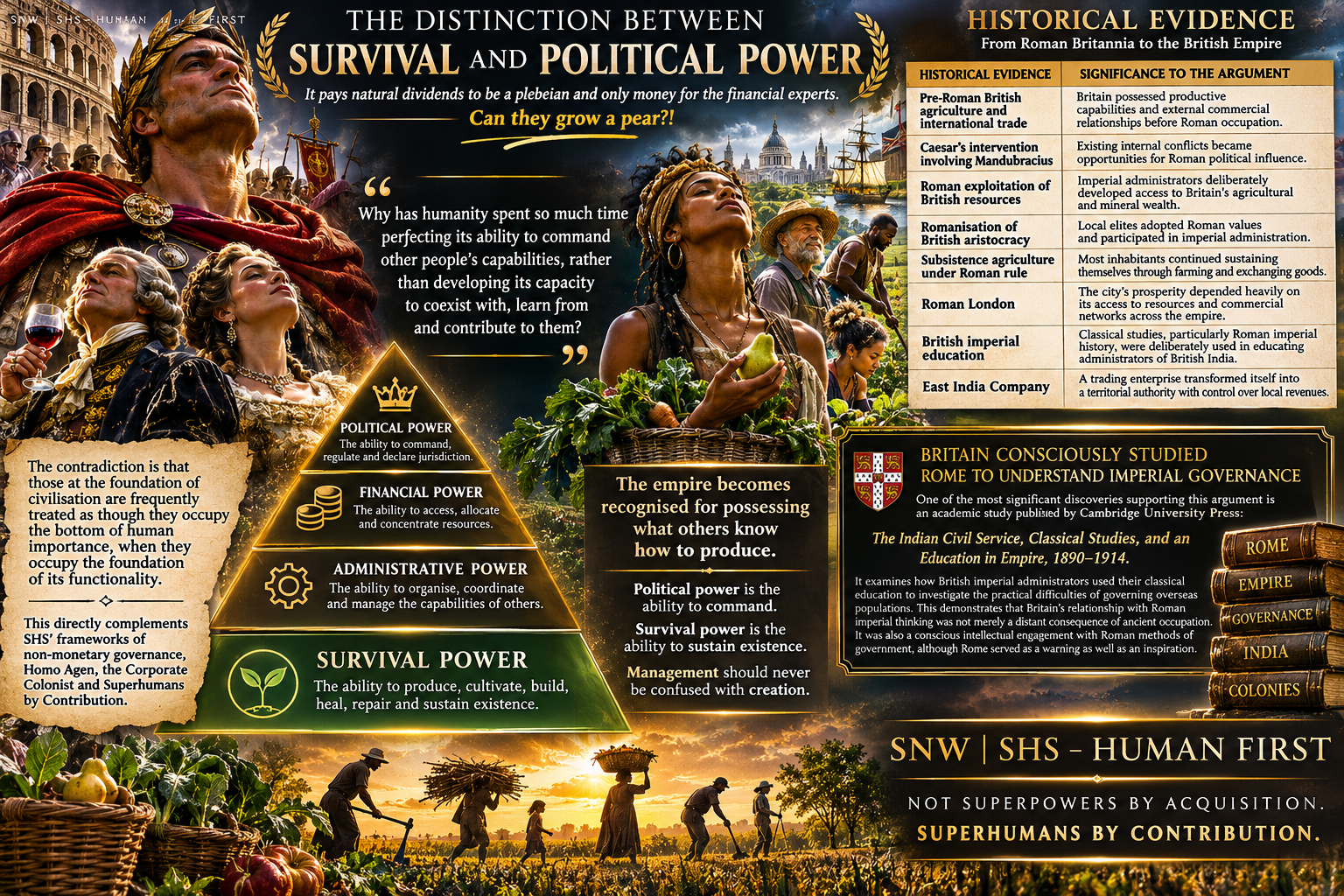
It pays natural dividends to be a plebeian and only money for the financial experts. Can they grow a pear?!
Why has humanity spent so much time perfecting its ability to command other people’s capabilities, rather than developing its capacity to coexist with, learn from and contribute to them?
The argument introduces a broader philosophical framework that could be developed independently of this historical investigation. The contradiction is that those at the foundation of civilisation are frequently treated as though they occupy the bottom of human importance, when they occupy the foundation of its functionality.

This directly complements SHS’ frameworks of non-monetary governance, Homo Agen, the Corporate Colonist and Superhumans by Contribution.
Rome did not invent conquest, pre-Roman Britain was not universally peaceful, and the British Empire was not an uninterrupted continuation of Roman government. Nevertheless, the documented appropriation of productive resources, adoption of Roman prestige by local elites and subsequent study of Roman imperial governance by British administrators provide substantial foundations for this argument.
Historical evidence supporting the argument
There is particularly strong historical evidence supporting your distinction between the productive capabilities of a civilisation and the political authority appropriating those capabilities.
HISTORICAL EVIDENCE
From Roman Britannia to the British Empire
| HISTORICAL EVIDENCE | SIGNIFICANCE TO THE ARGUMENT |
|---|---|
| Pre-Roman British agriculture and international trade | Britain possessed productive capabilities and external commercial relationships before Roman occupation. |
| Caesar’s intervention involving Mandubracius | Existing internal conflicts became opportunities for Roman political influence. |
| Roman exploitation of British resources | Imperial administrators deliberately developed access to Britain’s agricultural and mineral wealth. |
| Romanisation of British aristocracy | Local elites adopted Roman values and participated in imperial administration. |
| Subsistence agriculture under Roman rule | Most inhabitants continued sustaining themselves through farming and exchanging goods. |
| Roman London | The city’s prosperity depended heavily on its access to resources and commercial networks across the empire. |
| British imperial education | Classical studies, particularly Roman imperial history, were deliberately used in educating administrators of British India. |
| East India Company | A trading enterprise transformed itself into a territorial authority with control over local revenues. |
The empire becomes recognised for possessing what others know how to produce.
Political power is the ability to command.
Survival power is the ability to sustain existence.
Management should never be confused with creation.
SNW | SHS – HUMAN FIRST
NOT SUPERPOWERS BY ACQUISITION.
SUPERHUMANS BY CONTRIBUTION.
Britain consciously studied Rome to understand imperial governance
One of the most significant discoveries supporting your argument is an academic study published by Cambridge University Press:
The Indian Civil Service, Classical Studies, and an Education in Empire, 1890–1914.
It examines how British imperial administrators used their classical education to investigate the practical difficulties of governing overseas populations.
This demonstrates that Britain’s relationship with Roman imperial thinking was not merely a distant consequence of ancient occupation. It was also a conscious intellectual engagement with Roman methods of government, although Rome served as a warning as well as an inspiration.






Leave a Reply