
I’m not trying to accomplish something humanity hasn’t done before. We have had two evolutions of homo living together and interbreeding. Why should the Homo Agen be the first to be isolated?! Just because the Homo Sapiens thought it was the last?! Absolutely not. The last kind always precedes. That history, not fiction. So Ima rest assured I will too. As a different kind of you.
What if the next evolutionary transition begins not with a change in the body, but with a change in the priorities of the being inhabiting it?
SNW | SHS – HUMAN FIRST
Extracted from our exploration of pre-Roman Britain, human migration, civilisation and the relationship between human beings and their surrounding environments.
When we investigate the evolution of humanity, we tend to concentrate on the physical differences between the different manifestations of Homo, without giving enough consideration to the differences in mentality, priorities, behaviour and relationships with existence that may have contributed to their biological differentiation.
We look at the result of evolution without sufficiently investigating the conduct that may have directed it.
What if, in understanding the evolution of the body, we also need to understand the evolution of the individual’s relationship with life itself?
Related philosophical developments: Beyond Systematical Maturity, Natural v Systematic Relationships and Thoughtful, Expansive and Accountable Expression explore conscious development, relationships and self-regulation. These provide context for Homo Agen as a philosophical proposition rather than an established biological classification.
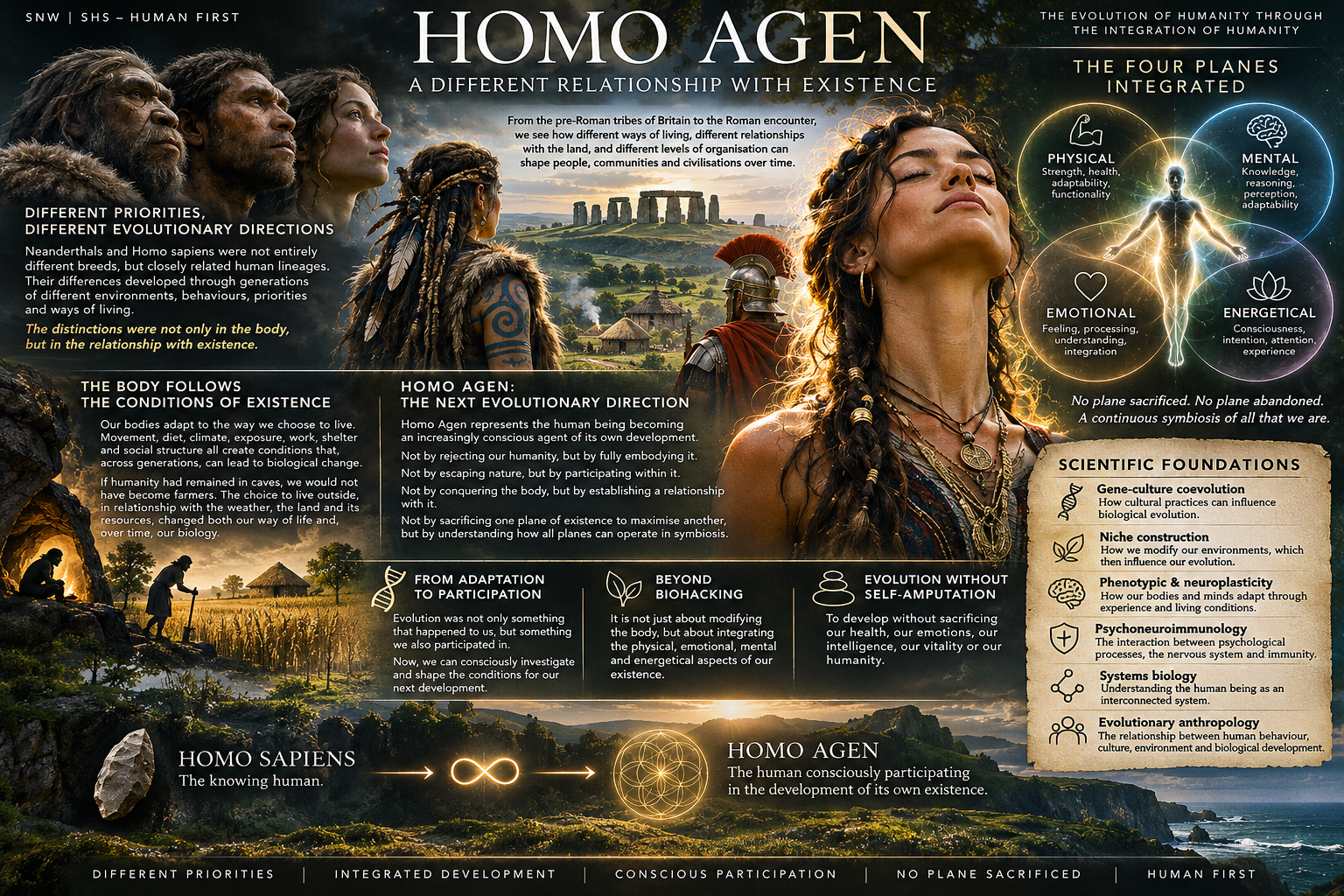
DIFFERENT PRIORITIES, DIFFERENT EVOLUTIONARY DIRECTIONS
Homo neanderthalensis and Homo sapiens were not two creations entirely disconnected from one another. They shared ancestry, inhabited the same planet, encountered one another and were biologically compatible enough to reproduce.
Their differences developed through generations of existence under different geographical, environmental, behavioural and evolutionary circumstances.
Humanity’s evolutionary story, rooted in Africa, became increasingly diversified as populations migrated, encountered different climates, established different ways of living and developed different relationships with their surroundings.
But how much of that differentiation can be attributed to the ways in which they approached existence?
What they prioritised.
What they consumed.
What they cultivated.
What they feared.
What they explored.
What they repeatedly exercised.
What they learned to withstand.
What they chose to preserve and what they chose to change.
The environment influenced the human being, but the human being also influenced the environment to which subsequent generations would have to adapt.
Evolution was never exclusively a one-directional relationship.
THE BODY FOLLOWS THE CONDITIONS OF EXISTENCE
Imagine if humanity had restricted its existence to caves.
There would have been no agricultural civilisation within the depths of those caves. No extensive cultivation of land, no developed relationship with pastures, no agricultural settlements and no equivalent exposure to the natural conditions associated with living outside.
Although different early human populations already lived beyond caves, the example illustrates something fundamental: a change in how we choose to inhabit the world introduces a change in the conditions under which our bodies operate.
Moving, hunting, gathering, cultivating, constructing shelters, experiencing sunlight, enduring different temperatures and consuming different foods all introduce different demands upon the organism.
Even within the relatively short period of fifty years, we can observe differences in human physical development resulting from changes in nutrition, physical activity, environmental exposure, occupation and lifestyle.
Now imagine the cumulative consequences of different ways of existing sustained over hundreds of thousands of years.
The scientific study of gene-culture coevolution already recognises that human cultural practices can influence the evolutionary pressures operating upon human populations.
Agriculture, for example, did not merely change what human beings ate. Certain agricultural practices also contributed, across generations, to biological adaptations associated with the digestion of food.
Our choices do command, over time, our genetics, as they can participate in constructing the conditions under which our biology develops and evolves.
The human being is therefore not merely a recipient of evolutionary circumstances. It is also a participant in their creation.
And this is where Homo Agen comes into consideration.
HOMO AGEN: A DIFFERENT RELATIONSHIP WITH THE SAME EXISTENCE
Homo Agen does not necessarily have to begin with a visibly different anatomy.
It may begin with an entirely different mentality, an entirely different set of priorities and an entirely different relationship with the world outside and within us.
Before a physical distinction becomes observable, there may already be a behavioural, intellectual, philosophical and experiential distinction.
Homo Agen, as I conceptualise it, represents the human being becoming an increasingly conscious agent of its own development.
Not through the rejection of its humanity, but through its fuller embodiment.
Not through escaping nature, but through understanding its participation within nature.
Not through conquering the body, but through establishing a relationship with it.
Not through sacrificing one plane of existence to maximise another, but through understanding how all planes can operate in symbiosis.
The distinction is not necessarily in what we have been given.
It is in what we choose to do with what we have been given.
BEYOND BIOHACKING: THE SYMBIOSIS OF ALL PLANES OF EXISTENCE
The development of Homo Agen cannot be reduced to biohacking.
Biohacking, in its broadest interpretation, concentrates on modifying the conditions of biological functioning to improve particular outcomes.
But what happens when the physical body is being optimised at the expense of emotional wellbeing?
When intellectual development comes at the expense of physical health?
When material accomplishments come at the expense of psychological stability?
When spiritual development becomes an excuse to neglect the physical body?
When an individual pursues longevity but sacrifices the experience of living in the process?
Where is the evolution of the entirety of the being?
The distinction within Homo Agen is that the development of one plane should not require the abandonment of another.
- The physical plane: Developing the body’s capacities, responsiveness, nourishment, recovery and adaptability. Everything that is conceiveable through the 5 senses.
- The emotional plane: Developing the capacity to experience, process, understand and integrate emotions without suppressing the ability to feel. Defines our Mental opportunity, meaning an emotion brings the chance to the mind to expand itself through the analysis of a specific emotion, whether new or familiar.
- The mental plane: Developing knowledge, reasoning, metacognition, perception, adaptability and independent thought, through the accountability and appropriate assignemnt of responsibilities of all energies experienced.
- The energetical plane: Developing, within my metaphysical understanding, awareness of the relationship between consciousness, intention, one’s electromagnetic field, time/space experience and surrounding existence.
The objective is not four independently developed planes.
The objective is their continuous integration.
A body that participates in the development of the mind.
A mind that participates in the wellbeing of the body.
Emotions that inform consciousness rather than being treated as inconveniences.
Consciousness that remains attentive to the entirety of the being rather than identifying exclusively with one of its capabilities.
No plane sacrificed. No plane abandoned. No plane developed through the unnecessary destruction of another. What the Homo Sapiens struggles to achieve.
HEALTH AS AN EXPERIENCE OF INTEGRATION
In a world where human beings are exposed to infectious diseases, environmental pollutants, psychological pressures, nutritional challenges and countless other conditions affecting wellbeing, I regard my own experience of sustained health as both a blessing and something worthy of investigation.
It is not simply about what I consume, what I avoid or how I exercise.
I am interested in the relationship between everything that constitutes my existence.
How I process experiences.
How I respond to external circumstances.
How I relate to my body.
How I integrate knowledge.
How I experience emotions.
How I manage my attention.
How I allow myself to continuously change.
My personal experience cannot, by itself, establish a universal biological conclusion. But it can provide a starting point for investigating whether the integration of different dimensions of human existence can contribute to sustained wellbeing.
Health should not exclusively be understood through the absence of disease.
It should also be investigated through the presence of functionality, responsiveness, adaptability, recovery, vitality and the capacity to continuously participate in life.
The objective is not to become incapable of feeling pain, tiredness, hunger or emotional intensity.
These experiences communicate information.
The objective is to develop the capacity to receive, understand and respond to that information.
And especially understanding how a grounded mental and emotional experience, in awareness of the energetical one, can build a stronger and healthier physical body and experience.
EVOLUTION WITHOUT SELF-AMPUTATION
Humanity has become accustomed to development through sacrifice.
Sacrificing sleep for productivity.
Sacrificing physical wellbeing for intellectual accomplishments.
Sacrificing emotional expression for social acceptance.
Sacrificing intellectual independence for institutional recognition.
Sacrificing personal freedom for economic security.
Sacrificing the experience of life for the means of sustaining it.
What if the next evolutionary direction requires us to abandon the assumption that something fundamental to our existence must always be sacrificed for something else to develop?
What if our next advancement is not specialisation, but integration?
Not becoming exceptionally capable in one area while remaining unnecessarily incapacitated in another, but developing the capacity to combine capabilities.
To become intellectually developed without becoming emotionally disconnected.
To become physically strong without becoming insensitive.
To become emotionally receptive without surrendering rationality.
To develop metaphysical understanding without abandoning physical reality.
To develop individual sovereignty without losing the ability to participate in collective existence.
This is evolution without self-amputation.
FROM UNCONSCIOUS ADAPTATION TO CONSCIOUS PARTICIPATION
For much of humanity’s evolutionary history, environmental circumstances introduced pressures to which populations adapted over generations.
But humanity now possesses an extraordinary capacity to investigate those circumstances, understand their consequences and consciously reorganise aspects of its relationship with them.
We can investigate our own biology.
We can observe our own psychological patterns.
We can question inherited behaviours.
We can restructure our environments.
We can accumulate knowledge and transmit it beyond the limitations of a single lifetime.
We can identify conditions that prevent development and create conditions that encourage it.
Why should we not investigate the possibility of applying that knowledge to the evolution of the entirety of the human being?
Not merely adapting to whatever circumstances happen to surround us, but consciously participating in the construction of circumstances conducive to our development.
This does not mean that consciousness can immediately, at this current frequency in space, override every biological limitation, though it does over time. It means that consciousness can participate in discovering, understanding and potentially expanding the capacities available to us.
HOMO AGEN DOES NOT REQUIRE THE ABANDONMENT OF HOMO SAPIENS
Homo Agen, in its present conceptualisation, is not an established biological species, nor does its development require humanity to reject its existing identity.
It is a proposed evolutionary direction.
One that begins with agency.
One that begins with a different relationship with existence.
One that begins with the recognition that knowing is not necessarily the same as embodying what is known.
Its development need not be restricted to a nationality, ancestry, ethnicity, gender, economic class or geographical location.
If the foundation is the development and integration of human capabilities, then the knowledge facilitating that development should be made increasingly accessible to humanity.
The objective is not to establish another hierarchy of human worth.
It is to expand what is available to the human being.
Should sustained differences in behaviour and environmental relationships eventually produce heritable biological differentiation, that would be a question for future scientific investigation.
But the development of our relationship with existence does not need to wait for a new biological classification.
THE NEXT EVOLUTION MAY BEGIN WITH A CHOICE
The body of humanity has changed throughout its history.
Its environments have changed.
Its relationships have changed.
Its knowledge has changed.
Its priorities have changed.
Its understanding of itself has changed.
Why should we assume that the present manifestation of humanity represents the conclusion of that process?
The most important distinction of Homo Agen will not initially be visible in the skull, the skeleton, the musculature or the genetic sequence.
It is initially visible in the way the human being conducts its existence.
In its relationship with itself.
In its relationship with others.
In its relationship with nature.
In its capacity to integrate knowledge rather than merely accumulate it.
In its capacity to develop without unnecessarily sacrificing the very things that constitute its humanity.
Homo Sapiens — the knowing human.
Homo Agen — the human consciously participating in the development of its own existence.
The next evolutionary direction has begun long before its biological consequences become distinguishable.
It has begun with a different set of priorities, a different mentality and a different relationship with life.
And instead of waiting for nature to impose the circumstances of our next adaptation, we can investigate how to consciously participate in their creation.
Not to become something other than human.
But to discover how much more being human can encompass.
The evolution of humanity through the integration of humanity.
HOMO AGEN.
SHS – HUMAN FIRST
…..
Write about this, extracted from the conversations happening about britains and romans, in the “pre roman britain tribes” chat:
And it’s also important we understand that the differences between neanthertals and homo sapiens was purely of focus. Different priorities, different approaches, different ways of living. Not a complete different breed. And it makes sense that the homo agen would come about in the same way. Different mentality and relationship with the wolrd outside of us
The different homo’s bodies of course had to accustom to the nature that evolved around them, just like people’s bodies are different now from 50yesrs ago. Everything changes and the choices direct those changes cause if we had stayed in caves we might have not changed and becamee farmers, as there’s no cultivable land and pastures in caves. The choice of finding a way to live outside of it, in relationsh to the weather, had civilisations adapt to the outside living which changed the bio to a point where it was so clear in terms of the differences between the two that got us to call the one species that had then evolved a different one from the one known prior. That’s the same for homo agen, especially in a world where sickness is so easy to catch for me to be this healthy is a blessing and a rarety, cause it is not just about biohacking, it is about havenig all planes of existence in simbiosis, without sacrificing any.
First image:


Leave a Reply