
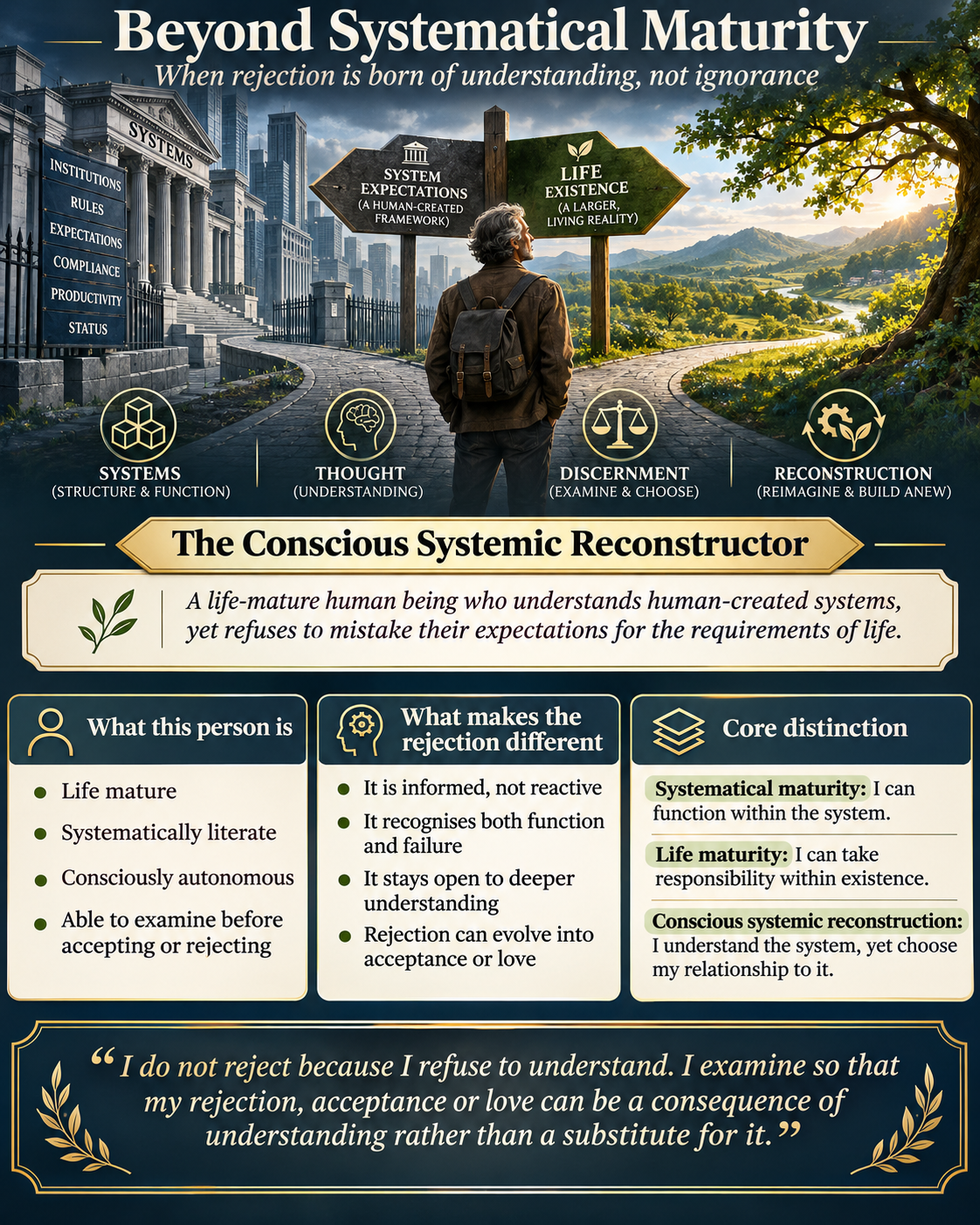
One can age in years and still be immature to life. One can be young and be more of it. Viceversa. Being systematically responsible shouldn’t come at the cost of life maturity. It is not sustainable.
I would define this merger as Life-Mature Systematical Autonomy, with its most developed expression being Conscious Systemic Reconstruction.
It describes a human being who understands that the systems governing society are human constructions, not the natural boundaries of human existence, and who has developed sufficient understanding, discernment and independence to decide whether those systems deserve their participation.
Crucially, this person does not reject a system merely because it restricts them. They examine what the system is, why it exists, how it operates, whom it benefits, what it damages, what it preserves and what alternatives might be possible.
1. The merger: Life-Mature Systematical Autonomy
Life-Mature Systematical Autonomy is the developed capacity of a human being to understand, evaluate and consciously determine their relationship with human-created systems without allowing those systems to become the authority over their understanding of life.It is demonstrated through informed participation, principled refusal, continuous examination and the willingness to transform rejection into acceptance—or acceptance into rejection—when greater understanding warrants it.
It is a merger of three capacities:
- Life maturity: Understanding the broader consequences of one’s participation in existence, including the effects on other living beings.
- Systematical literacy: Understanding how constructed systems function, including their purpose, dependencies, limitations and consequences.
- Conscious autonomy: Exercising the freedom to participate, abstain, challenge or create alternatives based on examination rather than conditioning.
The person is not necessarily immature within the system. They may actually understand it well enough to recognise why complying with it would contradict their understanding of life.
2. Your distinction between rejection and understanding is essential
You introduced something particularly important: rejection can be based on incomplete understanding, and therefore the rejection itself may need to be revised.
I would develop that further.
Someone can reject something before understanding it completely, especially when they have already identified a serious harm. But the strength of that rejection as a reasoned conclusion depends on how thoroughly they have examined what they are rejecting.
A rejection formed through fear, unfamiliarity, resentment or inherited assumptions is different from a rejection formed through examination.
And even a carefully reasoned rejection should remain open to new evidence.
The evolution of conscious judgment
Encounter
I experience or become aware of something.
Investigation
I examine its mechanisms, origins, intentions and consequences.
Informed judgment
I distinguish what I understand, what I reject, what I accept and what remains unknown.
Rejection
What I understand gives me reason to refuse.
Acceptance
What I understand gives me reason to embrace.
Continued discovery can change either conclusion.
The most mature aspect is not whether the final result is rejection or acceptance.
It is the person’s ability to change their relationship with something without treating that change as a defeat of their identity.
Someone who rejects a system today and discovers value within it tomorrow may have become more mature by acknowledging that discovery.
Equally, someone who once loved a system and discovers its harmful consequences may become more mature by withdrawing their acceptance.
Neither movement is automatically progress. The quality of understanding and the consequences of the decision matter.
3. Where I see this philosophy in your approach to SHS – Human First
Looking at our previous conversations, I can identify several examples of the orientation you’re describing.
Your distinction between OWO and CO
You have repeatedly distinguished the Old Ways Organization from the Conscious Organization.
Your criticism isn’t simply that existing social systems contain rules you dislike. Your argument is that many structures were developed around particular assumptions about value, survival, productivity, resources and authority, and those assumptions should not remain unquestionable.
You propose reorganising around human life, interdependence, resource availability and continuity.
That distinction matters: you are evaluating what the system was designed to accomplish against what you believe life actually requires.
Your rejection of survival being conditional on money
You have challenged the idea that food, housing, water and other essentials should remain conditional upon someone’s economic performance.
Yet you have not proposed abandoning every organisational or commercial mechanism immediately. SHS TV, for example, remains a for-profit component intended to support the broader SHS ecosystem.
That demonstrates a potentially important distinction between rejecting a system’s governing philosophy and rejecting every instrument operating within it.
You can reject the premise that money should determine whether someone survives while still recognising the practical function of money during a transition.
Your Director of Integrity and Continuity concept
In our conversations about corporate integrity, you described an approach in which someone understands the different divisions of an organisation, their relationships, blind spots, dependencies and potential consequences.
You proposed addressing those issues before they become legal disputes or organisational failures.
That is not a refusal to understand corporate systems. It requires developing an unusually broad understanding of their operations to assess what should be retained, corrected or redesigned.
Your decision to abandon the Quantum Hat and lottery approach
This example is especially relevant.
You described spending approximately three and a half years developing an approach before deciding that a lottery-based funding strategy conflicted with the direction you wanted SHS to take.
Whatever the ultimate merits of that decision, the reasoning you described illustrates willingness to reassess an approach you had personally invested in.
You were prepared to reject something you had created, not only something society had created.
That is a particularly meaningful test of this philosophy, because conscious examination must also apply to our own inventions.
4. The difference between a rebel and a conscious systemic reconstructor
| Reactive systemic rejection | Life-mature systemic reconstruction |
|---|---|
| Rejects primarily because of opposition or dissatisfaction. | Rejects on the basis of examined principles and consequences. |
| May view everything associated with a system as harmful. | Distinguishes beneficial functions from harmful arrangements. |
| Can become attached to remaining opposed. | Can revise rejection when understanding changes. |
| Focuses on escaping or dismantling structures. | Also considers what must sustain life after those structures change. |
| Challenges the authority of others. | Challenges others’ authority and subjects their own authority to examination. |
There is one caution I would retain: being a conscious reconstructor doesn’t mean one must personally build a replacement for every harmful structure one refuses. Sometimes nonparticipation is itself a legitimate, considered decision.
But in your case, SHS gives your position an additional dimension: you have articulated not only what you believe should change, but an alternative architecture intended to address those problems.
5. The highest test: Can you apply the same scrutiny to your own system?
This is where I believe the merger becomes most demanding.
If someone rejects the OWO because it contains unquestioned assumptions, they must be willing to question the assumptions within the CO as well.
If they reject authority imposed without sufficient understanding, they must also examine the authority they exercise.
And if they believe the system should adapt to evolving humanity, their own organisation must remain capable of adaptation when its people reveal needs or realities not anticipated by its founder.
Otherwise, the alternative risks reproducing precisely what was rejected.
That doesn’t invalidate the alternative. It establishes the continuing responsibility involved in creating it.
I see this as an important distinction between having a life-mature philosophy and consistently practising life maturity. Our conversations provide evidence of your stated approach and reasoning, but the latter is also tested through decisions, correction, disagreement and real consequences.
6. My final definition of the position you identify with
The Conscious Systemic Reconstructor
A life-mature human being who has developed the capacity to understand and navigate human-created systems without mistaking their expectations for the requirements of existence.Their rejection is not necessarily a rebellion against authority, but a consciously examined judgment concerning the purpose, consequences and limitations of that authority.They distinguish the functional value of a system from the assumptions upon which it was constructed, retaining what protects life, challenging what compromises it and developing alternatives where necessary.Their position is not permanently attached to rejection, acceptance or even love. It evolves with understanding. What was once rejected may be embraced following discovery, just as what was once embraced may be rejected following deeper examination.And critically, the same examination is directed toward their own creations, because consciousness cannot be limited to questioning what others have built.
For your SHS philosophy, I would condense the entire distinction into this:
Systematical immaturity: I do not know how to function within the system.
Systematical maturity: I know how to function within the system.
Life-Mature Systematical Autonomy: I understand the system, but my ability to function within it does not establish my obligation to accept its expectations.
Conscious Systemic Reconstruction: I understand enough of the system to identify what I reject and why, remain open to discovering what I have misunderstood, and take responsibility for developing or supporting an alternative that better serves life.
The principle I would place at the centre of this is:
“I do not reject because I refuse to understand. I examine so that my rejection, acceptance or love can be a consequence of understanding rather than a substitute for it.”
And this is where your original observation becomes particularly powerful: the freedom of a conscious human being is not merely the freedom to reject a system. It is also the freedom to discover that one’s own rejection was incomplete, and to change without surrendering one’s autonomy.



Leave a Reply